Starring — Film
- Actor
Alain Delon
French film star, born on the southern edge of Paris and made by it: the killer in a trenchcoat in Jean-Pierre Melville's Le Samouraï, whose emptied, rain-lit Paris is the version of the city his films exported to the world. He died in 2024 at his estate in the Loiret, south of Paris, far from the streets he is remembered walking.
In images
Details
- 1935–2024
- 8 November 1935
- Sceaux, France
- 18 August 2024
- Douchy-Montcorbon, France
- French
- Actor and producer
- Plein Soleil (1960), Rocco and His Brothers (1960), The Leopard (1963), Le Samouraï (1967), La Piscine (1969), Le Cercle rouge (1970), Monsieur Klein (1976)
- Actor
About Alain Delon
Alain Delon was the most exportable French film star of the twentieth century, and the strangest kind: a leading man who did his best work by removing things — expression, dialogue, warmth — until what was left was a face and a silence the camera could not stop watching. He was born in Sceaux, immediately south of Paris, in 1935, joined the navy at seventeen and served in Indochina — French colonial south-east Asia — and was in front of a camera by[1] 1957 with no training of any kind.
His Paris is mostly on film rather than in the biography. In Jean-Pierre Melville's Le Samouraï (1967) he plays Jef Costello, a hired killer in a trenchcoat and fedora who crosses an almost empty, rain-lit, colour-drained Paris of métro corridors, nightclubs and rented rooms — an invented city that half the world now pictures when it pictures French crime cinema. Delon also lived a real and less flattering Paris story: in 1968 a man from his own household was found murdered outside the city, and the scandal that followed reached the future president of France. He died on 18 August 2024 at his house in the Loiret, aged eighty-eight, and was buried on his own land rather than in the city that made him.
Sceaux, and a war he volunteered for
Delon was born on 8 November 1935 at Sceaux, a town just beyond the southern edge of Paris. His parents separated when he was small, his schooling was broken and unhappy, and at seventeen he enlisted in the French navy and went to Indochina — the French colonial territory, in what is now Vietnam, where France was fighting the war it lost at Dien Bien Phu in 1954. Nothing in this is a training for acting, and he never acquired one: he learned in front of the camera, by instinct, and said so for the rest of his life.
What he had instead was a face, and Paris friendships. The actors Jean-Claude Brialy and Brigitte Auber brought him into film circles in the mid-1950s, and by 1957 he was working: Quand la femme s'en mêle ('when the woman gets involved') for the director Yves Allégret, then Sois belle et tais-toi! ('be beautiful and shut up') for Marc Allégret. He was twenty-two, and the industry had already worked out what it had.
René Clément invents Delon
The film that made him was Plein Soleil (1960) — released in English as Purple Noon — René Clément's adaptation of Patricia Highsmith's novel The Talented Mr Ripley, in which Delon plays a poor young man who murders his rich friend and takes over his life. The Festival de Cannes, announcing his honorary Palme d'or — the festival's supreme award — nearly sixty years later, put it plainly[2]: this is the film with which Clément invents Delon — a thriller that is also an ode to his insolent beauty. He first walked the Cannes red carpet on 13 May 1961, for Clément's Quelle joie de vivre ('the joy of living').
Then came the Italians, and the best work of his first decade. For Luchino Visconti he played Rocco, the gentlest of five brothers in a southern Italian family coming apart after its move to industrial Milan, in Rocco and His Brothers (1960), and Tancredi, the charming, adaptable nephew, in The Leopard (1963), Visconti's film of Sicilian aristocracy losing its world, opposite Burt Lancaster and Claudia Cardinale. For Michelangelo Antonioni he was Piero, the stockbroker, in L'Éclipse (1962). By twenty-eight he had worked for three of the directors European cinema is measured by.
Melville's Paris
The director who mattered most to him was Jean-Pierre Melville, the French film-maker who built his own studio, wore a Stetson and a raincoat, and spent his career rebuilding American gangster films in a Paris of his own invention. In Le Samouraï (1967) Delon is Jef Costello, a contract killer who lives in a bare rented room with a bird in a cage, constructs alibis with the precision of an accountant, and is followed through the métro by half the police force. He says almost nothing. The performance became a template — the silent, ritualistic, professional killer — that film-makers from Hong Kong to Hollywood have been copying ever since.
They made Le Cercle rouge together in 1970, a heist film built around a long, near-silent robbery. What the collaboration produced was a picture of Paris that exists nowhere else: streets emptied of crowds, colour drained towards grey and blue, rain on the windscreen, a city of corridors where nobody explains anything. Delon is not a Parisian character actor decorating a real city — he and Melville built a city to hold him.
The Marković affair
In the autumn of 1968 the body of Stevan Marković, a thirty-one-year-old Yugoslav who had been living in Delon's Paris town house — half friend, half hanger-on, and often photographed with the actor and his wife Nathalie — was found wrapped in plastic on a rubbish tip west of Paris.[3] Police believed he had been killed after trying to blackmail wealthy people, the Delons included, with compromising photographs taken at parties. Three names circulated as suspects: Delon, his wife, and the Corsican gangster François Marcantoni, a friend of Delon's.
Nothing was ever proved against any of them, and Delon was never charged. The affair became a political weapon rather than a criminal case: rumours dragged in Georges Pompidou, France's former prime minister and its president from 1969, and his wife Claude, who were accused of attending the parties — a smear later understood to have been manufactured by Pompidou's political rivals. The murder remains unsolved. What it did to Delon was permanent: from 1968 onwards his public image carried an underworld shadow that he never entirely denied and never entirely disowned.
The star as his own producer
By the end of the 1960s he was producing his own films and choosing his own company. La Piscine (1969) — 'the swimming pool' — put him back with Romy Schneider, the Austrian-born actor with whom he had been the most photographed couple in Europe a few years earlier; Borsalino (1970) paired him with Jean-Paul Belmondo, the other great French star of his generation and his lifelong rival, in a Marseille gangster picture he produced himself.
The film he defended most fiercely was Monsieur Klein (1976), the American director Joseph Losey's account of a Paris art dealer during the German occupation who profits from buying pictures cheaply from Jewish families and is then mistaken for a Jewish man of the same name. Delon produced it and played Klein, and said afterwards that there was a great deal of himself in the film — his love of paintings among it. It is the performance most often cited by people who argue that he was more than a face.
The last Palme, and Douchy
In 1990 he did the last surprising thing of his career: he took the lead in Jean-Luc Godard's Nouvelle Vague — the title means 'New Wave' — which competed at Cannes that year — the biggest star in French popular cinema working for the director who had spent thirty years dismantling it. On 19 May 2019 he came back to Cannes to accept an honorary Palme d'or, an award he had refused for years on the grounds that he should only come to the festival to celebrate the directors who had chosen him. His daughter Anouchka handed it to him, he wept on the stage, and the ceremony was followed by a screening of Monsieur Klein.
It is a bit of a posthumous tribute — but while I am alive.
C'est un peu un hommage posthume, mais de mon vivant.
A stroke later in 2019 ended his public life, and a lymphoma — a cancer of the immune system — was diagnosed in his last months. He died on 18 August 2024 at his estate at Douchy, in the Loiret, south of Paris, aged eighty-eight; his three children, Anthony, Anouchka and Alain Fabien, announced it, and said he had died at home surrounded by his family. He had said in 2018 that he wanted to be buried like anybody else — more precisely, on his own property, near his dogs — and that is where he was buried, on the estate rather than in the city his films are set in.
Life events
Born on 8 November at Sceaux, just south of Paris; his parents separate while he is a child.
Enlists in the French navy at seventeen and serves in Indochina.
First films — Quand la femme s'en mêle for Yves Allégret, then Sois belle et tais-toi! for Marc Allégret — after the actors Jean-Claude Brialy and Brigitte Auber bring him into film circles.
Plein Soleil, René Clément's Highsmith adaptation, makes him a star; Visconti's Rocco and His Brothers follows.
First walks the Cannes red carpet on 13 May, for Clément's Quelle joie de vivre.
Plays Piero in Michelangelo Antonioni's L'Éclipse.
Tancredi in Visconti's The Leopard, opposite Burt Lancaster and Claudia Cardinale.
Le Samouraï: Jef Costello, the silent contract killer of Jean-Pierre Melville's Paris, and the role that became a template for film-makers everywhere.
Stevan Marković, who had been living in Delon's Paris house, is found murdered west of the city; Delon is questioned and never charged, and the scandal spreads to Georges and Claude Pompidou.
La Piscine, opposite Romy Schneider.
Le Cercle rouge for Melville, and Borsalino, which he produced himself, with Jean-Paul Belmondo.
Produces and stars in Joseph Losey's Monsieur Klein, the occupation film he said had more of himself in it than any other.
Takes the lead in Jean-Luc Godard's Nouvelle Vague, in competition at Cannes.
Accepts an honorary Palme d'or at Cannes on 19 May, handed to him by his daughter Anouchka — his last major public appearance; a stroke follows later that year.
Dies on 18 August at his estate at Douchy in the Loiret, aged eighty-eight, and is buried there, on his own land, as he had asked.
In the credits
People Alain Delon Knew
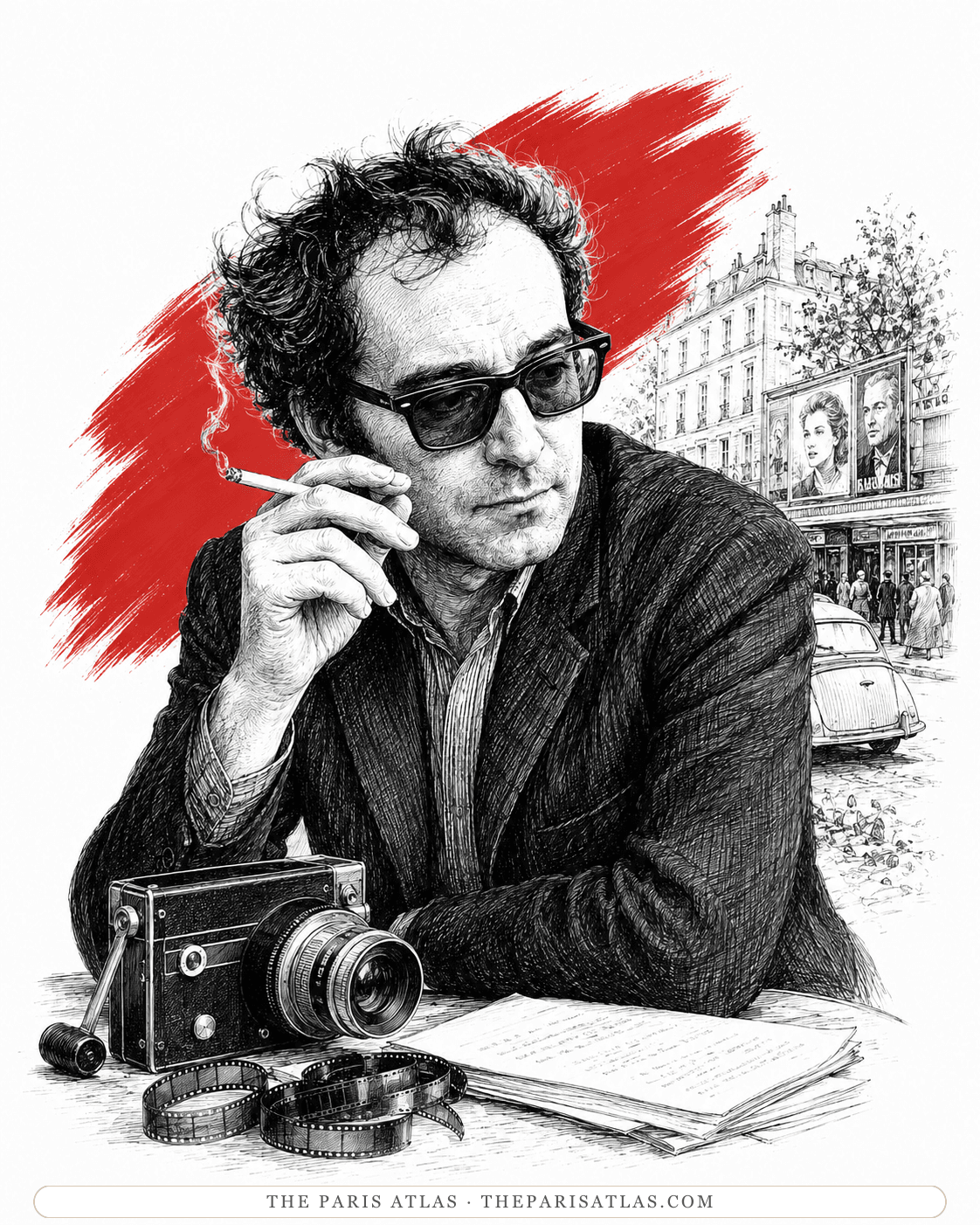
Jean-Luc Godard
- Filmmaker
- Critic
Collaborated with · 1990
Delon took the lead in Godard's Nouvelle Vague, opposite Domiziana Giordano; the film competed for the Palme d'or in 1990. It is the one crossing between the biggest star of French popular cinema and the director whose movement had defined itself against that cinema.
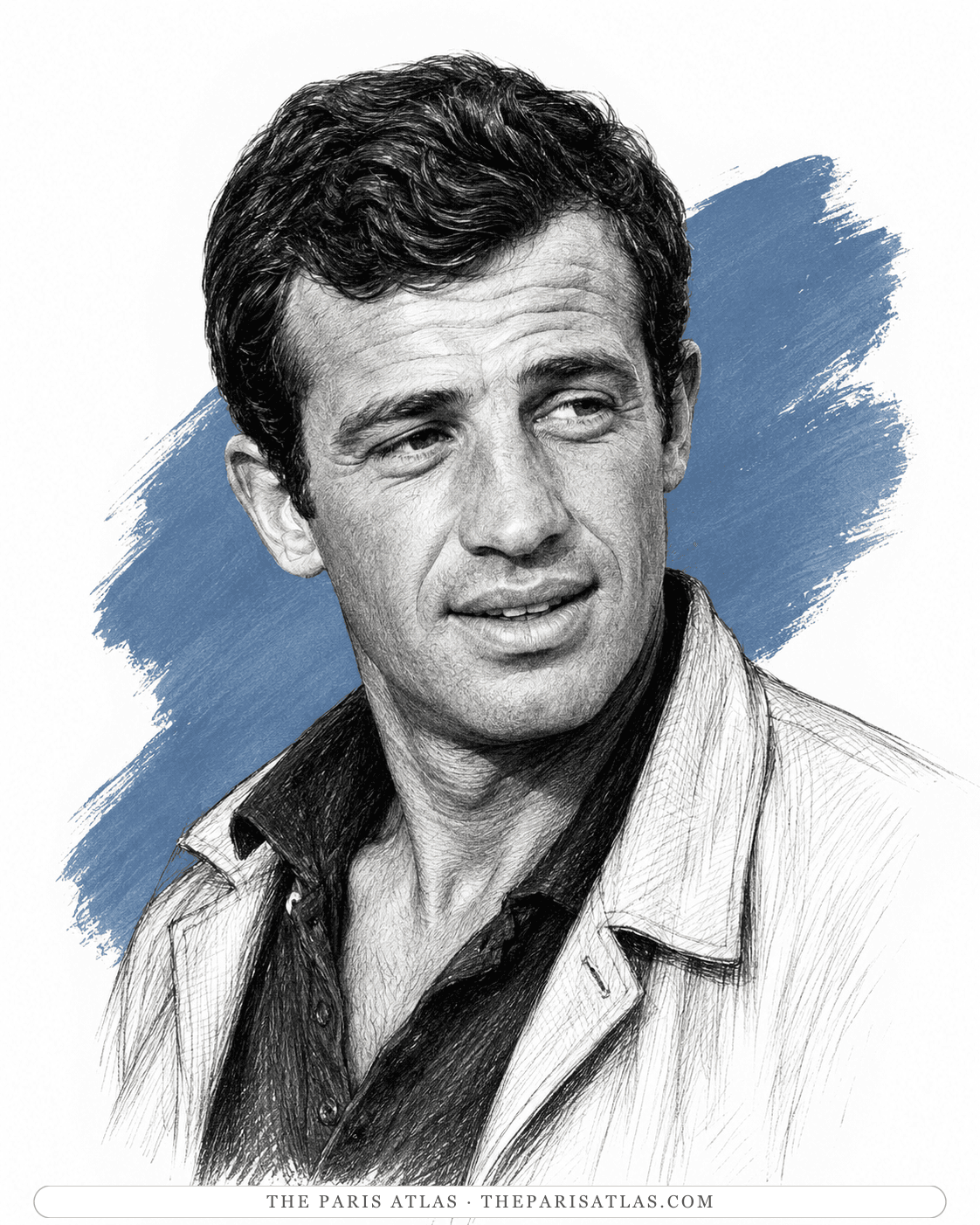
Jean-Paul Belmondo
- Actor
Collaborated with · 1970–1998
The two dominant French male stars of their generation built parallel careers as rivals and acted together only twice: Borsalino (1970), the Marseille gangster film Delon produced himself, and Une chance sur deux (1998).
Questions about Alain Delon
Who was Alain Delon?
A French film actor and producer, born at Sceaux outside Paris in 1935 and dead at his estate in the Loiret in 2024. He became a star with Plein Soleil in 1960, worked for Luchino Visconti, Michelangelo Antonioni, Jean-Pierre Melville, Joseph Losey and Jean-Luc Godard, and is best remembered as the silent hired killer Jef Costello in Le Samouraï (1967).
What is Le Samouraï about, and why does it matter?
Jean-Pierre Melville's 1967 film follows Jef Costello, a contract killer in a trenchcoat and fedora who lives alone in a bare room, builds meticulous alibis, and is hunted through Paris by the police after a nightclub shooting. Delon barely speaks in it. The film's cold, emptied, rain-lit Paris and its ritualistic professional killer became one of the most copied templates in world cinema, from Hong Kong crime films to American thrillers.
What was the Marković affair?
In the autumn of 1968 Stevan Marković, a young Yugoslav who had been living in Alain Delon's Paris house, was found murdered on a rubbish tip west of the city. Police believed he had been blackmailing wealthy acquaintances with photographs taken at parties. Delon, his wife Nathalie and the Corsican gangster François Marcantoni were all suspected; nobody was convicted, Delon was never charged, and the murder is still unsolved. The scandal spread into politics when rumours — later understood as smears by his rivals — placed Georges Pompidou and his wife Claude at the parties.
Did Alain Delon and Jean-Paul Belmondo work together?
Twice, in careers built as rivals: Borsalino (1970), the Marseille gangster film Delon produced himself, and Une chance sur deux ('one chance in two', 1998). They were the two dominant French male stars of the 1960s and 1970s, and the pairing was treated as an event on both occasions.
Why did Alain Delon get an honorary Palme d'or?
The Festival de Cannes gave him one on 19 May 2019 for his place in the history of cinema, joining a list that includes Jeanne Moreau, Agnès Varda, Jean-Paul Belmondo and Jean-Pierre Léaud. He had refused the honour for years, saying he should come to Cannes only to celebrate the directors who had chosen him. His daughter Anouchka handed it to him, and he called it a posthumous tribute paid while he was still alive. It was his last major public appearance before a stroke later that year.
How did Alain Delon die, and where is he buried?
He died on 18 August 2024, aged eighty-eight, at his estate at Douchy in the Loiret, after a stroke in 2019 and a diagnosis of lymphoma. His three children — Anthony, Anouchka and Alain Fabien — announced it and said he had died at home surrounded by his family. He had asked to be buried on his own property, near his dogs, and he was, rather than in Paris.
Was Alain Delon part of the French New Wave?
No. The New Wave directors of the late 1950s and 1960s built their films around unknowns and small budgets, and Delon was a commercial star working with established directors in France and Italy. The one crossing came late: in 1990 he played the lead in Jean-Luc Godard's Nouvelle Vague, which competed at Cannes — the movement's most famous director casting the star his generation had defined itself against.
Connections and Sources
Collaborated with · 1990
Jean-Luc Godard
Delon took the lead in Godard's Nouvelle Vague, opposite Domiziana Giordano; the film competed for the Palme d'or in 1990. It is the one crossing between the biggest star of French popular cinema and the director whose movement had defined itself against that cinema.
Collaborated with · 1970–1998
Jean-Paul Belmondo
The two dominant French male stars of their generation built parallel careers as rivals and acted together only twice: Borsalino (1970), the Marseille gangster film Delon produced himself, and Une chance sur deux (1998).
References
References
The sources below include biographies, scholarly essays, interviews, and primary materials that informed this page. They reflect both the historical record and ongoing critical conversations about Alain Delon and their work.

1↑Alain Delon (1935-2024)
WebsiteEncyclopædia UniversalisUsed forReference notice: the birth at Sceaux, the broken childhood, Indochina, and the films of the first decade.

2↑Alain Delon, Palme d'or d'Honneur du 72e Festival de Cannes
Official recordFestival de Cannes, 2019Used forThe festival's own account of the career, issued with the honorary Palme d'or in 2019.
3↑Murder in Paris '68: enthralling account of a scandal that even now seems hard to believe
PeriodicalThe Irish Times, 2026Used forThe Marković affair, as set out in the fullest recent account of it in English.
4L'acteur français Alain Delon est mort
PeriodicalRadio-Canada, 2024Used forObituary: the Melville films, La Piscine, the Belmondo pictures, the illness, the burial wish.
5Actor and 'French monument' Alain Delon dies aged 88
PeriodicalAl Jazeera, 2024Used forContemporary reporting or criticism used to document the historical reception and context of Alain Delon.
6Alain Delon In Tears As He Accepts The Palme D'Honneur At Cannes Film Festival
PeriodicalForbes, 2019Used forThe 2019 ceremony itself: who handed him the Palme, what he said, and the Losey screening that followed.
7Festival de Cannes — Il Gattopardo (Luchino Visconti), Cannes Classics
Official recordFestival de CannesUsed forOfficial record used to verify names, dates, institutional details, or other factual information on this page.
8Festival de Cannes — Nouvelle Vague (Jean-Luc Godard, In Competition 1990)
Official recordFestival de Cannes, 1990Used forOfficial record used to verify names, dates, institutional details, or other factual information on this page.
9Alain Delon Remembered — retrospective programme
WebsiteAmerican CinemathequeUsed forWeb source consulted for documented facts and historical context presented on the Alain Delon page.
i
Why these sources are here
These references anchor the page in the documented record and in the scholarly conversations around Alain Delon. Every claim on this page traces back to one or more of the works listed here.
 Explore more resources