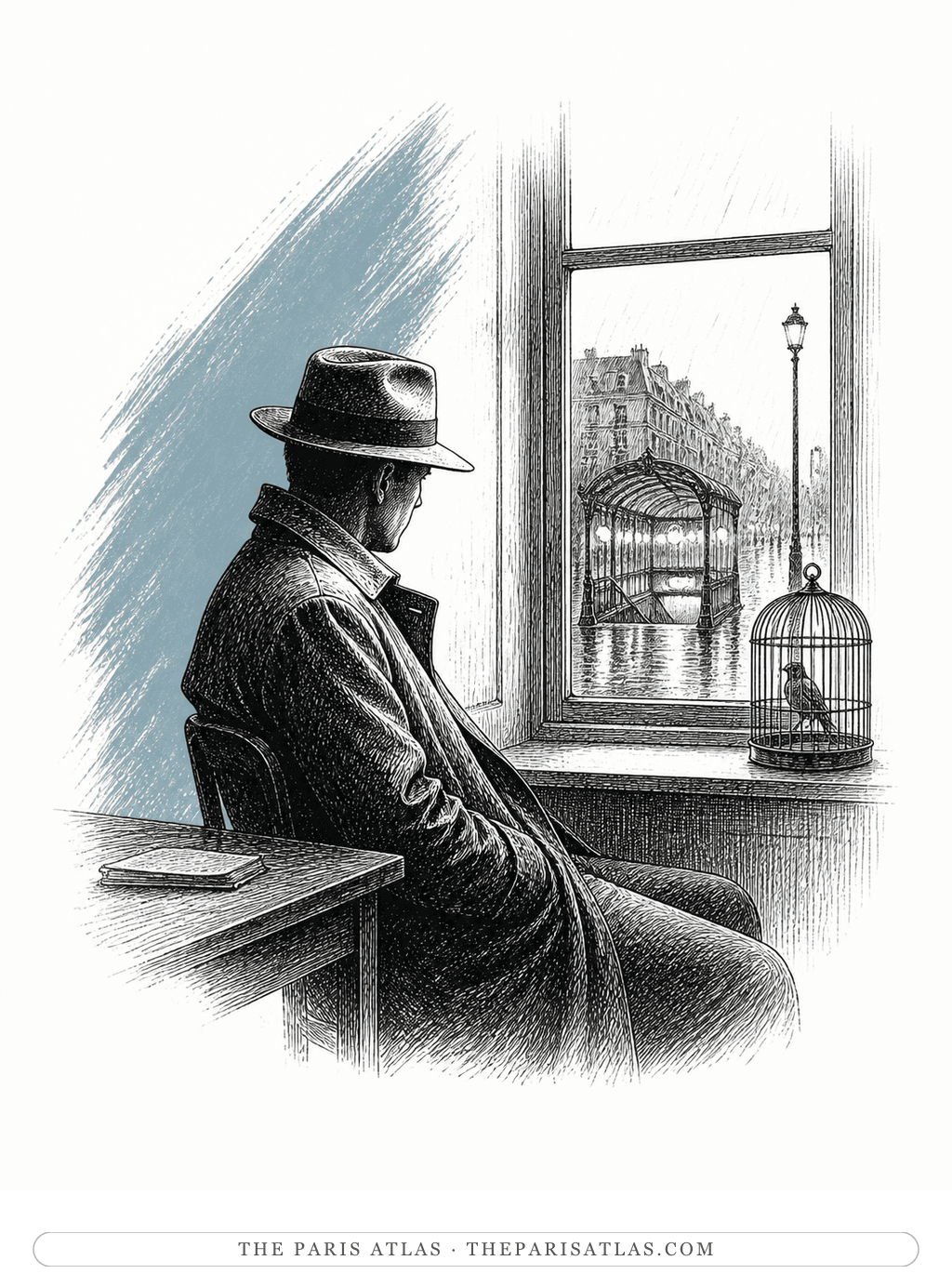
Le Samouraï
by Jean-Pierre Melville
A contract killer in a trench coat and fedora carries out a job in a Paris nightclub, is seen by a witness who does not identify him, and spends the rest of the film being closed in on by the police on one side and his employers on the other. Melville strips out almost all the dialogue and shoots a rain-grey Paris of métro corridors and rented rooms. Alain Delon was thirty-one, and the performance defined him.
- 1967
- Feature film, colour
What happens in it
Jef Costello is a professional killer who lives alone in a bare rented room with a caged bird. He works to a method: a stolen car, a set of keys, a rehearsed alibi, no improvisation and almost no speech.
He kills a nightclub owner and walks out past several witnesses. One of them — the club's pianist, played by Cathy Rosier — looks straight at him and then, questioned by the police, says it was not him. Why she does that is the hollow at the centre of the film, and Melville never fills it in.
From there Jef is squeezed from both sides: a police superintendent who is certain and cannot prove it, and the employers who decide a killer who has been seen is a liability. The film is the closing of that vice, at walking pace.
A film that refuses to talk
The opening runs for minutes with no dialogue at all — a man on a bed, a cigarette, a bird, rain. Across the whole film Delon says very little, and what he says is procedural.
This is the opposite of what the New Wave directors were doing at the same moment. Where Godard's characters talk constantly about books and politics and each other, Melville's do not talk at all, and the meaning has to be carried by objects: the brim of a hat, a set of keys tried one after another in a stolen car, a bird that goes quiet when someone has been in the room.
Melville was older than Godard, Truffaut and the rest, and had been making films since the late 1940s. They treated him as a precursor rather than a peer — he had already shown that you could shoot on location, cheaply, outside the studio system, which is the practical thing the New Wave is famous for.
The Paris of it
The city here is not a postcard and it is not a monument. It is rain on grey streets, the interiors of the métro, corridors, a police station, rented rooms and a nightclub. There is a long sequence of Jef being followed through the métro system that works as a piece of documentary about how the network actually connected.
Melville shot it through a pale, cold filter that drains the colour out of everything. The often-repeated account is that the blue was chosen to match Delon's eyes; it is a good story, and it is generally told as a story rather than as something Melville documented. Either way the effect is that a colour film feels like a black-and-white one that has been left out in the weather.
What came out of it
The Criterion Collection describes the film as a mixture of 1940s American gangster pictures, 1960s French pop, and Japanese lone-warrior mythology — Melville taking an American genre, running it through a code of honour borrowed from somewhere else entirely, and setting the result in Paris.
The visual grammar it fixed — the hitman as a disciplined professional, the ritual of preparation, the trench coat and hat, the near-total silence — became one of the most copied templates in film. Directors working in Hong Kong, in American crime cinema and in the neo-noir revival have all taken from it openly.
For Alain Delon it was the role that set the terms of the rest of his career: beautiful, still, and unreadable.
Timeline
1967
Le Samouraï is released, a French-Italian co-production of 95 minutes written and directed by Jean-Pierre Melville.
1967
Alain Delon, at thirty-one, plays Jef Costello — the role that fixes his screen persona.
Frequently asked questions
What is Le Samouraï about?
A contract killer, Jef Costello, carries out a hit in a Paris nightclub and is seen by a witness who then refuses to identify him. The rest of the film is the police closing in on one side and his own employers deciding to remove him on the other. It is told with almost no dialogue.
Who directed Le Samouraï and when?
Jean-Pierre Melville, who also wrote it. It was released in 1967, ran 95 minutes, and was a French-Italian co-production produced by Eugène Lepicier.
Who stars in Le Samouraï?
Alain Delon as Jef Costello, in the performance that defined him — he was thirty-one. François Périer plays the police superintendent, Nathalie Delon plays Jane Lagrange, and Cathy Rosier plays the pianist who sees him and says nothing.
Why does Le Samouraï look blue?
Melville shot it through a cold, pale filter that drains the colour from the image, so a colour film reads almost as black and white. The frequently repeated explanation is that the blue was chosen to match Alain Delon's eyes — a story told often enough to be worth knowing, though it is repeated as anecdote rather than documented by Melville.
Is Le Samouraï part of the French New Wave?
Not exactly. Melville was older and had been directing since the late 1940s, and the New Wave directors regarded him as a forerunner — he had already proved you could shoot on location and outside the studio system. His style is the opposite of theirs in one obvious way: their characters never stop talking, and his barely speak.
Why is Le Samouraï so influential?
It fixed a template: the hitman as a silent professional with a code, the ritual of preparation, the trench coat and hat, and violence presented as procedure rather than spectacle. Criterion describes it as 1940s American gangster cinema crossed with 1960s French pop and Japanese lone-warrior mythology. Crime directors have been borrowing from it openly ever since.
Where should Le Samouraï sit in a Paris film list?
Alongside the New Wave rather than inside it. Watch it near Breathless (1960), which also takes an American genre and relocates it, and near Alphaville (1965) for another Paris shot to look colder than it is. Melville gives you the city as weather and infrastructure — rain, the métro, corridors — rather than as landmarks.
References
The sources below include collection records, catalogues, scholarly research, and primary materials that informed this page. They document Le Samouraï, its making, and its place in cultural history.

1Le Samouraï (1967) — BFI collections record
WebsiteBritish Film InstituteUsed forThe BFI's collections record: 1967, France and Italy, 95 minutes, Melville as writer-director, Eugène Lepicier as producer, and the principal cast.
2Le samouraï (1967)
WebsiteThe Criterion CollectionUsed forCriterion on Jef Costello as a killer with samurai instincts, the trench coat and fedora, the vice closing between investigator and employer, the pale blue filter, Delon's age, and the film's mixture of American gangster cinema, French pop and lone-warrior mythology.

3Le Samouraï (Jean-Pierre Melville, 1967)
Official recordLa Cinémathèque françaiseUsed forOfficial record used to verify names, dates, institutional details, or other factual information on this page.
410 Great Hitman Films
PeriodicalBritish Film Institute, 2023Used forContemporary reporting or criticism used to document the historical reception and context of Le Samouraï.
These references provide the documented foundation for this work's history and interpretation. Claim-level citations remain attached to the specific claims they support.
 Explore more resources