Did Hemingway Write “For Sale: Baby Shoes, Never Worn”?
There is no reliable evidence that Ernest Hemingway wrote the six-word story. Similar newspaper advertisements appeared before he was an adult, and his name was attached to the modern wording decades after his death.
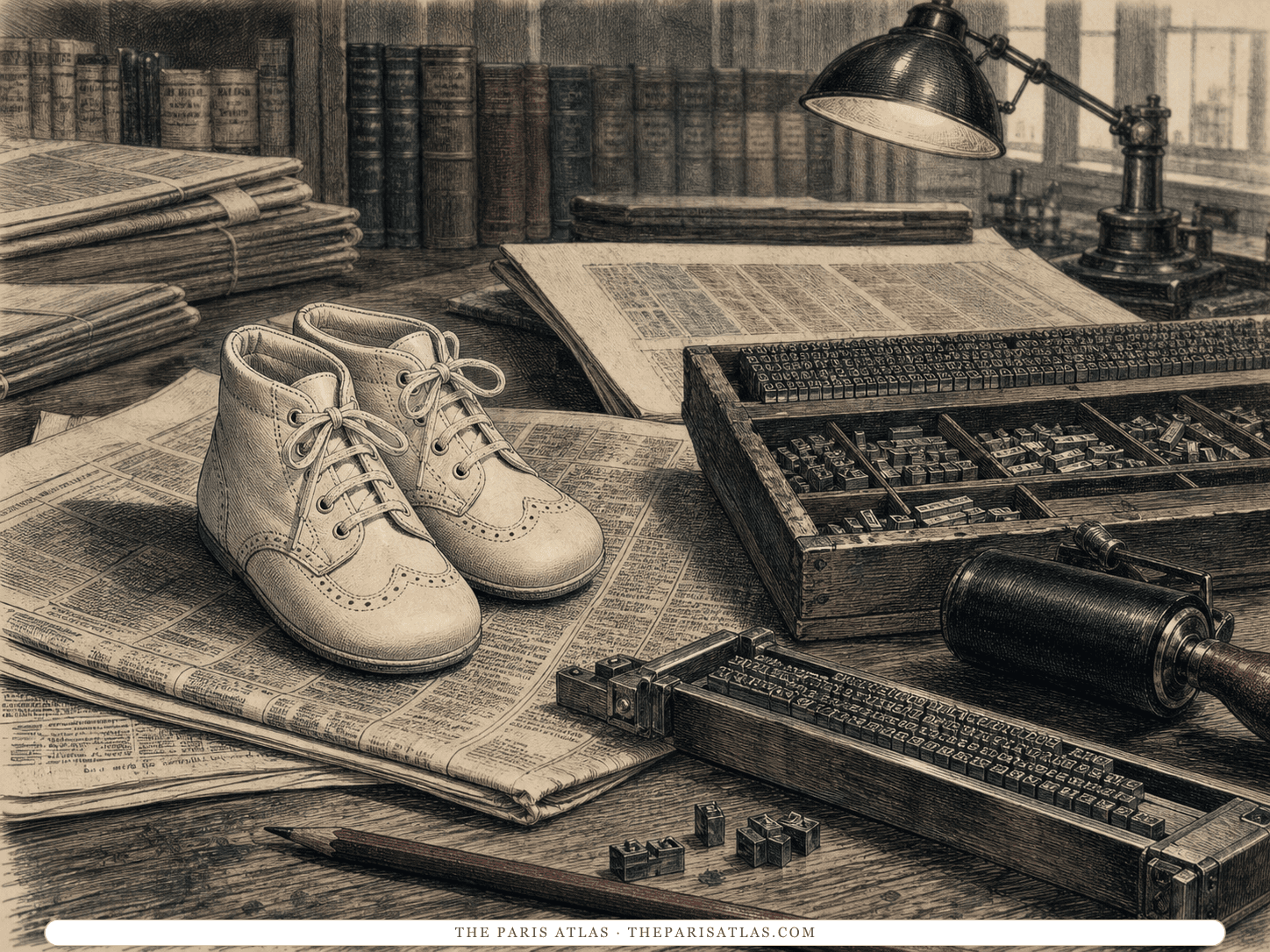
There is no reliable evidence that Ernest Hemingway wrote “For sale: baby shoes, never worn.” Researchers have found no manuscript, letter or interview in which he claimed it. They have also found no report from anyone who heard him tell it while he was alive. The author is unknown, so we describe it as an anonymous story that is often wrongly credited to Hemingway.[1][2]
What people say happened
The popular story says Hemingway was having lunch with other writers. Someone bet that he could not tell a complete story in six words. Hemingway supposedly wrote the baby-shoes sentence on a napkin, passed it around the table and collected ten dollars from each person.[1]
There is no record of this lunch from the time it supposedly happened. Later versions disagree about where it happened, who was present and how much money was bet. None identifies a witness who wrote about the event while Hemingway was alive. Those problems are why researchers treat the lunch story as a legend rather than a documented event.[1]
A sentence can resemble Hemingway's writing without being his work.
Similar wording was printed before the Hemingway story
Newspapers printed classified advertisements for unused baby clothes, cradles and carriages before Hemingway became a writer. One 1906 advertisement said: “For sale, baby carriage; never been used. Apply at this office.” Hemingway was seven years old at the time. This is not the exact six-word story, but it shows that the central idea was already in circulation.[1]
A 1910 newspaper article was even closer to the meaning readers now give the story. Headlined “Tragedy of Baby's Death Is Revealed in Sale of Clothes,” it described parents selling baby clothes that had never been used because their baby had died. This evidence does not identify the author of the six-word version. It does show that the same sad idea appeared in print long before the lunch story about Hemingway.[1]
Hemingway's name appeared much later
Hemingway died in 1961. The earliest known printed work that has him claim the modern six-word story is John de Groot's 1989 play Papa, published nearly twenty-eight years later. A play is fiction, so this scene is not proof that Hemingway told the story in real life.[1]
Two books published in 1991 repeated versions of the lunch bet, one by Peter Miller and one by Arthur C. Clarke. Neither supplied a manuscript, a dated newspaper report or testimony from a named person who attended the lunch. Repeating the claim made it more familiar, but it did not provide evidence for it.[1]
Why people connect it with Hemingway
The six words leave most of the story unstated. Many readers imagine that a baby died and that grieving parents are selling shoes the child never wore. Hemingway also left important facts unstated in stories such as “Hills Like White Elephants,” collected in Men Without Women. He called this approach the iceberg theory: the reader sees only a small part of the full story and must understand the rest from context.[3][2]
That similarity helps explain why the attribution is believable. It is not proof that Hemingway wrote the sentence. His famous name also gives the anonymous story a memorable origin, which makes the lunch anecdote easier to repeat than the less satisfying answer that the author is unknown.
How researchers took the attribution apart
The definitive skeptical work is Garson O'Toole's — a pseudonym used by the linguist Gregory F. Sullivan, who runs Quote Investigator and specialises in tracing famous misattributions back to their original source. O'Toole worked backward from the modern lunch-anecdote — the version in Peter Miller's 1991 book Get Published! Get Produced!, which placed Hemingway at the Algonquin Round Table taking the bet from writers including Robert Benchley and Franklin P. Adams — and found no primary source for it. No one at the Algonquin ever wrote about the lunch. Neither Benchley nor Adams, both of whom wrote prolifically and daily, ever mentioned it. Miller supplied no citation.[1]
Working forward from the earliest possible date, O'Toole then found a chain of earlier appearances that made the story's precursors clearer than the story's origin. William R. Kane, editor of the writers' trade magazine The Editor, published a short piece in his own magazine in 1917 called "Little Shoes, Never Worn" — a narrative about a mother selling baby clothes she had never used, which is not the six-word story but is very close to what modern readers imagine when they read it. A 1921 humour piece in Judge and other 1910s newspaper classifieds carried the same underlying idea in even more compressed form. Kane's story predates Hemingway's first published fiction by seven years.[1][2]
The academic follow-up is David Fishelov's 2024 article in the literary-studies journal Connotations, which reads the surviving evidence in the same direction and adds a separate argument: the six-word story does not need a Hemingway attribution to work. The compression that makes it powerful is a formal choice that any writer of the period could have made; the reader supplies what the sentence leaves out. Naming an author of unusual stature makes the anecdote more attractive to repeat but does not make the sentence better than it already is.
Our conclusion
The six-word story is not a Hemingway work. It is anonymous, and commonly misattributed to him. That conclusion would change if reliable new evidence appeared: a dated manuscript, a newspaper report from Hemingway's lifetime, or checkable testimony from someone who heard him tell it.
Sources and further reading
Garson O'Toole's Quote Investigator study, “For Sale, Baby Shoes, Never Worn,” documents the early newspaper examples and the late appearance of Hemingway's name. David Fishelov's 2024 article in Connotations examines the same attribution and the story's later reputation. Amit Katwala's 2025 WIRED investigation summarizes the evidence and interviews researchers who have studied it.
The evidence supports a simple answer: the story's author is unknown, and there is no reliable reason to call it Hemingway's. The sentence can still be powerful without a famous name attached to it.


 View source