The Paris AtlasCharting the artists, works, and places worth returning to.
  • Filmmaker
  • Actor
· French · 1861–1938

Georges Méliès

Cinema's first magician — a conjurer who saw the Lumières' invention and built it a dream life: five hundred films from a glass studio, a rocket in the Moon's eye, and a toy stand at Montparnasse station at the end.

In images

Details

Lived
1861–1938
Born
8 December 1861
Birthplace
Paris
Died
21 January 1938 · aged 76
Place of death
Paris
Nationality
French
Roles
FilmmakerActor

About Georges Méliès

Georges Méliès sat in the Grand Café on 28 December 1895 at the Lumière brothers' first public film screening and tried to buy the invention on the spot. Refused — Antoine Lumière told him the machine had no commercial future to sell — he bought a projector in London, rebuilt it into a camera, and spent the next seventeen years giving cinema its imagination: over five hundred films, most famously A Trip to the Moon of 1902, whose rocket-in-the-Moon's-eye is the first universally recognized image in film history.[1]

He was a stage magician first — owner of the Théâtre Robert-Houdin from 1888 — and every trick he found in the camera was a conjuror's trick scaled up: the stop-substitution he discovered when his camera jammed on the place de l'Opéra, multiple exposures, hand-painted colour, a glass studio at Montreuil built like a greenhouse for daylight. The fall was as complete as the rise: bankrupt by 1913, his negatives melted down in the war, he was found in 1925 selling toys from a kiosk in the Gare Montparnasse. Paris made it up to him just in time — a gala in 1929, the Légion d'honneur from Louis Lumière's own hands in 1931, and a state pension for the end.

The magician buys a machine

Méliès was born in Paris on 8 December 1861, third son of a wealthy boot manufacturer, and discovered conjuring in London at Maskelyne's Egyptian Hall while supposedly learning English for the family business. In 1888 he sold his share in the boots to his brothers and bought the Théâtre Robert-Houdin on the boulevard des Italiens, the little temple of French magic, where he staged illusions of his own design for seven years.[2]

On 28 December 1895 he was in the audience at the Salon Indien du Grand Café for the Lumière brothers' first paid public screening. He offered to buy a Cinématographe before the evening ended and was turned down flat. Within months he had acquired an English projector, reverse-engineered it into a camera, and begun shooting; the Star Film company followed, its motto Le monde à la portée de la main — the whole world within reach.[1]

The glass studio

The famous accident came early: filming street traffic at the place de l'Opéra, his camera jammed for a few seconds, and when the developed strip jumped an omnibus into a hearse Méliès saw what a splice could do. Stop-substitution became the engine of a whole genre — beheadings, vanishings, devils in puffs of smoke — and in 1897 he built the world's first purpose-built film studio at Montreuil, just east of Paris: a greenhouse of glass walls and roof, sized exactly to his theatre stage, where daylight did the lighting and trapdoors did the magic.[1]

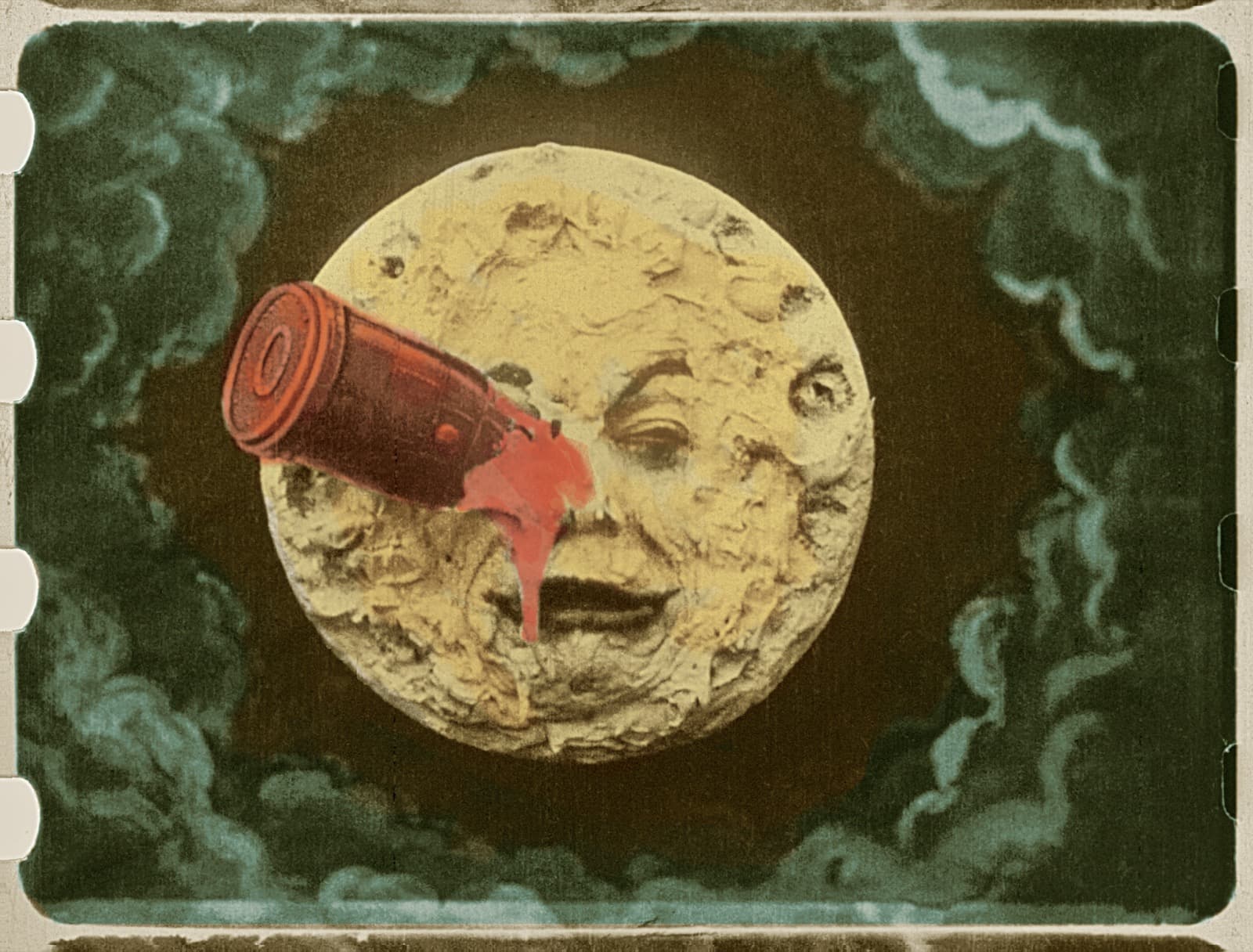
A Trip to the Moon, 1902 — the frame everyone knows. Méliès plays Professor Barbenfouillis, leading the expedition. (Georges Méliès (Star Film), via Wikimedia Commons · Public domain)

A Trip to the Moon, shot there in 1902 — fourteen minutes, a then-enormous ten thousand francs, Méliès himself leading the astronomers — became the first worldwide hit in the medium's history. It made everyone money except its maker: Thomas Edison's agents obtained a print and duplicated it across America without paying a centime, and the piracy, Méliès said later, taught him what the film business was going to be.[3]

The toy stand at Montparnasse

The industry he had invented outgrew him: longer films, story realism, distribution systems he refused until too late. By 1913 Star Film was bankrupt and his wife Eugénie was dead; the war finished the ruin, the army confiscating hundreds of his prints to melt for silver and celluloid — boot heels, by the standard account, a grim joke on the family trade. In 1923, evicted from the Théâtre Robert-Houdin and enraged, he burned the negatives left at Montreuil himself.[2]

Méliès in 1938, the year of his death — ten years after journalists found cinema's first magician selling toys at a station kiosk. (Regards magazine, via Wikimedia Commons · Public domain)

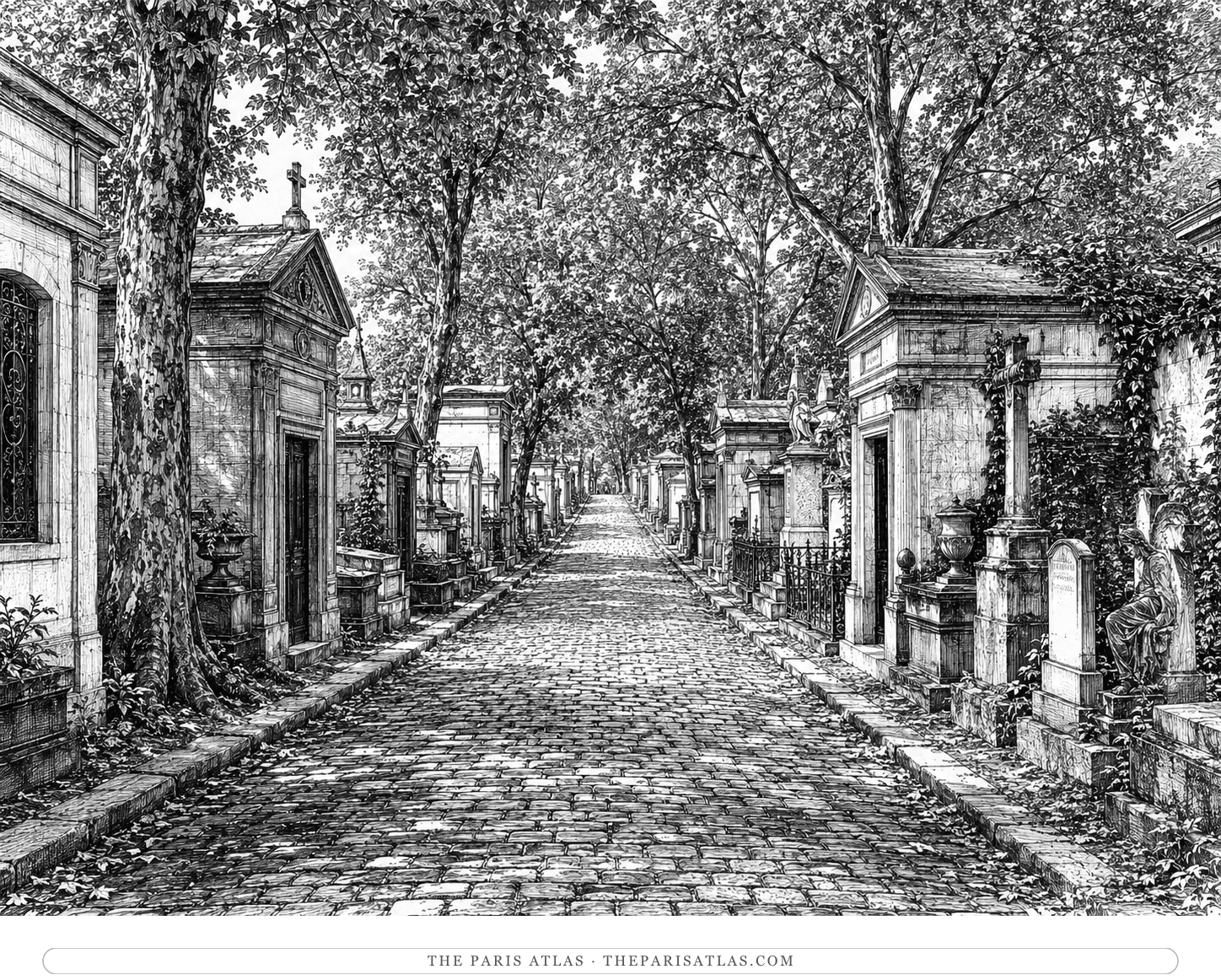
From 1925 he stood twelve hours a day in a toy-and-sweet kiosk in the Gare Montparnasse, run with Jeanne d'Alcy, the actress of his early films whom he married that year. Journalists and young cinephiles rediscovered him there at the decade's end: a gala tribute at the Salle Pleyel in 1929 played the surviving films to an audience that gave him an ovation, Louis Lumière — the man who had refused to sell him a camera — pinned the Légion d'honneur on him in 1931, and the state gave the old magician an apartment at the Orly cinema veterans' home. He died in Paris on 21 January 1938 and is buried at Père Lachaise, where his tomb carries a portrait relief and the title he earned: creator of the cinematographic spectacle.[2]

The Star Film catalogue

Méliès made something in the region of five hundred and twenty films between 1896 and 1913, and sold them by catalogue, numbered, like any other manufactured product. Star Film had agents across Europe and an office in New York run by his brother Gaston.[4]

A large part of the output was hand-coloured. Méliès sent prints to the workshop of Élisabeth Thuillier, where women painted each frame individually with fine brushes, working to a colour scheme she set. The studio employed more than two hundred of them, and each woman applied a single colour, so a film carrying twenty colours passed down a line of twenty pairs of hands.[4]

The catalogue was also stolen from constantly. A Trip to the Moon was duplicated and sold in America without payment, most damagingly by Thomas Edison's people, who had a print copied and distributed while Méliès was still shipping his own. The New York office was opened largely to stop it, and it did not.[3]

Burning the negatives

By 1923 Méliès had lost the Théâtre Robert-Houdin to a road-widening scheme, lost the company, and was being pursued for debt. The Montreuil property was sold.[2]

In a single fit that year he burned the negatives held there. He set fire to the lot in the garden: the masters of hundreds of films, most of which existed nowhere else.[2]

That was not the only loss. During the First World War the French Army had confiscated more than four hundred Star Film prints and melted them down for the silver in them and for celluloid, which went into boot heels. Of the five hundred and twenty-odd titles, roughly two hundred survive, and almost every one of those came back from a copy that had been sold abroad and forgotten.[4]

The colour Voyage

A Trip to the Moon was released in 1902 in both black-and-white and hand-coloured versions. The coloured print was assumed lost for most of a century.[4]

One turned up in 1993, in a donation to the Filmoteca de Catalunya in Barcelona, decomposed into a solid block of nitrate. It took until 2011 to separate, scan and reassemble it frame by frame, and it was shown that year at Cannes.[4]

The film that had made him internationally famous in 1902 came back in the form he had originally sold it, more than seventy years after his death and nearly ninety years after he burned the negative.[4]

Life events

  1. 1861

    Born in Paris on 8 December, third son of a boot manufacturer.

    — Georges Méliès — biographie et chronologie; MÉLIÈS Georges (1861-1938) — Amis et Passionnés du Père-Lachaise

  2. 1888

    Sells his share of the family business and buys the Théâtre Robert-Houdin, temple of French stage magic.

    — Georges Méliès — biographie et chronologie; Georges Méliès par ses archives, portrait d'un homme-orchestre

  3. 1895

    At the Lumières' first public screening on 28 December, he tries to buy the Cinématographe that night and is refused.

    — Georges Méliès — biographie et chronologie; BFI — Georges Méliès: extracts from his autobiographical account

  4. 1896

    His camera jams at the place de l'Opéra and an omnibus becomes a hearse — the stop trick, the seed of special effects.

    — Emilie Bickerton, The magical films of Georges Méliès make him a name to conjure with (2021); The Illusory Tableaux of Georges Méliès — programme notes

  5. 1897

    Builds the glass studio at Montreuil, the world's first purpose-built film studio.

    — Georges Méliès — biographie et chronologie; MÉLIÈS Georges (1861-1938) — Amis et Passionnés du Père-Lachaise

  6. 1902

    A Trip to the Moon — fourteen minutes, ten thousand francs — becomes cinema's first worldwide hit, and Edison's agents pirate it across America.

    The rocket in the Moon's eye — A Trip to the Moon, 1902, the most famous image of early cinema. Méliès played the lead astronomer himself. (Georges Méliès (Star Film), via Wikimedia Commons)

    — The Illusory Tableaux of Georges Méliès — programme notes; Georges Méliès — biographie et chronologie

  7. 1903

    Opens a New York office under his brother Gaston to stop American duplication of his films.

  8. 1913

    Star Film is bankrupt; the industry he invented has outgrown its inventor.

    — Georges Méliès — biographie et chronologie; Georges Méliès par ses archives, portrait d'un homme-orchestre

  9. 1917

    The army confiscates hundreds of his prints, melting them down for silver and celluloid; in 1923 he burns the Montreuil negatives himself.

    — The Illusory Tableaux of Georges Méliès — programme notes; MÉLIÈS Georges (1861-1938) — Amis et Passionnés du Père-Lachaise

  10. 1917

    The French Army confiscates more than four hundred Star Film prints and melts them down for their silver and celluloid, which goes into boot heels.

  11. 1923

    Loses the Théâtre Robert-Houdin to a road-widening scheme and the Montreuil property to sale.

  12. 1923

    Burns the negatives of hundreds of films in the garden at Montreuil.

  13. 1925

    Begins selling toys and sweets from a kiosk in the Gare Montparnasse with Jeanne d'Alcy, whom he marries.

    — Georges Méliès — biographie et chronologie; Georges Méliès par ses archives, portrait d'un homme-orchestre

  14. 1929

    Rediscovered: a gala at the Salle Pleyel plays the surviving films to an ovation.

    — Georges Méliès — biographie et chronologie; Georges Méliès par ses archives, portrait d'un homme-orchestre

  15. 1931

    Louis Lumière himself pins the Légion d'honneur on the man he once refused to sell a camera.

    — Georges Méliès par ses archives, portrait d'un homme-orchestre; Georges Méliès — biographie et chronologie

  16. 1932

    Is given an apartment at the Château d'Orly by the cinema industry's mutual aid society.

  17. 1938

    Dies in Paris on 21 January, aged seventy-six; buried at Père Lachaise.

    Georges Méliès near the end of his life, published in the magazine Regards in 1938 — the year of his death, a decade after his rediscovery at the Gare Montparnasse toy stand. (Regards magazine, via Wikimedia Commons)

    — Georges Méliès — biographie et chronologie; MÉLIÈS Georges (1861-1938) — Amis et Passionnés du Père-Lachaise

  18. 1993

    A hand-coloured print of A Trip to the Moon reaches the Filmoteca de Catalunya in Barcelona, decomposed into a block of nitrate.

  19. 2011

    The restored colour Trip to the Moon is shown at Cannes, reassembled frame by frame.

Selected works

Cataloged from the holding institutions' records. Reproductions appear only where the rights are verified.

Cinema

Hand-colored frame from A Trip to the Moon: the Man in the Moon's cratered face against teal clouds, a red bullet-shaped capsule lodged in his right eye

Artwork reproduction

Film

A Trip to the Moon

1902 · Silent film

The rocket in the Moon's eye: Méliès's 1902 fantasy — astronomers in wizard hats, a capsule fired from a giant cannon, umbrella-wielding battles with lunar insect-men — is the first film in the world's shared imagination, and the proof, seven years into cinema's existence, that the camera could lie magnificently.

Georges Méliès, A Trip to the Moon, 1902. Image: public domain.

Who Inspired Georges Méliès

People whose work inspired Georges Méliès. They did not necessarily meet or know one another.

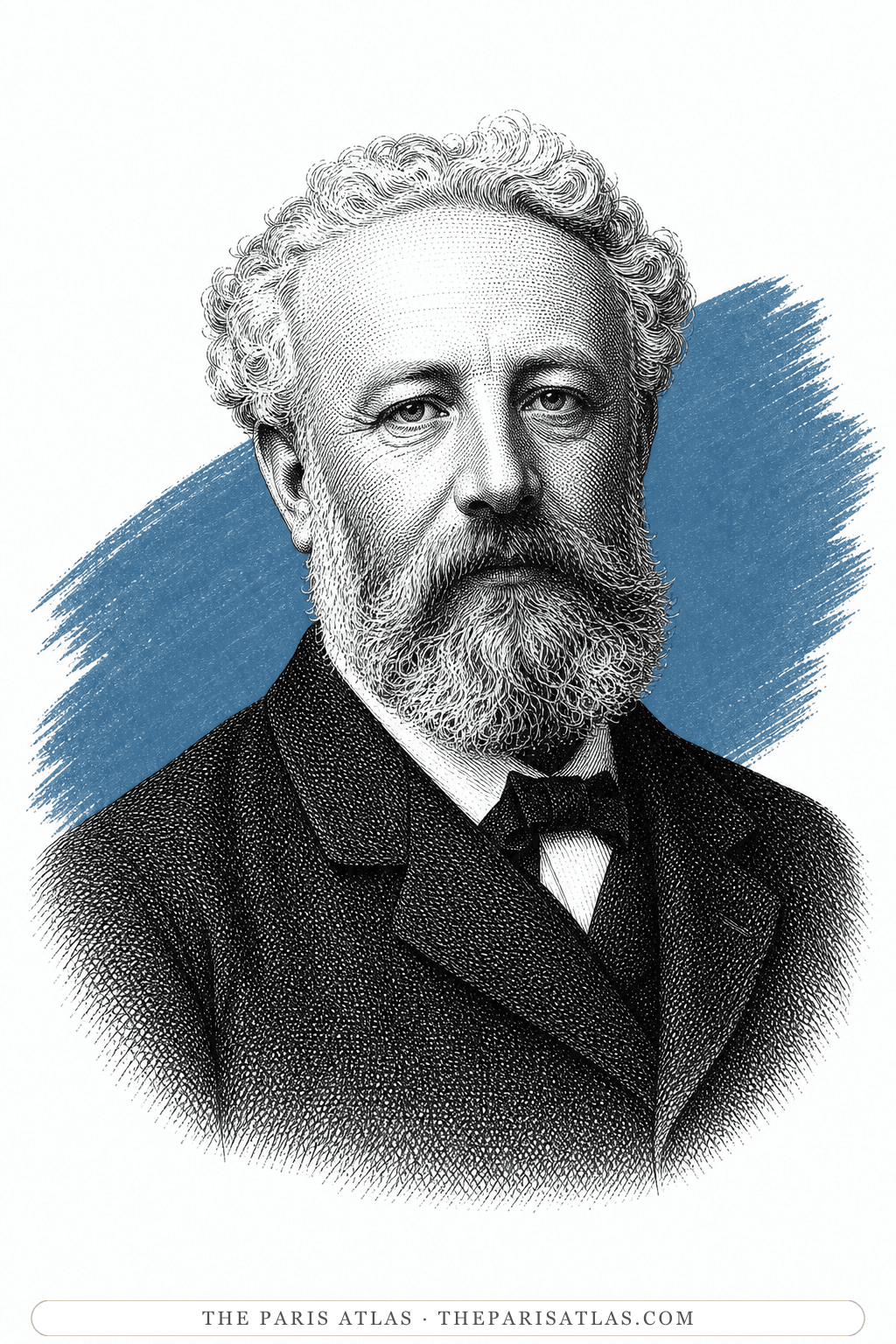
Illustrated portrait of Jules Verne

Jules Verne

Méliès built A Trip to the Moon on Verne's From the Earth to the Moon and its sequel, taking the cannon-launched projectile straight from the novels. Verne was fifty-three years older and still alive when the film appeared in 1902; he died three years later.

— Méliès, Georges; Verne, Jules

Georges Méliès’s Places

The cataloged places connected to Georges Méliès — through the books, and through the documented record.

Places you can enter today appear first, followed by addresses to see from outside and sites that have vanished.

Organizations

Founded · 1896

Star Film

Founded his own production company within a year of seeing the Lumières' invention, and built its glass studio at Montreuil in 1897 — France's first purpose-built film studio, run as a one-man industry: director, designer, performer, technician, and distributor.

— Encyclopaedia Britannica — Georges Méliès; BFI — Georges Méliès: extracts from his autobiographical account

Questions about Georges Méliès

What is Georges Méliès famous for?

Inventing cinema as spectacle. A Paris stage magician who saw the Lumière brothers' first screening in December 1895, he made over five hundred films between 1896 and 1912, discovered or perfected the medium's first special effects — the stop trick, multiple exposure, hand-painted colour — and built the world's first film studio, a glasshouse at Montreuil. A Trip to the Moon (1902), with its rocket in the Moon's eye, is the most famous image of early cinema.

Did Méliès really end up selling toys at a train station?

Yes — from 1925 he ran a toy and sweet kiosk in the Gare Montparnasse with Jeanne d'Alcy, the actress of his early films, twelve hours a day. Bankruptcy in 1913, the wartime melting of his confiscated prints, and his own burning of the Montreuil negatives in 1923 had erased both fortune and archive. Journalists found him at the kiosk at the decade's end, and the rehabilitation followed: the 1929 Salle Pleyel gala, the Légion d'honneur in 1931, and a state apartment for his last years. Martin Scorsese's film Hugo (2011) is built on this chapter.

How did Méliès discover special effects?

By accident, on the place de l'Opéra in 1896: his camera jammed for a few seconds while filming traffic, and on the developed film an omnibus appeared to transform into a hearse. The jam became the deliberate stop-substitution splice — stop the camera, change the scene, restart — which powered his vanishings, beheadings and devils, and stands at the origin of every effects shot since.

What happened to Méliès's films?

Most are gone. Of over five hundred, roughly two hundred survive. The French army confiscated hundreds of prints during the First World War and melted them for silver and celluloid; Méliès himself, evicted and embittered, burned his remaining Montreuil negatives in 1923. A Trip to the Moon survives in many prints — including one hand-coloured copy rediscovered in 1993 and restored in 2011.

Where is Georges Méliès buried?

Père Lachaise cemetery in Paris, division 64. His tomb carries a bronze portrait relief and names him créateur du spectacle cinématographique — creator of the cinematographic spectacle. It remains one of the cemetery's pilgrimage graves for film lovers.

How many films did Georges Méliès make?

Something in the region of five hundred and twenty, between 1896 and 1913, sold by numbered catalogue like any other manufactured product. Fewer than two hundred survive, and almost all of those came back from prints that had been sold abroad and forgotten.

Why did Méliès burn his own films?

Because by 1923 he had lost the Théâtre Robert-Houdin, the company and the Montreuil property, and was being pursued for debt. He set fire to the negatives held at Montreuil in a single fit that year, and sold surviving prints for their celluloid, which was melted down and reused for shoe heels.

Were his films in colour?

Many of them. Méliès sent prints to Élisabeth Thuillier's workshop, where a team of women painted each frame individually with fine brushes to a colour scheme she set. A single film could pass through two hundred pairs of hands.

What happened to the colour version of A Trip to the Moon?

It was assumed lost for most of a century. A print reached the Filmoteca de Catalunya in Barcelona in 1993, decomposed into a solid block of nitrate. Separating, scanning and reassembling it took until 2011, when it was shown at Cannes.

Connections and Sources

Georges Méliès’s connections to people, places, and works, with the sources behind each one.

Buried at · 1938

Père-Lachaise Cemetery

Buried in division 64 in January 1938 — cinema's first magician, a decade after the Gare Montparnasse toy stand and the rediscovery that restored his name.

— Paris Discovery Guide — 101 Famous Graves in Père Lachaise Cemetery

Founded · 1896

Star Film

Founded his own production company within a year of seeing the Lumières' invention, and built its glass studio at Montreuil in 1897 — France's first purpose-built film studio, run as a one-man industry: director, designer, performer, technician, and distributor.

— Encyclopaedia Britannica — Georges Méliès; BFI — Georges Méliès: extracts from his autobiographical account

Performed in · 1902

A Trip to the Moon

Georges Méliès plays Professor Barbenfouillis.

— Encyclopaedia Britannica — A Trip to the Moon

Influenced by · 1902

Jules Verne

Méliès built A Trip to the Moon on Verne's From the Earth to the Moon and its sequel, taking the cannon-launched projectile straight from the novels. Verne was fifty-three years older and still alive when the film appeared in 1902; he died three years later.

— Méliès, Georges; Verne, Jules

References

References

The sources below include biographies, scholarly essays, interviews, and primary materials that informed this page. They reflect both the historical record and ongoing critical conversations about Georges Méliès and their work.

  1. 1abcBFI — Georges Méliès: extracts from his autobiographical account

    Website
    Used for

    Web source consulted for documented facts and historical context presented on the Georges Méliès page.

    View source
  2. 2abcdeGeorges Méliès — biographie et chronologie

    Website
    Cinémathèque Méliès — Les Amis de Georges Méliès
    Used for

    Web source consulted for documented facts and historical context presented on the Georges Méliès page.

    View source
  3. 3abThe Illusory Tableaux of Georges Méliès — programme notes

    Website
    Harvard Film Archive
    Used for

    Web source consulted for documented facts and historical context presented on the Georges Méliès page.

    View source
  1. 4abcdefGeorges Méliès par ses archives, portrait d'un homme-orchestre

    Website
    La Cinémathèque française
    Used for

    Web source consulted for documented facts and historical context presented on the Georges Méliès page.

    View source
  2. 5The magical films of Georges Méliès make him a name to conjure with

    Periodical
    Apollo, 2021
    Used for

    Contemporary reporting or criticism used to document the historical reception and context of Georges Méliès.

    View source
  3. 6MÉLIÈS Georges (1861-1938) — Amis et Passionnés du Père-Lachaise

    Website
    Les Amis et Passionnés du Père-Lachaise
    Used for

    Web source consulted for documented facts and historical context presented on the Georges Méliès page.

    View source
i
Why these sources are here

These references anchor the page in the documented record and in the scholarly conversations around Georges Méliès. Every claim on this page traces back to one or more of the works listed here.

Explore more resources