
Film
A Trip to the Moon
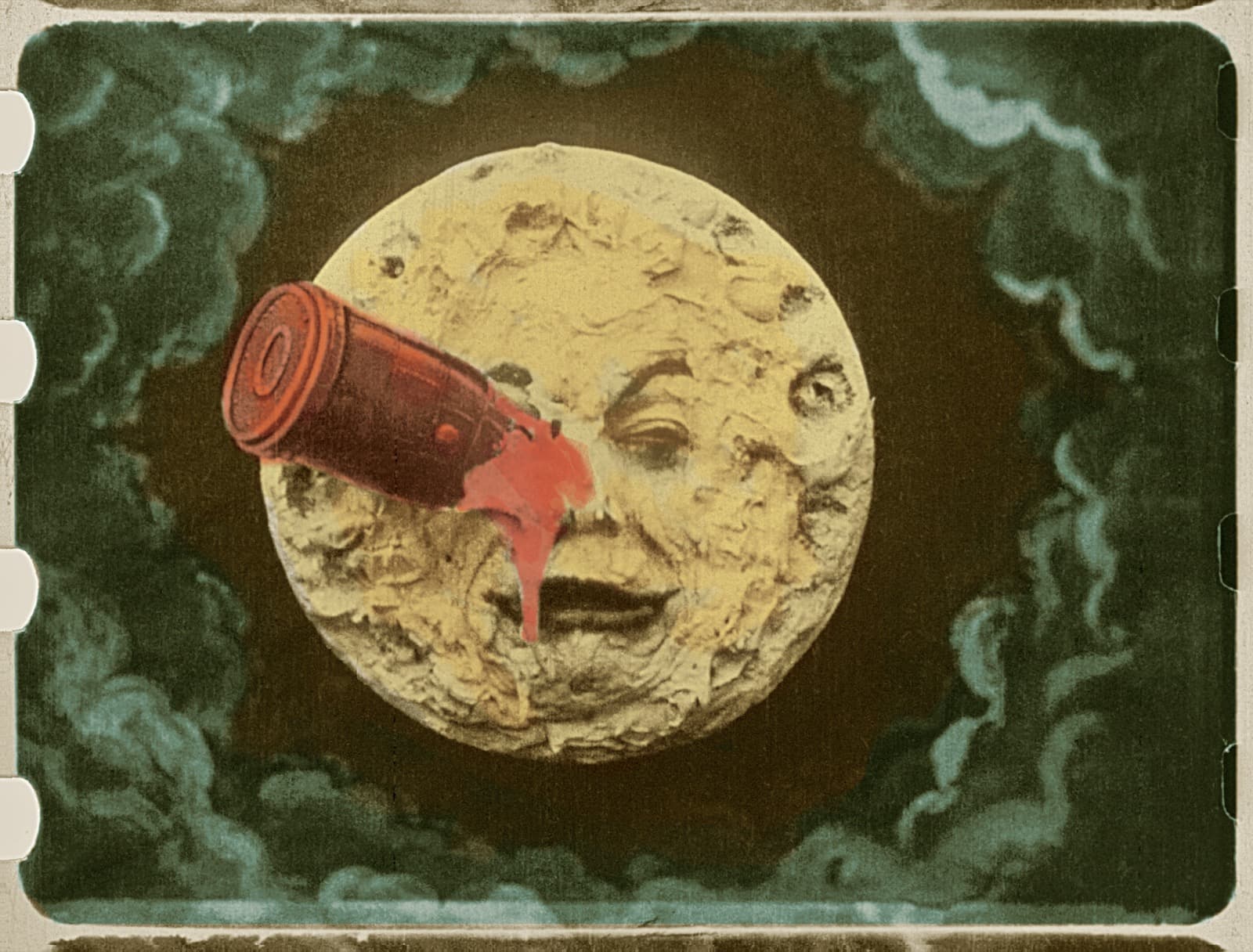
The rocket in the Moon's eye: Méliès's 1902 fantasy — astronomers in wizard hats, a capsule fired from a giant cannon, umbrella-wielding battles with lunar insect-men — is the first film in the world's shared imagination, and the proof, seven years into cinema's existence, that the camera could lie magnificently.
- 1902
- Silent film
About Georges Méliès
Watch the film
A magician buys a camera
Méliès was a stage conjurer — owner of the Théâtre Robert-Houdin — who attended the Lumière brothers' first public screening in December 1895 and offered to buy their machine on the spot. They refused, telling him the invention had no future. He built his own camera instead, discovered by accident that stopping and restarting the film could make a Paris omnibus turn into a hearse, and spent the next fifteen years inventing the special effect: substitution splices, multiple exposures, dissolves, hand-painted color.[1][2]
At Montreuil, east of Paris, he built France's first purpose-built film studio — a greenhouse of glass and iron the dimensions of his theater stage — and made some five hundred films in it for his company, Star Film. A Trip to the Moon was the most ambitious: three months and ten thousand francs, with acrobats from the Folies Bergère as the Selenites and Méliès himself leading the expedition as Professor Barbenfouillis.[1][3]
One image from it belongs to everyone: the capsule striking the Man in the Moon square in his custard-pie face. It may be the single most reproduced frame in the history of the medium.
What happens in the thirty tableaux
At a meeting of the Astronomers' Club, Professor Barbenfouillis proposes an expedition; after a noisy dispute — telescopes become stools, an umbrella becomes a weapon of debate — five colleagues agree to go. Workers cast a hollow, bullet-shaped capsule; a chorus line in sailor suits loads it into a colossal cannon; the shot fires. Then the landing, which Méliès shows twice: first symbolically, the Moon's face swelling toward the audience until the capsule puts out its eye, and then again, matter-of-factly, on the lunar plain. Continuity mattered less than pleasure — cinema was already learning that an event could repeat from a new angle because each image says something different.[4]
The astronomers watch the Earth rise, sleep under a snowfall, and descend into a crater of giant mushrooms, where they meet the Selenites — acrobats who burst into smoke when struck with an umbrella. Captured, hauled before the lunar king, the explorers fight free, tip their capsule off a cliff, and fall home into the sea. A parade follows: medals, a statue of Barbenfouillis, and a captive Selenite exhibited to the crowd.[4]
Which is the film's sly second face. The explorers arrive uninvited, attack the first inhabitants they meet, and return to be celebrated — caricatures of European conquest from a director who had drawn political cartoons. The ending plays as slapstick and reads, a century on, as satire: a dream of discovery that is also a joke about empire.
How the tricks were done
The machinery is visible everywhere, and the visibility is the charm. Selenites explode by substitution splice — stop the camera, swap the acrobat for a puff of smoke, resume. The Moon approaches not because the heavy camera moved but because the performer playing the Moon was pulled toward it on a concealed ramp. Around these camera tricks stands a complete theater: painted flats, trapdoors, pyrotechnics, costumes, and stage machinery, photographed from the honest position of a spectator in the stalls.[3]
The film also corrects the myth of the solitary magician it helped create. Méliès was the organizing imagination — director, designer, performer, editor, distributor — but the fantasy was manufactured by camera operators Théophile Michault and Lucien Tainguy, by dancers and acrobats, by scene painters and costume workers and, for the color prints, by a workshop of professional colorists. The auteur, before the word existed, ran a factory of enchantment.[3][5]
Verne, Wells, and the collage
Méliès later named Jules Verne's From the Earth to the Moon and its sequel as inspirations, and the cannon-launched projectile is pure Verne. The underground lunar kingdom owes at least as much to H. G. Wells's The First Men in the Moon, published the year before; Offenbach's 1875 stage féerie Le Voyage dans la Lune and a generation of fairground Moon attractions had already made lunar travel a popular entertainment. The film adapts none of them faithfully. It is a collage of everything the nineteenth century had imagined about the Moon, reassembled by a conjurer who cared less about science than about what a trick could make an audience feel.[2][4]
Painted by hand
The film was photographed in black and white, but Méliès sold deluxe prints in color — painted frame by frame in the Paris workshop of Élisabeth Thuillier and her daughter Marie-Berthe, where teams of women applied aniline dyes with brushes, often one color per worker, through thousands of frames. The result was not color photography but painting applied to photography: the lunar world in yellows, blues, pinks, and greens, each print a manufactured art object. The hero image above is one of those frames — the Moon's wound in actual red.[5]
A success he could not keep
A Trip to the Moon was a worldwide hit, and in the United States a largely unpaid one: Edison's agents and rivals like Lubin duplicated prints and sold copies as their own, fortunes that never reached Montreuil. Méliès answered by sending his brother Gaston to open an American branch of Star Film in 1903 — an early lesson in how much faster an image crosses borders than the ownership of it. The Moon with the capsule in its eye became, in effect, cinema's first meme: endlessly copied, detached from its source, more famous than most of the people who made it.[1]
The industry that eventually outgrew the magician belonged to the integrated studios — Pathé, and Gaumont, where Louis Feuillade's serials, Les Vampires above all, ruled the wartime screens that Méliès's théâtre-fantasy never reached.
By 1913 Star Film was finished. In 1923, bankrupt, Méliès burned his stock of negatives in the Montreuil garden.[1]
Ruin at Montparnasse
Then the strangest scene in his filmography, unstaged: the wizard of Montreuil spent his last working years selling toys and sweets from a small stand in the concourse of the Gare Montparnasse. A journalist recognized him there in the late 1920s; the rediscovery led to a gala tribute at the Salle Pleyel in 1929, the Légion d'honneur in 1931 — pinned on by Louis Lumière, who had once told him film had no future — and a retirement flat at last. He died in 1938 and lies in Père-Lachaise Cemetery, where our walking route passes his grave.[1]
The Moon's eye, forever
A hand-colored print — believed lost for most of a century — surfaced in Barcelona in 1993 in a state close to solid decay. Restorers separated and digitized 13,375 image fragments over the better part of two decades, and the color version premiered at Cannes in 2011 with a new score by the French band Air, who expanded it into an album the following year. The film that invented cinematic fantasy now circulates in the version its richest first audiences actually saw: a dream with the paint still wet.[6]
The images never needed the restoration to survive. Queen wove Méliès footage through the 1995 video for Heaven for Everyone; a year later the Smashing Pumpkins' Tonight, Tonight rebuilt his whole visual language — painted skies, umbrella battles, a rescue ship named the S.S. Méliès — and swept the MTV Video Music Awards; Martin Scorsese's Hugo (2011) put the toy stand, the burned negatives, and the glass studio itself before a new generation, with the Moon's eye as its emblem. Cinema's handmade-enchantment lineage runs straight from Montreuil to Jean Cocteau — whose Beauty and the Beast worked its miracles the same way, in the camera, by hand — and on to every effects film since.
The screen not as a window, but as a box of tricks.
Timeline
1895
Méliès attends the Lumière brothers' first public program in December and offers to buy their camera; refused, he builds his own.
1897
The glass studio rises at Montreuil — France's first purpose-built film studio, sized to the stage of the Théâtre Robert-Houdin.
Inside the glass studio at Montreuil — France's first purpose-built film studio, a greenhouse sized to a theater stage, with scenery painted flat on the floor and the prop stock of five hundred films on the walls. 1902
Released by Star Film as catalog nos. 399–411, 'a grand spectacle in thirty tableaux' — three months' work and ten thousand francs.
Loading the capsule: the chorus line in sailor suits pushes the shell into the cannon's breech, a marine officer presiding, painted rooftops below — the launch as music-hall number. 1902–03
Pirated across the United States by Edison's agents and others; Gaston Méliès opens Star Film's American branch to fight the copying — the star trademark on the title card was part of the defense.
The title card, with the Star Film trademark and 'Geo Méliès, Paris' — branding stamped onto the film itself, part of Méliès's losing war against the pirates duplicating his prints abroad. 1913
Star Film collapses as the industrial studios outgrow the magician.
1923
Bankrupt, Méliès burns his stock of negatives in the Montreuil garden.
1929
Rediscovered at his Gare Montparnasse toy stand, he is honored with a gala at the Salle Pleyel.
1931
The Légion d'honneur, presented by Louis Lumière.
1938
Méliès dies in Paris and is buried at Père-Lachaise, division 64.
1993
A hand-colored nitrate print surfaces in Barcelona, decayed nearly solid.
2011
The restored color version — 13,375 reassembled fragments — premieres at Cannes with a new score by Air.
The finale, in hand-painted color: a statue of Barbenfouillis bestriding the wounded Moon, chorus line at attention — conquest congratulating itself, which is the film's last joke.
Frequently asked questions
Who made A Trip to the Moon?
Georges Méliès, a Paris stage magician turned filmmaker, who wrote, produced, directed and starred in it — as Professor Barbenfouillis — and released it through his Star Film company in 1902.
What happens in the film?
A party of astronomers is fired to the Moon in a capsule shot from a giant cannon, fights off the insect-like Selenites with umbrellas, and escapes back to Earth. It runs about fourteen minutes, staged as thirty tableaux.
What is that famous image of the rocket in the Moon's eye?
It is the capsule landing in the eye of the Man in the Moon — one of the most recognized single shots in film history, and the image most people picture when they think of early cinema.
How were the special effects done?
With stage-magic techniques adapted to film: substitution splices (stopping the camera to swap or vanish something), dissolves, painted scenery and theatrical machinery, shot in Méliès's glass studio at Montreuil.
Was it originally in color?
Yes — a version was hand-colored frame by frame by the Thuillier workshop in Paris. A decayed hand-colored print found in Barcelona in 1993 was reconstructed from over thirteen thousand fragments and premiered in restored color at Cannes in 2011.
What happened to Georges Méliès afterward?
Star Film collapsed in 1913 and, bankrupt, he burned his negatives in 1923. He was found running a toy stand at the Gare Montparnasse before a 1929 gala and the Légion d'honneur revived his reputation; he died in 1938.
Related videos
The Smashing Pumpkins — Tonight, Tonight (1996)
Queen — Heaven for Everyone (1995)
Hugo — official trailer (2011)
Air — Seven Stars (2012)
In the atlas
If you like Georges Méliès
Explore directors from the same movements and circles.

John Cassavetes
The American actor and filmmaker who financed personal films outside the studio system and built them around the difficult, unfinished behavior of people in families and relationships.
View artist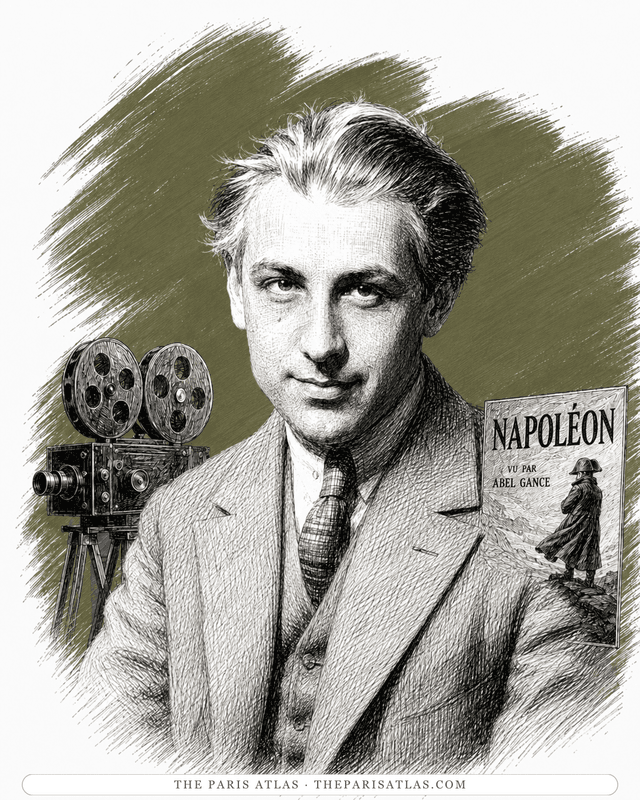
Abel Gance
French cinema's great maximalist — J'accuse raised the dead of the war, and Napoléon strapped cameras to horses and split the screen in three before the talkies arrived.
View artist
John Huston
American film director who trained as a painter, filmed the life of Henri de Toulouse-Lautrec in Moulin Rouge, and won two Academy Awards for The Treasure of the Sierra Madre.
View artist
In images
References
References
The sources below include collection records, catalogues, scholarly research, and primary materials that informed this page. They document A Trip to the Moon, its making, and its place in cultural history.


6↑Festival de Cannes — Cannes Classics 2011 (the restored color Voyage dans la Lune)
WebsiteUsed forWeb source consulted for documented facts and historical context presented on the A Trip to the Moon page.
i
Why these sources are here
These references provide the documented foundation for this work's history and interpretation. Claim-level citations remain attached to the specific claims they support.
 Explore more resources