Film
Beauty and the Beast
by Jean Cocteau
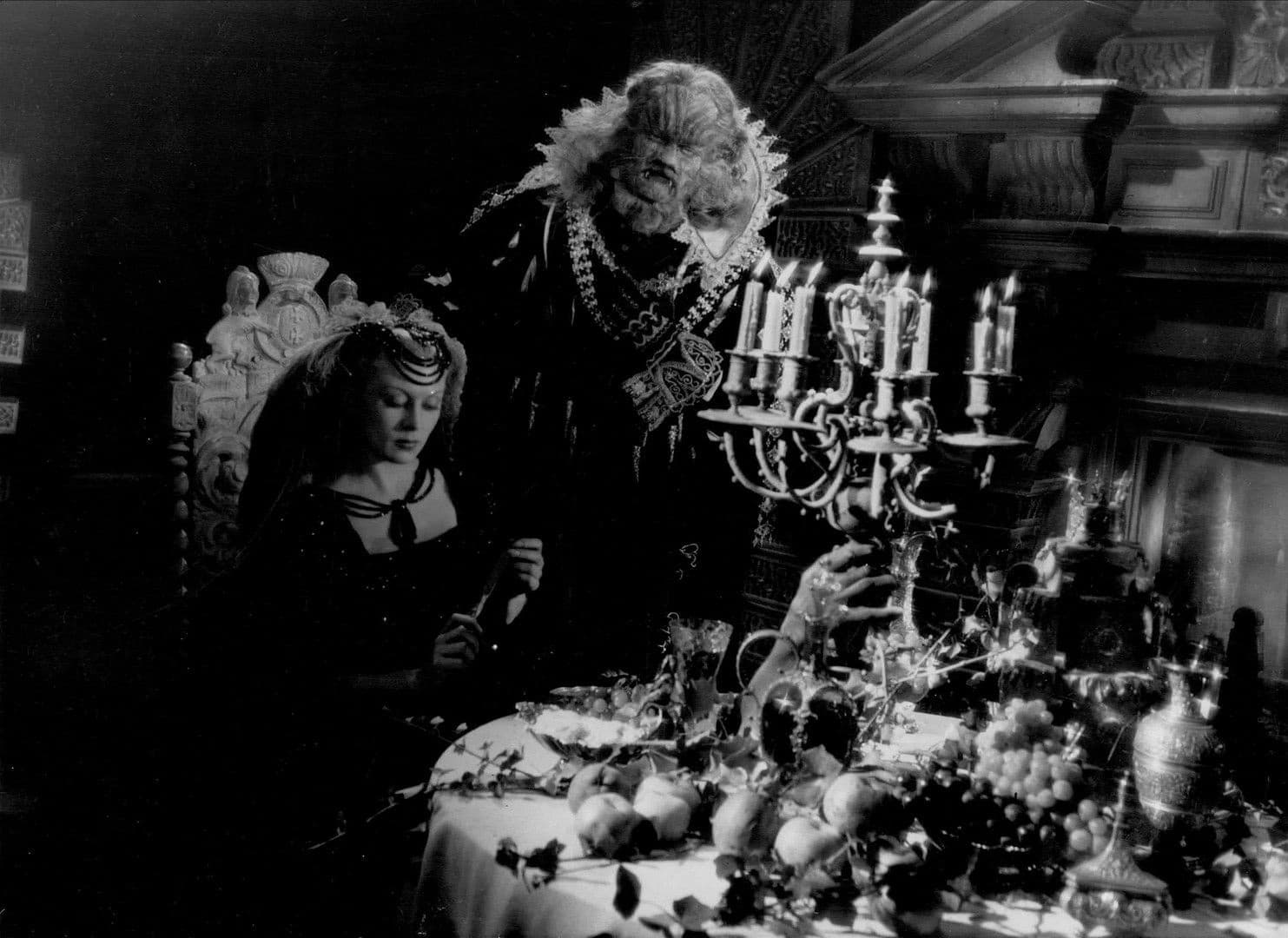
Cocteau's fairy tale, made in the deprivations just after the Occupation: living caryatids, smoking candelabra held by human arms, and Jean Marais under the Beast's fur. The most beloved of his films — 'once upon a time' rendered with an avant-gardist's conviction that enchantment is a technique.
- 1946
- Feature film
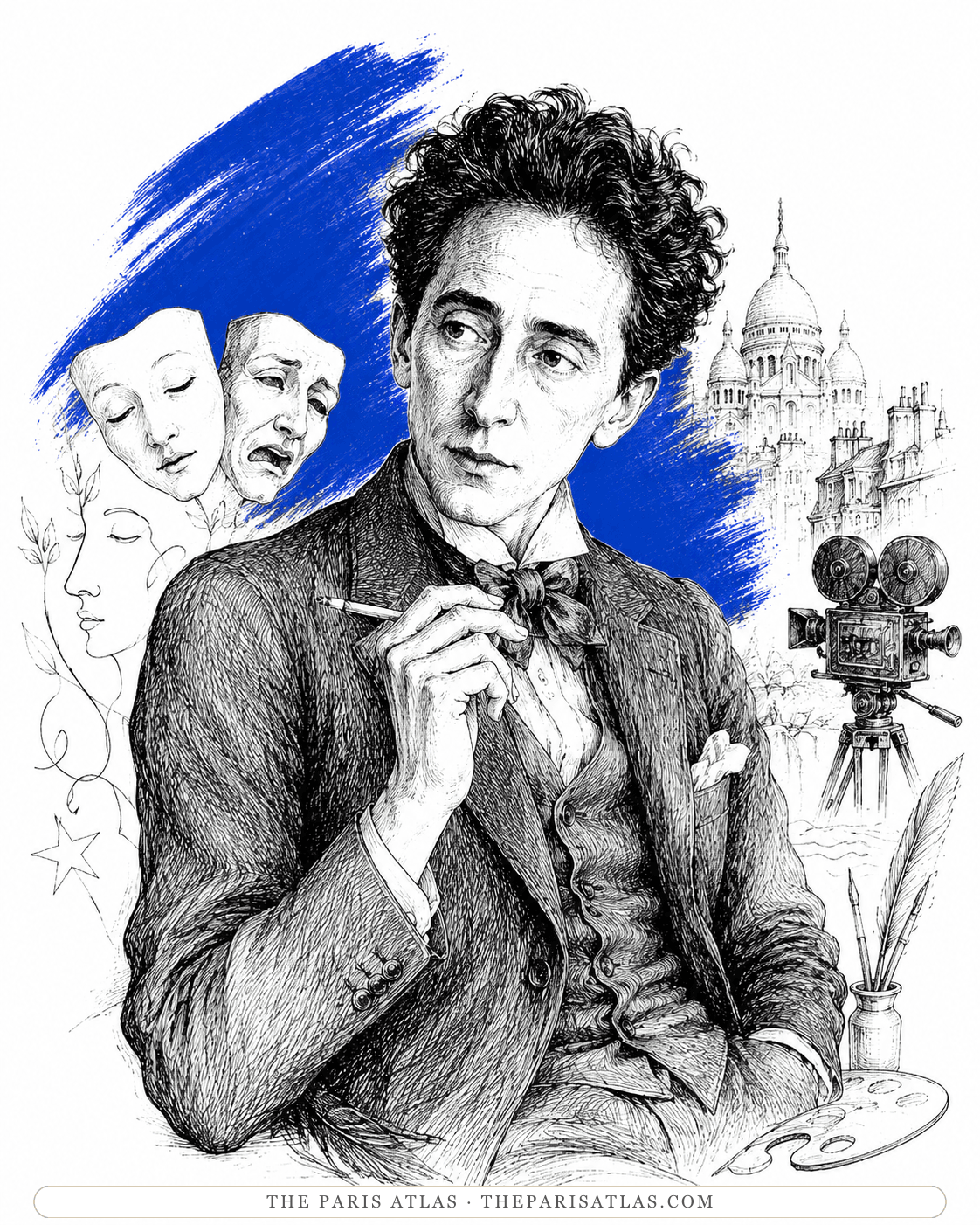
About Jean Cocteau
The film
A ruined merchant picks a rose from the wrong garden, and his youngest daughter goes to the Beast's castle to pay for it. From that oldest of bargains Cocteau made the defining fairy-tale film: Belle serene among wonders, the Beast smoking with shame after the hunt, and a castle that watches its guests — corridors lined with living candelabra, caryatids whose eyes follow, doors that open on their own authority.
What distinguishes Cocteau's version is its refusal to wink. The film opens by asking the audience for a child's faith, then earns it with technique: everything on screen was done in the camera, by hand, with light. Enchantment, the film insists, is a craft like carpentry.
It remains the most beloved of Cocteau's films, and the one through which most of the world first meets him.
The story
Belle keeps house for her merchant father, two vain sisters, and a reckless brother. The brother's friend Avenant wants to marry her; she refuses him. When her father loses his fortune and takes the wrong road home, he shelters in a château where the doors open themselves and dinner appears without a host. He picks a rose from the garden for Belle. The Beast appears and offers the classic sentence: die for the theft, or send a daughter in your place.
Belle goes. The Beast treats her as the mistress of the house, and every evening he asks the same question: will she marry him? Every evening she says no. But the ritual softens — fear turns to curiosity, disgust to pity, pity to something neither can name. When a magic mirror shows her father ill, the Beast lets her go home for a week, trusting her with the glove that carries its wearer anywhere and the golden key to the pavilion that holds his treasure. If she does not come back, he tells her, he will die.
Her sisters delay her. Avenant and her brother ride off to rob the pavilion. Belle returns by the glove and finds the Beast dying beside the water — and the ending arrives as a crossing: an arrow from the pavilion's statue strikes Avenant, who falls wearing the Beast's face, while the Beast rises transformed into a prince wearing Avenant's.
1945–1946
Enchantment after the Occupation
The film was shot in the year after the Liberation, in a France short of everything a film needs. Film stock was rationed and inconsistent, electricity failed mid-take, costume fabric was scrounged, and Cocteau — a poet directing his first narrative feature at fifty-six — was ill through much of the shoot. He kept a production diary, published in 1946 as La Belle et la Bête: journal d'un film, and it turned the film's troubles into literature of its own.
The production moved between the Saint-Maurice and Épinay studios, the manor country of the Touraine for Belle's farmhouse, and the park of the Château de Raray in the Oise for the Beast's domain.
Raray needed almost no dressing. Its sculpted hunting balustrades already looked like the film Cocteau intended to make — court ritual and animal life carved into the same stone. One of the poorest years in French production ended up yielding its most opulent-looking film.
How the magic was made
Cocteau favored tricks that could be performed in front of the lens, or made by running the film itself differently. The famous effects are almost all sleights of the simplest kind:
- The living candelabra — real human arms through concealed openings in the walls, their owners hidden behind the set.
- Candles that light themselves — the crew blew them out, and the film ran backward.
- Belle's floating entrance — a wheeled platform, slow motion, and curtains doing the rest.
- The magic glove — an edit, nothing more: a gesture in one place completed in another.
- The mirror — Cocteau's signature threshold, a surface that opens instead of reflecting, fifteen years after The Blood of a Poet and four before Orphée.
- The Beast's smoking hands — smoke rising from his fingers after a kill: appetite made visible as guilt.
Henri Alekan lit the farmhouse like Dutch genre painting and the castle like an engraving come to life. Cocteau described the look he wanted from Alekan in four words and a breeze:[1]
“Relief, contours, contrastes et quelque chose d'impondérable, comme un vent léger qui circule.”
Relief, contours, contrasts — and something imponderable, like a light wind moving through.
The Beast under the fur
Cocteau's brief for the creature was exact:[2]
“Faire un monstre, qui au lieu d'être épouvantable, soit séduisant, de cette séduction du monstre.”
A monster who, instead of being horrifying, seduces — with the monster's own kind of seduction. The makeup artist Hagop Arakélian built it as a three-part mask of fine tulle with animal and human hair implanted strand by strand: beard, wig, muzzle. It went on in five hours a day — three for the face, one for each clawed hand — and Marais, who could barely eat through the mouthpiece, lived on purées and compotes for the length of the shoot. His own dog, Moulouk, had suggested the fur.
Cocteau insisted Marais's clear human eyes stay visible inside the animal head. The performance lives there, and in posture, breath, and hands — an animal trying, painfully, to behave like a courtly man.[1]
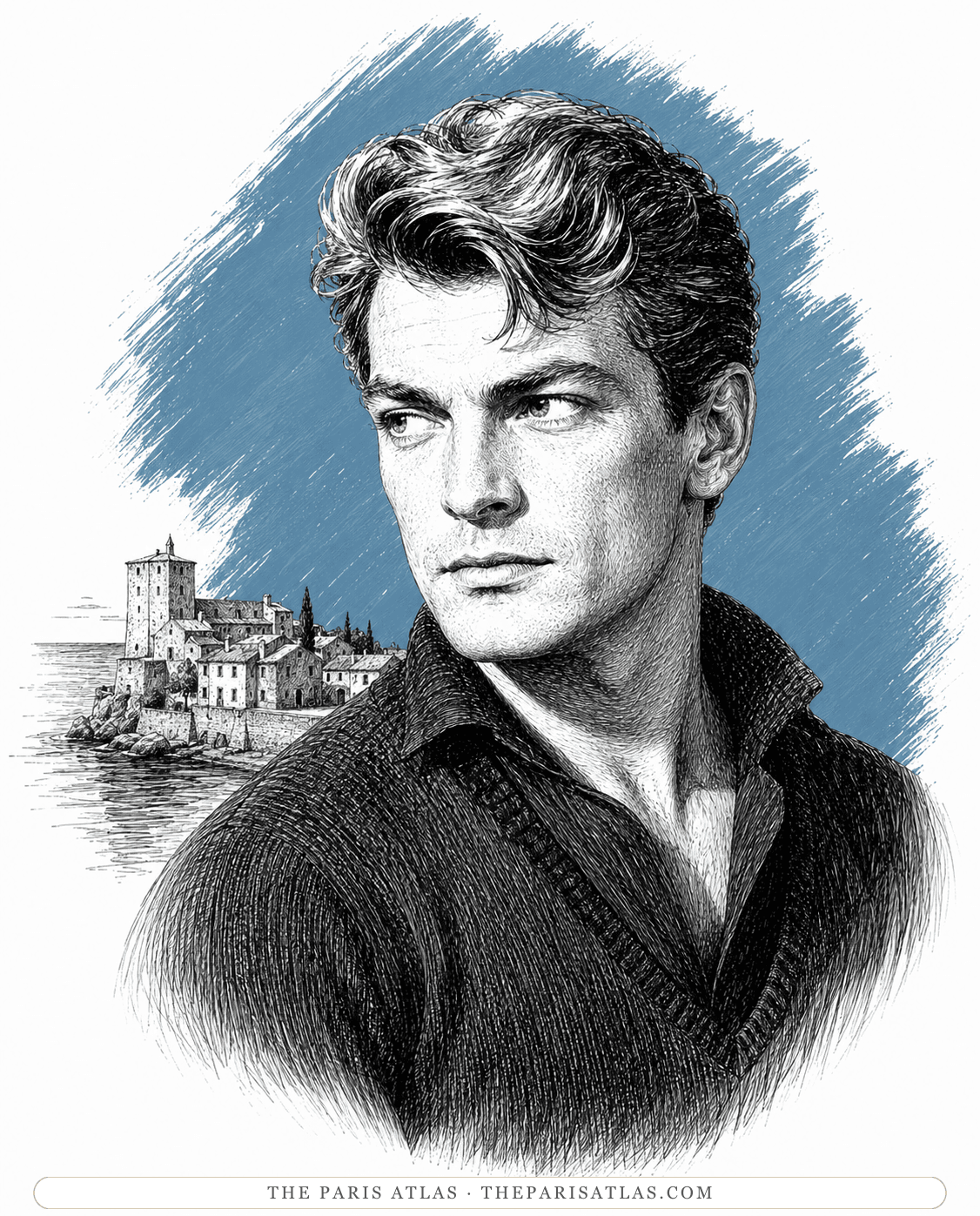
Three faces of Jean Marais
Marais plays all three men in Belle's life: Avenant, the handsome suitor she refuses; the Beast she learns to love; and Prince Ardent, the reward. The casting binds the film's ending into a knot no later adaptation has tried to tie. When the Beast rises transformed, he wears the face of the man Belle rejected — and she says so. The resemblance troubles her.[3]
The airborne finale gives the fairy tale its promised ending and leaves a crack running through it. Belle loved a being whose shame and gentleness had become specific to her; the prince is a stranger with a familiar face.
The happy ending arrives wearing the face she refused.
The triple casting also carries the film's off-screen history. Marais was Cocteau's collaborator, muse, and partner, and the film they made together keeps asking where monstrosity actually lives — in an animal face, in appetite, in social cruelty, or in the wish to possess another person. It never quite answers.[4]
Before Disney, and after
The tale came to Cocteau with two centuries of pictures already attached. Jeanne-Marie Leprince de Beaumont published the version he adapted in 1756; Walter Crane illustrated it in 1875; Gustave Doré's engravings and Vermeer's interiors shaped how the film's world was lit and furnished.
Disney's 1991 version arrives forty-five years later, and the household objects that sing in it descend from furniture that watches in this one. The two films share a tale, not a temperature: Disney's castle explains itself and moves toward affirmation; Cocteau's is intimate, erotic, and faintly funereal, and its arms hold their candles in silence.
The film's strangest afterlife belongs to Philip Glass, whose 1994 La Belle et la Bête removes the dialogue and Auric's score entirely and sets a sung opera in their place, performed live in synchronization with the projected film — the actors' mouths moving to new music. An adaptation of an adaptation, faithful to the film's own belief that transformation is the point. Gaumont-side restorers gave the film itself a second life too: the 2013 digital restoration premiered at Cannes Classics, sixty-seven years after the film competed there new.[5]
Within Cocteau's work it is the middle passage between mirrors: The Blood of a Poet opened the threshold in 1930, and Orphée would drive it into the underworld in 1950, with Marais again at the wheel.[3]
Timeline
1756
Jeanne-Marie Leprince de Beaumont publishes the compact moral version of the tale that Cocteau will adapt.
1875
Walter Crane's illustrated edition — the tale's two centuries of pictures continue, with a boar-tusked Beast in a tailored coat.
The tale before cinema: Walter Crane's Beast — tusked, tailored, courtly — from his 1875 illustrated edition. Beaumont's story spent two centuries in pictures before Cocteau gave it motion. 1930
Cocteau's The Blood of a Poet opens the mirror-threshold his cinema will keep crossing.
1944
Cocteau drafts the adaptation during the Occupation, adding Avenant and cutting the tale to its bones.
Aug 1945
Shooting begins, months after the war's end — rationed stock, failing electricity, and a director ill for much of it, keeping the journal.
Cocteau directing La Belle et la Bête, 1945 — ill through much of the shoot, keeping the journal that turned the production's troubles into a book of their own. 1946
The film competes at the first postwar Cannes festival and wins the Prix Louis-Delluc; the journal is published the same year.
Belle and her Beast at the studio: Josette Day and Jean Marais by Studio Harcourt, 1946 — the release-year portrait, all Harcourt gloss. 1947
New York sees it, and the film's international reputation begins.
1994
Philip Glass premieres his synchronized cinema-opera — the film with its voice replaced by singing.
2013
The digital restoration premieres at Cannes Classics, sixty-seven years after the original competition.
Frequently asked questions
Who made Beauty and the Beast?
Jean Cocteau wrote and directed it in 1946, adapting Jeanne-Marie Leprince de Beaumont's 1756 fairy tale.
Who starred in it?
Jean Marais played the Beast — and two other roles — with Josette Day as Belle.
What is it famous for?
Its handmade enchantment: living caryatids, candelabra held aloft by human arms reaching out of the walls, and a castle rendered with an avant-gardist's conviction that magic is a technique.
When and under what conditions was it made?
In 1946, in the deprivations just after the Occupation, when film stock and power were scarce.
How many roles does Jean Marais play?
Three — Avenant, the Beast, and Prince Ardent, the prince the Beast becomes.
Is it related to the Disney version?
It long predates Disney's animated film and is the most beloved of Cocteau's own films; both draw on the same eighteenth-century tale.
Related videos
La Belle et la Bête — trailer (BFI)
Mark Kermode reviews La Belle et la Bête — BFI
Philip Glass introduces La Belle et la Bête (2013)
In the atlas
More by Jean Cocteau
If you like Jean Cocteau
Explore directors from the same movements and circles.
Ingmar Bergman
Swedish director of The Seventh Seal, Persona and Fanny and Alexander, whose sixty films put questions of faith, death and marriage on screen. James Baldwin profiled him in Nobody Knows My Name.
View artist
Marguerite Duras
French novelist and screenwriter, later a director in her own right; her screenplay for Alain Resnais's Hiroshima mon amour (1959) carried the New Wave into literature and earned an Academy Award nomination.
View artist
Romain Gary
Novelist, diplomat, and the only writer to win the Prix Goncourt twice — once under his own name and once under a pseudonym. Jean Seberg's husband from 1962 to 1970.
View artist
In images
References
References
The sources below include collection records, catalogues, scholarly research, and primary materials that informed this page. They document Beauty and the Beast, its making, and its place in cultural history.


2↑La Belle et la Bête: journal d'un film
MemoirJean Cocteau, 1946Used forFirst-person evidence and historical context used in preparing the Beauty and the Beast page.
4↑La Cinémathèque française — Cocteau's production journal for La Belle et la Bête
WebsiteUsed forWeb source consulted for documented facts and historical context presented on the Beauty and the Beast page.
5↑Philip Glass — La Belle et la Bête (official work page)
WebsiteUsed forWeb source consulted for documented facts and historical context presented on the Beauty and the Beast page.
6Festival de Cannes — La Belle et la Bête, 1946 competition record
WebsiteUsed forWeb source consulted for documented facts and historical context presented on the Beauty and the Beast page.
7Festival de Cannes — Cannes Classics 2013: Beauty and the Beast, Jean Cocteau's most popular film
WebsiteUsed forWeb source consulted for documented facts and historical context presented on the Beauty and the Beast page.
8Film France — Château de Raray location record
WebsiteUsed forWeb source consulted for documented facts and historical context presented on the Beauty and the Beast page.
i
Why these sources are here
These references provide the documented foundation for this work's history and interpretation. Claim-level citations remain attached to the specific claims they support.
 Explore more resources