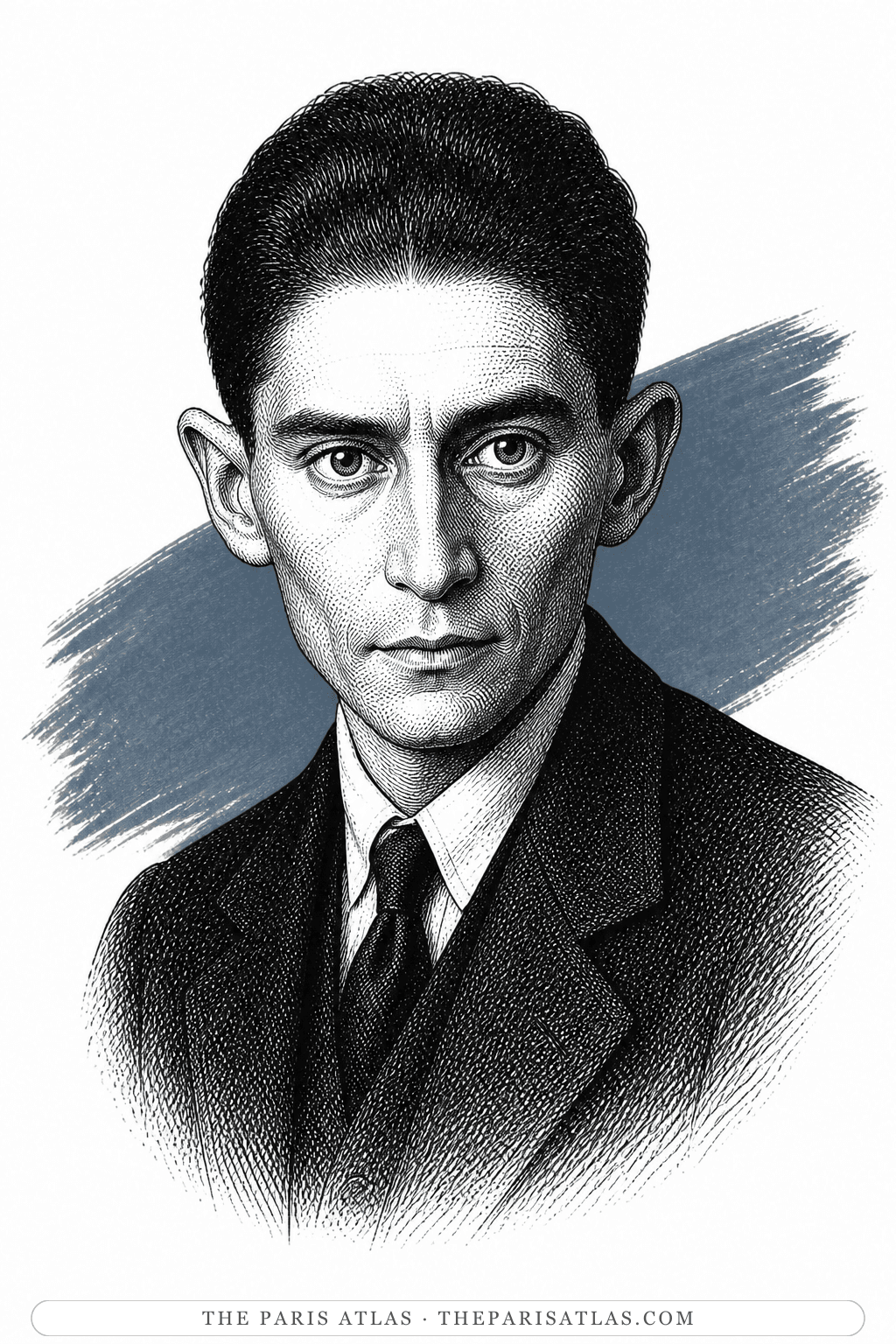


The Trial
Kafka’s earlier unfinished novel follows Josef K. through a prosecution whose charge he cannot discover.
Read our take
by Franz Kafka
A stranger seeks permission to belong, while every explanation makes his position harder to establish.
K. arrives in a snowbound village and presents himself as a land surveyor engaged by the castle authorities. Telephone messages, letters and personal introductions seem to promise recognition, but none gives him a secure position. Kafka’s unfinished novel follows his attempts to work, find shelter and reach an official named Klamm, while showing the strain those attempts place on the people around him.
Even sleeping in the village requires permission. When a young official challenges K. at the inn, a telephone inquiry first rejects his claim and then appears to confirm it. The change gives K. a reason to stay, but it does not establish terms that everyone accepts.
The village superintendent says there is no surveying work to do. He describes years of conflicting instructions and misplaced correspondence, then disputes the authority of K.’s letter. His long explanation turns a question about a job into a dispute over whether K. has been offered work at all.
Frieda, a barmaid who has been Klamm’s mistress, leaves her position to live with K. He talks of marriage but continues seeking an interview with Klamm. Her hope of a life together increasingly conflicts with his determination to gain a recognized place in the village.
K. tries to walk toward the castle, but the village road never brings him to its entrance. He is exhausted before his campaign has properly begun. Later, in the Herrenhof inn, Frieda lets him look through a peephole at Klamm, whom she says is asleep.
After Frieda leaves the Herrenhof with him, K. insists that he must speak to Klamm before their marriage. The Bridge Inn’s landlady warns him that he cannot expect such access. Her concern for Frieda comes with hostility toward a stranger whose assumptions she distrusts.
K. and Frieda end up living at the school, where he serves as janitor. He dismisses his intrusive assistants, Arthur and Jeremiah. Frieda asks him to leave the village with her, but he refuses. The prospect of staying matters more to him than escaping the struggle.
Frieda eventually returns to work at the Herrenhof and tells K. that they will not marry. She has gone there with Jeremiah, one of the dismissed assistants. K.’s explanations fail to repair their relationship, and she refuses him entry to her room.
Kafka left the manuscript unfinished, without resolving K.’s position. Max Brod later reported an unwritten plan in which permission to remain would arrive as K. was dying. That account belongs to Brod’s afterword, not to a concluding chapter Kafka actually wrote.
The telephone inquiry on K.'s first night first denies his position and then appears to confirm it. A message that seems to settle the matter instead becomes one more statement whose authority can be disputed. The superintendent later distinguishes between official arrangements and communications K. has treated as binding.
This uncertainty does not mean that nothing happens or that all officials secretly share a plan. K. receives messages, employment and explanations, but their meaning changes with the person interpreting them. The novel makes the effort to establish a dependable rule consume the time in which a life might otherwise be lived.
The superintendent's account of departmental correspondence supplies abundant detail about an administrative history. It does not give K. the simple answer he wants about his work. Explanation can acknowledge mistakes while dispersing responsibility so widely that no present person appears able to remedy them.
K. responds by insisting on rights rather than favors. That insistence is understandable, but it also commits him to obtaining recognition from the very system whose responses keep defeating him. The struggle persists partly because a different kind of life would require him to relinquish the terms on which he wants to be accepted.
Frieda's connection to Klamm makes her important to K.'s pursuit of the authorities. Her decision to leave her work with K. also contains a different possibility: a shared life whose value need not depend on that pursuit. The disagreement becomes explicit when she proposes leaving the village and he refuses.
The landlady's accusations, K.'s explanations and Frieda's changing judgment cannot simply be combined into an omniscient verdict about everyone's motives. Their competing accounts are the evidence the novel provides. Frieda's eventual refusal of marriage has force as her decision, even when K. continues trying to explain it through other people.
The castle can invite religious or political interpretations, but the narrative's local problems remain precise: permission to sleep, access to an employer, work, shelter and a damaged relationship. Treating every person as a fixed symbol can obscure the practical injuries through which authority is experienced.
Kafka did not write a concluding resolution. Brod's reported plan for K.'s belated permission to remain is an account of an unwritten ending, and the early Muir text consulted here also reflects omissions in Brod's edition. Neither should be mistaken for the complete surviving manuscript or used to declare the meaning of a final chapter Kafka never supplied.
The early Muir translation: chapters I, III–V, XIII and XVII–XVIII, plus Brod's afterword. Later restored manuscript passages are outside this reading.
The manuscript and publication history, including the omissions and subsequent editions.
I don’t want any act of favour from the Castle, but my rights.
I came here to stay. I’ll stay here.
K. treats Klamm’s letter as evidence of employment. The superintendent reads it as a private expression of interest. Their disagreement shows how much can depend on who is allowed to interpret a document.
Frieda wants his company and asks him to leave with her. Listening to her complaints makes the cost of his campaign visible within an intimate relationship.
The officials need rooms, food and sleep. An innkeeper decides where their clients can wait. Kafka makes large claims to power depend on small, inconvenient arrangements.
1922
Kafka works on the novel from January to August, leaving it unfinished.
1926
Kurt Wolff Verlag in Munich publishes Das Schloss, edited by Max Brod with an afterword. This edition omits passages and the final three manuscript chapters.
2024
Penguin Classics issues the selected US paperback on July 9, translated by J. A. Underwood, with introduction and notes by John Zilcosky.

Kafka’s earlier unfinished novel follows Josef K. through a prosecution whose charge he cannot discover.
Read our take
The story of Gregor Samsa makes work, family dependence and a suddenly disputed place at home painfully immediate.
Read our take
Kafka’s first novel follows a young migrant through a succession of employers and unstable offers of help.
Read our takeA stranger called K. tries to establish his right to work and stay in a village governed by distant castle officials. His pursuit of recognition becomes entangled with lodging, employment and his relationship with Frieda.
No. He worked on it in 1922 and left it unfinished. Brod’s later account of a proposed deathbed resolution must not be mistaken for a written ending.
It appeared in German as Das Schloss in 1926, published by Kurt Wolff Verlag in Munich after Kafka’s death. Max Brod edited it and supplied an afterword.
They are the protagonists of different novels. The Castle calls its stranger K. and centers on his claim to a surveying post. The Trial follows the prosecution of Josef K.
The novel does not identify its village and castle as Prague. Its opening describes a snowbound settlement and a shabby cluster of buildings above it. A biographical connection should not be treated as the story’s stated location.
The selected paperback is Penguin Classics’ 2024 US edition, translated by J. A. Underwood, ISBN 9780241678916, 352 pages. The guide’s quotations and chapter numbers use the earlier Muir translation, whose text omits later manuscript material.
Explore authors with a similar voice, perspective, and influence.
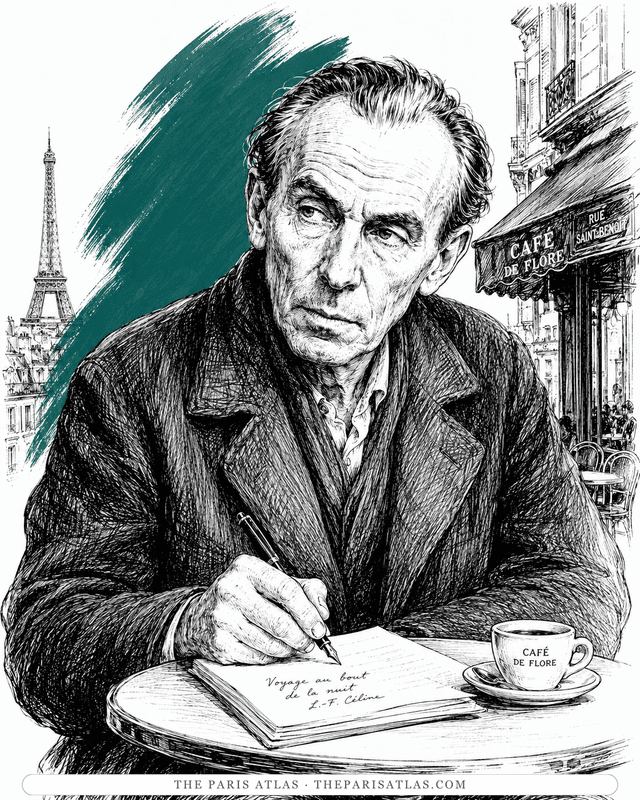
The doctor of the Paris slums who wrote the century's blackest, funniest novel — and changed the sound of French prose.
View author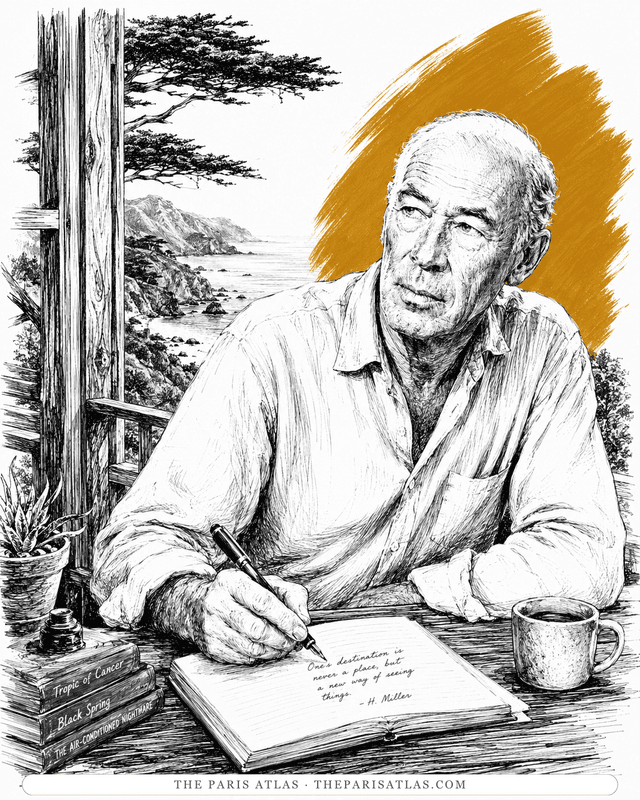
The Brooklyn dropout who arrived in Paris broke at thirty-eight and wrote the exuberant, banned books that ended American censorship.
View author
American novelist and composer whose expatriate fiction explores dislocation, unstable intimacy, fatalism, and North Africa.
View authorThe sources below include the primary text, editions, scholarship, archival materials, and other records that informed this page. They document The Castle, its publication, and its place in literary history.


The primary text represented by this page, used for descriptions of the work’s contents and for any quoted passages shown here.
Primary text for the described encounters, twelve character readings and two quotations. Selected chapters and continuous passages were read, not the whole novel. The colophon identifies the 1930 Muir translation; Brod explains omitted material and reports an unwritten ending.
Publisher’s Kafka bibliography establishes January–August 1922 composition, the 1926 Munich first edition, Brod’s editorial role and the omission of the final three manuscript chapters.
Publisher’s account distinguishes the unfinished manuscript, early omissions and later restored publications.
Publisher record verifies the selected paperback’s July 9, 2024 US date, 352 pages, ISBN, Underwood translation and Zilcosky introduction and notes. That translation and introduction were not consulted.
The primary text is the baseline reference for every book page. Additional references document publication history, interpretation, and historical context where that evidence is available.
 Explore more resources