

The Trial
Written in the same months of 1914. Josef K. is arrested and tried by a court that never tells him the charge, like the condemned man who never hears his sentence.
Read our takeIn the Penal Colony
Franz Kafka
by Franz Kafka
An officer shows a visiting traveler the machine that executes prisoners by writing the broken rule into their skin, and asks him to help save it.
Franz Kafka wrote In the Penal Colony in October 1914, while he was working on The Trial.[1][2] On an island penal colony, an officer shows a foreign traveler a machine that kills a condemned man over twelve hours. Its needles write the rule the man broke into his body.[3] The officer is the machine's last open defender, and the colony's new commandant wants to end its use. Kurt Wolff published the story in Leipzig in 1919, in a single printing of 1,000 copies.[3][1]
The story takes place in a small, deep, sandy valley shut in by bare slopes. Only four people are there. An officer runs the execution, and a traveler from abroad has come to watch. A condemned man stands in chains, and a soldier holds the end of the chain.[3] The traveler came only out of politeness, because the colony's commandant invited him (page 5).
The valley is hot. The officer has pushed two small ladies' handkerchiefs into the collar of his uniform. The traveler says the uniforms are too heavy for the tropics. The officer agrees, but says they stand for home, and the officers do not want to lose home (page 7).[3]
The machine has three parts. The prisoner lies face down on the Bed. Above him hangs the Harrow, named after the spiked frame a farmer drags over a field. At the top is a box the officer calls the Designer, which holds the gears (page 9). The Harrow is made of glass so that anyone can watch it work. Long needles do the writing, and short ones spray water to wash the blood away (page 22).[3]
The condemned man does not know his sentence. He does not even know he has been sentenced, and he had no chance to defend himself. A captain complained about him that morning. The officer wrote down the complaint and then the sentence, without hearing the man at all (pages 16 to 20).[3]
The officer explains all of this in French. Neither the soldier nor the prisoner understands French. The prisoner still tries to follow, and keeps looking wherever the officer points (pages 10 and 11).[3]
An officer shows a visiting traveler the execution machine in a penal colony. The machine was invented by the colony's old commandant, who has since died. The officer worked on it from the first experiments and still uses the old commandant's drawings to set its gears (pages 8, 9 and 25).
The condemned man is a soldier who served as a captain's orderly. His duty was to get up at every hour and salute at the captain's door. He fell asleep. When the captain whipped him across the face, he grabbed the captain's legs and shouted, "Throw the whip away, or I'll eat you" (pages 18 and 19). The machine is to write "Honor your superior!" on his body (page 16).
The officer describes the twelve hours in detail. After six hours, he says, the prisoner stops eating and grows quiet. He begins to read the writing with his wounds, and his face changes (pages 26 to 28). Then the man is stripped and strapped down. A strap breaks, and the prisoner is sick all over the machine. The officer blames the new commandant, who now controls the money for spare parts (pages 29 to 34).
The officer then admits the machine has no open supporters left. He remembers execution days when the whole valley filled with spectators (pages 35 to 38). He believes the new commandant invited the traveler so that a foreigner's criticism would give him an excuse to end the machine. He begs the traveler to speak for it at the next day's meeting of officials (pages 40 to 50). The traveler says no. He will tell the commandant privately that he opposes the procedure, and then he will leave (pages 50 to 52).
The officer says, "Then it's time." He frees the condemned man. He chooses a drawing that reads "Be just!" and sets it in the machine. Then he takes off his uniform, breaks his sword and lies down under the Harrow himself. The condemned man and the soldier strap him in (pages 52 to 60).
The machine runs silently. Then the Designer opens and its gears roll out one by one onto the sand. The Harrow does not write. The needles only stab, and the traveler sees that this is plain murder. The officer dies impaled on the needles. His face shows no sign of the promised redemption. The point of the great iron spike goes through his forehead (pages 61 to 65).
The soldier takes the traveler to the teahouse, where the old commandant lies buried under a table. The gravestone promises that he will rise again and retake the colony. The traveler goes down to the harbor. When the soldier and the condemned man try to jump into his boat, he keeps them off with a heavy knotted rope (pages 65 to 69).
Kafka wrote the story between 5 and 18 October 1914. He had begun The Trial that August, soon after the First World War broke out. His German publisher S. Fischer calls the story an offshoot of the novel. In both, a court ignores the defense, and announcing the sentence is the same act as carrying it out.
The same account points to two things Kafka saw around him. His job at the Workers' Accident Insurance Institute in Prague had made him familiar with pictures of injured bodies. In the autumn of 1914, the first eyewitness reports of a mechanized war were also reaching Prague. No manuscript of the story survives.
On the evening of 10 November 1916, Kafka read the still unpublished story at the Galerie Hans Goltz in Munich. He also read some poems by his friend Max Brod. There were at most fifty listeners. Felice Bauer, his fiancée, came from Berlin for it, and the poet Rainer Maria Rilke was very probably there. The Munich evening was the only public reading Kafka ever gave outside Prague.
A famous story says that listeners fainted. The story comes from the writer Max Pulver, who was in the audience. His account, first published in 1953, says three people passed out and others left before the end.
S. Fischer's Kafka site treats that account as a fantasy. Three newspaper reviews of the evening are known, and they mention only vague unease in the audience. Max Brod later wrote that Kafka told him about the reading in detail and never mentioned anyone fainting.
Kafka knew the story could provoke the censors, and he chose to read it anyway. According to S. Fischer, he told himself that the work was innocent at heart.
The story waited almost five years to be printed. Kurt Wolff Verlag issued it as the fourth title in a new series called Drugulin-Drucke, after the Leipzig printing house W. Drugulin, which printed the books. The colophon says the book was printed in May 1919, in a single edition of 1,000 copies. S. Fischer dates its publication to October 1919.
Kurt Wolff told Kafka the story made a painful impression on him. S. Fischer quotes Kafka's answer. Rendered in English, Kafka said that "not only is it painful, but our general time and my particular time were and are very painful too, and mine has been painful for even longer than the general one."
Kurt Tucholsky reviewed the book in Die Weltbühne on 3 June 1920, under his pen name Peter Panter. He called it a masterpiece and compared it with Heinrich von Kleist's novella Michael Kohlhaas. At the scene of the felt gag and the writing needles, he wrote, he swallowed a faint taste of blood. Near the end he told readers not to ask what the story meant, because it did not mean anything. His last line compared it with Kleist once more.
Kafka had been to Paris twice before he wrote the story. He went with Max Brod and Otto Brod in October 1910, and with Max Brod again in August and September 1911. The story itself never names a place. Its colony is an island, the traveler comes from Europe, and the officer speaks French to him.
Kafka's biographer Reiner Stach sets the story beside a Paris novel. Octave Mirbeau's Le Jardin des supplices, published in English as The Torture Garden, came out in Paris in 1899 from Charpentier and Fasquelle. In Reiner Stach's reading, Mirbeau keeps his horrors at an exotic distance, while Kafka turns his readers into witnesses too.
The BnF catalogue records three early French translations. Jean Carrive's version, Au bagne, appeared in Marseille in 1939. Jean Starobinski's La Colonie pénitentiaire followed in 1945, published jointly in Fribourg and in Paris. Gallimard in Paris published Alexandre Vialatte's translation in 1948. Gallimard put it into its Folio paperback series in 1972.
The story has also been staged in Paris. Joanna Bruzdowicz's opera La Colonie pénitentiaire, with a libretto by Antoine Golea, was revived there on 28 April 1979. Matthias Langhoff's version, Île du salut, opened at the Théâtre de la Ville on 8 October 1996.
Guilt is always beyond doubt.Die Schuld ist immer zweifellos.
There would be no point in announcing it to him. He learns it on his body.Es wäre nutzlos, es ihm zu verkünden. Er erfährt es ja auf seinem Leib.
Honor your superior!Ehre deinen Vorgesetzten!
The officer explains his machine part by part, from the cotton wool on the Bed to the water that washes the blood away. Kafka makes the explanation so exact that the reader, like the traveler, starts to follow it with interest.
The traveler thinks it is risky to meddle in another country's affairs. He is also sure the procedure is unjust. Watching him decide what to say, and to whom, is the story's real suspense.
Kafka wrote the story in October 1914, in the middle of work on The Trial. Both books imagine a court that never hears the accused, and each helps explain the other.
Kurt Tucholsky, reviewing it in 1920, tried reading it as an allegory and as an attack on military courts, and gave up both. He told readers the story did not mean anything at all.
A European visitor, invited by the new commandant to watch the execution. He travels to see things, he says, not to change other countries' courts.
The colony's judge and the machine's keeper. He worked on the machine with the old commandant and is now its last open defender.
A soldier sentenced to death for disobeying and insulting the captain he served. He knows nothing of his sentence and speaks no French.
The guard who holds the condemned man's chain. He understands no French and does what the officer tells him.
The colony's dead founder, who invented the machine. He never appears, but everyone in the story lives in his shadow.
1914
Franz Kafka writes the story between 5 and 18 October, while he is working on The Trial.
1916
On 10 November Kafka reads the unpublished story at the Galerie Hans Goltz in Munich. The evening is his only public reading outside Prague.
1919
Kurt Wolff Verlag in Leipzig publishes In der Strafkolonie as a Drugulin-Druck, printed in May in a single edition of 1,000 copies. S. Fischer dates publication to October.
1920
On 3 June Kurt Tucholsky, writing as Peter Panter, reviews the book in Die Weltbühne and compares it with Heinrich von Kleist's Michael Kohlhaas.
1939
Jean Carrive's French translation, Au bagne, is published by Les Cahiers du Sud in Marseille.
1945
Jean Starobinski's French translation, La Colonie pénitentiaire, is published in Fribourg and in Paris.
1948
Schocken Books in New York publishes Willa and Edwin Muir's English translation in The Penal Colony: Stories and Short Pieces. Gallimard in Paris publishes Alexandre Vialatte's French translation.
1953
Max Pulver's memoir of the Munich reading is first published. His account is the source of the story that listeners fainted.
1996
Matthias Langhoff's stage version, Île du salut, opens at the Théâtre de la Ville in Paris on 8 October.
2000
Philip Glass's chamber opera In the Penal Colony, with a libretto by Rudolph Wurlitzer, premieres at A Contemporary Theatre in Seattle on 31 August.


Written in the same months of 1914. Josef K. is arrested and tried by a court that never tells him the charge, like the condemned man who never hears his sentence.
Read our take
Kafka's best-known story, written two years earlier. Both stories share the flat, exact telling of something terrible happening to a body.
Read our take
A stranger arrives from outside and tries to deal with an authority whose rules he cannot read, much as the traveler cannot read the old commandant's drawings.
Read our take
Kafka's first novel, about a young man in a foreign country who keeps being judged by employers and officials without a fair hearing.
Read our takeAn officer in an island penal colony shows a visiting traveler a machine that executes prisoners over twelve hours by writing the broken rule into their skin with needles. The officer is the machine's last defender and asks the traveler to help him save it.
"Honor your superior!" The man was a captain's orderly who fell asleep on duty and then threatened the captain. The officer explains that the prisoner is never told his sentence, because he learns it on his body.
He wrote it between 5 and 18 October 1914, during his work on The Trial. Kurt Wolff Verlag in Leipzig published it as a small book in 1919, printed in a single edition of 1,000 copies.
Probably not. Kafka read it at the Galerie Hans Goltz on 10 November 1916. The fainting story comes from Max Pulver's memoir, first published in 1953. The newspaper reviews mention only unease, and Max Brod said Kafka never spoke of anyone fainting.
Kafka never says. The officer calls it an island, the valley is hot enough for the traveler to talk about the tropics, and the traveler comes from Europe. The country that owns the colony is never named.
Only an indirect one. Kafka had visited Paris in 1910 and 1911, and the officer speaks French in the story. Reiner Stach's biography compares it with Octave Mirbeau's Paris novel The Torture Garden, and Gallimard in Paris published Alexandre Vialatte's French translation in 1948.
The Harrow is the part of the machine that does the writing. A harrow is a spiked frame dragged over a field to break up the soil. Kafka's Harrow is made of glass and hangs over the prisoner, with long needles that write and short ones that spray water.
Schocken's The Complete Stories, edited by Nahum N. Glatzer, which prints Willa and Edwin Muir's translation. The guide's quotations are new English renderings of Kafka's German, with the German printed alongside.
Explore authors with a similar voice, perspective, and influence.
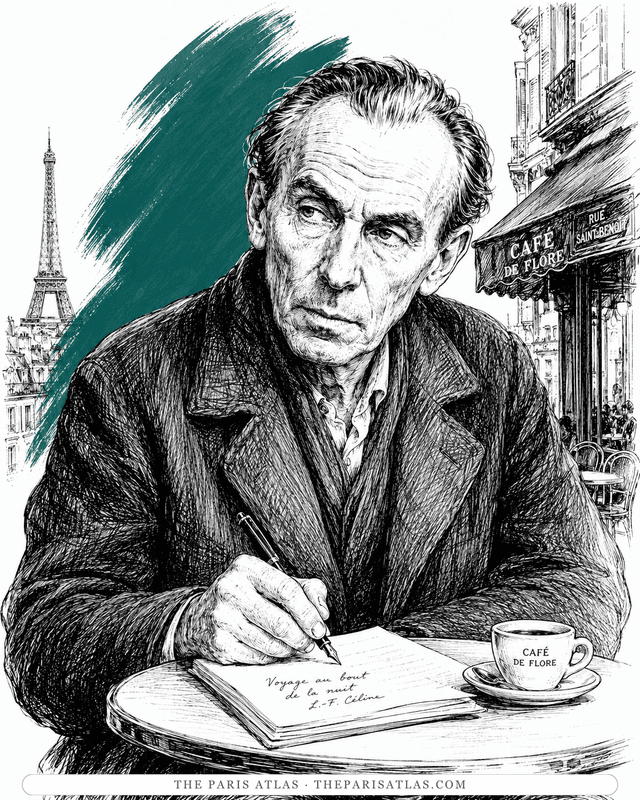
The doctor of the Paris slums who wrote the century's blackest, funniest novel — and changed the sound of French prose.
View author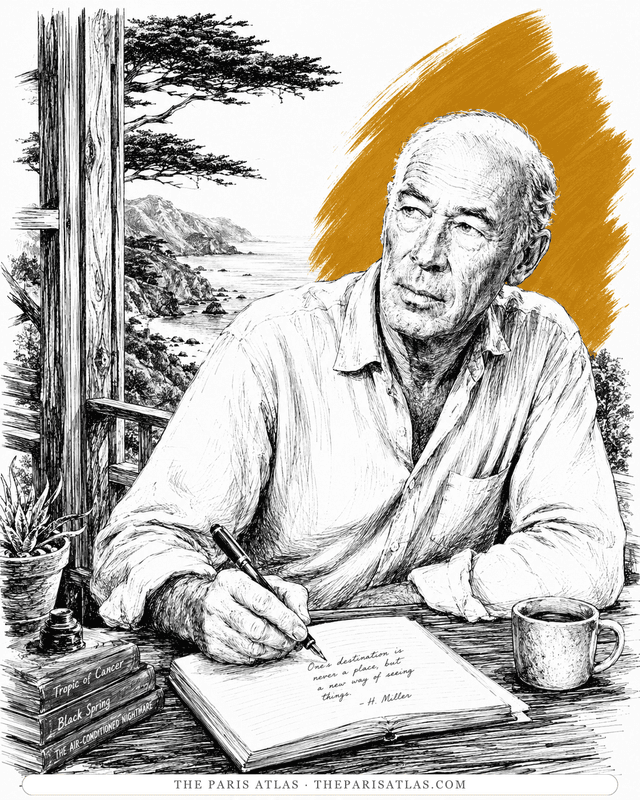
The Brooklyn dropout who arrived in Paris broke at thirty-eight and wrote the exuberant, banned books that ended American censorship.
View author
American novelist and composer whose expatriate fiction explores dislocation, unstable intimacy, fatalism, and North Africa.
View authorThe sources below include the primary text, editions, scholarship, archival materials, and other records that informed this page. They document In the Penal Colony, its publication, and its place in literary history.

Kafka's life chronology: the 1910 and 1911 Paris trips, the October 1914 writing and the Munich reading.
Primary text: the German of the 1919 first edition, with its page numbers and colophon. Read in full for the plot, the character guides and every quotation.

The Bavarian State Library's scan of the 1919 first edition, for checking the transcription against the printed book.
German National Library catalogue record for the 1919 Kurt Wolff edition.
S. Fischer's essay on the story: its link to The Trial, the war and Kafka's insurance work, Kurt Wolff's reaction and Kafka's reply.
The Munich reading of 10 November 1916 and the origin of the fainting story, with the sources it rests on.
Kurt Tucholsky's review in Die Weltbühne, 3 June 1920, as transcribed by textlog.de.
Reiner Stach's biography, cited for his comparison of the story with Octave Mirbeau. The passage was read through Open Library's full-text search, not in the printed book, and no page number is given.
BnF record for Octave Mirbeau's Le Jardin des supplices, Paris, 1899.
BnF record for Jean Carrive's French translation, Marseille, 1939.
BnF record for Jean Starobinski's French translation, Fribourg and Paris, 1945.
BnF record for Alexandre Vialatte's French translation, Gallimard, Paris, 1948.
BnF record for the 1972 Folio paperback of Vialatte's translation, with its ISBN.
BnF performance record for the Paris revival of Joanna Bruzdowicz's opera, 28 April 1979.
BnF performance record for Matthias Langhoff's Île du salut, Théâtre de la Ville, Paris, 8 October 1996.
Publisher's page for The Complete Stories: ISBN, date, page count and contents.
Library catalogue data for The Complete Stories, naming Nahum N. Glatzer as editor and listing In the Penal Colony among the contents.
Library catalogue data for Schocken's The Penal Colony: Stories and Short Pieces, translated by Willa and Edwin Muir.
IRCAM's record of Philip Glass's chamber opera: libretto, commission and the Seattle premiere of 31 August 2000.
The primary text is the baseline reference for every book page. Additional references document publication history, interpretation, and historical context where that evidence is available.
 Explore more resources