The Condemned Man
A soldier sentenced to death for disobeying and insulting the captain he served. He knows nothing of his sentence and speaks no French.
At first he simply tries to understand what is happening to him. Once the officer frees him, he wants, if he is allowed, to be really free (page 53).
The book
In the Penal Colony
Franz Kafka
Who they are in the book
Spoiler-freeKafka describes him as dull-looking and wide-mouthed, with neglected hair and face (page 5). He was the captain's orderly and had to salute at the captain's door every hour through the night (pages 18 and 19).
He understands nothing of the officer's French, yet he watches everything. Once he is freed, he turns out to be curious, playful and quick to laugh.
How The Condemned Man Is Portrayed
- Waiting like a dogOn page 6 he looks so submissive, Kafka writes, like a dog, that he could have run free on the slopes and been whistled back when the execution began.
- Following explanations he cannot understandOn pages 10 and 11 he keeps looking wherever the officer points, although he cannot understand French. On page 16 his lips move as he strains to catch his own sentence.
- Peering into the glass HarrowOn pages 23 and 24 he follows the traveler to look into the glass. The officer throws a clod of earth at the dozing soldier, who yanks the prisoner back so hard that he falls.
- Being set freeOn pages 52 and 53 the officer tells him in his own language that he is free. For the first time his face comes alive. He laughs quietly to himself and turns to each of the three men in turn.
- Dancing in his cut clothesOn page 56 he washes his filthy shirt in the bucket and puts his clothes back on. They were slit up the back, so he turns in circles in front of the soldier, and the prisoner and the soldier laugh out loud.
- Deciding it is revengeOn pages 59 and 60 he watches the officer undress and decides the traveler has ordered revenge. A broad, silent laugh stays on his face. He insists on strapping the officer in properly.
- Chasing the boatOn pages 61 and 62 he kneels to beg to stay and watch. On pages 68 and 69 he and the soldier run down the harbor steps after the traveler, too frightened to shout, and are kept out of the boat.
The Condemned Man quotes
There would be no point in announcing it to him. He learns it on his body.Es wäre nutzlos, es ihm zu verkünden. Er erfährt es ja auf seinem Leib.
Honor your superior!Ehre deinen Vorgesetzten!
If you like In the Penal Colony


If you like Franz Kafka
Explore authors with a similar voice, perspective, and influence.
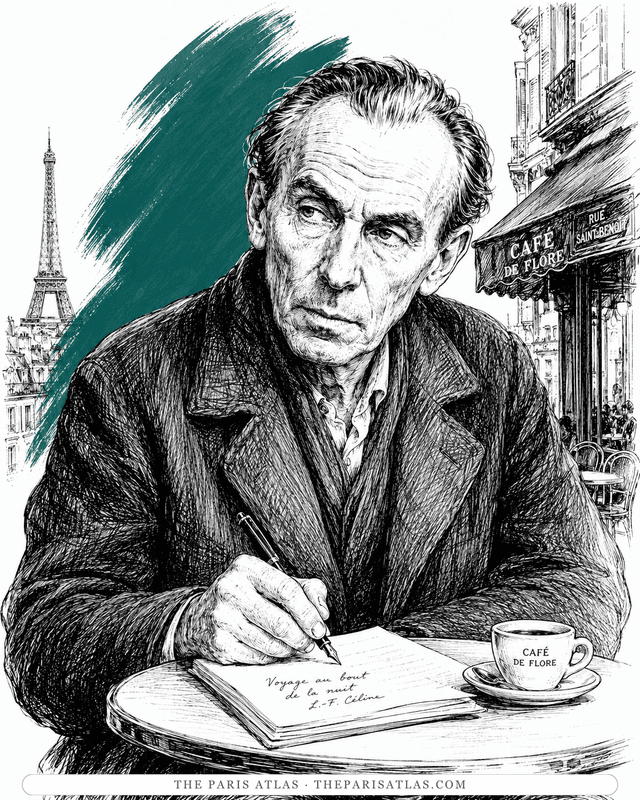
Louis-Ferdinand Céline
The doctor of the Paris slums who wrote the century's blackest, funniest novel — and changed the sound of French prose.
View author
Henry Miller
The Brooklyn dropout who arrived in Paris broke at thirty-eight and wrote the exuberant, banned books that ended American censorship.
View author
Paul Bowles
American novelist and composer whose expatriate fiction explores dislocation, unstable intimacy, fatalism, and North Africa.
View author