The Officer
The colony's judge and the machine's keeper. He worked on the machine with the old commandant and is now its last open defender.
He wants the machine and the old commandant's procedure to survive the new commandant, and he wants the traveler to help save them.
The book
In the Penal Colony
Franz Kafka
Who they are in the book
Spoiler-freeHe is young for a judge, he says, but he was the old commandant's assistant in all criminal cases and knows the machine best (page 18). He wears a tight dress uniform with epaulettes and braid in the tropical heat (page 10).
He is proud, eager and warm with the traveler, touching his arm and even embracing him. He is also quick to anger at anything that threatens the machine.
How The Officer Is Portrayed
- Doing a mechanic's work himselfOn pages 6 and 7 he crawls under the machine and climbs a ladder to check its upper parts. Kafka notes this is work a mechanic could have done. He finishes out of breath, with two ladies' handkerchiefs pushed into his collar.
- Washing before touching the drawingsOn page 15 his hands do not seem clean enough to handle the old commandant's drawings, so he washes them again. On page 25 he refuses to hand the sheets over, calling them the most precious thing he owns.
- Explaining how he judgesOn pages 18 to 20 he explains his rule: guilt is always beyond doubt. He heard the captain's complaint, wrote the sentence and had the man chained. Questioning the prisoner, he says, would only have produced lies.
- Losing his temper over the felt gagOn pages 30 to 34 a strap breaks and the prisoner vomits. The officer blames the new commandant, who controls the money for spare parts. He complains that more than a hundred dying men have bitten the same felt.
- Remembering the old execution daysOn pages 35 to 38 he describes crowds filling the valley, fanfares, and children brought close to watch. Carried away, he embraces the traveler and lays his head on his shoulder.
- Planning a scene for tomorrow's meetingOn pages 40 to 50 he imagines the commandant on a balcony full of ladies. He begs the traveler to speak up at the next day's meeting of officials, which, he complains, is mostly about harbor works.
- Taking the prisoner's placeOn pages 52 to 60 he frees the condemned man and sets the drawing "Be just!" in the machine. He handles each piece of his uniform with care, then throws it into the pit. He breaks his sword and lies down.
The Officer quotes
Guilt is always beyond doubt.Die Schuld ist immer zweifellos.
There would be no point in announcing it to him. He learns it on his body.Es wäre nutzlos, es ihm zu verkünden. Er erfährt es ja auf seinem Leib.
Honor your superior!Ehre deinen Vorgesetzten!
If you like In the Penal Colony


If you like Franz Kafka
Explore authors with a similar voice, perspective, and influence.
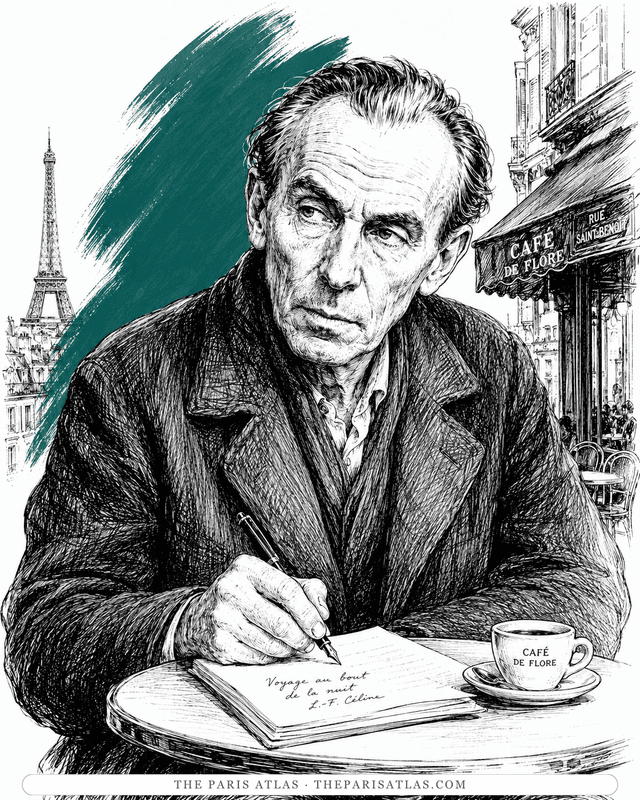
Louis-Ferdinand Céline
The doctor of the Paris slums who wrote the century's blackest, funniest novel — and changed the sound of French prose.
View author
Henry Miller
The Brooklyn dropout who arrived in Paris broke at thirty-eight and wrote the exuberant, banned books that ended American censorship.
View author
Paul Bowles
American novelist and composer whose expatriate fiction explores dislocation, unstable intimacy, fatalism, and North Africa.
View author