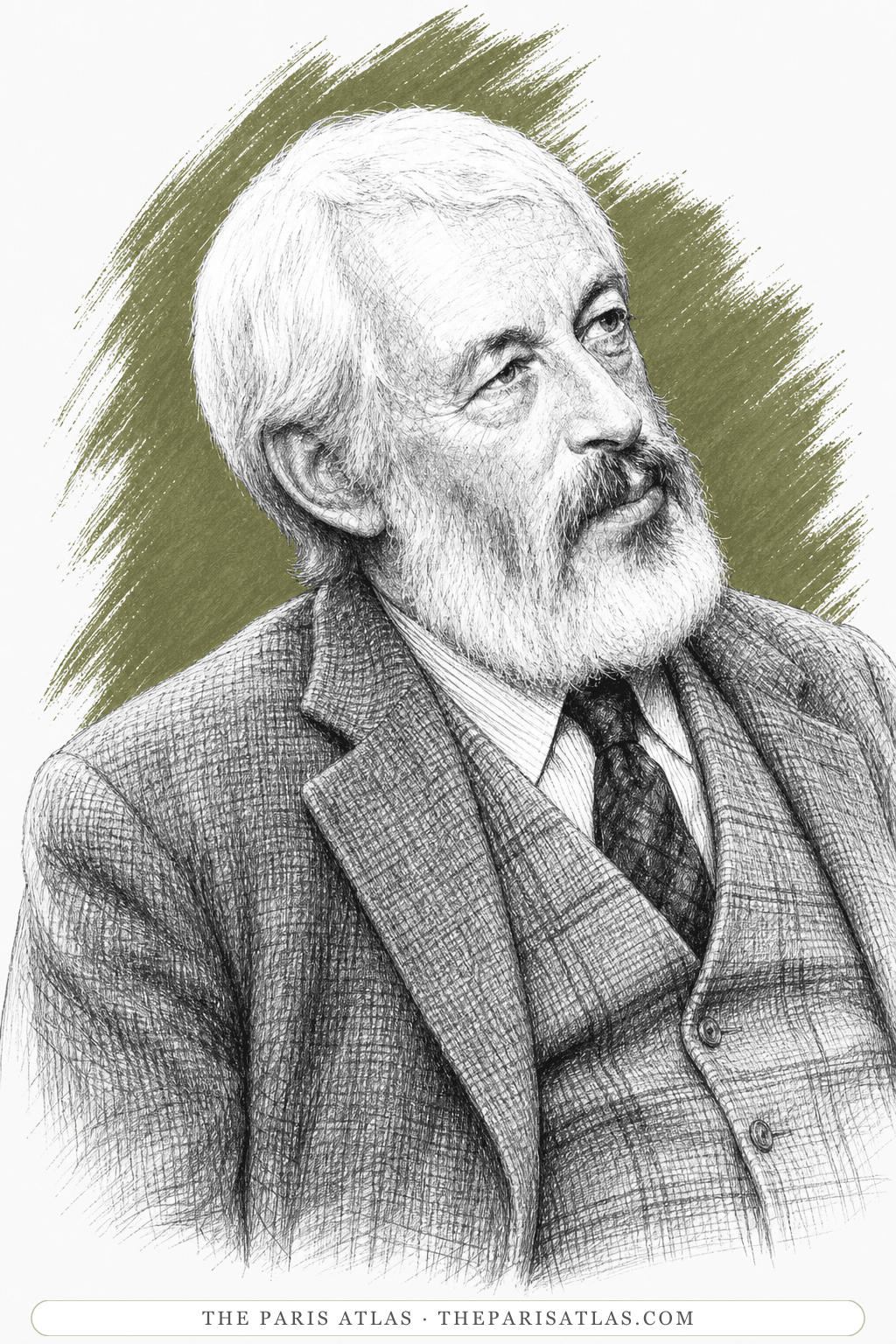
J. P. Donleavy
Donleavy identified Kafka's world of invisible forces and unexplained threats as a major and lasting influence.
Prague novelist who worked fourteen years as an accident-insurance official, left three novels unfinished, told his friend Max Brod to burn everything, and was disobeyed. His Paris is a holiday, not an exile: he came twice as a tourist with Brod between 1909 and 1912, and never lived there.
Franz Kafka wrote The Trial and The Castle and the story in which a man wakes up as an insect, and published almost none of it. He spent his working life as a salaried official in an accident-insurance office in Prague, wrote at night, left his three novels unfinished, and asked his closest friend to burn the manuscripts after his death. The friend, the writer Max Brod, refused, published them, and made Kafka one of the most read authors of the twentieth century.
The Paris connection here is small and honest, and worth stating plainly because the myth is otherwise: Kafka was a tourist in Paris, never an exile in it. He came on holiday with Brod on their European trips between 1909 and 1912, kept travel diaries as he went, and went home each time to the same office in Prague. The Bodleian Library in Oxford — the University of Oxford's main research library, and now the holder of most of his surviving papers — reads those notebooks as a writer teaching himself description on the road. Paris is where he practised, not where he lived.
Kafka was born on 3 July 1883 in the Old Town of Prague, then a city of the Austro-Hungarian Empire, into a German-speaking Jewish family. His father, Hermann Kafka, was a wholesaler of haberdashery — buttons, ribbons, trimmings — and a large, overbearing presence his son never got out from under; his mother was Julie, born Löwy. Kafka went to German-language schools, then studied law at the German half of Prague's Karl-Ferdinand University — the old university had been split in 1882 into a German-speaking and a Czech-speaking institution — and took his doctorate in law in 1906. In 1902, at a student debating and reading club, he met Max Brod, a fellow student who became a novelist, critic and eventually his editor. The friendship lasted until Kafka died.
After a compulsory year of court practice and a short spell at an Italian insurance firm, Kafka joined the Workers' Accident Insurance Institute for the Kingdom of Bohemia in 1908, at its offices on Na Poříčí street. He stayed fourteen years. The job was neither a sinecure — a salaried post with no real work attached — nor a joke: the institute was a state body that insured Bohemian workers against industrial accidents, and Kafka assessed injury claims, wrote reports on factory safety, and rose from articled clerk, a trainee bound to the office by contract, to secretary and finally, in 1922, to chief secretary — after which he asked for early retirement on medical grounds. The literature was written in the hours the office left him, which is why so little of it was finished.
Between 1909 and 1912 Kafka travelled around Europe with Max Brod — northern Italy, Paris, Weimar — and it was on these journeys that he began keeping the diaries he wrote for the rest of his life. This is the whole of his relationship with the city: a well-off young professional using his annual leave, going where a Prague clerk with an interest in literature would go, and writing it down. He did not emigrate to Paris, did not join a literary circle there, and did not set a book there.
What the trips did produce was the travel notebooks. The Bodleian Libraries in Oxford, which hold the majority of Kafka's papers, describe them as showing how his travels in western Europe let him practise descriptive writing — the deliberate, close, faintly absurd noticing that his fiction would later run on. His notebooks were kept in German but also carry Hebrew, Czech, French and Italian; he was a considerable linguist for a man who never settled anywhere but Prague.
Illness had a habit of ending these journeys. The 1911 trip closed not with a return to the desk but with Kafka checking into a sanatorium at Erlenbach, near Zurich — a residential clinic of the natural-healing kind then fashionable across central Europe, which treated patients with diet, fresh air, cold water and exercise rather than medicine, and the first of a series of such cures he took at the end of foreign trips, at Jungborn in Germany in 1912 and at Riva on Lake Garda in 1913. The pattern held for the rest of his life: travel, collapse, sanatorium, Prague.
The breakthrough came in 1912. In a single overnight sitting Kafka wrote The Judgment, and in the same period began his first novel, The Man Who Disappeared — the book Brod later retitled Amerika — and wrote The Metamorphosis, in which a travelling salesman wakes to find he has become an enormous insect and is slowly starved out by his family. A collection of eighteen short pieces, Meditation, appeared that December. In August 1912, at the flat of Max Brod's parents, he met Felice Bauer, a young Berlin office worker at a firm that made dictating machines, to whom he would write more than five hundred letters and to whom he became engaged twice, breaking it off both times.
In 1914 he moved out of his parents' home for the first time and worked on The Trial — a man is arrested one morning, never told the charge, and ground down by a court he can never reach. The Metamorphosis was published in 1915 by Kurt Wolff, the Leipzig publisher who brought out most of the little Kafka printed in his lifetime. In 1916 he wrote the stories collected as A Country Doctor in a rented room on Golden Lane, the alley of tiny cottages built into the wall of Prague Castle. In August 1917 came the first sign of the tuberculosis that killed him, and the rest of his life was a rota of sanatoria broken by short returns to the office.[1] In 1922 he worked on The Castle, in which a man summoned to a village can never gain admission to the authority that summoned him. He finished none of the three novels.
In 1922 Kafka left instructions for Max Brod to burn all his papers and manuscripts after his death; he had written a note to similar effect in late 1921. In 1923 he met Dora Diamant, a young woman who had run away from a strictly observant Hasidic Jewish family in Galicia, then the Austrian province on what is now the Polish-Ukrainian border, and moved with her to Berlin — the only period he lived away from Prague. His health broke down; in March 1924 Brod and Kafka's uncle brought him back to his parents' flat on the Old Town Square, and in April he went with Dora and his doctor friend Robert Klopstock to a sanatorium at Kierling, outside Vienna. He died there in June 1924, of tuberculosis of the larynx, and was buried in the family plot in the New Jewish Cemetery in Prague.
In 1922, Franz Kafka left instructions for his friend Max Brod to burn all his papers and manuscripts after his death.
Brod preserved the manuscripts and explained his decision in print. He edited the three unfinished novels for publication after Kafka’s death. The Castle appeared in 1926 and Amerika in December 1927. The latter used Brod’s title for the project Kafka had called Der Verschollene, or The Missing Person. Its opening chapter, The Stoker, had already been published separately in 1913.
The manuscripts then had a career of their own. In 1939, with the German army about to enter Prague, Brod caught one of the last trains out, carrying Kafka's papers in a suitcase; he crossed the Polish border before it closed, sailed from the Black Sea port of Constanța and reached Tel Aviv with the suitcase still in hand. By 1956 the papers were in the library of the publisher Salman Schocken in Jerusalem, and the Suez Crisis of that year — the war in which Israel, Britain and France attacked Egypt, and which looked from Jerusalem like the start of something worse — sent them on again, to a bank vault in Zurich for safekeeping.
In 1961 Kafka's heirs — the children of his three sisters, all three of whom had been murdered in the Nazi camps — agreed with Malcolm Pasley, a Kafka scholar at Oxford, that the archive should come to him. Pasley got the news while skiing in the Alps, drove to the Zurich bank, collected the papers and brought them back to Oxford in his small Fiat. The Bodleian Libraries have held them since. The manuscripts of The Castle and The Man Who Disappeared are there, along with notebooks, drawings, letters, postcards and photographs, and the university runs an Oxford Kafka Research Centre devoted to them. A writer who asked for his papers to be destroyed is now the best-archived novelist of his generation.
Kafka is often described as a clerk who hated his job, which undersells both the job and how good he was at it. From 1908 until he was pensioned off in 1922 he worked for the Workers' Accident Insurance Institute for the Kingdom of Bohemia in Prague, and he was promoted repeatedly.
The work was industrial injury. He assessed claims from factories and workshops, calculated risk, inspected machinery and wrote technical reports on how workers were being maimed and how it might be prevented. He was writing about lathes, planing machines and the hands they took off. His employer valued him enough to keep deferring his requests to leave.
There is a persistent claim, repeated after the management writer Peter Drucker made it, that Kafka invented the civilian hard hat and won a medal for it. No document from his employer supports this, and it should be treated as a story about Kafka rather than a fact about him.
Very little of Kafka appeared while he was alive, and none of the three novels. What he did publish were short books, most of them thin: Betrachtung (1912), Das Urteil (1913), Der Heizer (1913), Die Verwandlung (1915), In der Strafkolonie (1919), Ein Land[2]arzt (1919) and Ein Hungerkünstler, which appeared in the year he died.
In the note he left for Max Brod telling him to burn the rest, Kafka named the handful of things he was prepared to let stand. They were Das Urteil, Der Heizer, Die Verwandlung, In der Strafkolonie, Ein Landarzt and the story Ein Hungerkünstler. Everything else, he wrote, was to be destroyed unread. That short list is the only bibliography he ever authorised.
In August 1917 Kafka had a haemorrhage in the night and was diagnosed with tuberculosis. He was thirty-four. The next seven years were a circuit of sanatoria, sick leave and returns to work, until the institute pensioned him off in 1922.
In 1923 he moved to Berlin with Dora Diamant, a young woman from a Hasidic family in Poland, and for a few months lived away from Prague and his parents for the first time. The disease reached his larynx. By the spring of 1924 he could not swallow, and at a sanatorium at Kierling outside Vienna he was effectively starving. He was correcting the proofs of Ein Hungerkünstler, a story about a man who starves in public, while it happened. He died on 3 June 1924, aged forty, and was buried in the New Jewish Cemetery in Prague-Žižkov.
Dora Diamant kept a quantity of his notebooks and letters. The Gestapo seized them from her in 1933 and they have never been found.
Kafka died before the catastrophe that consumed almost everyone close to him. His three sisters were all murdered: Ottla, who was closest to him, was deported from Theresienstadt to Auschwitz in 1943 and killed after volunteering to accompany a transport of children. Elli and Valli were deported to the Łódź ghetto and then to the Chełmno extermination camp.
Milena Jesenská, the Czech journalist who translated him into Czech and to whom he wrote the letters published as Briefe an Milena, was arrested for her work in the resistance and died at Ravensbrück in May 1944.
Max Brod carried the manuscripts out of Prague in a suitcase in March 1939, on what is usually described as the last train to leave for Palestine before the German occupation closed the border. The papers he took became the basis of everything published under Kafka's name after his death. Their ownership was still being fought over in the Israeli courts long afterwards, between the state and the heirs of Brod's secretary Esther Hoffe, until the Supreme Court ru[3]led against the family in August 2016. The manuscripts were transferred to the National Library of Israel; the bulk of the material Brod had earlier sold sits in the Bodleian Library in Oxford.
Born on 3 July in the Old Town of Prague, eldest son of the haberdashery wholesaler Hermann Kafka and Julie Löwy.
Meets Max Brod at a students' reading and debating club; the friendship lasts until Kafka's death.
Works at the Workers' Accident Insurance Institute for the Kingdom of Bohemia on Na Poříčí street, rising from articled clerk to secretary and finally chief secretary before retiring early on medical grounds.
Travels around Europe with Max Brod — northern Italy, Paris, Weimar — and begins keeping the diaries. These trips are the whole of his Paris.
Ends the year's travels at a natural-healing sanatorium at Erlenbach near Zurich — the first of several such cures tacked onto the end of foreign trips.
Writes The Judgment in one night, begins the novel later published as Amerika, writes The Metamorphosis, and publishes the collection Meditation in December. Meets Felice Bauer in August.
Moves out of the family home and works on The Trial; The Metamorphosis is published by Kurt Wolff in Leipzig in 1915 — one of the few books to appear in his lifetime.
First signs of tuberculosis in August; the sanatorium years begin.
Leaves a note in late 1921, and instructions in 1922, that Max Brod is to burn all his papers and manuscripts after his death. In the same year he works on The Castle.
Meets Dora Diamant and moves with her to Berlin, the only time he lives outside Prague.
Dies in June of laryngeal tuberculosis at the sanatorium in Kierling, outside Vienna, and is buried in the New Jewish Cemetery in Prague. Brod decides to ignore the instruction to burn the papers.
Brod edits and publishes five major works and collections from the manuscripts, among them The Castle, The Trial and Amerika.
Brod escapes Prague on one of the last trains before the German army arrives, carrying Kafka's papers in a suitcase, and reaches Tel Aviv.
The Kafka scholar Malcolm Pasley collects the papers from a Zurich bank vault and drives them to Oxford in his Fiat; the Bodleian has held them since.
I think we ought to read only the kind of books that wound and stab us. If the book we are reading doesn't wake us up with a blow on the head, what are we reading it for? A book must be the axe for the frozen sea inside us.Ich glaube, man sollte überhaupt nur solche Bücher lesen, die einen beißen und stechen. Wenn das Buch, das wir lesen, uns nicht mit einem Faustschlag auf den Schädel weckt, wozu lesen wir dann das Buch? […] ein Buch muß die Axt sein für das gefrorene Meer in uns.
We are as forlorn as children lost in the woods. When you stand in front of me and look at me, what do you know of the griefs that are in me and what do I know of yours?Verlassen sind wir doch wie verirrte Kinder im Walde. Wenn Du vor mir stehst und mich ansiehst, was weißt Du von den Schmerzen, die in mir sind und was weiß ich von den Deinen.
Prague won't let go. It won't let go of the both of us. The little mother has got claws. We ought to set fire to it in two places, at Vyšehrad and at the Hradschin, and then it might be possible for us to get away.Prag läßt nicht los. Uns beide nicht. Dieses Mütterchen hat Krallen. Da muß man sich fügen oder –. An zwei Seiten müßten wir es anzünden, am Vyšehrad und am Hradschin, dann wäre es möglich, daß wir loskommen.
Donleavy identified Kafka's world of invisible forces and unexplained threats as a major and lasting influence.

An impossible transformation exposes how quickly love can become a judgment about usefulness.

An officer shows a visiting traveler the machine that executes prisoners by writing the broken rule into their skin, and asks him to help save it.

A man is arrested without a charge and trapped inside rules controlled by authorities who refuse to explain them.

A stranger seeks permission to belong, while every explanation makes his position harder to establish.

A young migrant looks for steady work in an America where each welcome can become another form of dependence.
No. He visited as a tourist on the European trips he took with his friend Max Brod between 1909 and 1912, alongside northern Italy and Weimar, and went home to his job in Prague each time. He lived his whole life in Prague apart from a few months in Berlin in 1923 and a series of stays in sanatoria. There is no Kafka address in Paris, no Paris circle and no Paris book.
He was an accident-insurance official. From 1908 to 1922 he worked at the Workers' Accident Insurance Institute for the Kingdom of Bohemia, in its offices on Na Poříčí street in Prague, assessing industrial injury claims and writing on factory safety. He started as an articled clerk, ended as chief secretary in 1922, and then took early retirement on health grounds. He wrote his fiction outside office hours, which is a large part of why so little of it was finished.
Yes. In 1922 he left instructions for Max Brod to burn all his papers and manuscripts after his death, having already written a note to the same effect in late 1921. Brod ignored the instruction when Kafka died in June 1924 and published a long defence of his decision. The rights and wrongs are still debated — either a dying man's clear wish was overridden, or Kafka deliberately left his papers with the one person he could be sure would not burn them.
His lifetime publications included Meditation, The Metamorphosis, A Country Doctor and The Stoker, the opening chapter of the novel later called Amerika. None of the three novels had appeared as a whole when he died. Brod subsequently edited them for publication, including The Castle in 1926 and Amerika in 1927.
Because Max Brod carried them out of Prague in a suitcase in 1939, ahead of the German army, and got them to Tel Aviv. They were later deposited in the publisher Salman Schocken's library in Jerusalem, then moved to a Zurich bank vault during the Suez Crisis in 1956. In 1961 Kafka's heirs agreed to place the archive with the Oxford scholar Malcolm Pasley, who drove it back from Zurich in his Fiat. The Bodleian Libraries hold the majority of Kafka's papers today, including the manuscripts of The Castle and The Man Who Disappeared.
Of tuberculosis of the larynx, in June 1924, aged forty. The disease first showed itself in August 1917 and the last seven years of his life were largely spent in sanatoria. He died at a sanatorium in Kierling, near Klosterneuburg outside Vienna, where he had gone in April 1924 with Dora Diamant and his friend the doctor Robert Klopstock, and was buried in the family plot in the New Jewish Cemetery in Prague.
A man is arrested one morning, is never told what he is charged with, and spends the book trying and failing to reach the court that has charged him — being worn down by corridors, functionaries and procedure rather than by any accusation he can answer. Kafka worked on it from 1914 and never finished it; Brod assembled and published it after his death. It is the book behind the adjective "Kafkaesque", which describes a bureaucracy that is impenetrable, unanswerable and quietly fatal.
Visited · 1909–1912
Kafka came to Paris as a tourist, never as a resident. The Franz Kafka Museum in Prague places him in the city on the European trips he took with his friend Max Brod between 1909 and 1912, alongside northern Italy and Weimar, and dates the beginning of his diaries to those journeys. The Bodleian Libraries, which hold most of his surviving papers, read the resulting notebooks as a writer using travel to practise description. He kept his insurance job in Prague throughout and returned to it after every trip.
Influenced
Donleavy identified Kafka's world of invisible forces and unexplained threats as a major and lasting influence.
The sources below include biographies, scholarly essays, interviews, and primary materials that informed this page. They reflect both the historical record and ongoing critical conversations about Franz Kafka and their work.


Reference article cross-checked for the insurance career, the illness, the burial and the fate of his sisters.
German Wikisource scans of the first editions, used to verify the fiction and the aphorisms.
Report of the Israeli Supreme Court ruling of August 2016 on the Brod and Hoffe papers.
The Castle’s 1926 first publication and Brod’s editing.
Kafka’s original title and the December 1927 publication as Amerika.
The Stoker’s separate publication in 1913.
University of Vienna transcription of Kafka's letters to Oskar Pollak, used to verify the German of the 1902–1904 letters.
Project Gutenberg's transcription of the Kurt Wolff first edition of Die Verwandlung, Leipzig 1917.
Life chronology from the museum in Prague: schooling, the insurance institute, the European trips with Max Brod, the sanatoria.
The Bodleian's own account of the burn instruction, Brod's refusal, and how the archive travelled from Prague to Oxford.
The 2024 centenary exhibition: what the archive contains and how the travel notebooks are read.
The Oxford research centre built around the manuscripts.
Brod's own life of Kafka, written by the friend who refused to burn the manuscripts — the source of the standard account, and interested in it. Listed as further reading, not consulted directly.
The middle volume of the standard modern biography, covering the years of the European travels with Brod. Listed as further reading, not consulted directly.
These references anchor the page in the documented record and in the scholarly conversations around Franz Kafka. Every claim on this page traces back to one or more of the works listed here.
 Explore more resources