The Acrobat
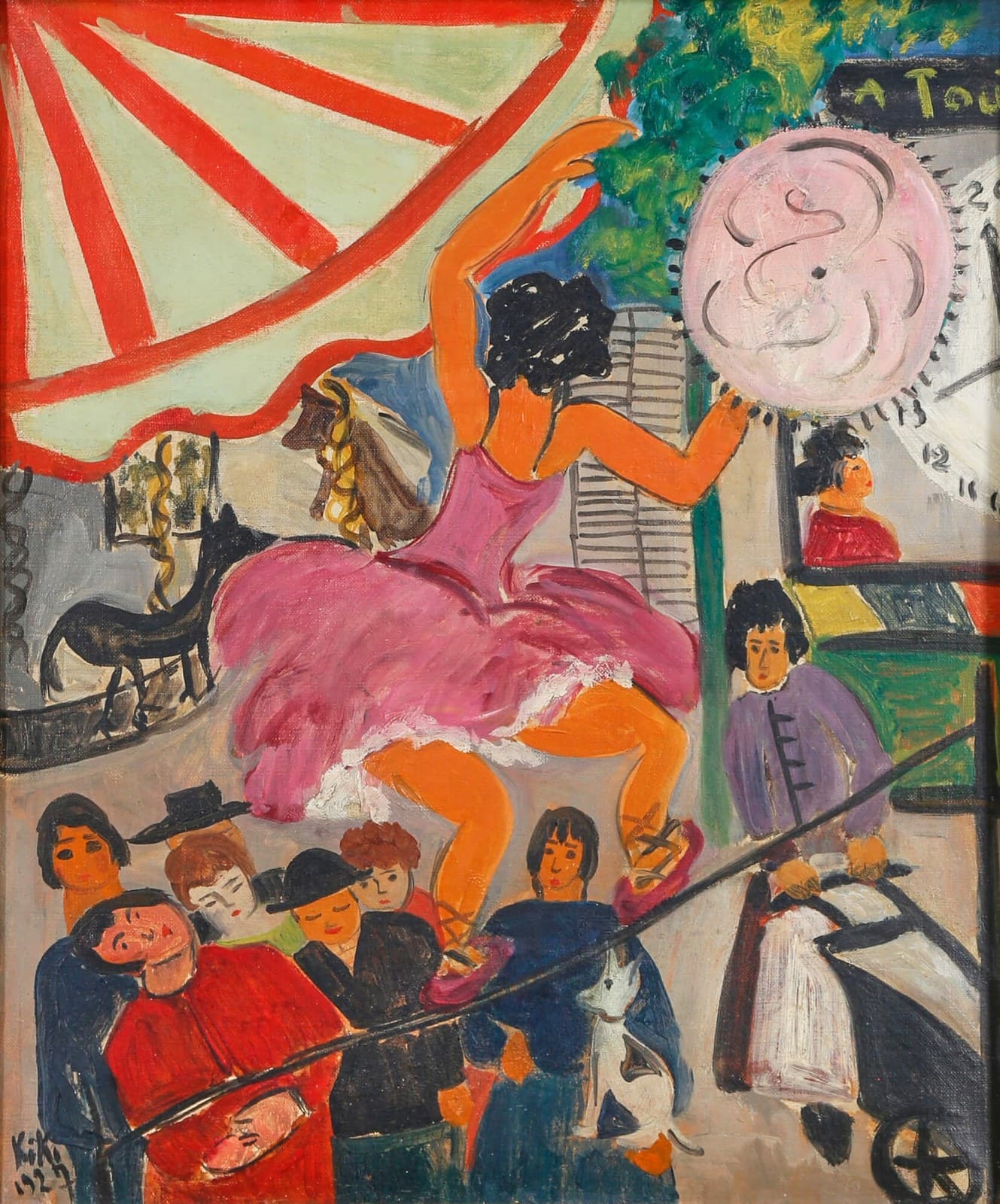
A woman in a pink skirt dances in front of a fairground, one arm curled above her head, the other hand at the rim of a large pale disc. Kiki de Montparnasse painted it in 1927, the year she first exhibited her own canvases at the Galerie au Sacre du Printemps. It is the work of hers that has sold for the most at auction, and it belongs to a private collection in Paris.
- 1927
- Oil on canvas
About Kiki de Montparnasse
What the painting shows
A dancer holds the centre of the canvas. She wears a pink skirt over a white frilled petticoat, her arms and legs bare and painted a flat orange, her hair a solid black mass. One arm curls above her head with the fingers turned in. The other reaches right, and her hand rests at the rim of a large pale pink disc.
The disc is ringed with short black dashes and carries dark curling scrolls across its face. Behind it, on a pale panel at the right edge, the numerals 13 and 12 are painted in dark strokes with short marks radiating between them.
A canopy striped in red and cream fills the upper left corner, its bands spreading from the corner like the ribs of a fan. Below it a brown horse's head comes forward on a gold braided harness, and a black animal stands further left. A grey structure with white rungs rises behind the dancer.
The lower quarter is a band of onlookers. A wide black straw hat, a bowler, auburn hair, a red-haired child and several closed or lowered pairs of eyes are packed shoulder to shoulder. A white and tan dog looks out between a woman's blue coat and a long dark pole that crosses the picture on the diagonal.
The canvas is 54.9 by 46 centimetres. Kiki de Montparnasse signed it at the lower left over a patch of bare ground, and wrote the date under her name.
Painted the year she first showed
Alice Prin — Kiki de Montparnasse was the name Montparnasse gave her — exhibited her own paintings at the Galerie au Sacre du Printemps in March 1927, and the show sold out. Billy Klüver and Julie Martin record it in the standard account of the quarter. She exhibited twice more, in 1930 and 1931, and then not again in her lifetime.
The 1927 date on this canvas puts it in that year. Whether it hung in that March show is not recorded. Its documented history begins sixty-two years later, at a Briest sale at Drouot in Paris on 3 March 1989.
Two years after the exhibition she published Souvenirs with Henri Broca in Paris. The sale catalogue that described a copy in 2018 lists what the book carried: a preface by Tsuguharu Foujita, six illustrations, ten photographs by Man Ray, and reproductions of twenty paintings by the author. Her canvases reached more people through that book than through any gallery.
The fairground, not the studio
Kiki de Montparnasse spent the 1920s being painted. Tsuguharu Foujita, Moïse Kisling, Chaïm Soutine, Maurice Mendjizky and Man Ray all worked from her, and those pictures are theirs rather than hers. What she painted when she picked up a brush was something else: village memory, street and circus, the crowd rather than the single posed body.
The Acrobat keeps that crowd. The dancer is the tallest thing in the picture, but she is surrounded — by the horse, the canopy, the numbered panel, the row of heads along the bottom. Nobody in that row is watching her. The faces are turned away, lowered or closed.
The handling is deliberately plain. Outlines are drawn in dark paint and filled with flat colour, hands are mittens, and the perspective stacks upward rather than receding. The Musée du Pays Châtillonnais, which put her own work on show in her birthplace in 2026, presents her as a painter and a writer alongside the model.
Where it has been
The painting came up at Briest at Drouot in Paris on 3 March 1989 as lot 194. It then went to the Zabriskie Gallery in New York, which left its label on the back, and the gallery showed it in an exhibition of her work from 9 April to 24 May 2002.
FauveParis sold it in Paris on 15 May 2021, as lot 2 of a sale of modern and contemporary art. The estimate was 10,000 to 15,000 euros and it made 19,275 euros with the buyer's premium, which remains the highest price paid at auction for a work by Kiki de Montparnasse.
It is in a private collection in Paris. No museum owns it, and no public collection is known to hold any painting by her.
Close reading
Reading the work, detail by detail
A fairground stacked upward rather than set back. Follow the striped canopy, the dancer's curled hand, the dashed disc and the numbers beside it, then drop to the row of spectators along the bottom and the signature in the corner.
1.The striped canopy
The canopy is painted as flat bands with no shading and no pole holding it up. Its stripes run from the corner rather than from a centre, which puts the top of the picture at an angle the rest of the scene does not share.
2.The raised hand
The fingers turn in rather than reaching. Kiki de Montparnasse drew the hand as a single closed shape with four short notches for the fingers, the same shorthand she uses for every hand in the picture.
3.The dashed disc
The disc is the largest single object in the painting after the canopy. Its rim is a ring of separate black dashes, its face carries loose dark scrolls, and the dancer's hand rests against it without gripping anything.
4.The numbers 13 and 12
Two numerals are legible on the pale panel, 13 above and 12 below, with short strokes set between them. Numbered divisions of that kind belong to fairground equipment rather than to a clock, and they are the clearest evidence in the picture of where the dancer is standing.
5.The horse's head
The horse is cut off at the neck and carries a heavy gold-yellow braid down its cheek. It is painted at the same scale as the people, and nothing holds it up, which is how a carousel animal appears when the machine itself is left out.
6.The frilled petticoat
The frill is the only place in the painting where the paint is worked into texture rather than laid flat. Kiki de Montparnasse dragged white across the pink in short broken strokes, and left the ridges standing.
7.The front row
Five or six faces are pressed together with no space between them. Several pairs of eyes are closed or cast down, and none of the faces in the row is turned toward the dancer above them.
8.The dog
The dog is the only figure in the lower band that faces the viewer directly. Its head is painted in cream and pale tan with a single dark dot for the eye, tucked under the diagonal of the pole.
9.The signature
She signed with the name the quarter gave her, capital K at each end, not with Alice Prin. The date below reads 192 and then a fourth digit that the dark blue paint of the figure above has run across; FauveParis catalogues it as 1927.
Timeline
1927
Painted, signed and dated. Kiki de Montparnasse exhibits her own canvases for the first time, at the Galerie au Sacre du Printemps in Paris in March, and the show sells out.
1929
Souvenirs appears from Henri Broca in Paris, reproducing twenty of her paintings alongside ten photographs by Man Ray and a preface by Tsuguharu Foujita.
1989
Sold at Briest, Drouot, Paris, 3 March, as lot 194.
2002
Shown at the Zabriskie Gallery, New York, 9 April to 24 May, in an exhibition devoted to her work.
2021
Sold at FauveParis on 15 May for 19,275 euros with premium, against an estimate of 10,000 to 15,000 — the artist's auction record.
Where to see it
A viewing location has not yet been listed for this work.
Frequently asked questions
Did Kiki de Montparnasse paint The Acrobat herself?
Yes. Alice Prin, known as Kiki de Montparnasse, painted it in 1927 and signed it Kiki at the lower left. She is far better known as the model in other people's pictures, but this is one of her own, and the atlas records it under her as the artist rather than as the sitter.
Where is The Acrobat by Kiki de Montparnasse?
In a private collection in Paris. It passed through a Briest sale at Drouot in 1989 and the Zabriskie Gallery in New York, and FauveParis sold it in Paris on 15 May 2021. No museum owns it, and it is not on public view.
How much did The Acrobat sell for?
19,275 euros including the buyer's premium, at FauveParis on 15 May 2021, against an estimate of 10,000 to 15,000 euros. That is the highest price paid at auction for any work by Kiki de Montparnasse.
What is happening in The Acrobat?
A woman in a pink skirt and white petticoat dances in front of a fairground. A striped canopy fills the upper left, a carousel horse comes forward on a gold harness, and a pale disc ringed with black dashes stands at her right hand. A row of spectators crosses the bottom of the canvas, none of them looking at her.
How big is The Acrobat?
54.9 by 46 centimetres, oil on canvas, upright. FauveParis catalogued it as 21 5/8 by 18 1/8 inches and recorded old restorations.
How many times did Kiki de Montparnasse exhibit her own paintings?
Three times in her life — at the Galerie au Sacre du Printemps in March 1927, then again in 1930 and 1931. The 1927 show sold out. Her paintings reached a wider audience through Souvenirs, her 1929 book, which reproduced twenty of them.
More by Kiki de Montparnasse
If you like Kiki de Montparnasse
Explore painters from the same movements and circles.

William S. Burroughs
American Beat novelist, essayist, performer and visual artist who completed Naked Lunch at the Beat Hotel in Paris and made cut-up writing a defining avant-garde method.
View artist
Leonora Carrington
English painter and writer who fled a debutante's future for Surrealist Paris at twenty, survived the war's wreckage of that life — internment for her lover Max Ernst, an asylum in Spain for her — and rebuilt herself in Mexico into one of the century's great painters of the uncanny.
View artist
Giorgio de Chirico
Italian painter whose metaphysical cityscapes helped shape Surrealism. The MNAC's 2018 Gala exhibition records that he valued her practical intelligence and asked her to act as his agent.
View artist
References
The sources below include collection records, catalogues, scholarly research, and primary materials that informed this page. They document The Acrobat, its making, and its place in cultural history.


1Kiki de Montparnasse, L'Acrobate (1927) — lot 2, Art moderne & contemporain, 15 May 2021
WebsiteFauveParis, 2021Used forAuction record for the painting: medium, dimensions, inscription, provenance, the 2002 Zabriskie exhibition and the result.
2Kiki's Paris: Artists and Lovers 1900–1930
BiographyHarry N. Abrams, 1989Used forThe standard account of Montparnasse and of her 1927 exhibition at the Galerie au Sacre du Printemps.

3Kiki et le Montparnasse des années 1930 — Arts africains, sale catalogue, Drouot-Richelieu, 21 September 2018
Exhibition catalogueDe Baecque et associés and Lynda Trouvé, Paris, 2018Used forDescribes a copy of Souvenirs and lists what it contained, including reproductions of twenty paintings by the author.
4Kiki, Reine de Montparnasse — exhibition, 1 April to 30 December 2026
WebsiteMusée du Pays Châtillonnais – Trésor de Vix, Châtillon-sur-Seine, 2026Used forThe 2026 exhibition in her birthplace, which shows her own paintings and drawings alongside the portraits of her.
5Kiki's Memoirs (Souvenirs)
MemoirHenri Broca, Paris, 1929Used forFirst-person evidence and historical context used in preparing the The Acrobat page.
These references provide the documented foundation for this work's history and interpretation. Claim-level citations remain attached to the specific claims they support.
 Explore more resources