Circus
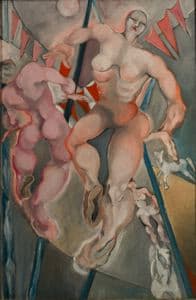
A nude acrobat with a small pale face and a dark cap hangs in mid-air at the centre of the canvas, her thighs swollen with muscle. Pink horses tumble down the left side, and red-and-white pennants run across the top. Zelda Fitzgerald painted Circus around 1938 and gave it to the Montgomery Museum of Fine Arts, which accessioned it in 1943 and keeps it on view.
- about 1938
- Oil on canvas
- Montgomery Museum of Fine ArtsMontgomery, Alabama, United States
About Zelda Fitzgerald
What the painting shows
A string of red-and-white striped pennants runs across the top of the canvas, and a pale disc hangs at the top left like a spotlight. Below the flags an acrobat sits on nothing at all. Her body is nude and heavily muscled, the thighs and calves thicker than her waist, one leg thrust out to the left with the foot pointing down and the other folded beneath her. Her face is small and pale under a dark cap, with dark eyes.
Down the left side a tangle of pink and red forms tumbles from the flags to the ground: the horses the museum lists among the picture's subjects. A smaller grey figure on thin legs stands at the lower right. Grey poles cross the picture on the diagonal like the rigging of a tent, and the ground is pale grey and rounded, with feet resting on it at the bottom edge.
The canvas measures 92.1 by 61.6 centimetres, about thirty-six by twenty-four inches. The museum's own description states that the bodies with bulging muscles are intentionally distorted and elongated. The fractured planes on which the figures float and the skewed perspective, it adds, are further reflections of French Modernist design.
Where the style came from
The Montgomery Museum of Fine Arts calls her style an eclectic combination of the Cubist and Expressionist idioms she encountered in Paris during the 1920s. In 1924 Gerald Murphy and Sara Murphy introduced her to Pablo Picasso, Jean Cocteau and Fernand Léger, and the Murphys had themselves studied with Natalia Goncharova, who designed for Sergei Diaghilev's Ballets Russes. Her own ballet training in Paris brought her close to the designers of the avant-garde stage.
The curator Everl Adair, writing for the R.W. Norton Art Gallery in Shreveport, finds in Circus the influence of André Lhote, Louis Marcoussis and André Derain, and a subject and approach shared with the American painter Walt Kuhn. The museum's record puts it in fewer names: her style was based loosely on the design elements she adopted from artists practising avant-garde stage design.
Acrobats before Circus
Acrobats were already her subject in 1934, when Cary Ross showed thirteen of her paintings and fifteen drawings in his New York studio. Time described one of them, Chinese Theatre, as a gnarled mass of acrobats with an indicated audience for background.
Gerald Murphy bought Chinese Theatre and disliked it, according to Everl Adair, calling its figures monstrous, hideous men, all with swollen intertwining legs. Dorothy Parker bought several pieces and found the blood-red colour disturbing. The museum states that most of the paintings shown in 1934 are unlocated today. Circus, painted about four years later, carries the same subject and the same swollen legs.
Given by the artist, and on view
The museum records Circus as a gift of the artist under accession number 1943.0005, which places the gift in 1943. She had given it Hope in 1938 and Ballerinas in 1942. A native of Montgomery, the museum notes, she lived most of the latter part of her life with her family there, receiving periodic treatment for her illness.
The painting is number 79, on page 190, of American Paintings from the Montgomery Museum of Fine Arts, the collection catalogue of 2006. The museum's online record marked it as currently on view in September 2026.
Close reading
Reading the work, detail by detail
An acrobat hangs in the air with nothing to hold her. Start with the pale face under its dark cap, then the pennants above it, then the swollen thigh, the pink horses tumbling down the left side and the small grey figure at the bottom right.
1.The face under the cap
The face is small, pale and tilted, with dark eyes and a dark cap pulled down over the hair. It sits on a neck and shoulders far heavier than itself, which is where the distortion the museum describes begins.
2.The striped pennants
The pennants are triangles striped in red and white, strung on a line across the top of the picture. They are the sharpest edges in a painting otherwise made of curves, and the only place the red is unmixed.
3.The swollen thigh
One leg is thrust out to the left, and the thigh is thicker than the waist above it. The museum's record says the bodies with bulging muscles are intentionally distorted and elongated, and the thigh is the clearest case.
4.The pink horses
The left side of the canvas is a cascade of pink and red shapes, and the museum lists horses among the picture's subjects. They fold into one another like the acrobats in Chinese Theatre that Gerald Murphy described as swollen and intertwining.
5.The small grey figure
A small grey figure on spindly legs stands at the lower right, dwarfed by the acrobat above it. Whether it is a second performer or an animal, the paint does not settle.
6.The disc and the poles
A pale disc hangs at the top left like a spotlight or a balloon, and grey poles run down from the top on the diagonal. The museum calls the surfaces fractured planes on which the figures float, and the poles are what fractures them.
7.The feet at the bottom
Feet rest on the rounded grey ground at the bottom edge, the only part of the picture with any weight on it. Everything above them hangs, tumbles or floats.
Timeline
1924
Gerald Murphy and Sara Murphy introduce Zelda Fitzgerald to the circle of Pablo Picasso, Jean Cocteau and Fernand Léger in France.
1925
Takes her first formal painting lessons on Capri in the winter.
1934
Cary Ross shows thirteen of her paintings and fifteen drawings in New York, 29 March to 30 April. Time describes Chinese Theatre as a gnarled mass of acrobats; Gerald Murphy buys it.
c. 1938
Paints Circus, on the museum's dating.
1943
Gives Circus to the Montgomery Museum of Fine Arts, which accessions it as 1943.0005.
2006
Catalogued as number 79 in American Paintings from the Montgomery Museum of Fine Arts.
2026
The museum's online record marks the painting as currently on view, as of September.
Where to see it
Montgomery Museum of Fine Arts
Montgomery, Alabama, United States
A public viewing address has not yet been confirmed for this holding.
The museum's online record marked the painting as currently on view in September 2026. Displays change, so check the record before making a special visit.
Frequently asked questions
Where is Circus by Zelda Fitzgerald?
At the Montgomery Museum of Fine Arts in Montgomery, Alabama, accession number 1943.0005, a gift of the artist. The museum's online record marked it as currently on view in September 2026; displays change, so check before travelling.
What does Circus show?
A nude, heavily muscled acrobat hanging in mid-air under a string of red-and-white pennants, with a small pale face under a dark cap. Pink horses tumble down the left side, a small grey figure stands at the lower right, and grey poles cross the picture like tent rigging.
Why are the bodies in Circus distorted?
On purpose, according to the museum, whose record says the bodies with bulging muscles are intentionally distorted and elongated, and that the fractured planes and skewed perspective reflect French Modernist design. Enlarged legs and feet run through her work; Time noticed them in her ballet picture of 1934.
Which painters influenced Circus?
The curator Everl Adair names André Lhote, Louis Marcoussis and André Derain, and finds an approach and subject shared with Walt Kuhn. The museum points to the Cubist and Expressionist idioms she met in Paris in the 1920s and to avant-garde stage design, which she knew through the Ballets Russes.
When was Circus painted?
About 1938, on the museum's dating. She gave it to the museum in 1943, the year in its accession number, five years after giving it Hope and one year after Ballerinas.
Did Zelda Fitzgerald paint other acrobats?
Yes. Chinese Theatre, shown in New York in 1934, was described by Time as a gnarled mass of acrobats with an indicated audience. Gerald Murphy bought it and called its figures monstrous, hideous men with swollen intertwining legs. The museum states that most of the 1934 paintings are unlocated today.
More by Zelda Fitzgerald
If you like Zelda Fitzgerald
Explore painters from the same movements and circles.
William S. Burroughs
American Beat novelist, essayist, performer and visual artist who completed Naked Lunch at the Beat Hotel in Paris and made cut-up writing a defining avant-garde method.
View artist
Leonora Carrington
English painter and writer who fled a debutante's future for Surrealist Paris at twenty, survived the war's wreckage of that life — internment for her lover Max Ernst, an asylum in Spain for her — and rebuilt herself in Mexico into one of the century's great painters of the uncanny.
View artist
Giorgio de Chirico
Italian painter whose metaphysical cityscapes helped shape Surrealism. The MNAC's 2018 Gala exhibition records that he valued her practical intelligence and asked her to act as his agent.
View artist
References
The sources below include collection records, catalogues, scholarly research, and primary materials that informed this page. They document Circus, its making, and its place in cultural history.


1Zelda Sayre Fitzgerald, Circus (about 1938) — object record
WebsiteMontgomery Museum of Fine ArtsUsed forThe holding museum's object record: title, date, medium, dimensions, credit line, on-view status, its description and the 2006 catalogue reference.

2American Paintings from the Montgomery Museum of Fine Arts
NonfictionMontgomery Museum of Fine Arts, 2006Used forThe museum's collection catalogue in which Circus is published.
3Zelda Sayre Fitzgerald — artist record and biography, MMFA online collection
WebsiteMontgomery Museum of Fine ArtsUsed forThe museum's artist biography: the Cubist and Expressionist idioms of Paris, the Murphys and Goncharova, the Capri lessons and the 1934 show.
4Zelda Sayre Fitzgerald, Hope (about 1938) — object record
WebsiteMontgomery Museum of Fine ArtsUsed forHer 1938 gift to the museum.
5Zelda Sayre Fitzgerald, Ballerinas (about 1933) — object record
WebsiteMontgomery Museum of Fine ArtsUsed forHer 1942 gift to the museum.
6A Tincture of Madness: Zelda Fitzgerald and Modernist Art
WebsiteResource Library, Traditional Fine Arts Organization, 2005Used forEverl Adair on Lhote, Marcoussis, Derain and Walt Kuhn, and on Gerald Murphy's and Dorothy Parker's purchases in 1934.

7Art: Work of a Wife
PeriodicalTime, 1934Used forThe 9 April 1934 review describing Chinese Theatre as a gnarled mass of acrobats.
These references provide the documented foundation for this work's history and interpretation. Claim-level citations remain attached to the specific claims they support.
 Explore more resources