Japanese Magnolias
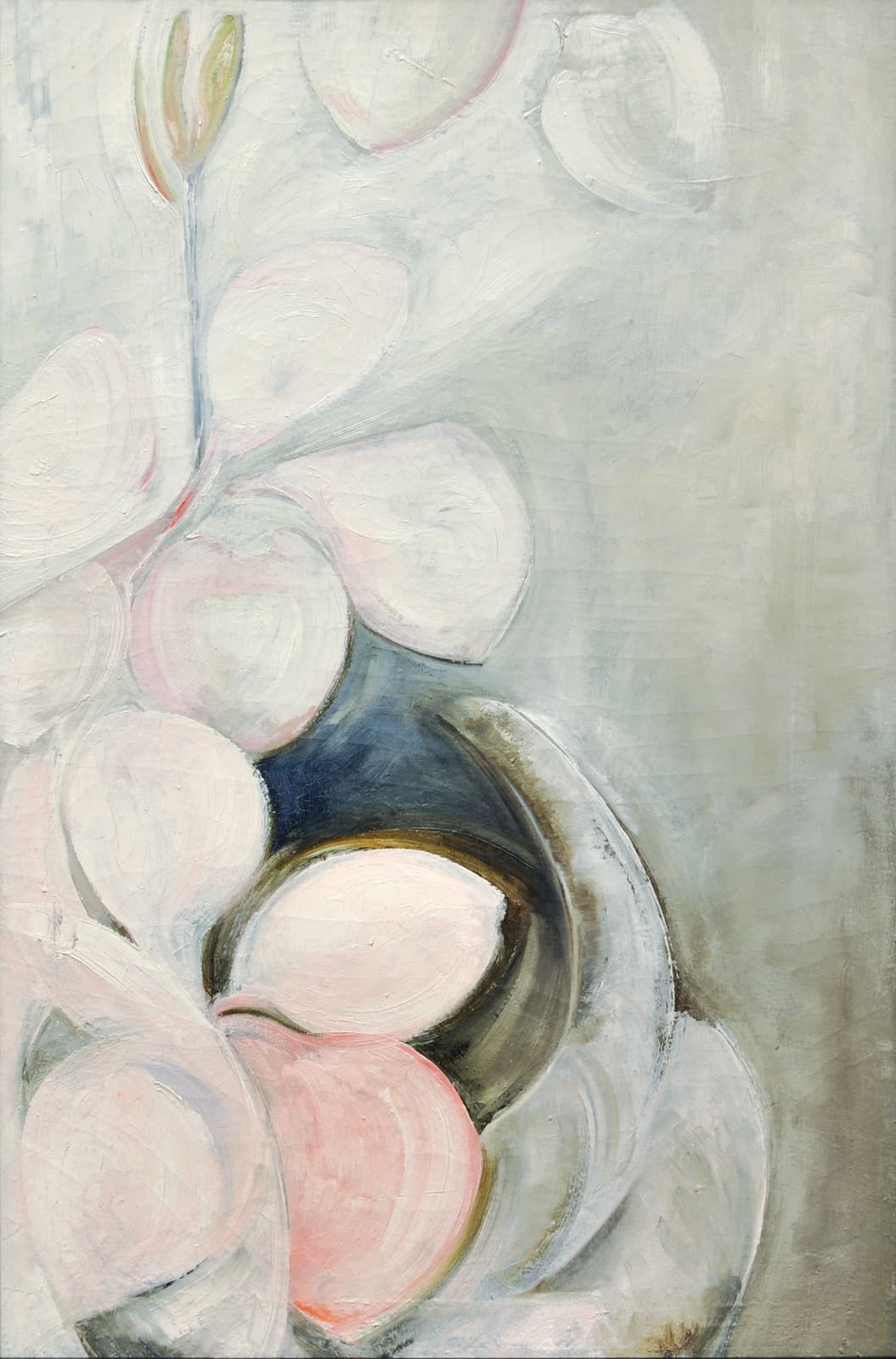
Magnolia petals fill the canvas at close range, painted as overlapping pale lobes of white and pink, with a bud on a bare stem at the top left and a dark bowl holding the lowest blossoms. Zelda Fitzgerald painted it around 1945, in the last years of her life. The Asheville Art Museum owns it and keeps it on view, in the city where she died in 1948.
- circa 1945
- Oil on canvas
- Asheville Art MuseumAsheville, North Carolina, United States
About Zelda Fitzgerald
What the painting shows
The blossoms are seen from very close. Each petal is a rounded lobe of white or pale pink, laid over its neighbours in thick, visible strokes, so that the flowers read as a heap of soft discs rather than as botanical drawing. A bare stem rises at the top left to a single closed bud with two green sepals. At the centre right a dark bowl, painted in navy and brown, holds the lowest blossoms, and its pale rim curves away at the lower right. One petal at the bottom centre is flushed a deep pink; everything else is nearly white.
The ground behind the flowers is a brushed grey-green that warms to beige at the right edge. The museum's one-line description reads: abstract still life, white blossoms against pink ground. In the museum's own photograph the ground reads grey and beige, with the pink confined to the petals.
The canvas measures 36 by 24 inches, 91.4 by 61 centimetres, and 37 1/4 by 25 1/4 inches in its frame.
Flowers, her constant subject
Flowers were the subject Zelda Fitzgerald returned to most. The Johnson Collection in Spartanburg owns her Still Life with Cyclamen. Its account states that her ethereal flowers were probably begun on Capri, where she took her first painting lessons in the winter of 1925, and that she sometimes heightened her watercolours with gouache. Eleanor Lanahan, her granddaughter, has written that she always painted flowers, that it was one of her great solaces, and that she imbued them with symbolism and gave them liberally as gifts.
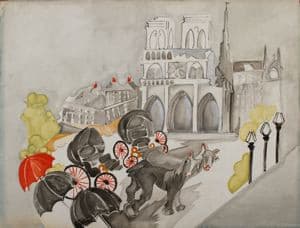
The Montgomery Museum of Fine Arts holds two more flower oils by her, White Flowers in a Vase and Poppies. The Asheville catalogue entry of 2021 lists floral paintings beside paper dolls and Cubist cityscapes as her subjects, and calls Japanese Magnolias a close-up view of Japanese magnolia blossoms.
Asheville and the last years
The museum dates the canvas to about 1945. Zelda Fitzgerald spent those years between her mother's house in Montgomery and Highland Hospital in Asheville, which she had first entered in 1936 and where she died in a fire on the night of 10 March 1948. The museum's 2025 label for the exhibition Flora Symbolica: The Art of Flowers dates most of her work to the last fourteen years of her life. She made it, including many paintings of flowers, while a patient at an Asheville psychiatric hospital.
The 2021 catalogue entry, by Graham Boettcher, records that she took up art in earnest in 1925 and became a skilled painter in both watercolour and oil. It states that she exhibited her work only once during her lifetime and remained largely unknown as an artist until the late twentieth century. It also records that her family destroyed much of her art after her death.
The one lifetime exhibition it counts is the New York show of 1934, thirteen paintings and fifteen drawings at Cary Ross's studio. She had also been photographed with her oil White Roses in October 1933 to promote the Independent Artists' Exhibition at the Baltimore Museum of Art, according to the Scott and Zelda Fitzgerald Museum, which showed that painting in 2023.
How it reached the museum
Ted Mitchell gave the painting to the Asheville Art Museum in memory of Edna Mitchell, and it carries accession number 1997.04.21. The museum showed it in Intersections in American Art from September 2019, published it in Asheville Art Museum: An Introduction to the Collection in 2021, and wrote a new label for Flora Symbolica: The Art of Flowers in March 2025.
Its online record marked the canvas on view in September 2026. The museum is at 2 South Pack Square in Asheville, North Carolina. The record's copyright field for the painting reads No Copyright, Non-Commercial Use Only.
Close reading
Reading the work, detail by detail
The flowers are so close that the canvas cannot hold them. Start with the bud on its bare stem at the top left, then the dark bowl, the one deep pink petal, the pale petals at the top right and the brushed grey ground.
1.The bud on its stem
A bare stem rises from the blossoms to a single closed bud with two green sepals. It is the only green in the picture, and the only part of the plant painted thinly enough to show the weave of the canvas.
2.The dark bowl
The bowl is the darkest thing on the canvas, painted in navy and brown with the blossoms sitting in it. Its far side is a curved band of grey, so the bowl reads as a hollow rather than a shape.
3.The deep pink petal
One petal at the bottom is a deep pink with a red edge, the strongest colour on the canvas. The museum's description speaks of a pink ground, but in its own photograph the pink is here, in the petals, and the ground is grey.
4.The pale petals at the top right
At the top right the petals are painted almost the colour of the ground, as pale rounded lobes with a faint pink rim. They are the flowers furthest from the bowl and the closest to disappearing.
5.The rim of the bowl
The rim curves away to the lower right in long grey strokes, wider than the bowl's dark interior would suggest. It gives the blossoms something to sit in without ever becoming a vase on a table.
6.The petals at the left edge
The petals at the left edge are cut off by the frame, so the flowers continue beyond the canvas. The paint is thick and the strokes follow the curve of each lobe, which is what makes the petals read as soft.
7.The brushed ground
The ground is grey-green at the centre and beige at the right edge, painted in horizontal strokes that never quite cover the canvas. Nothing in it says table, wall or window; the flowers hang in it.
Timeline
1925
Takes up art in earnest, in the Asheville Art Museum's account, with her first lessons on Capri that winter.
1936
Enters Highland Hospital in Asheville, which becomes her main hospital for the rest of her life.
c. 1945
Paints Japanese Magnolias, on the museum's dating.
1948
Dies in the fire at Highland Hospital on the night of 10 March.
1997
Given to the Asheville Art Museum by Ted Mitchell in memory of Edna Mitchell, as accession 1997.04.21.
2019
Shown in Intersections in American Art at the museum from 11 September.
2021
Published in Asheville Art Museum: An Introduction to the Collection, with an entry by Graham Boettcher.
2025
Labelled for Flora Symbolica: The Art of Flowers by Jessica Orzulak and Robin S. Klaus in March.
Where to see it
Asheville Art Museum
Asheville, North Carolina, United States
A public viewing address has not yet been confirmed for this holding.
The museum's online record marked the painting on view in September 2026. Displays change, so check the record before making a special visit.
Frequently asked questions
Where is Japanese Magnolias by Zelda Fitzgerald?
At the Asheville Art Museum, 2 South Pack Square, Asheville, North Carolina, accession number 1997.04.21. The museum's online record marked it on view in September 2026; displays change, so check before travelling.
What does Japanese Magnolias show?
Magnolia blossoms seen from very close, painted as overlapping rounded petals of white and pale pink in thick strokes, with a single bud on a bare stem at the top left and a dark bowl holding the lowest flowers. One petal at the bottom is a deep pink, and the ground is a brushed grey-green.
When did Zelda Fitzgerald paint Japanese Magnolias?
About 1945, on the museum's dating, in the last years of her life. She died in Asheville in March 1948.
Did Zelda Fitzgerald paint many flowers?
Yes. Her granddaughter Eleanor Lanahan has written that she always painted flowers, as a solace and as gifts. The Johnson Collection owns her Still Life with Cyclamen, the Montgomery Museum of Fine Arts holds White Flowers in a Vase and Poppies, and the Fitzgerald Museum in Montgomery showed her oil White Roses in 2023.
Why is a Montgomery painter's picture in Asheville?
Zelda Fitzgerald was a patient at Highland Hospital in Asheville from 1936, returning when her illness worsened, and died there in a fire in 1948. Ted Mitchell gave the painting to the Asheville Art Museum in memory of Edna Mitchell; the museum's record does not say where the canvas was before that.
How big is Japanese Magnolias?
36 by 24 inches, about 91.4 by 61 centimetres, oil on canvas, in upright format. In its frame it measures 37 1/4 by 25 1/4 inches.
More by Zelda Fitzgerald
If you like Zelda Fitzgerald
Explore painters from the same movements and circles.

William S. Burroughs
American Beat novelist, essayist, performer and visual artist who completed Naked Lunch at the Beat Hotel in Paris and made cut-up writing a defining avant-garde method.
View artist
Leonora Carrington
English painter and writer who fled a debutante's future for Surrealist Paris at twenty, survived the war's wreckage of that life — internment for her lover Max Ernst, an asylum in Spain for her — and rebuilt herself in Mexico into one of the century's great painters of the uncanny.
View artist
Giorgio de Chirico
Italian painter whose metaphysical cityscapes helped shape Surrealism. The MNAC's 2018 Gala exhibition records that he valued her practical intelligence and asked her to act as his agent.
View artist
References
The sources below include collection records, catalogues, scholarly research, and primary materials that informed this page. They document Japanese Magnolias, its making, and its place in cultural history.


1Zelda Sayre Fitzgerald, Japanese Magnolias (circa 1945) — object record
WebsiteAsheville Art MuseumUsed forThe holding museum's object record: title, date, medium, dimensions, credit line, copyright field, on-view status, exhibition list and its 2021 and 2025 labels.
2Zelda Sayre Fitzgerald — artist record, Asheville Art Museum collection
WebsiteAsheville Art MuseumUsed forThe museum's artist record: first lessons on the 1924–26 European stay, painting kept up until her death, and the loss of most of her work.
3Zelda Fitzgerald — artist page
WebsiteThe Johnson Collection, Spartanburg, South CarolinaUsed forFlowers probably begun on Capri, sometimes heightened with gouache; the collection's Still Life with Cyclamen.
4Zelda by Herself
WebsiteHalsey Institute of Contemporary Art, College of Charleston, 2003Used forEleanor Lanahan on the flowers her grandmother always painted and gave away.
5Zelda Sayre Fitzgerald — artist record and biography, MMFA online collection
WebsiteMontgomery Museum of Fine ArtsUsed forThe Capri lessons of winter 1925, the 1934 show, and the museum's list of her works, including White Flowers in a Vase and Poppies.
6Exhibition of Zelda Sayre Fitzgerald's "Lost" "White Roses"
WebsiteThe Scott & Zelda Fitzgerald Museum, 2023Used forThe October 1933 photograph with White Roses for the Baltimore Museum of Art's Independent Artists' Exhibition, and the 2023 showing.
7Zelda Sayre Fitzgerald
WebsiteEncyclopedia of AlabamaUsed forHer hospital years and death at Highland Hospital, Asheville.
These references provide the documented foundation for this work's history and interpretation. Claim-level citations remain attached to the specific claims they support.
 Explore more resources