Notre Dame de Paris
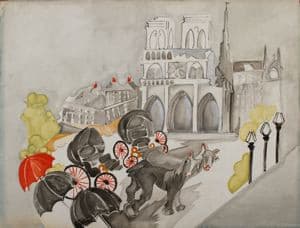
The west front of Notre-Dame stands in grey wash at the top of the sheet, with the spire rising behind it. Below it a wet square fills with black umbrellas, two horse-drawn carriages with red-spoked wheels and a line of street lamps. Zelda Fitzgerald painted it around 1944, more than a decade after she last saw Paris. The Montgomery Museum of Fine Arts holds it as a gift from her daughter, Frances Fitzgerald Smith.
- about 1944
- Watercolor and graphite on paper
- Montgomery Museum of Fine ArtsMontgomery, Alabama, United States
About Zelda Fitzgerald
What the sheet shows
The cathedral fills the upper right of the sheet: two square towers, the rose window between them, the three deep portals below, and the spire rising behind the roof. All of it is grey wash over pencil, and the paper shows through as sky.
The square in front is wet. A row of black umbrellas crosses the lower left, one of them orange. Two carriages with tall red-spoked wheels wait at the centre, one under a black hood, and a dark horse with a wide doe's eye pulls the nearer one off to the right. Three street lamps stand in a line at the right edge, and yellow-green foliage bunches at both sides. A low grey building at the left carries small red flags.
The Montgomery Museum of Fine Arts reads the sheet the same way. Its record describes a grey tonality that suggests a twentieth-century urban pall, transformed by the charming carriages with their doe-eyed horses and the row of umbrellas. The sparkle, the museum says, comes from bright touches of red, yellow-green and orange.
Paris painted from memory
Zelda Fitzgerald did not paint Notre-Dame from the pavement. The museum dates the sheet to about 1944 and states that it was most likely painted in the early 1940s, inspired by her memories of the 1920s. It belongs to a series of cityscapes of Paris and New York that she made around 1944.
The memories were long ones. The Fitzgeralds spent much of the 1920s in France, and the museum records that in 1924 Gerald Murphy and Sara Murphy introduced her to the circle of Pablo Picasso, Jean Cocteau and Fernand Léger. She took her first formal painting lessons on the island of Capri in the winter of 1925. In Paris she came to know the Russian designers who painted for Sergei Diaghilev's Ballets Russes, and from 1928 she trained in ballet there under Lubov Egorova.
She returned to the United States for good in 1931, after the breakdown of April 1930 that ended her dancing. The New York half of the same series survives with her family: Times Square, a gouache of about 1944 in the collection of Samuel J. Lanahan, travelled in the estate's touring exhibition between 2000 and 2007.
How it reached Montgomery
The sheet belongs to the Montgomery Museum of Fine Arts, in the city where Zelda Fitzgerald was born and where she lived with her family between hospital stays in the 1940s. Its accession number, 1986.0004.0010, places it in a group given in 1986 by her daughter, Frances Fitzgerald Smith, known as Scottie. The same gift brought the museum her paper dolls.
The museum owns thirty watercolours and oil paintings by her, most of them from that gift, and states that the majority of her surviving works remain with her descendants. Most of the pictures shown in her one New York exhibition, in 1934, are unlocated today, and her family destroyed an unknown number after her death.
The museum's online record for the sheet does not say whether it is on view, so a visitor should check before travelling.
Close reading
Reading the work, detail by detail
The cathedral is grey and the square below it is wet. Start with the two towers and the spire behind them, then come down to the umbrellas, the carriages, the doe-eyed horse and the three lamps that give the sheet its red, orange and yellow-green.
1.The towers and the three portals
The front of the cathedral is built up in grey washes over pencil, with the paper showing through above the towers. The three portals are the darkest marks on the sheet, and the rose window sits between the towers as a pale ring.
2.The spire behind the roof
The spire rises to the right of the towers, thinner than anything else on the sheet. It is the flèche that stood over the crossing until the fire of 2019, so the picture records a skyline that no longer exists.
3.The row of umbrellas
The umbrellas are painted as overlapping black domes with no people under them, so the crowd reads as a row of shapes. One is orange and one red, two of the bright touches the museum's record singles out.
4.The horse and the carriages
The horse has the wide, dark eye the museum calls doe-eyed, and the two carriages have wheels taller than the umbrellas, with their spokes picked out in red. Grey shafts and hoods tie them to the grey square.
5.The three street lamps
Three lamps stand at the right edge, their posts drawn as straight black lines and their lanterns as small dark heads. They are the only verticals in the lower half of the sheet apart from the cathedral itself.
6.The red flags on the building
A low building runs along the left side of the square, and its front carries small red marks, flags or awnings. With the orange umbrella and the red wheel spokes, they are the warm notes the museum credits with making the scene sparkle.
7.The yellow-green foliage
The trees are painted as rounded yellow-green blobs at both edges, wetter and looser than the cathedral. They mark the season as much as anything on the sheet does.
Timeline
1924
The Fitzgeralds sail for France. Gerald Murphy and Sara Murphy introduce Zelda Fitzgerald to the circle of Pablo Picasso, Jean Cocteau and Fernand Léger.
1925
Takes her first formal painting lessons on Capri in the winter, according to the Montgomery Museum of Fine Arts.
1928
Trains in ballet under Lubov Egorova, formerly of the Imperial Russian Ballet, in Paris.
1931
Returns permanently to the United States after the breakdown of April 1930.
c. 1944
Paints Notre Dame de Paris from memory, as one of a series of Paris and New York cityscapes.
1986
Given to the Montgomery Museum of Fine Arts by Frances Fitzgerald Smith, as accession 1986.0004.0010.
Where to see it
Montgomery Museum of Fine Arts
Montgomery, Alabama, United States
A public viewing address has not yet been confirmed for this holding.
The museum's online record does not state whether the sheet is on view. Check with the museum before making a special visit.
Frequently asked questions
Where is Notre Dame de Paris by Zelda Fitzgerald?
At the Montgomery Museum of Fine Arts in Montgomery, Alabama, accession number 1986.0004.0010, given by her daughter Frances Fitzgerald Smith in 1986. The museum's online record does not say whether it is on view, so check before making a special visit.
When did Zelda Fitzgerald paint Notre Dame de Paris?
About 1944, according to the museum, which places it in a series of Paris and New York cityscapes made around that year. She had left France in 1931, so the picture was painted from memory.
What does Notre Dame de Paris show?
The west front of the cathedral, with its two towers, rose window and three portals and the spire behind, above a wet square. A row of umbrellas crosses the lower left, two carriages with red-spoked wheels wait at the centre, a doe-eyed horse pulls one of them, and three street lamps stand at the right. It is grey wash over pencil with touches of red, orange and yellow-green.
Did Zelda Fitzgerald live in Paris?
Yes. The Fitzgeralds spent much of 1924 to 1931 in France, in Paris and on the Riviera. She took her first painting lessons on Capri in the winter of 1925 and trained in ballet under Lubov Egorova in Paris from 1928, until her breakdown in April 1930.
What is Notre Dame de Paris painted with?
Watercolour and graphite on paper. The sheet measures 34.3 by 45.1 centimetres, about thirteen and a half by seventeen and three-quarter inches.
Why is Notre Dame de Paris so grey?
The museum reads the grey tonality as a twentieth-century urban pall, which the carriages, the doe-eyed horses and the umbrellas transform. The sparkle comes from small touches of red, yellow-green and orange laid over the grey.
More by Zelda Fitzgerald
If you like Zelda Fitzgerald
Explore painters from the same movements and circles.
William S. Burroughs
American Beat novelist, essayist, performer and visual artist who completed Naked Lunch at the Beat Hotel in Paris and made cut-up writing a defining avant-garde method.
View artist
Leonora Carrington
English painter and writer who fled a debutante's future for Surrealist Paris at twenty, survived the war's wreckage of that life — internment for her lover Max Ernst, an asylum in Spain for her — and rebuilt herself in Mexico into one of the century's great painters of the uncanny.
View artist
Giorgio de Chirico
Italian painter whose metaphysical cityscapes helped shape Surrealism. The MNAC's 2018 Gala exhibition records that he valued her practical intelligence and asked her to act as his agent.
View artist
References
The sources below include collection records, catalogues, scholarly research, and primary materials that informed this page. They document Notre Dame de Paris, its making, and its place in cultural history.


1Zelda Sayre Fitzgerald, Notre Dame de Paris (about 1944) — object record
WebsiteMontgomery Museum of Fine ArtsUsed forThe holding museum's object record: title, date, medium, dimensions, credit line and its reading of the picture.
2Zelda Sayre Fitzgerald — artist record and biography, MMFA online collection
WebsiteMontgomery Museum of Fine ArtsUsed forThe museum's artist biography: the Murphys, the Capri lessons of 1925, the Ballets Russes designers, the 1934 show and the thirty works it owns.
3Zelda Sayre Fitzgerald, Circus (about 1938) — object record
WebsiteMontgomery Museum of Fine ArtsUsed forThe museum's note that she lived most of her later life with her Montgomery family, receiving periodic treatment.
4Zelda Fitzgerald — artist page
WebsiteThe Johnson Collection, Spartanburg, South CarolinaUsed forHer ballet study in Paris with a teacher from the Diaghilev troupe, the breakdown of April 1930 and her return to the United States in 1931.
5Fitzgerald, Zelda (1900–1948)
WebsiteEncyclopedia.comUsed forLubov Egorova and the Paris ballet years from 1928.
6Zelda: By Herself — The Art of Zelda Fitzgerald, Berman Museum of Art
WebsiteResource Library, Traditional Fine Arts Organization, 2001Used forTimes Square, c. 1944, gouache on paper, collection of Samuel J. Lanahan, in the touring show.
7Zelda by Herself: The Art of Zelda Fitzgerald — touring exhibition, 2000–2007
WebsiteInternational Arts & ArtistsUsed forThe estate's touring exhibition of 2000–2007 and its venues.

8New picture of Zelda emerges by herself
PeriodicalThe Baltimore Sun, 1996Used forThe 1940s cityscapes of New York and Paris in the family's collection.
These references provide the documented foundation for this work's history and interpretation. Claim-level citations remain attached to the specific claims they support.
 Explore more resources