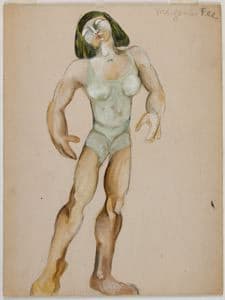
Morgan Le Fay (Paper Doll)
A figure in a pale green leotard stands on a sheet of cream academy board, dark hair to her shoulders, her arms and legs far too muscular for her small head, and her name written at the top right. She is Morgan Le Fay, the enchantress of the King Arthur legends, one of seven paper dolls with painted costumes that Zelda Fitzgerald made around 1941. The Montgomery Museum of Fine Arts received the set from her daughter in 1986.
- about 1941
- Watercolor and graphite on academy board
- Montgomery Museum of Fine ArtsMontgomery, Alabama, United States
About Zelda Fitzgerald
What the doll shows
The doll stands facing forward on a piece of cream board, 28.7 by 13.3 centimetres, with nothing painted behind her. Her hair is dark green-black and falls to her shoulders around a small pale face. She wears a one-piece leotard in pale green, cut like a bathing suit. The rest of her is bare: long arms with big hands held away from her sides, thick thighs that narrow to long calves, and large feet planted apart. Her name is written in pencil in the top right corner.
Two painted costumes go with her, catalogued separately by the museum, one 29.5 by 14.6 centimetres and one 29.2 by 15.2 centimetres, both on paper. The museum describes the method for the whole group: the figures were carefully conceived, drawn in pencil, and then washed with watercolour and gouache.
Who she is, and who she stands with
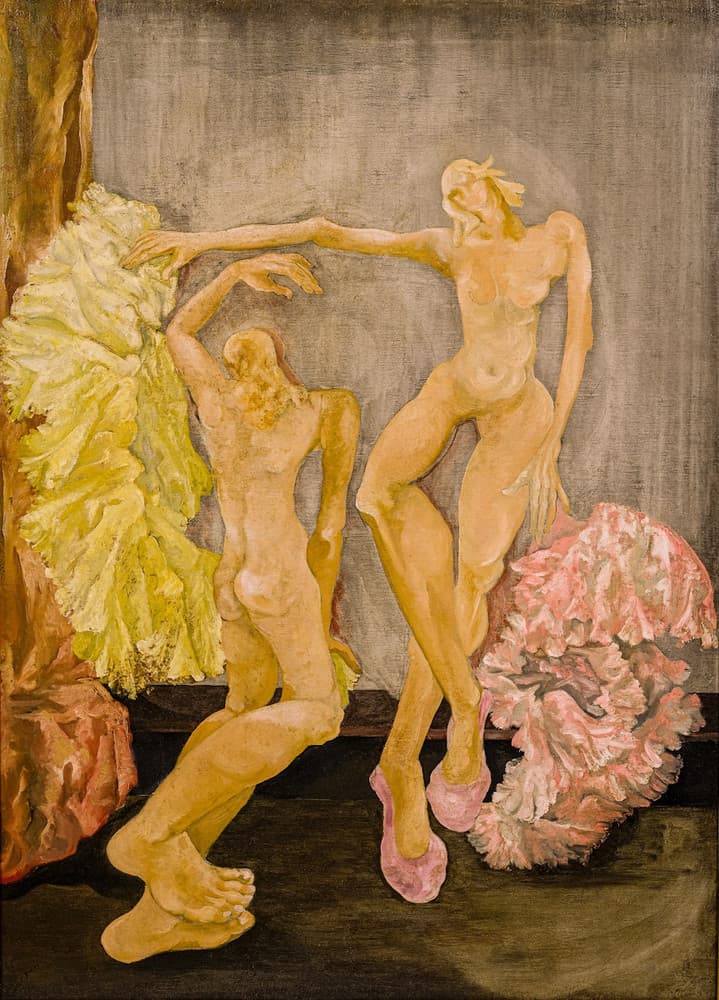
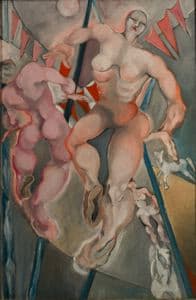
Morgan Le Fay is the enchantress of the legends of King Arthur. She belongs to a group of seven dolls at the museum, five of them from the Arthurian legend, Percival, Galahad, Gewaine, Erwaine and Morgan Le Fay, and two from the fairy tale, Hansel and Gretel. The museum notes their theatrical flair and finds in them the muscular but graceful figures of her oils, recalling her ties to the ballet and to stage design.
The museum dates the dolls to about 1941. In the same record it suggests they most likely date from very late in her life, perhaps after Scottie's marriage in 1943. Both statements stand on the museum's page, and neither is documented further.
From the nursery to a publisher
The first paper dolls were for her daughter. The museum records that Zelda Fitzgerald made them for Scottie in the 1920s, the decade the family spent largely in France, as playthings, and that she later made another set for her first grandchild. Eleanor Lanahan, her granddaughter, has written that when her brother Tim was born in 1946 Zelda Fitzgerald set to work making him a luscious collection of paper dolls.
By 1941 she wanted them published. In March 1941 she wrote to Maxwell Perkins, her husband's editor at Charles Scribner's Sons, asking about a publisher for the dolls. The dolls are charming, she wrote, and there isn't any reason why children shouldn't learn while having a good time. That August the Montgomery Advertiser described an installation of her paper dolls in the Children's Room. They were in no way ordinary paper dolls, it reported, but paintings after modern French painters, which she believed the best way to introduce children to the trends in contemporary painting.
The museum reports both documents. The letter is in the archives of Charles Scribner's Sons at Princeton University Library, and the museum states that around the same time she painted bowls and trays that she sold for pin money.
At the museum
The seven dolls and their costumes came to the museum in 1986 from Frances Fitzgerald Smith, known as Scottie, in the gift that also brought Notre Dame de Paris. Morgan Le Fay (Paper Doll) carries accession number 1986.0004.0006.0002; her costumes are 1986.0004.0006.0001 and 1986.0004.0006.0003.
From 28 February to 1 June 2025 the museum showed the group as Zelda Fitzgerald's Paper Dolls in its Weil Graphic Arts Study Center. The Encyclopedia of Alabama illustrates the doll with her two costumes as a triptych. The museum's online record does not say whether she is on view now.
Close reading
Reading the work, detail by detail
A doll with the muscles of a dancer, standing on bare board. Start with the name written at the top right, then the face and hair, the pale green leotard, the big hands, the thighs and the feet planted apart.
1.The name in the corner
The name is written by hand in the top right corner of the board, the only text on the object. It is what identifies the figure as Morgan Le Fay rather than any other woman of the Arthurian set.
2.The face and the hair
The hair is painted dark green-black and falls to the shoulders around a small pale face. The eyes are dark marks, and the features are drawn with the same pencil that outlines the body.
3.The pale green leotard
The doll wears a one-piece leotard in pale green, cut like a bathing suit, and nothing else. Her costumes are separate objects, and the museum catalogues two of them under their own accession numbers.
4.The big hands
The hands are large and held away from the sides, each finger drawn separately. The museum finds in the dolls the muscular but graceful figures of her oils, and the hands are where the muscle shows first.
5.The thighs
The thighs are as thick as the torso and narrow sharply to the calves, the proportions of her ballet pictures rather than of a child's toy. The museum records that she made paper dolls after modern French painters.
6.The feet planted apart
The feet are large and set apart, so the doll stands square on the board. The stance is a dancer's, and the museum notes that the dolls recall her ties to the ballet and to stage design.
7.The bare board
Nothing is painted around the figure. The cream academy board is left bare to the edges, which is how a paper doll is made: the figure is meant to be cut out and dressed.
Timeline
1920s
Makes her first paper dolls for her daughter Scottie, as playthings, during the family's years in France.
1941
Writes to Maxwell Perkins in March asking about a publisher for the dolls. In August the Montgomery Advertiser reports an installation of them in the Children's Room.
c. 1941
Makes the King Arthur and fairy-tale dolls now at the museum, on its dating; the museum also suggests a date after 1943.
1946
Makes a collection of paper dolls for her first grandchild, Tim Lanahan, according to Eleanor Lanahan.
1986
Frances Fitzgerald Smith gives the seven dolls and their costumes to the Montgomery Museum of Fine Arts.
2025
Shown in Zelda Fitzgerald's Paper Dolls at the museum's Weil Graphic Arts Study Center, 28 February to 1 June.
Where to see it
Montgomery Museum of Fine Arts
Montgomery, Alabama, United States
A public viewing address has not yet been confirmed for this holding.
Shown in Zelda Fitzgerald's Paper Dolls at the museum's Weil Graphic Arts Study Center, 28 February to 1 June 2025. The online record does not state whether the doll is on view now.
Frequently asked questions
Who is Morgan Le Fay in Zelda Fitzgerald's paper dolls?
The enchantress of the King Arthur legends, one of five Arthurian figures in the set of seven dolls at the Montgomery Museum of Fine Arts, with Percival, Galahad, Gewaine and Erwaine. Hansel and Gretel complete the group. She has two painted costumes of her own.
Where are Zelda Fitzgerald's paper dolls?
Seven dolls with their costumes are at the Montgomery Museum of Fine Arts, given by her daughter Frances Fitzgerald Smith in 1986; Morgan Le Fay is accession 1986.0004.0006.0002. Others remain with her family, whose paper-doll constructions toured with the estate's exhibition Zelda by Herself between 2000 and 2007.
When did Zelda Fitzgerald make the paper dolls?
The museum dates the King Arthur dolls to about 1941 and also suggests they may date from after her daughter's marriage in 1943. Her first dolls were made for Scottie in the 1920s, and she made a set for her grandson Tim in 1946.
Did Zelda Fitzgerald try to publish her paper dolls?
Yes. In March 1941 she wrote to Maxwell Perkins at Scribner's asking about a publisher, calling the dolls charming and arguing that children could learn while having a good time. No edition appeared in her lifetime.
What are the paper dolls made of?
The doll is watercolour and graphite on academy board, 28.7 by 13.3 centimetres; her costumes are on paper. The museum describes the figures as drawn in pencil and then washed with watercolour and gouache.
Can you see Morgan Le Fay at the museum?
The museum showed the whole group from 28 February to 1 June 2025 in its Weil Graphic Arts Study Center. Its online record does not say whether the doll is on view now, so check before visiting.
More by Zelda Fitzgerald
If you like Zelda Fitzgerald
Explore painters from the same movements and circles.
William S. Burroughs
American Beat novelist, essayist, performer and visual artist who completed Naked Lunch at the Beat Hotel in Paris and made cut-up writing a defining avant-garde method.
View artist
Leonora Carrington
English painter and writer who fled a debutante's future for Surrealist Paris at twenty, survived the war's wreckage of that life — internment for her lover Max Ernst, an asylum in Spain for her — and rebuilt herself in Mexico into one of the century's great painters of the uncanny.
View artist
Giorgio de Chirico
Italian painter whose metaphysical cityscapes helped shape Surrealism. The MNAC's 2018 Gala exhibition records that he valued her practical intelligence and asked her to act as his agent.
View artist
References
The sources below include collection records, catalogues, scholarly research, and primary materials that informed this page. They document Morgan Le Fay (Paper Doll), its making, and its place in cultural history.

1Zelda Sayre Fitzgerald, Morgan Le Fay (Paper Doll) (about 1941) — object record
WebsiteMontgomery Museum of Fine ArtsUsed forThe holding museum's object record: title, date, medium, dimensions, credit line, the related costumes and its account of the seven dolls.
2Zelda Sayre Fitzgerald — artist record and biography, MMFA online collection
WebsiteMontgomery Museum of Fine ArtsUsed forThe museum's artist biography: the dolls for Scottie and for her first grandchild, the March 1941 letter to Maxwell Perkins, the Montgomery Advertiser of 17 August 1941, and the bowls and trays.
3Zelda Fitzgerald's Paper Dolls — exhibition, 28 February – 1 June 2025
WebsiteMontgomery Museum of Fine Arts, 2025Used forThe 2025 exhibition at the Weil Graphic Arts Study Center, with Morgan Le Fay and Gewaine named.
4Zelda by Herself
WebsiteHalsey Institute of Contemporary Art, College of Charleston, 2003Used forEleanor Lanahan on the paper dolls made for her brother Tim in 1946.
5Zelda Sayre Fitzgerald
WebsiteEncyclopedia of AlabamaUsed forIllustrates Morgan Le Fay with her costumes as a triptych.
6Zelda by Herself: The Art of Zelda Fitzgerald — touring exhibition, 2000–2007
WebsiteInternational Arts & ArtistsUsed forThe estate's touring show of watercolours and paper-doll constructions, 2000–2007.
7Zelda Fitzgerald Papers finding aid
WebsitePrinceton University LibraryUsed forHer papers at Princeton University Library, which also holds the Scribner archive containing the 1941 letter.
These references provide the documented foundation for this work's history and interpretation. Claim-level citations remain attached to the specific claims they support.
 Explore more resources