Ballerinas
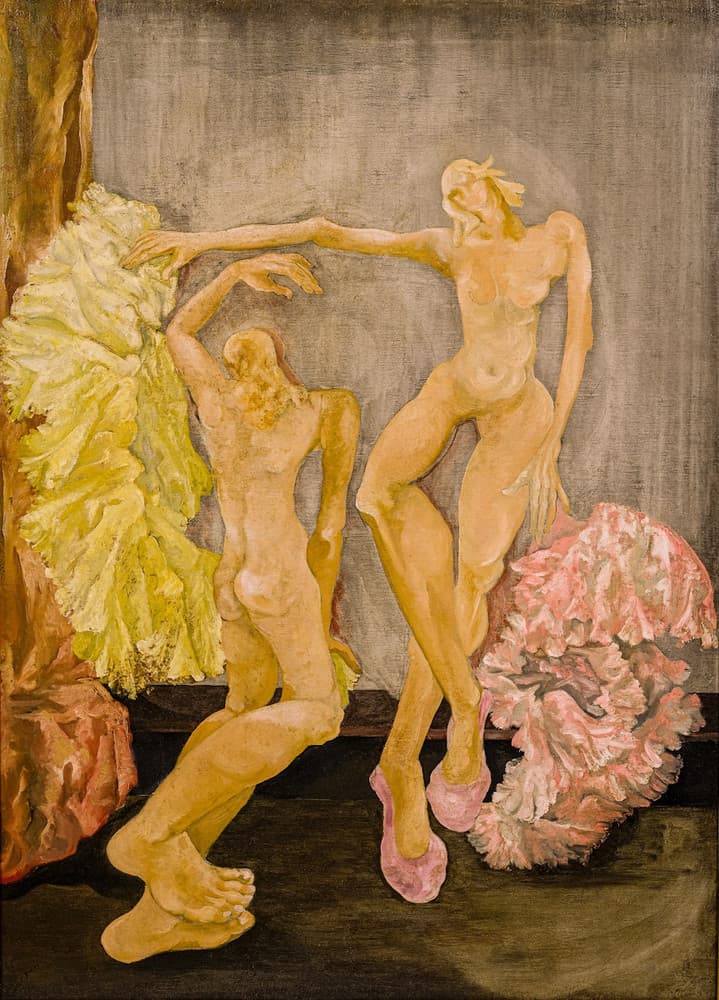
Two nude dancers with enlarged hands and feet rehearse in front of a grey wall, one seated on the floor and one standing on a single leg in pink ballet slippers, their hands meeting above their heads. Zelda Fitzgerald painted the canvas around 1933, three years after the breakdown that ended her own ballet training in Paris. The Montgomery Museum of Fine Arts records it as her own gift, made in 1942.
- about 1933
- Oil on canvas
- Montgomery Museum of Fine ArtsMontgomery, Alabama, United States
About Zelda Fitzgerald
What the painting shows
Two figures, painted in orange-tan, occupy a bare floor in front of a grey wall. The standing dancer at the right balances on one leg with her head thrown back and her short yellow hair flying. One arm stretches out to the left and the other hangs behind her. She wears pink slippers, one flat on the floor at the centre of the canvas and one raised behind her.
The seated dancer at the left has her back to the viewer. Her right arm goes up over her head so that her hand meets the standing dancer's at the top centre, and her legs stretch to the lower left. They end in a foot as long as her torso, with the toenails painted.
A yellow-green ruffled tutu hangs at the left in front of a red-orange curtain, and a pink one lies crumpled on the floor at the right. A dark ledge runs along the base of the wall. Legs and feet are far larger than any body could carry, and the museum indexes the picture under tutu, drape, dancing and ballet.
The canvas measures 92.1 by 66.7 centimetres, about thirty-six by twenty-six inches.
The ballet years behind it
Zelda Fitzgerald took up ballet again at twenty-seven, in 1927, and from 1928 trained in Paris under Lubov Egorova, a former ballerina of the Imperial Russian Ballet in St Petersburg. She practised for up to eight hours a day and was offered a place with a company in Naples in 1929. In April 1930 she broke down, and her dancing ended in the clinics that followed.
The Montgomery Museum of Fine Arts connects that training to her painting. Gerald Murphy and Sara Murphy, it records, had studied with Natalia Goncharova, who designed for Sergei Diaghilev's Ballets Russes, and her own study of dance with a member of Diaghilev's troupe brought her into closer contact with avant-garde stage design. The museum describes her style as based loosely on design elements taken from artists working in that field.
The 1934 show and a picture with enlarged feet
In 1934 F. Scott Fitzgerald arranged the one exhibition of her painting held in her lifetime. His letter of 26 March 1934 to the critic Gilbert Seldes announced that Zelda's paintings would be exhibited at 525 East 86th Street from Thursday on. Cary Ross, a friend of the couple, showed thirteen paintings and fifteen drawings in his studio there from 29 March to 30 April, with a small collateral display in the lobby of the Algonquin Hotel. At her request the show was titled Parfois la Folie est la Sagesse, sometimes madness is wisdom.
Time reviewed it on 9 April 1934 under the heading Work of a Wife. It called the show her latest bid for fame and the pictures the work of a brilliant introvert, vividly painted and intensely rhythmic. One sentence describes a ballet picture: a pinkish reminiscence of her ballet days showed figures with enlarged legs and feet.
Ballerinas is dated about 1933 by the museum and shows exactly those features. Whether Time's reviewer was looking at this canvas is not documented. The museum's record lists no exhibition history for it, and the museum states that most of the paintings Cary Ross showed are unlocated today.
Given by the artist
The Montgomery Museum of Fine Arts records Ballerinas as a gift of the artist under accession number 1942.0003, which places the gift in 1942. She lived most of her later life with her family in Montgomery, the museum notes, receiving periodic treatment for her illness. Ballerinas was the second of three gifts she made to the museum: Hope, accessioned in 1938, and Circus, in 1943, came the same way.
The museum has also placed a reproduction of the painting on Google Arts & Culture, with the rights line Montgomery Museum of Fine Arts, Montgomery, Alabama; gift of the artist. Its own online record does not say whether the canvas is on view.
Close reading
Reading the work, detail by detail
Two dancers, one seated and one standing, and a pair of tutus that nobody is wearing. Start where the two hands meet at the top, then follow the standing dancer down to her pink slippers and the seated dancer down to a foot the size of her torso.
1.Where the hands meet
The standing dancer reaches across to the left and the seated dancer reaches up, and their hands meet at the top centre against the grey wall. The fingers are long and separate, painted with the same care as the feet.
2.The head thrown back
The standing dancer's head is thrown so far back that her face is a profile of chin and nose, with yellow hair flying above it. Nothing in the picture looks at the viewer.
3.The pink slippers
The standing dancer's slippers are the only clothing on either figure. One foot is flat on the floor at the centre of the canvas and the other is raised behind her, so she balances on a single leg.
4.The enormous foot
The seated dancer's leg ends in a foot as long as her torso, with each toenail painted. Time's reviewer in 1934 saw figures with enlarged legs and feet in her ballet picture, and the museum dates this canvas to about 1933.
5.The yellow tutu and the curtain
A yellow-green tutu hangs at the left, its ruffles painted in short curling strokes, in front of a red-orange curtain that runs the height of the canvas. The dancers have taken the costumes off, or not yet put them on.
6.The pink tutu on the floor
The second tutu lies on the floor at the right, a heap of pink ruffles behind the standing dancer's raised leg. Its pink matches the slippers, and the museum indexes the picture under tutu and drape.
7.The seated dancer's back
The seated dancer turns her back, and her spine and shoulder blades are painted as a few dark lines on the orange-tan skin. Her head drops forward while her arm goes up, so the body pulls two ways at once.
Timeline
1927
Returns to ballet at twenty-seven, an obsessive pursuit in the Montgomery Museum of Fine Arts' account.
1928
Trains in Paris under Lubov Egorova, formerly of the Imperial Russian Ballet, for up to eight hours a day.
1929
Offered a place with a ballet company in Naples in September.
1930
Breaks down in April and enters a clinic outside Paris. Her dancing ends.
c. 1933
Paints Ballerinas, on the museum's dating.
1934
Cary Ross shows thirteen of her paintings and fifteen drawings at 525 East 86th Street, New York, from 29 March to 30 April. Time describes a ballet picture with enlarged legs and feet.
1942
Gives Ballerinas to the Montgomery Museum of Fine Arts, which accessions it as 1942.0003.
Where to see it
Montgomery Museum of Fine Arts
Montgomery, Alabama, United States
A public viewing address has not yet been confirmed for this holding.
The museum's online record does not state whether the canvas is on view. Check with the museum before making a special visit.
Frequently asked questions
Where is Ballerinas by Zelda Fitzgerald?
At the Montgomery Museum of Fine Arts in Montgomery, Alabama, accession number 1942.0003, which records it as a gift of the artist. The museum's online record does not say whether it is on view. A reproduction is on Google Arts & Culture.
What does Ballerinas show?
Two nude dancers in front of a grey wall. One stands on a single leg in pink slippers with her head thrown back. The other sits on the floor with her back turned, one arm raised so that their hands meet above them, her legs stretched out to an enormous foot. A yellow-green tutu hangs at the left and a pink one lies on the floor at the right.
Was Ballerinas in Zelda Fitzgerald's 1934 exhibition?
It is not documented. Time's review of the show on 9 April 1934 described a pinkish reminiscence of her ballet days, with figures with enlarged legs and feet. That fits the canvas. The museum's record lists no exhibition history for it, and the museum states that most of the paintings shown in 1934 are unlocated.
Why are the feet in Ballerinas so large?
Enlarged legs and feet were her habit, noticed by Time in 1934. The curator Everl Adair describes her ballet pictures as elongated figures with enlarged appendages and knotted muscles, and compares them with Thomas Hart Benton and Paul Cadmus. The Montgomery Museum of Fine Arts says of her Circus that bodies with bulging muscles are intentionally distorted and elongated.
When did Zelda Fitzgerald train as a ballet dancer?
She returned to ballet at twenty-seven in 1927 and trained in Paris under Lubov Egorova from 1928, practising up to eight hours a day. A Naples company offered her a place in September 1929. Her breakdown in April 1930 ended the training.
How big is Ballerinas?
92.1 by 66.7 centimetres, oil on canvas, about thirty-six and a quarter by twenty-six and a quarter inches, in upright format.
More by Zelda Fitzgerald
If you like Zelda Fitzgerald
Explore painters from the same movements and circles.

William S. Burroughs
American Beat novelist, essayist, performer and visual artist who completed Naked Lunch at the Beat Hotel in Paris and made cut-up writing a defining avant-garde method.
View artist
Leonora Carrington
English painter and writer who fled a debutante's future for Surrealist Paris at twenty, survived the war's wreckage of that life — internment for her lover Max Ernst, an asylum in Spain for her — and rebuilt herself in Mexico into one of the century's great painters of the uncanny.
View artist
Giorgio de Chirico
Italian painter whose metaphysical cityscapes helped shape Surrealism. The MNAC's 2018 Gala exhibition records that he valued her practical intelligence and asked her to act as his agent.
View artist
References
The sources below include collection records, catalogues, scholarly research, and primary materials that informed this page. They document Ballerinas, its making, and its place in cultural history.


1Zelda Sayre Fitzgerald, Ballerinas (about 1933) — object record
WebsiteMontgomery Museum of Fine ArtsUsed forThe holding museum's object record: title, date, medium, dimensions, credit line and keywords.
2Ballerinas — Zelda Fitzgerald, Montgomery Museum of Fine Arts
WebsiteGoogle Arts & CultureUsed forThe museum's reproduction as served by Google Arts & Culture, with its rights line.
3Zelda Sayre Fitzgerald — artist record and biography, MMFA online collection
WebsiteMontgomery Museum of Fine ArtsUsed forThe museum's artist biography: ballet at twenty-seven, the Murphys and Goncharova, the Diaghilev troupe, and the 1934 show with its dates, address and title.
4Zelda Sayre Fitzgerald, Circus (about 1938) — object record
WebsiteMontgomery Museum of Fine ArtsUsed forThe museum on her stage-design-based style and her later life in Montgomery; her 1943 gift.
5Zelda Sayre Fitzgerald, Hope (about 1938) — object record
WebsiteMontgomery Museum of Fine ArtsUsed forHer 1938 gift to the museum.

6Art: Work of a Wife
PeriodicalTime, 1934Used forThe 9 April 1934 review: the ballet picture with enlarged legs and feet, and her Paris study under Egorova.
7F. Scott Fitzgerald, two typed letters signed to Gilbert Seldes, 1934 and 1936 — lot 57, Fine Books and Manuscripts including Americana
WebsiteSotheby's, 2008Used forF. Scott Fitzgerald's letter of 26 March 1934 announcing the show at 525 East 86th Street, and the Algonquin showing.
8A Tincture of Madness: Zelda Fitzgerald and Modernist Art
WebsiteResource Library, Traditional Fine Arts Organization, 2005Used forEverl Adair on the enlarged appendages and knotted muscles of her ballet figures.
9Fitzgerald, Zelda (1900–1948)
WebsiteEncyclopedia.comUsed forLubov Egorova, the eight-hour days and the Naples offer of 1929.
10Zelda Fitzgerald — artist page
WebsiteThe Johnson Collection, Spartanburg, South CarolinaUsed forThe breakdown of April 1930 and the hospitals that followed.
These references provide the documented foundation for this work's history and interpretation. Claim-level citations remain attached to the specific claims they support.
 Explore more resources