The Paris AtlasCharting the artists, works, and places worth returning to.
  • Artists' model
  • Singer
  • Painter
  • Author
· French · 1901–1953

Kiki de Montparnasse

Alice Prin — model for Soutine, Foujita and Modigliani, Man Ray's partner and the back with the violin f-holes, cabaret singer at Le Jockey, memoirist introduced by Hemingway, painter of a sold-out show, and, by acclamation in 1929, Queen of Montparnasse.

In images

Details

Lived
1901–1953
Born
1901
Birthplace
Châtillon-sur-Seine
Died
1953
Place of death
Paris
Nationality
French
Roles
Artists' modelSingerPainterAuthor
Also known as
Alice Prin

About Kiki de Montparnasse

Kiki de Montparnasse was born Alice Ernestine Prin in Burgundy in 1901, illegitimate and poor, and came to Paris at twelve to work in workshops and bakeries. By seventeen she was modelling — for Chaïm Soutine, for Amedeo Modigliani, for Moïse Kisling, and for Tsuguharu Foujita, whose 1922 nude of her, Reclining Nude with Toile de Jouy, was the sensation of the Salon d'Automne.[1]

In late 1921 she met Man Ray, and for six years was his partner and the face — and back — of his best-known images: Le Violon d'Ingres, her spine painted with a violin's f-holes, and Noire et Blanche, her sleeping profile beside an African mask. But the passive word muse undersells her on every count: she sang bawdy songs nightly at Le Jockey, acted in avant-garde films including Fernand Léger's Ballet mécanique, sold out an exhibition of her own paintings in 1927, and published a scandalous memoir in 1929 with an introduction by Ernest Hemingway. The same year the quarter crowned her its queen.[1]

Alice Prin

She was born on 2 October 1901 at Châtillon-sur-Seine in Burgundy, raised in her grandmother's crowded house with five other illegitimate cousins, and sent to Paris at twelve to join her mother and earn — a bindery, a bakery, an errand round. At about seventeen a sculptor asked her to pose, her mother called the work prostitution, and Alice chose the studios; Montparnasse renamed her Kiki within a couple of years.[2]

Kiki at about nineteen, by Gustaw Gwozdecki — the year before Man Ray. (Gustaw Gwozdecki, via Wikimedia Commons · Public domain)

The painters found in her exactly what the academies could not supply: presence. Chaïm Soutine painted her; Amedeo Modigliani drew her; Kisling's portraits of her multiplied; and Foujita's 1922 nude of Kiki on a toile de Jouy sheet made the Japanese painter the most talked-about artist in Paris and its model the most recognizable body in the quarter.[1]

The violin back

She met Man Ray at a café table in late 1921 — she was being refused service for not wearing a hat, he took her side — and moved into his life and his photographs for six stormy years. Le Violon d'Ingres of 1924, her bare back turned into a violin with two painted f-holes, became one of the most reproduced photographs ever made; Noire et Blanche, in 1926, set her closed-eyed face beside a Baule mask. In 2022 a print of the Violon sold for 12.4 million dollars, the record for any photograph at auction.[1]

Kiki walking with Foujita in 1926, photographed by Iwata Nakayama. (Iwata Nakayama, via Wikimedia Commons · Public domain)

The camera was only one of her stages. She sang at Le Jockey on the boulevard du Montparnasse — filthy Burgundian café songs delivered deadpan in black hose, to a room that included everyone history now files under Paris in the twenties — and appeared in the era's experimental films: Fernand Léger's Ballet mécanique and Man Ray's L'Étoile de mer among them.[3]

Queen of Montparnasse

In 1927 the Galerie au Sacre du Printemps hung an exhibition of Kiki's own paintings — direct, funny, faux-naïf scenes of sailors, fairs and Burgundy — and it sold out. In 1929 came Kiki's Memoirs, dictated candour about poverty, modelling and the quarter, with an introduction in which Ernest Hemingway declared it the best book he had read since The Enormous Room and its author a woman who had never been a lady, but had been a queen. The US authorities banned the translation, which guaranteed its fame. That same year Montparnasse made Hemingway's word official, electing her Queen of Montparnasse at a gala at the Bobino.[1]

The reign had nowhere to go but down. She ran her own cabaret, Chez Kiki, in the 1930s, kept singing as the quarter's fame drained toward Saint-Germain, and slid through the war years into cocaine and drink. She collapsed and died in Paris on 29 April 1953, aged fifty-one, and was buried in Thiais cemetery with Foujita among the mourners at a funeral the old Montparnasse turned out for. Man Ray photographed her to the end of her beauty; the quarter, people said at the graveside, was buried with her.[1]

Foujita's nude

The painting that made Kiki famous before Man Ray's photographs of her did was Tsuguharu Foujita's Reclining Nude with Toile de Jouy, shown at the Salon d'Automne in 1922.[1]

Foujita painted her stretched out on a patterned cloth, in his own manner: a fine ink outline over a milk-white ground he had spent years working out, so that the skin has no shadow in it at all. The picture was the sensation of the Salon and sold for a sum that changed both their lives.

It also fixed the arrangement of the quarter. Kiki modelled for Foujita, Soutine, Kisling, Per Krohg and others across the 1920s, and a Montparnasse painter's route to a Salon success frequently ran through her.[1]

On film

Kiki appears in several of the experimental films made in Paris in the 1920s, which is where the still photographs of her start moving.

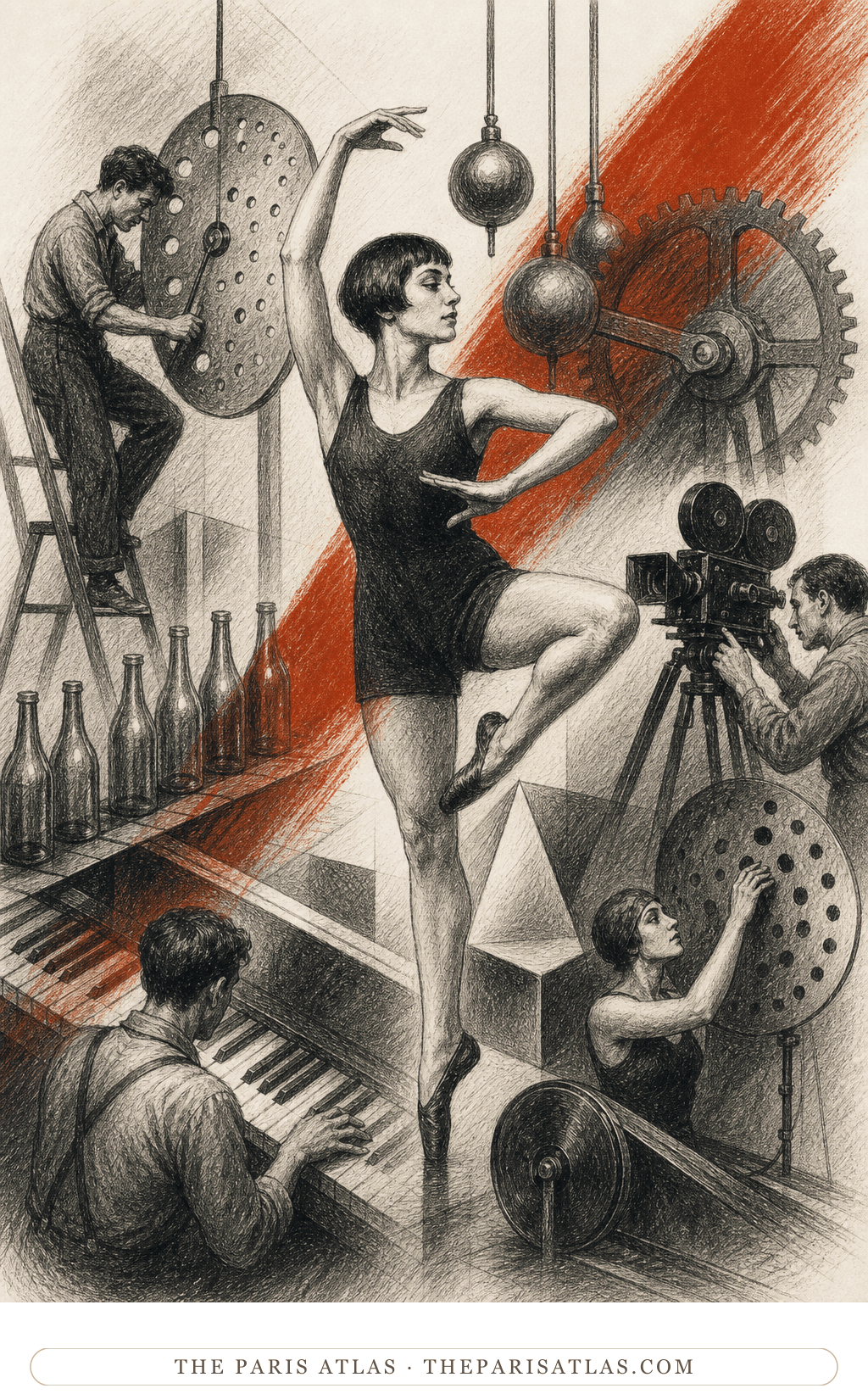
Ballet mécanique, made in 1924 by Fernand Léger with Dudley Murphy, returns again and again to her face, her eyes and her lips in close-up. They are cut against pistons, gears, kitchen implements and a woman climbing a flight of stairs on a loop. The film has no story at all, and it is one of the founding works of abstract cinema.[1]

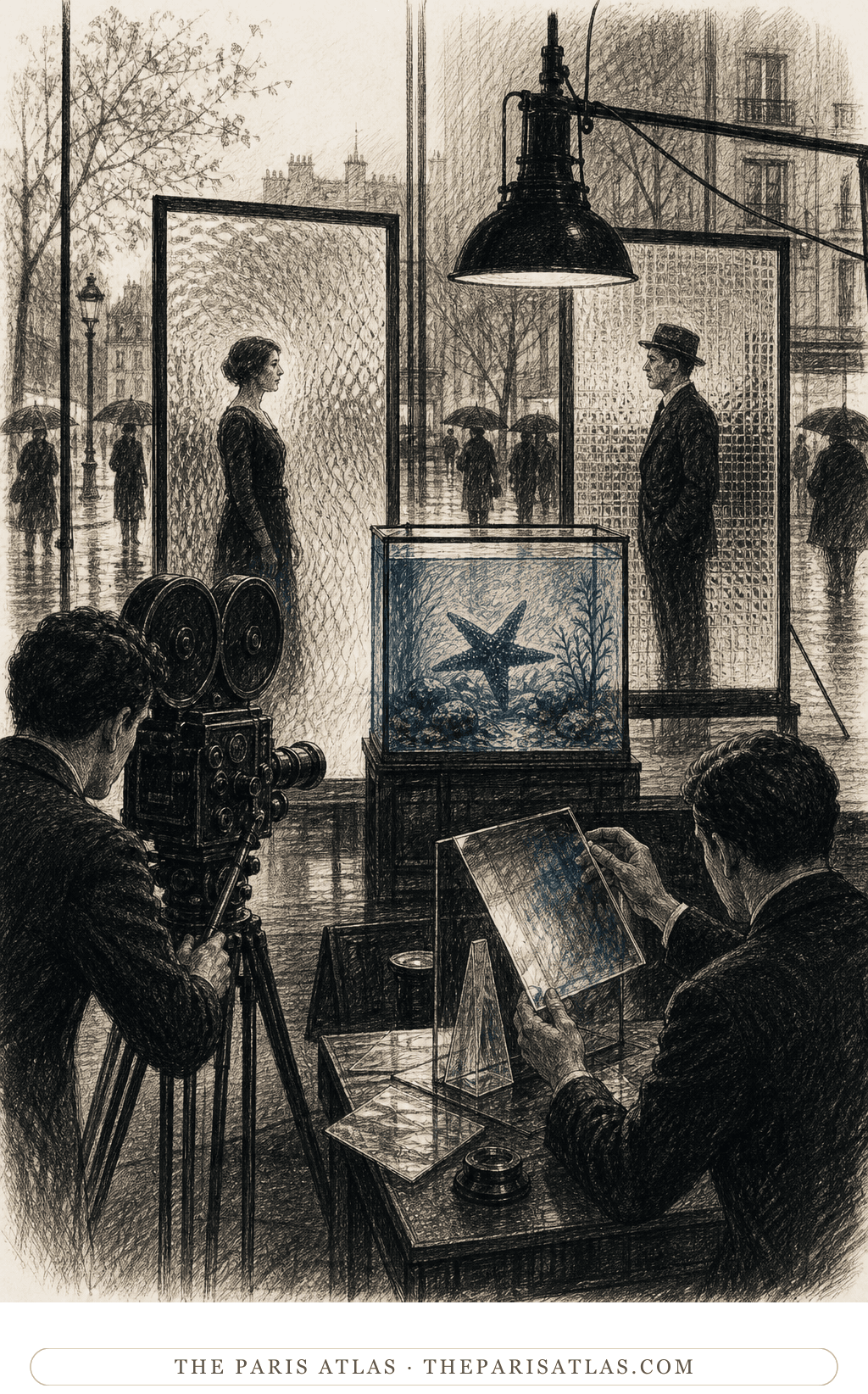
Man Ray put her in Emak-Bakia in 1926, in a shot where she opens her eyes to reveal a second pair painted on her closed eyelids. In L'Étoile de mer, from 1928, built on a poem by Robert Desnos, she is the woman seen through distorting glass for most of the film's fifteen minutes.[1]

The memoirs

Kiki published her memoirs in Paris in 1929, at twenty-eight, written in her own unschooled French and dictated in part to friends.[2]

The English edition came out the following year from the Black Manikin Press, and Ernest Hemingway wrote the introduction — something he did for almost nobody. He said the book was the closest thing to a novel about that Paris that anyone had produced, and that Kiki had never been a lady at any time.[2]

United States customs banned the English edition as obscene, and it did not circulate legally there for decades. The book is now a primary source on Montparnasse in the 1920s, and one of the very few written from the model's side of the easel.[1]

Life events

  1. 1901

    Born Alice Ernestine Prin on 2 October at Châtillon-sur-Seine, Burgundy.

    — Billy Klüver and Julie Martin, Kiki's Paris: Artists and Lovers 1900–1930 (1989)

  2. 1913

    Sent to Paris at twelve to work — bindery, bakery, errands.

    — Kiki de Montparnasse (Alice Prin), Kiki's Memoirs (Souvenirs) (1929); Billy Klüver and Julie Martin, Kiki's Paris: Artists and Lovers 1900–1930 (1989)

  3. 1918

    Begins modelling in the Montparnasse studios; Soutine, Kisling and Modigliani follow.

    — Kiki de Montparnasse (Alice Prin), Kiki's Memoirs (Souvenirs) (1929); Billy Klüver and Julie Martin, Kiki's Paris: Artists and Lovers 1900–1930 (1989)

  4. 1921

    Meets Man Ray at a café table in the autumn; six years as his partner and image begin.

    — Billy Klüver and Julie Martin, Kiki's Paris: Artists and Lovers 1900–1930 (1989)

  5. 1922

    Foujita's nude of her is the sensation of the Salon d'Automne.

    — Billy Klüver and Julie Martin, Kiki's Paris: Artists and Lovers 1900–1930 (1989)

  6. 1922

    Tsuguharu Foujita's Reclining Nude with Toile de Jouy, for which she modelled, is the sensation of the Salon d'Automne.

  7. 1924

    Le Violon d'Ingres: Man Ray paints f-holes on her photographed back.

    — Billy Klüver and Julie Martin, Kiki's Paris: Artists and Lovers 1900–1930 (1989)

  8. 1924

    Appears in Fernand Léger and Dudley Murphy's Ballet mécanique, one of the founding works of abstract cinema.

  9. 1926

    Appears in Man Ray's Emak-Bakia, opening her eyes to reveal a second pair painted on her eyelids.

  10. 1927

    Her own paintings sell out at the Galerie au Sacre du Printemps.

    — Billy Klüver and Julie Martin, Kiki's Paris: Artists and Lovers 1900–1930 (1989)

  11. 1928

    Stars in Man Ray's L'Étoile de mer, built on a poem by Robert Desnos.

  12. 1929

    Kiki's Memoirs appears with Hemingway's introduction and is banned in the United States; Montparnasse crowns her its Queen at the Bobino.

    — Billy Klüver and Julie Martin, Kiki's Paris: Artists and Lovers 1900–1930 (1989); Kiki de Montparnasse (Alice Prin), Kiki's Memoirs (Souvenirs) (1929)

  13. 1930

    The English edition of her memoirs appears from the Black Manikin Press with an introduction by Ernest Hemingway, and is banned as obscene in the United States.

  14. 1953

    Dies in Paris on 29 April, aged fifty-one, after years of drink and cocaine; buried at Thiais, with the old quarter at the grave.

    — Billy Klüver and Julie Martin, Kiki's Paris: Artists and Lovers 1900–1930 (1989)

Art Depicting Kiki de Montparnasse

Works with Kiki as their subject.

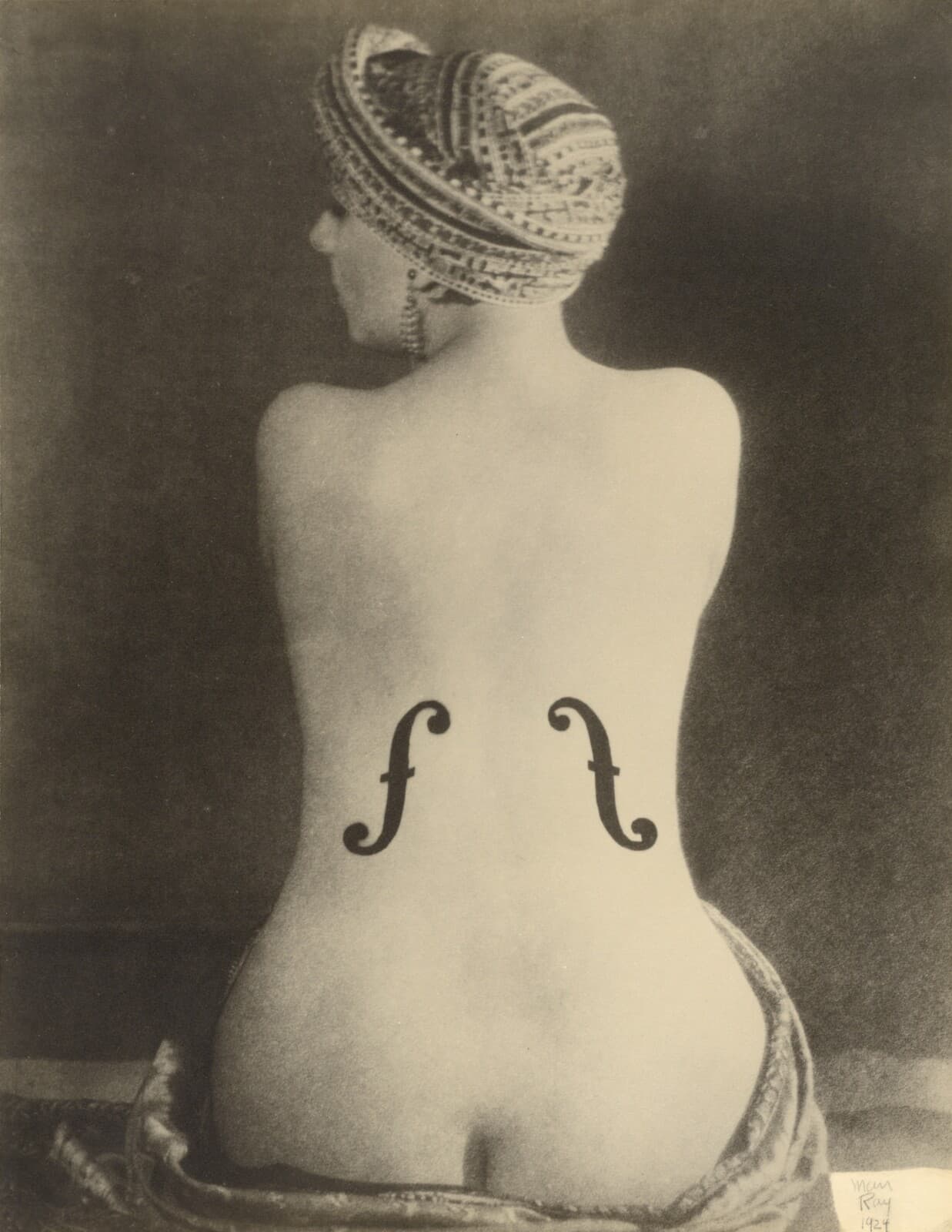
A woman sits with her back to the camera, bare to the hips, her head wrapped in a patterned turban and turned so that only the edge of her profile shows. A long beaded earring hangs clear of her jaw. Two solid black violin f-holes, each with a round eye at either end and a short nick at mid-height, stand on her lower back on either side of the spine, the right one set higher than the left. Patterned cloth is bunched under her hips, and the backdrop darkens from left to right

Artwork reproduction

Photograph

Le Violon d'Ingres

Man Ray · 1924 · Gelatin silver print

A woman sits with her back to the camera, bare to the hips, her head wrapped in a patterned turban and turned so that only the edge of her profile shows. Two black violin f-holes stand on her lower back. Man Ray, born Emmanuel Radnitzky, made the photograph in Paris in 1924 with Kiki de Montparnasse, born Alice Prin. The J. Paul Getty Museum holds this 1924 gelatin silver print as 86.XM.626.10.
J. Paul Getty Museum

Man Ray, Le Violon d'Ingres, 1924. J. Paul Getty Museum. Image © the rights holder, shown under fair use.

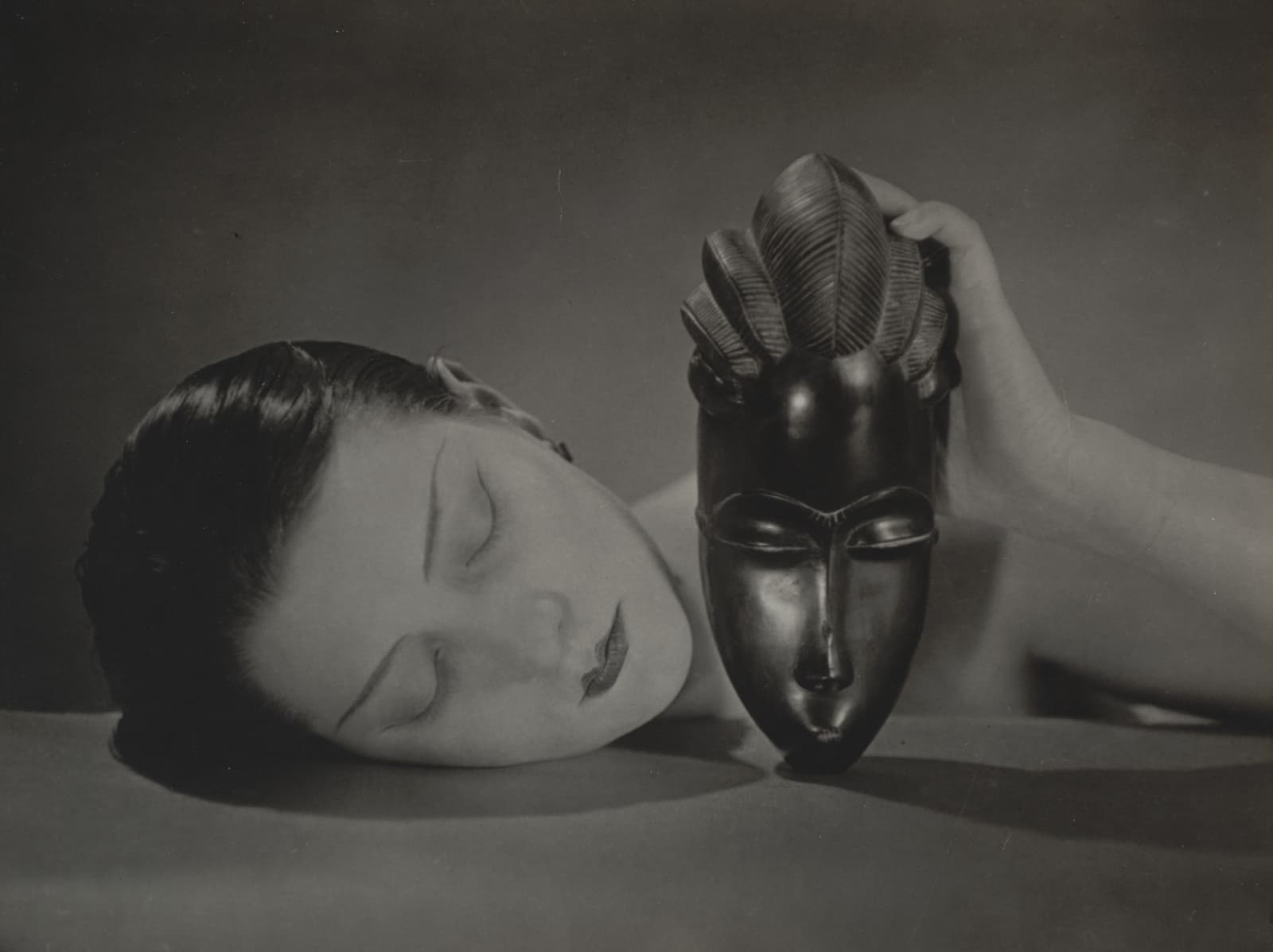
A woman's pale face lies sideways on a table, eyes closed, her short dark hair slicked flat. Beside it a black polished wooden mask with a long oval face and half-closed eyes stands upright on its chin, held at the top by her hand, its crest carved like grooved leaves. Both cast soft shadows on the tabletop against a plain grey background

Artwork reproduction

Photograph

Noire et blanche

Man Ray · 1926 · Gelatin silver print

Kiki de Montparnasse rests her head on a table, eyes closed, beside a black wooden mask that she holds upright. Man Ray made the photograph in Paris in 1926, and Paris Vogue published it that May as Visage de nacre et masque d'ébène. The title Noire et blanche came two years later. The Museum of Modern Art in New York owns this print.

The Museum of Modern Art

Man Ray, Noire et blanche, 1926. The Museum of Modern Art. Image © the rights holder, shown under fair use.

Selected works

Cataloged from the holding institutions' records. Reproductions appear only where the rights are verified.

Paintings

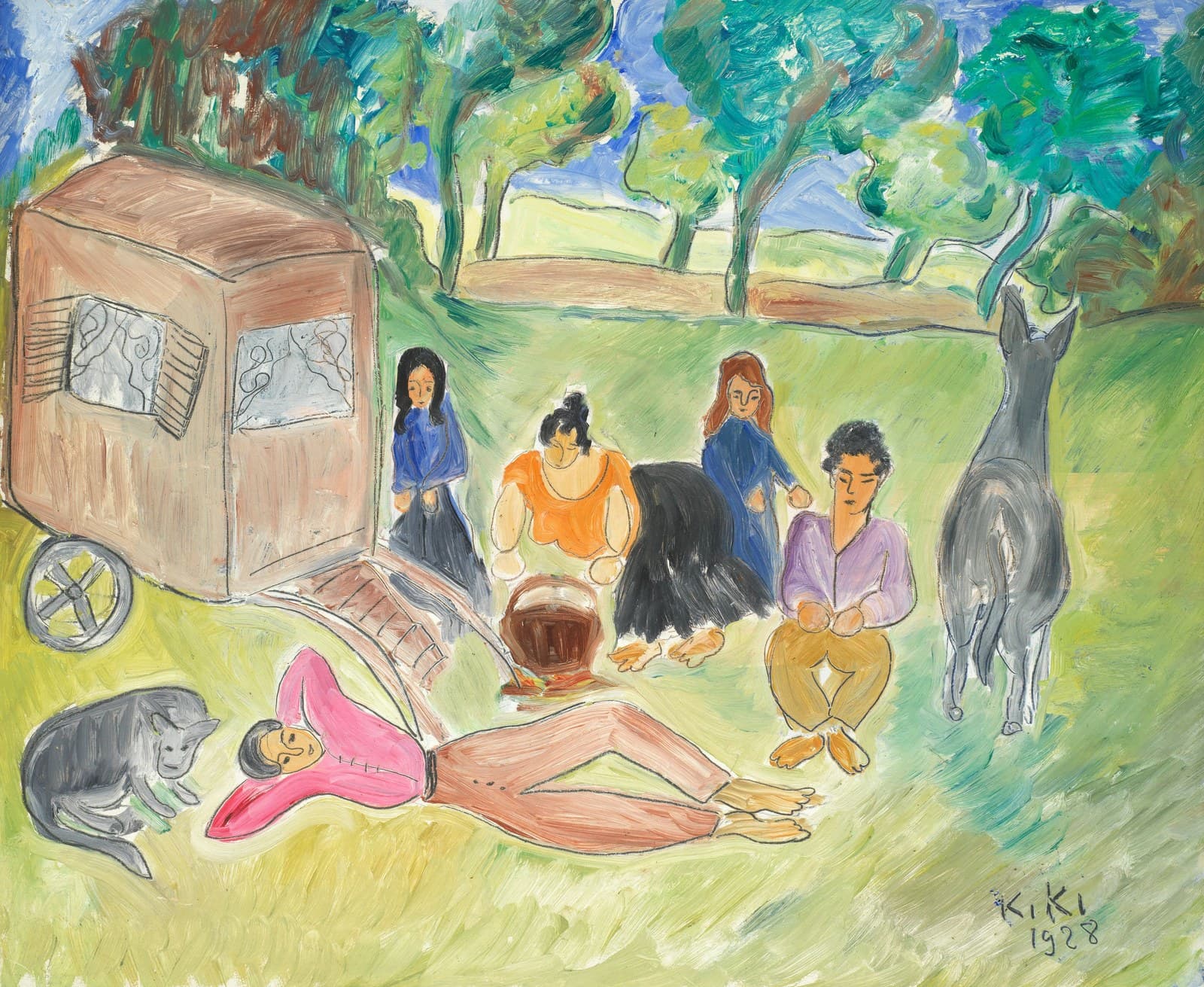
A pink-brown caravan stands at the left edge of a green meadow with a spoked wheel lying flat on the grass beneath it and a slatted plank running down from its door. Five figures in orange, black, blue and lilac stand and crouch around a brown basket on the grass, a grey donkey seen from behind waits at the right, and a person in a pink jacket lies full length across the foreground with one arm folded over their head and a grey cat beside them. Green and blue-green trees and a strip of pale field close the background

Artwork reproduction

Painting

Gitans

1928 · Oil on board

A caravan stands at the edge of a meadow with its wheel off, and five figures gather around a basket on the grass. A donkey waits at the right. One person lies stretched out across the whole foreground with a cat beside them. Kiki de Montparnasse painted it in 1928 and signed it KiKi at the lower right. It belongs to a private collection in the United Kingdom.

Kiki de Montparnasse, Gitans, 1928. Image © the rights holder, shown under fair use.

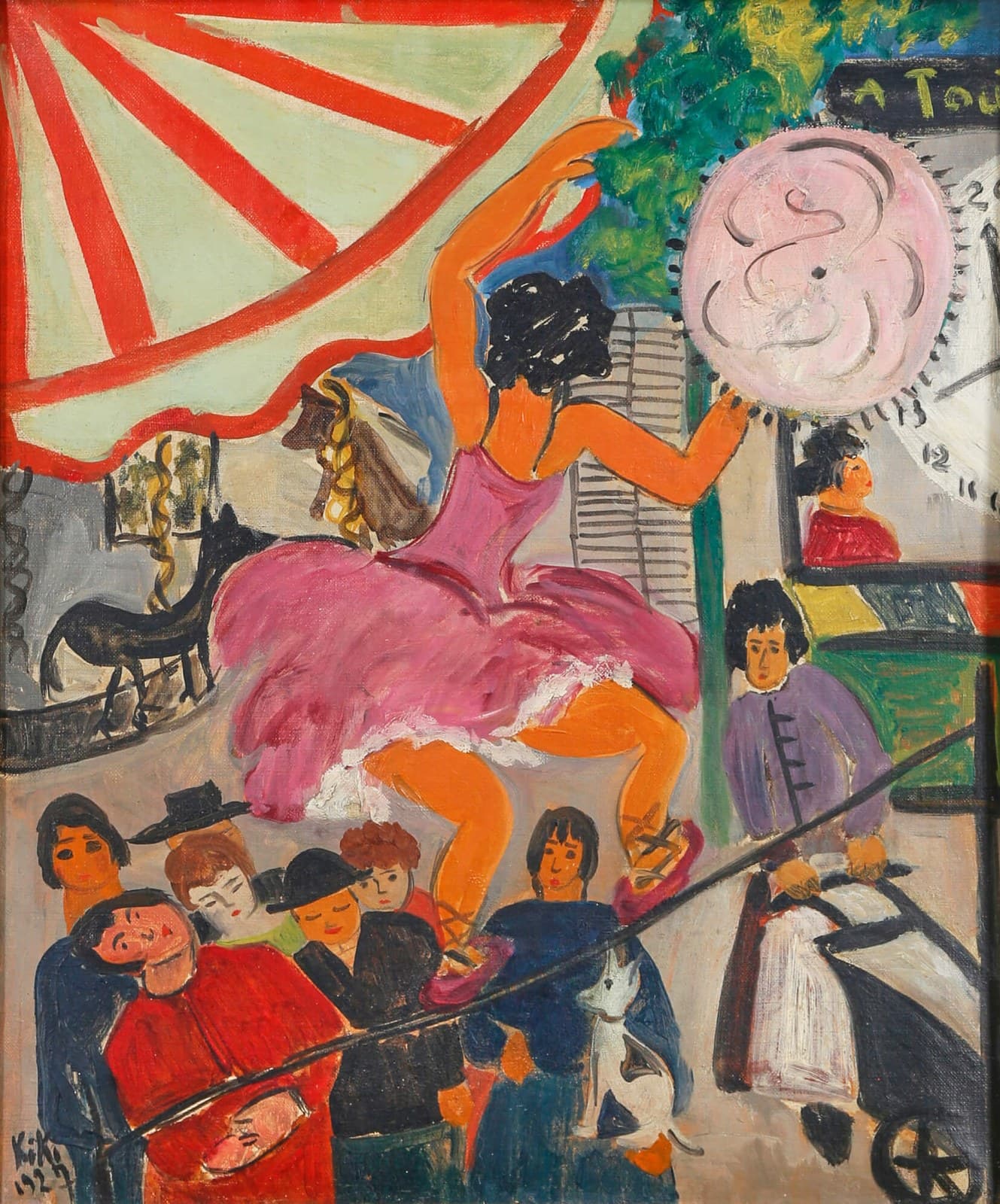
A woman in a pink skirt over a white frilled petticoat dances at a fairground, her arms and legs painted flat orange, her hair a solid black mass. One arm curls above her head; the other hand rests at the rim of a large pale pink disc ringed with short black dashes. A canopy striped red and cream fills the upper left corner, a brown horse's head in a gold braided harness comes forward at the left, and a band of spectators in hats fills the lower quarter with a white and tan dog among them

Artwork reproduction

Painting

The Acrobat

1927 · Oil on canvas

A woman in a pink skirt dances in front of a fairground, one arm curled above her head, the other hand at the rim of a large pale disc. Kiki de Montparnasse painted it in 1927, the year she first exhibited her own canvases at the Galerie au Sacre du Printemps. It is the work of hers that has sold for the most at auction, and it belongs to a private collection in Paris.

Kiki de Montparnasse, The Acrobat, 1927. Image © the rights holder, shown under fair use.

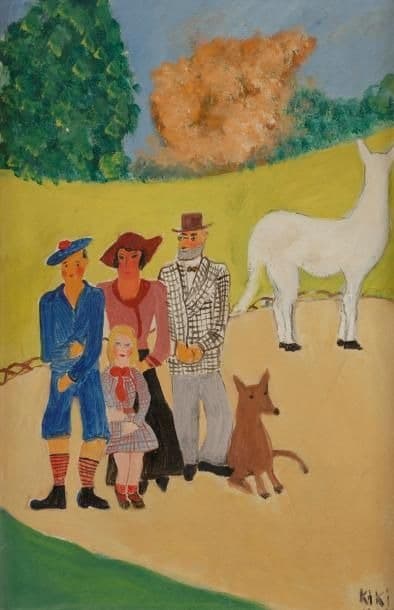
Four figures stand shoulder to shoulder on a pale sandy path crossing a yellow-green slope. At the left a tall figure in a blue jacket and shorts wears a blue bonnet with a red tuft, red and white striped stockings and black boots. Beside them a woman in a dark red wide-brimmed hat wears a pink jacket over a long black skirt. A small blonde girl in a pink checked dress with a red bow stands in front. A bearded man in a dark red bowler hat and wire spectacles wears a black and white checked jacket with pale grey trousers. A tall white animal with a long neck and dark hooves stands on the path at the right. A brown dog with pointed ears sits in the open ground. A dark green tree fills the upper left and an orange-leaved tree stands in the middle distance

Artwork reproduction

Painting

La Famille écossaise

1929 · Oil on canvas

Four figures stand together on a sandy path across a yellow-green slope. A tall white animal with a long neck waits behind them at the right, and a brown dog sits in the open ground. Kiki de Montparnasse signed the canvas Kiki at the lower right and wrote the title and the date on the back of the stretcher. Ader sold it at the Hôtel Drouot on 14 March 2018.

Kiki de Montparnasse, La Famille écossaise, 1929. Image © the rights holder, shown under fair use.

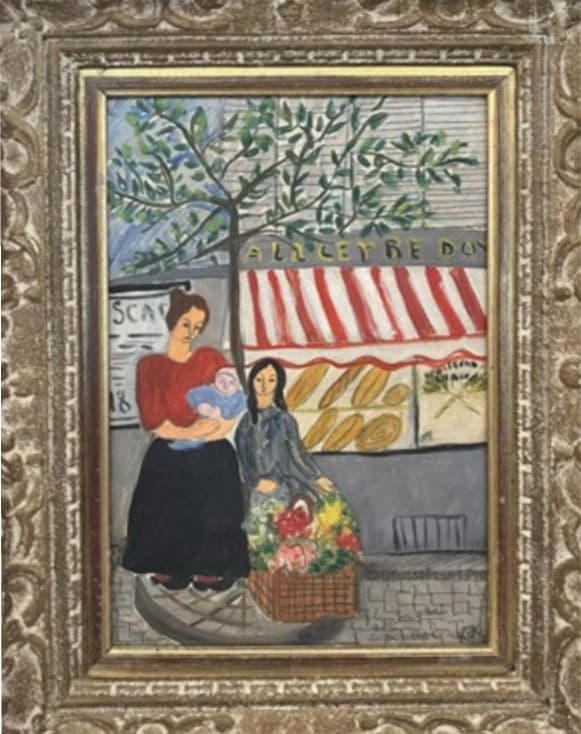
An upright painting in a carved silvered frame. A woman in a dark red blouse and long black skirt stands at the left holding a baby wrapped in blue with a pink cap. A second figure in a blue-grey coat, with long black hair, sits behind a large wicker basket packed with red, pink, white and yellow flowers. Behind them a bakery window shows rows of long golden loaves under a red and white striped awning with a scalloped red valance. A grey fascia above the awning is lettered in pale gold. A tall poster lettered SCA stands at the left edge, and a thin-branched tree crosses the top

Artwork reproduction

Painting

La marchande de fleurs

Undated · Oil on its original canvas

A woman in a red blouse stands on a Paris pavement holding a baby wrapped in blue. A second figure sits behind a wicker basket packed with flowers, in front of a bakery whose red and white awning runs across the picture. Kiki de Montparnasse dedicated the canvas to a friend at the lower right and signed it Kiki. Millon sold it in Paris on 13 June 2024.

Kiki de Montparnasse, La marchande de fleurs, Undated. Image © the rights holder, shown under fair use.

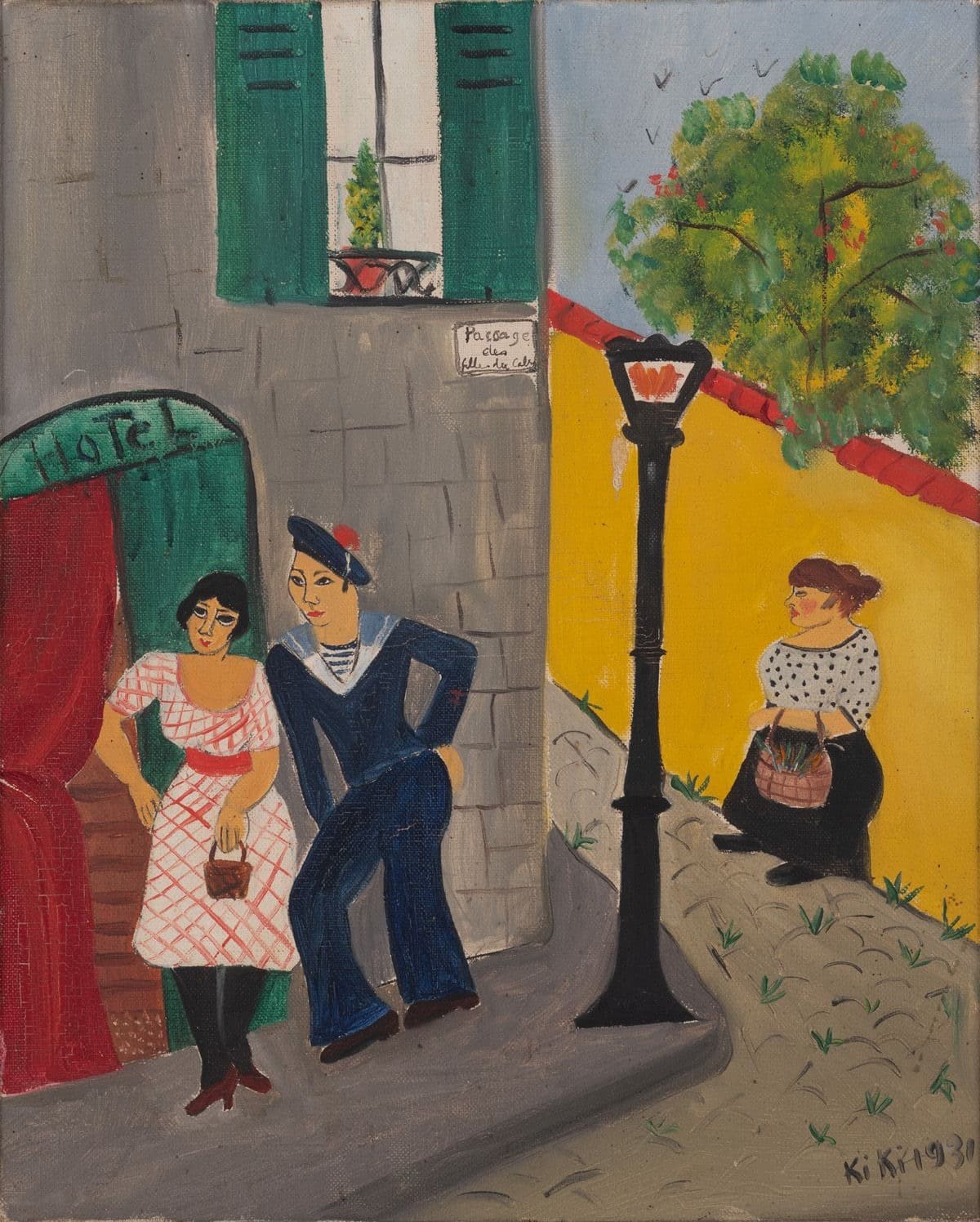
A street corner in flat colour. At the left a green awning lettered Hôtel curves over a doorway with a red curtain inside it. A woman stands in the opening in a white dress cross-hatched in pink with a red sash, black stockings and dark red shoes, holding a small brown basket. A sailor leans against the grey stone beside her with a hand on his hip, in a navy cap with a red pompom, a white square collar over a blue and white striped undershirt, and navy trousers. A small white plaque on the wall reads Passage des filles du Calvaire. A black lamppost with an orange flame in its white lantern rises through the centre. Across the road a second woman in a black-spotted white blouse and long black skirt stands against a yellow wall, a wicker basket of green stems in her hands. A tree with red fruit rises behind the wall, and birds cross a pale blue sky

Artwork reproduction

Painting

Untitled (Sailor Outside a Hotel)

1931 · Oil on canvas

A sailor in navy blue stands at a hotel door beside a woman in a pink checked dress. A painted street sign on the wall above them reads Passage des filles du Calvaire. Across the street a second woman waits against a yellow wall with a basket over her arm. Kiki de Montparnasse signed and dated the canvas KiKi 1931 at the lower right. Piasa catalogued it only as Untitled, and the words in brackets are the atlas's description of what is in the picture, not her title.

Kiki de Montparnasse, Untitled (Sailor Outside a Hotel), 1931. Image © the rights holder, shown under fair use.

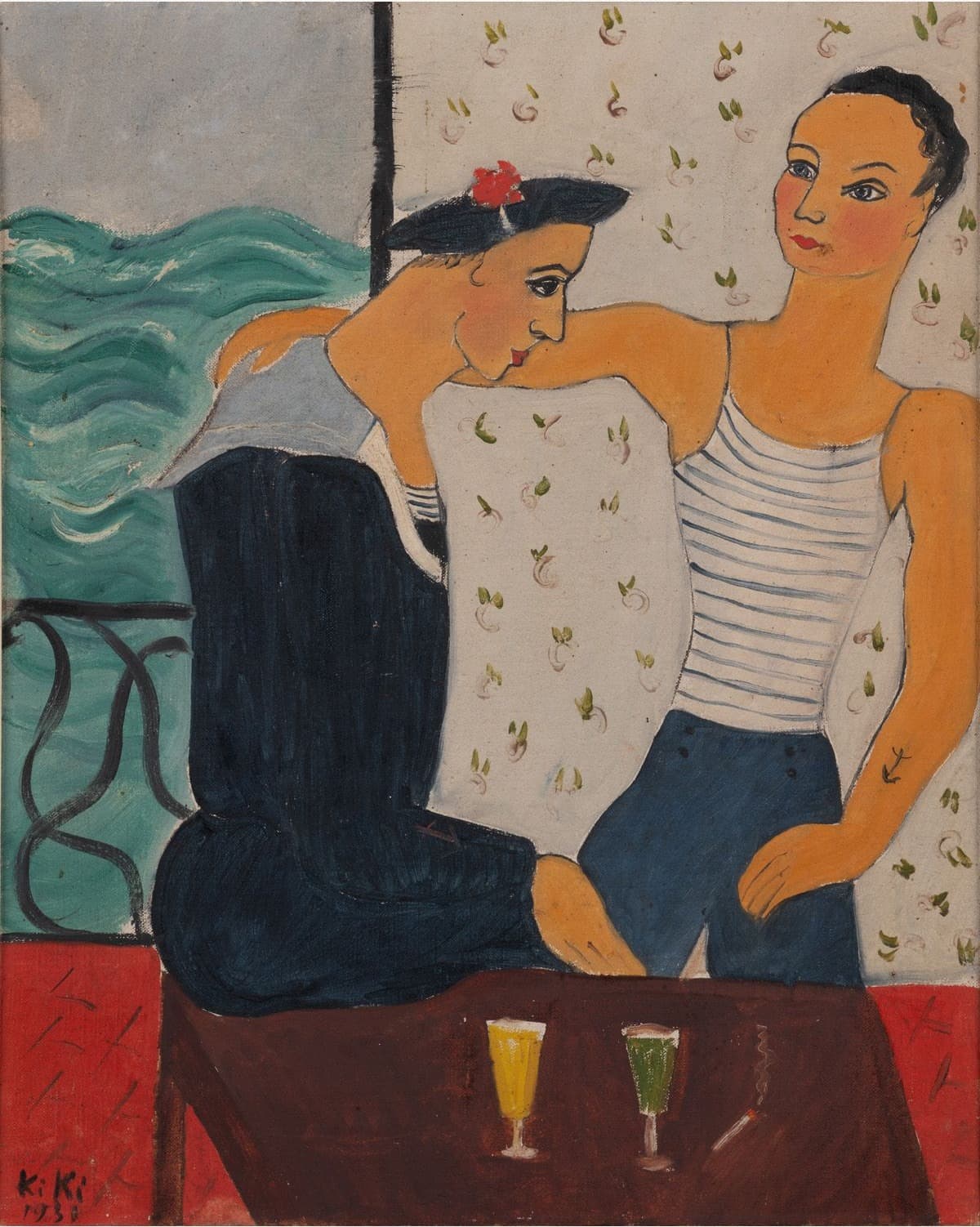
Two figures in French naval dress at a dark red-brown table. The seated one at the left leans forward with the chin on a bare orange forearm, wearing a dark navy jumper with a pale grey-blue square sailor collar and a navy cap with a red pompom on black hair. The standing one at the right has one hand on the hip and the other arm across the first figure's shoulders. That figure wears a white jersey striped in blue and dark blue buttoned trousers, with a small dark anchor tattooed on the forearm. Two tall glasses stand on the table, one filled with yellow and one with green, each with a pale head. A panel of green water with white crests fills the left background behind a black iron curve, and the wall at the right is papered with small sprigs of green leaves and pink buds

Artwork reproduction

Painting

Untitled (Two Sailors at a Table)

1931 · Oil on canvas

Two figures in French naval dress sit and stand at a dark red table with two glasses on it. One wears a navy cap with a red pompom and a square sailor collar; the other wears a striped jersey and has an anchor tattooed on the forearm. Green water fills a panel behind them and the wall beside it is papered with small sprigs. Kiki de Montparnasse signed and dated the canvas KiKi 1931 at the lower left. Piasa catalogued it only as Untitled, and the words in brackets are the atlas's description of what is in the picture, not her title.

Kiki de Montparnasse, Untitled (Two Sailors at a Table), 1931. Image © the rights holder, shown under fair use.

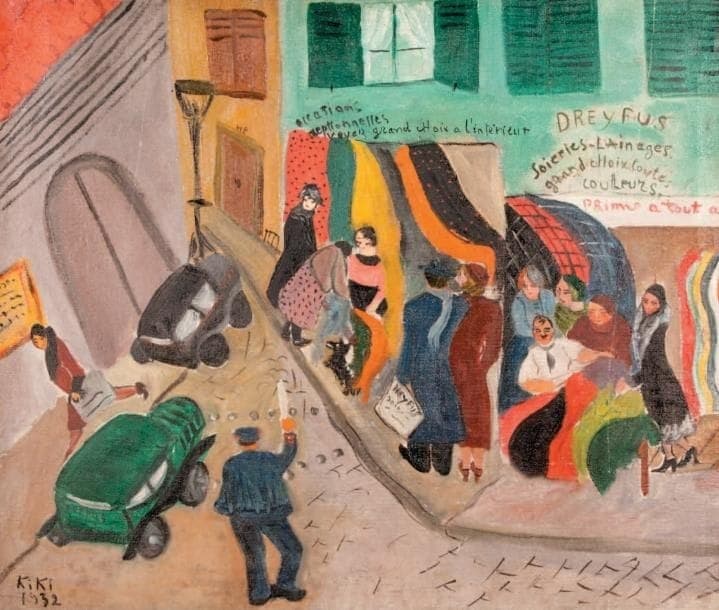
A Paris street corner seen from above. Long bolts of cloth in red with dark spots, green, yellow, grey, orange, black and cream hang from the first floor of a green-painted drapery down over the pavement. Above them the wall is lettered by hand: occasions exceptionnelles, voyez grand choix à l'intérieur, and at the right DREYFUS in large capitals with Soieries - Lainages below it. About a dozen women in coats and cloche hats press along the cloth, with a small black and white dog at the kerb. On the road at the left a policeman in a dark blue cape and flat navy cap stands with his back turned. His right arm is raised, holding a white baton with an orange tip, between a parked black car and a green van. Green shutters and an open window with a white curtain stand above the shop front

Artwork reproduction

Painting

Le marché aux soieries à Paris

1932 · Oil on canvas

Bolts of cloth hang in bands of red, yellow, orange and black down the front of a Paris drapery. A crowd of women in coats and cloche hats presses along them. On the road at the left a policeman stands with his back turned, one arm raised with a white baton, between a parked black car and a green van. Kiki de Montparnasse signed and dated the canvas KiKi 1932 at the lower left.

Kiki de Montparnasse, Le marché aux soieries à Paris, 1932. Image © the rights holder, shown under fair use.

Drawings

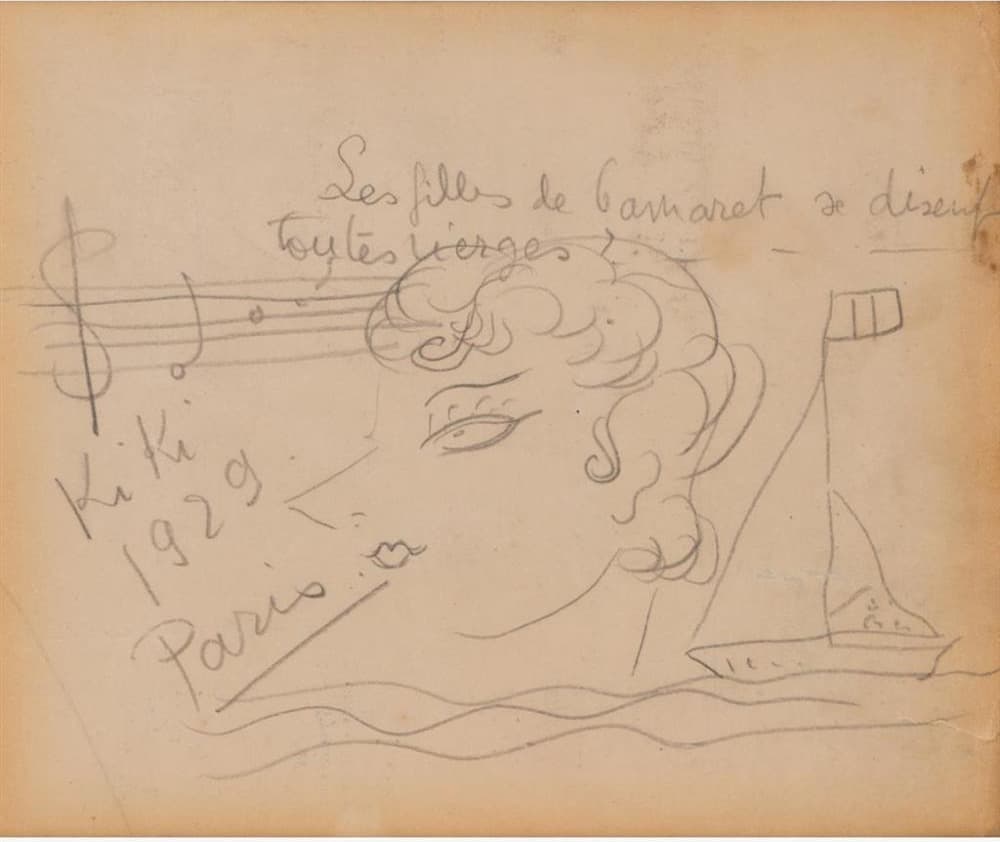
A small sheet of tanned cream paper drawn on in pencil. Across the top, in handwriting, runs the line Les filles de Camaret se disent toutes vierges ? with a question mark and a ruled dash. A treble clef and a five-line stave carrying a few note heads run in from the left edge. A woman's head in profile faces left in the centre, her hair a mass of drawn ringlets with two long S-curls at the neck, one lashed eye, a narrow V of a nose and a small closed mouth. A sailing boat with a triangular sail and a tall flagged mast sits at the right on two wavy lines of sea, and the signature Kiki 1929 Paris is written in three underlined lines at the left

Artwork reproduction

Drawing

Les filles de Camaret se disent toutes vierges ?

1929 · Pencil on paper

Kiki de Montparnasse wrote the opening line of a bawdy sailors' song across the top of a small sheet. She drew a stave and a treble clef running in from the left. A woman's head in profile fills the middle, with a sailing boat on a two-line sea beside it. She signed and dated it Kiki 1929 Paris. The drawing is the only one of her works in the atlas that shows her singing and her drawing in the same gesture.

Kiki de Montparnasse, Les filles de Camaret se disent toutes vierges ?, 1929. Image © the rights holder, shown under fair use.

In the credits

Works that credit Kiki.

People Kiki de Montparnasse Knew

Relationships with other people, with sources for each connection.

Illustrated portrait of Man Ray

Man Ray

  • Photographer
  • Painter
  • Filmmaker

Partner of · 1921–1927

Partners for six years from late 1921. She was his model through the decade's most famous images, including Le Violon d'Ingres of 1924, the photograph of her back painted with a violin's f-holes.

— Encyclopaedia Britannica — Man Ray

Questions about Kiki de Montparnasse

Who was Kiki de Montparnasse?

Alice Ernestine Prin (1901–1953), the model, singer, painter and memoirist who was the human centre of Montparnasse in the 1920s. She posed for Soutine, Modigliani, Kisling and Foujita, was Man Ray's partner and most famous subject, sang nightly at Le Jockey, sold out a show of her own paintings, and was crowned Queen of Montparnasse in 1929.

What is Le Violon d'Ingres?

Man Ray's 1924 photograph of Kiki's bare back with two violin f-holes painted onto the print — her body turned into the instrument, under a turban borrowed from Ingres's harem pictures. The title is also a French idiom for a hobby: Ingres famously played the violin. A print sold in 2022 for 12.4 million dollars, the highest price ever paid for a photograph at auction.

Did Kiki de Montparnasse paint?

Yes, and successfully. Her 1927 exhibition at the Galerie au Sacre du Printemps in Paris — direct, humorous scenes of sailors, circuses and her native Burgundy — sold out. The paintings were long dismissed as a mascot's sideline; they have been re-exhibited and revalued in recent decades.

What did Hemingway write about Kiki?

The introduction to Kiki's Memoirs (1929) — the only introduction he ever wrote for another author's book. In it he said the book was the best he had read since E. E. Cummings's The Enormous Room, and summed up its author as a woman who was never a lady at any time, but for a decade was about as close as the era came to a queen. The American authorities banned the English translation, which sealed its legend.

How did Kiki de Montparnasse die?

She collapsed outside her flat in Paris and died on 29 April 1953, at fifty-one, worn down by years of alcohol and cocaine that began during the Occupation. Foujita helped pay for the funeral at Thiais cemetery, and the surviving artists of the old quarter followed the coffin. The obituaries wrote that Montparnasse itself was being buried.

Which painting of Kiki came first?

Tsuguharu Foujita's Reclining Nude with Toile de Jouy, shown at the Salon d'Automne in 1922, before Man Ray's best-known photographs of her appeared. Foujita painted her on a patterned cloth in fine ink outline over the milk-white ground he had spent years working out. It was the sensation of the Salon and sold for a sum that changed both their lives.

Was Kiki de Montparnasse in films?

Yes, in several of the experimental films made in Paris in the 1920s. Fernand Léger's Ballet mécanique of 1924 opens and closes on her face. Man Ray put her in Emak-Bakia in 1926, opening her eyes to show a second pair painted on her eyelids, and in L'Étoile de mer in 1928, built on a poem by Robert Desnos.

Did Kiki write a book?

She published her memoirs in Paris in 1929, at twenty-eight, in her own unschooled French. Ernest Hemingway wrote the introduction to the English edition the following year, something he did for almost nobody. United States customs banned it as obscene and it did not circulate legally there for decades.

Why does Kiki matter beyond the photographs?

Because she was a working artist and a witness, not only a model. She sang at Le Jockey, exhibited her own paintings in 1927, and appeared in the decade's experimental films. She also wrote the memoirs, one of the very few accounts of Montparnasse in the 1920s written from the model's side of the easel.

Connections and Sources

Kiki de Montparnasse’s connections to people, places, and works, with the sources behind each one.

Performed in · 1924

Ballet mécanique

Kiki de Montparnasse appears in the film.

— The Museum of Modern Art — Ballet mécanique (collection record)

Performed in · 1928

The Starfish

Kiki de Montparnasse appears in the film.

— La Cinémathèque française — L'Étoile de mer (film record)

Partner of · 1921–1927

Man Ray

Partners for six years from late 1921. She was his model through the decade's most famous images, including Le Violon d'Ingres of 1924, the photograph of her back painted with a violin's f-holes.

— Encyclopaedia Britannica — Man Ray

Depicted in · 1924

Le Violon d'Ingres

The J. Paul Getty Museum names the sitter in both of its records of the image, and identifies her as Alice Prin on its record of Noire et Blanche of 1926. She is seen from behind, bare to the hips, her head in a wound turban and her face turned almost out of the frame; the two violin f-holes on her lower back were added to a print and the print rephotographed.

— Man Ray, Le Violon d'Ingres (Ingres's Violin), 1924 (86.XM.626.10) (1924), 86.XM.626.10; Man Ray, Noire et Blanche (Black and White), 1926 (86.XM.626.14) (1926), 86.XM.626.14

Depicted in · 1926

Noire et blanche

The Centre Pompidou's record of the glass negative names the sitter as Kiki de Montparnasse (Alice Ernestine Prin) and titles the image Kiki (Alice Prin), Noire et blanche. The J. Paul Getty Museum names her as Kiki (Alice Prin) on its print of another pose from the same session, and Christie's names her in its 2017 lot essay. She lies with her head on a table, eyes closed, holding a black wooden mask upright beside her face.

— Man Ray, Noire et blanche, 1926 — glass-plate negative (AM 1994-393 (1505)), AM 1994-393 (1505); Man Ray, Noire et Blanche (Black and White), 1926 (86.XM.626.14) (1926), 86.XM.626.14; Man Ray (1890–1976), Noire et Blanche, 1926 — lot 8, Stripped Bare: Photographs from the Collection of Thomas Koerfer, Paris, 9 November 2017 (2017), lot 8, lot essay

References

References

The sources below include biographies, scholarly essays, interviews, and primary materials that informed this page. They reflect both the historical record and ongoing critical conversations about Kiki de Montparnasse and their work.

  1. 1abcdefghijkKiki's Paris: Artists and Lovers 1900–1930

    Biography
    Harry N. Abrams, 1989
    Used for

    Biographical evidence used to verify chronology, relationships, and historical context connected to Kiki de Montparnasse.

  2. 2abcKiki's Memoirs (Souvenirs)

    Memoir
    Henri Broca, Paris, 1929
    Used for

    First-person evidence and historical context used in preparing the Kiki de Montparnasse page.

  1. 3↑Memoirs of Montparnasse

    Memoir
    Oxford University Press, 1970
    Used for

    First-person evidence and historical context used in preparing the Kiki de Montparnasse page.

  2. 4Cimetière du Montparnasse — map of the most searched-for burial places (English edition)

    Official record
    Ville de Paris
    Used for

    Official record used to verify names, dates, institutional details, or other factual information on this page.

    View source
i
Why these sources are here

These references anchor the page in the documented record and in the scholarly conversations around Kiki de Montparnasse. Every claim on this page traces back to one or more of the works listed here.

Explore more resources
Browse all authors