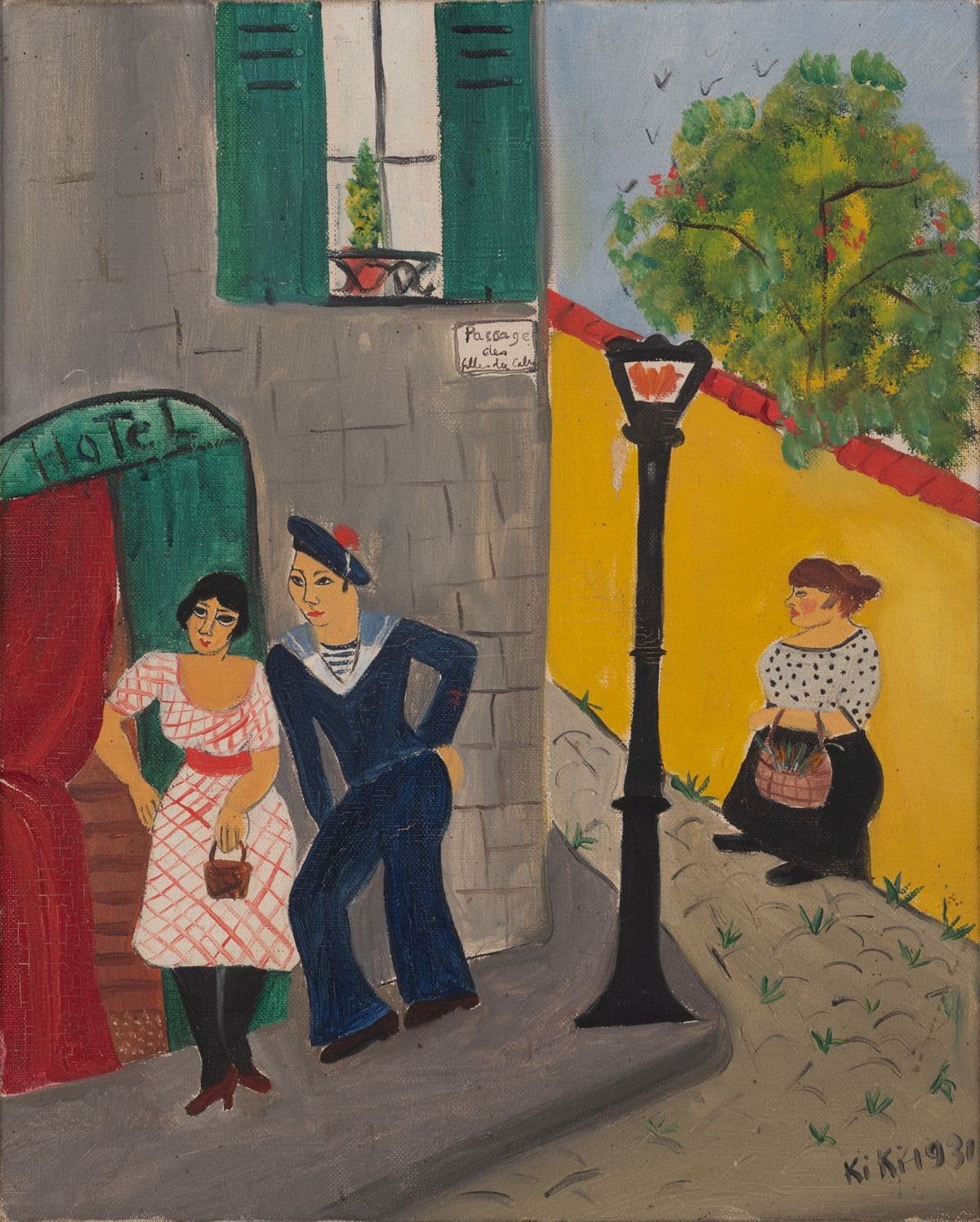
Untitled (Sailor Outside a Hotel)
A sailor in navy blue stands at a hotel door beside a woman in a pink checked dress. A painted street sign on the wall above them reads Passage des filles du Calvaire. Across the street a second woman waits against a yellow wall with a basket over her arm. Kiki de Montparnasse signed and dated the canvas KiKi 1931 at the lower right. Piasa catalogued it only as Untitled, and the words in brackets are the atlas's description of what is in the picture, not her title.
- 1931
- Oil on canvas
About Kiki de Montparnasse

What the painting shows
A grey stone corner divides the canvas. At the left a green awning lettered Hôtel curves over a doorway, with a red curtain hanging inside it and a strip of brickwork below. Above the corner a window stands open between green shutters, with a window box and a small plant on the sill.
A woman stands in the doorway in a white dress cross-hatched in pink, gathered at the waist by a red sash. She wears black stockings and dark red shoes and carries a small brown basket in one hand. Her hair is a short black bob and her eyes are drawn with heavy dark lids.
Beside her a sailor leans back against the stonework with one hand on the hip and the legs crossed at the ankle. He wears a navy cap with a red pompom, a white square collar edged in pale blue over a blue and white striped undershirt, a navy jumper and navy trousers with brown shoes.
A small white plaque is painted on the wall above them in a thin dark hand: Passage des filles du Calvaire. To the right of it a black lamppost rises the full height of the canvas, its lantern glazed white with an orange flame inside.
Across the street a long yellow wall runs back under a coping of red tiles, with a tree above it carrying green leaves and small red fruit and a scatter of dark birds in the pale blue sky. A second woman stands against the wall in a white blouse spotted with black and a long black skirt, a wicker basket of green stems and orange tips held in front of her. The canvas is 41 by 33 centimetres.
Why the title is in brackets
Piasa catalogued the canvas as Untitled, 1931. Lot 150 in the same sale carries exactly the same catalogue title and the same year. Two works cannot share one address in the atlas, so a descriptor was added.
The words in brackets come from the picture and from nothing else. The green awning lettered Hôtel, the navy cap with its red pompom, the square collar and the striped undershirt are all legible in the reproduction.
The parenthetical is descriptive. Alice Prin did not title the painting, no catalogue records a title for it, and the atlas does not claim one for her.
The street she lettered in
The plaque on the wall names a real Paris street in the third arrondissement, the passage des Filles-du-Calvaire, and the name is painted into the canvas rather than supplied by a cataloguer. Whether she painted the place itself cannot be told from the picture, which gives a corner, a door and a wall and no landmark.
What the canvas shows is a hotel door, a woman standing in it, a sailor at her shoulder and a second woman waiting across the road. It does not state what passes between them. Naval uniform, a hotel and women waiting in a street were the ordinary furniture of a port or garrison quarter.
Alice Prin knew that trade at first hand. She came to Paris as a child, worked in a bakery and a bindery, posed naked for painters from her teens, sang in the cabarets of Montparnasse, and at times sold sex for money. She set her life down in her own words in Souvenirs in 1929, without euphemism.
Where it has been
Piasa sold the painting in Paris on 10 June 2026, as lot 151 of Art moderne et surréalisme. The estimate was 8,000 to 12,000 euros and it made 10,496 euros with the buyer's premium.
The house published a condition report with the lot: good overall condition, minor wear along the edges, fine scattered cracking, and minor soiling and splatters. The framed dimensions are given as 52 by 43 centimetres.
Piasa records the provenance as a private collection in Paris. No museum holds it, and no public collection is known to hold any painting by Kiki de Montparnasse.
Close reading
Reading the work, detail by detail
A street corner with two women, a sailor and a lamppost. Follow the lettered awning and the open shutters above it, then the handwritten street plaque, the pair in the doorway, the lamp with its flame, and the tree, the second woman and the signature on the path.
1.The word Hôtel
The awning is a single green arch outlined in black, and Hôtel is written across it by hand rather than set in type. A second word follows it that the paint does not resolve. A red curtain hangs in the doorway underneath.
2.The open window
The shutters are flat green panels with three black strokes each for slats. The window between them is left white, and a shallow box on the sill carries a small conical plant and a red line along its front.
3.The street plaque
The plaque is painted on and then written on, in the same thin hand as the awning. Three lines read Passage, des, and filles du Calvaire, the last of them running out of room at the right edge of the plaque.
4.The woman in the doorway
Her dress is ruled into a pink diamond check over white and pulled in by a flat red sash. She stands with the weight on one hip, the free hand holding a small brown basket, and her eyes are drawn with heavy dark lids.
5.The sailor
The uniform is complete and exact: the flat navy cap with its red pompom, the square collar edged in pale blue, the striped undershirt at the throat. The face under it carries the same red mouth and dark lashes as the women in the picture.
6.The lamp
The lantern is drawn as a black frame with a white pane, and the flame inside is a few strokes of orange. A pale drip of paint runs down the post below it. The post itself is one unbroken black column from the pavement to the top.
7.The tree and the birds
The tree is dabbed in two greens and a yellow with red dots for fruit, and a brown branch drawn through it. The birds are single V strokes, seven of them, spaced across the sky. The wall below carries a coping of separate red tiles.
8.The woman against the wall
Her blouse is dotted with separate black marks over white, the skirt below it a single black shape. The basket is drawn as a crosshatched wicker bowl and filled with green stems whose tips are picked out in orange.
9.The signature
She signed KiKi 1931 on the path itself, in the same dark line she used for the plaque and the awning. The date reads clearly: a one, a nine, a three and a one. Green tufts of grass stand around the letters.
Timeline
1929
Souvenirs appears from Henri Broca in Paris, her own account of her life, with a preface by Tsuguharu Foujita and ten photographs by Man Ray.
1931
Painted, signed and dated at the lower right. She exhibits her paintings for the third and last time in her life.
2026
Sold at Piasa in Paris on 10 June as lot 151, for 10,496 euros with premium against an estimate of 8,000 to 12,000.
Where to see it
A viewing location has not yet been listed for this work.
Frequently asked questions
Does the painting have a title?
No. Piasa catalogued it as Untitled, 1931. The words Sailor Outside a Hotel are the atlas's description of what the canvas shows, added to tell it apart from a second untitled canvas of the same year sold in the same session. Alice Prin did not title it.
What does the painting show?
A street corner. A woman in a white dress cross-hatched in pink stands in a hotel doorway under a green awning lettered Hôtel, with a sailor leaning against the stonework beside her. A black lamppost divides the picture, and across the road a second woman waits against a yellow wall with a basket in her hands.
What does the street sign in the painting say?
Passage des filles du Calvaire, written by hand on a small white plaque on the stone wall. It names a real street in the third arrondissement of Paris. The plaque is painted into the canvas; no catalogue supplies a location for the scene.
How big is the painting?
41 by 33 centimetres, oil on canvas, upright. Piasa gives the framed size as 52 by 43 centimetres and records fine scattered cracking and minor wear along the edges.
How much did it sell for?
10,496 euros including the buyer's premium, at Piasa in Paris on 10 June 2026, against an estimate of 8,000 to 12,000 euros. The companion lot, catalogued under the same title and year, made 11,808 euros in the same session.
Is the painting a picture of prostitution?
The canvas does not say. It shows a hotel door, a woman standing in it, a sailor at her shoulder and a second woman waiting across the street. Alice Prin knew that world from the inside and wrote about it plainly in her Souvenirs of 1929, but nothing in the painting or the catalogue names what is happening.
More by Kiki de Montparnasse
If you like Kiki de Montparnasse
Explore painters from the same movements and circles.

William S. Burroughs
American Beat novelist, essayist, performer and visual artist who completed Naked Lunch at the Beat Hotel in Paris and made cut-up writing a defining avant-garde method.
View artist
Leonora Carrington
English painter and writer who fled a debutante's future for Surrealist Paris at twenty, survived the war's wreckage of that life — internment for her lover Max Ernst, an asylum in Spain for her — and rebuilt herself in Mexico into one of the century's great painters of the uncanny.
View artist
Giorgio de Chirico
Italian painter whose metaphysical cityscapes helped shape Surrealism. The MNAC's 2018 Gala exhibition records that he valued her practical intelligence and asked her to act as his agent.
View artist
References
The sources below include collection records, catalogues, scholarly research, and primary materials that informed this page. They document Untitled (Sailor Outside a Hotel), its making, and its place in cultural history.


1Kiki de Montparnasse, Untitled, 1931 — lot 151, Art moderne et surréalisme, 10 June 2026
WebsitePiasa, 2026Used forAuction record for the painting: the catalogue title Untitled, 1931, the medium, dimensions, inscription, provenance, condition report and result.
2Art moderne et surréalisme, 10 June 2026 — sale catalogue and results
WebsitePiasa, 2026Used forThe sale in which lots 150 and 151 were both catalogued as Untitled, 1931.
3Kiki's Memoirs (Souvenirs)
MemoirHenri Broca, Paris, 1929Used forHer own account of her life, published by Henri Broca in Paris in 1929.
4Kiki's Paris: Artists and Lovers 1900–1930
BiographyHarry N. Abrams, 1989Used forThe standard account of Montparnasse, of her work as a painter and of the life she led in the quarter.
5Kiki, Reine de Montparnasse — exhibition, 1 April to 30 December 2026
WebsiteMusée du Pays Châtillonnais – Trésor de Vix, Châtillon-sur-Seine, 2026Used forThe 2026 exhibition in her birthplace, which shows her own paintings and drawings alongside the portraits of her.
These references provide the documented foundation for this work's history and interpretation. Claim-level citations remain attached to the specific claims they support.
 Explore more resources