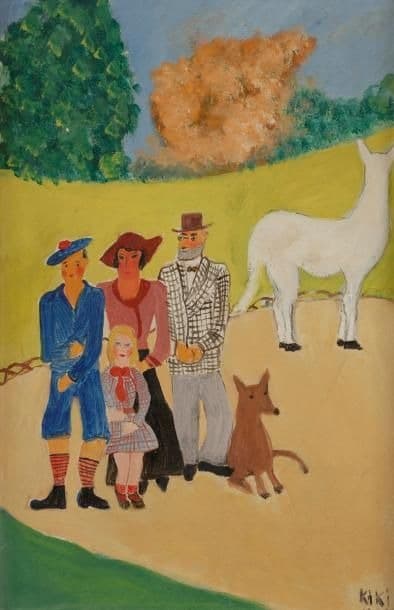
La Famille écossaise
Four figures stand together on a sandy path across a yellow-green slope. A tall white animal with a long neck waits behind them at the right, and a brown dog sits in the open ground. Kiki de Montparnasse signed the canvas Kiki at the lower right and wrote the title and the date on the back of the stretcher. Ader sold it at the Hôtel Drouot on 14 March 2018.
- 1929
- Oil on canvas
About Kiki de Montparnasse

What the painting shows
The four figures are packed shoulder to shoulder in the lower left half of the canvas. The tallest, at the left, wears a blue jacket over blue shorts, a blue bonnet with a red tuft on top, red and white striped stockings and heavy black boots.
Beside that figure a woman in a dark red wide-brimmed hat wears a pink jacket with puffed shoulders over a long black skirt. Her arm goes behind the small girl in front of her. The girl is blonde, in a pink checked dress with a large red bow at the throat and red shoes.
The fourth figure is a bearded man in a dark red bowler hat and wire spectacles, in a black and white checked jacket and waistcoat with a bow tie, pale grey trousers and black shoes. His hands are held together in front of him.
A tall white animal stands on the path at the right, its long neck rising above the figures, its small head turned away, its hooves and tail dark. A brown dog sits in the middle of the path with its ears up, its front paws white and its long thin tail curled behind it.
The ground is a broad slope of yellow-green, the path a band of pale sand across it, and a green bank cuts the lower left corner. A dark green tree fills the upper left, an orange-leaved tree stands in the middle distance, and the sky above is pale blue. The canvas is 41 by 27 centimetres.
A title in her own hand
Ader records the title and the date written on the reverse of the stretcher, as well as the signature and date at the lower right. That makes La Famille écossaise one of the few pictures by Kiki de Montparnasse whose title is her own rather than a cataloguer's.
The Scottish reading rests on the clothes. The bonnet with its tuft, the striped stockings and the checked cloth of the man's suit are the dress a Paris audience of the 1920s would have read as Scottish. The painting gives no landscape or building to confirm it.
The white animal is the part the title does not explain. Its long neck, small head and dark hooves fit neither a dog nor a cow, and the reproduction is too small to resolve its muzzle. The atlas describes it rather than name it.
Painted the year of Souvenirs
Alice Prin — Kiki de Montparnasse was the name Montparnasse gave her — dated the canvas 1929. Her book Souvenirs appeared from Henri Broca in Paris in the same year, with a preface by Tsuguharu Foujita, ten photographs by Man Ray and reproductions of twenty of her own paintings.
The De Baecque catalogue that described a copy of the book in 2018 lists those contents. No published list of the twenty reproductions names this canvas, so the record does not claim that it appeared in the book.
She had exhibited her paintings at the Galerie au Sacre du Printemps in March 1927, and she showed again in 1930 and 1931. Billy Klüver and Julie Martin record all three in the standard account of the quarter.
Where it has been
Ader sold the painting at the Hôtel Drouot in Paris on 14 March 2018, as lot 51 of Tableaux modernes — Art naïf — Art brut. The public view ran on 13 and 14 March in room 1.
The estimate was 1,000 to 1,500 euros and it made 1,375 euros with the buyer's premium. Ader's lot page carries the full catalogue entry and the result.
It is in private hands. No museum holds it, and no public collection is known to hold any painting by Kiki de Montparnasse.
Close reading
Reading the work, detail by detail
The only reproduction is the auction house's photograph at 394 by 610 pixels, which is small. Flat colour, outline and pattern survive at that size; brushwork and small features do not. The views stay at low magnification, and where a passage will not resolve the commentary says so.
1.The blue bonnet
The bonnet is a flat blue disc with a small red tuft on top, drawn without a band. The face under it is a plain orange oval with a dark mark for each eye and a red dot for the mouth.
2.The striped stockings
The stockings are the most worked pattern in the picture: red bands ruled across cream, running from the knee to the boot. The boots below them are solid black shapes with no laces drawn.
3.The woman in the red hat
The hat is a broad dark red shape with a dipped brim, painted as one flat area. Her jacket is pink with raised shoulders, and the dark skirt below it is a single black mass with no fold drawn into it.
4.The girl in the checked dress
The girl's dress is drawn as a grid of pink lines over cream, the same device as the man's suit. Her hair is a solid mass of yellow and the bow at her throat is the strongest red in the group.
5.The man in the checked suit
The check is ruled over the whole suit, jacket and waistcoat alike, in two sets of black lines. The spectacles are a single wire loop across the face, and the beard is a flat grey shape under the mouth.
6.The white animal
The animal is painted as one white shape against the yellow-green field. The long neck, the small head and the dark hooves are clear; the muzzle is not, and the reproduction is too small to say what animal it is.
7.The dog
The dog is drawn in a single warm brown with the muzzle picked out darker and the paws left white. The tail is one long thin stroke that curls away behind the body, and the ears stand up as two points.
8.The orange tree
The orange tree is scrubbed on in loose strokes of orange, cream and brown, and it is the only part of the picture painted loosely. Everything else is drawn first and filled.
9.The signature
She signed with the name the quarter gave her, capital K at each end, in the corner of the path. Ader catalogues the lower right as signed and dated, but no digits separate at this size, and the 1929 the atlas carries is the date the house reads on the stretcher.
Timeline
1927
Kiki de Montparnasse exhibits her own paintings for the first time, at the Galerie au Sacre du Printemps in Paris in March; the show sells out.
1929
Painted, signed and dated. Souvenirs appears from Henri Broca in Paris in the same year, reproducing twenty of her paintings.
2018
Sold at Ader, Hôtel Drouot, Paris, 14 March, as lot 51, for 1,375 euros with premium against an estimate of 1,000 to 1,500.
Where to see it
A viewing location has not yet been listed for this work.
Frequently asked questions
Who painted La Famille écossaise?
Kiki de Montparnasse — Alice Prin — painted it in 1929 and signed it Kiki at the lower right. She also wrote the title and the date on the back of the stretcher, which is rare among her surviving pictures.
What does La Famille écossaise show?
Four figures standing together on a sandy path across a yellow-green slope. They are a tall figure in a blue bonnet and striped stockings, a woman in a dark red hat, a small blonde girl in a checked dress and a bearded man in a checked suit. A white long-necked animal stands behind them and a brown dog sits on the path.
Why is it called the Scottish family?
The title is the artist's own, written on the stretcher. The Scottish reading rests on the clothes — a bonnet with a tuft, red and white striped stockings and checked cloth — rather than on any landscape or building in the picture.
What is the white animal in La Famille écossaise?
The painting does not say and no catalogue names it. What resolves in the only reproduction is a tall white animal with a long neck, a small head turned away, dark hooves and a dark tail. The atlas describes it rather than identify it.
How big is La Famille écossaise?
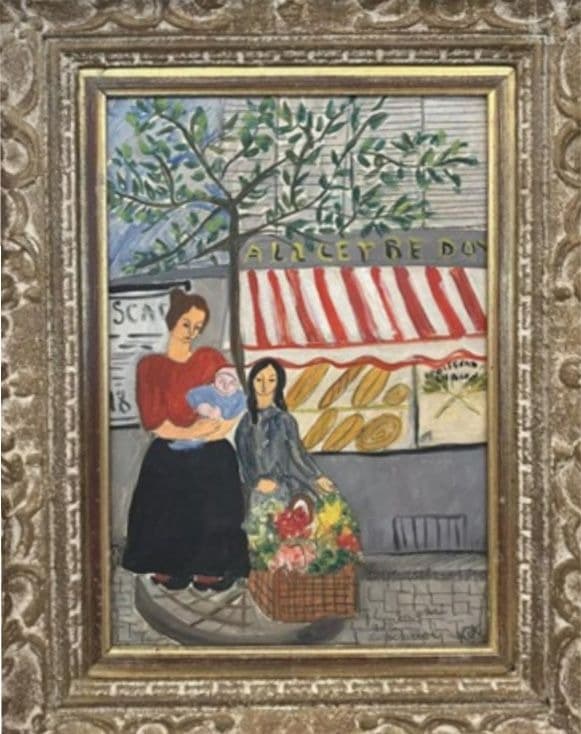
41 by 27 centimetres, oil on canvas, upright. That is the same size as another of her canvases, La marchande de fleurs, which Millon sold in 2024.
How much did La Famille écossaise sell for?
1,375 euros including the buyer's premium, at Ader in Paris on 14 March 2018, against an estimate of 1,000 to 1,500 euros.
More by Kiki de Montparnasse
If you like Kiki de Montparnasse
Explore painters from the same movements and circles.

William S. Burroughs
American Beat novelist, essayist, performer and visual artist who completed Naked Lunch at the Beat Hotel in Paris and made cut-up writing a defining avant-garde method.
View artist
Leonora Carrington
English painter and writer who fled a debutante's future for Surrealist Paris at twenty, survived the war's wreckage of that life — internment for her lover Max Ernst, an asylum in Spain for her — and rebuilt herself in Mexico into one of the century's great painters of the uncanny.
View artist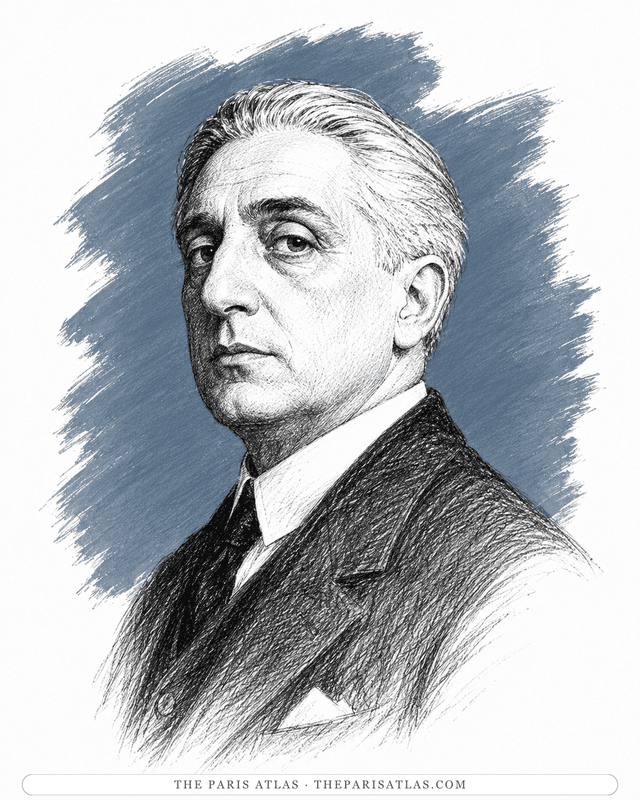
Giorgio de Chirico
Italian painter whose metaphysical cityscapes helped shape Surrealism. The MNAC's 2018 Gala exhibition records that he valued her practical intelligence and asked her to act as his agent.
View artist
References
The sources below include collection records, catalogues, scholarly research, and primary materials that informed this page. They document La Famille écossaise, its making, and its place in cultural history.


1Alice Ernestine Prin dite Kiki de Montparnasse, La Famille écossaise (1929) — lot 51, Tableaux modernes, Art naïf, Art brut, 14 March 2018
WebsiteAder, 2018Used forAuction record for the painting: title, date, medium, dimensions, the inscriptions front and back, the estimate and the result.
2Kiki's Paris: Artists and Lovers 1900–1930
BiographyHarry N. Abrams, 1989Used forThe standard account of Montparnasse and of her three exhibitions as a painter.

3Kiki et le Montparnasse des années 1930 — Arts africains, sale catalogue, Drouot-Richelieu, 21 September 2018
Exhibition catalogueDe Baecque et associés and Lynda Trouvé, Paris, 2018Used forDescribes a copy of Souvenirs and lists reproductions of twenty paintings by the author among its contents.
4Kiki, Reine de Montparnasse — exhibition, 1 April to 30 December 2026
WebsiteMusée du Pays Châtillonnais – Trésor de Vix, Châtillon-sur-Seine, 2026Used forThe 2026 exhibition in her birthplace, which shows her own paintings and drawings alongside the portraits of her.
These references provide the documented foundation for this work's history and interpretation. Claim-level citations remain attached to the specific claims they support.
 Explore more resources