Gitans
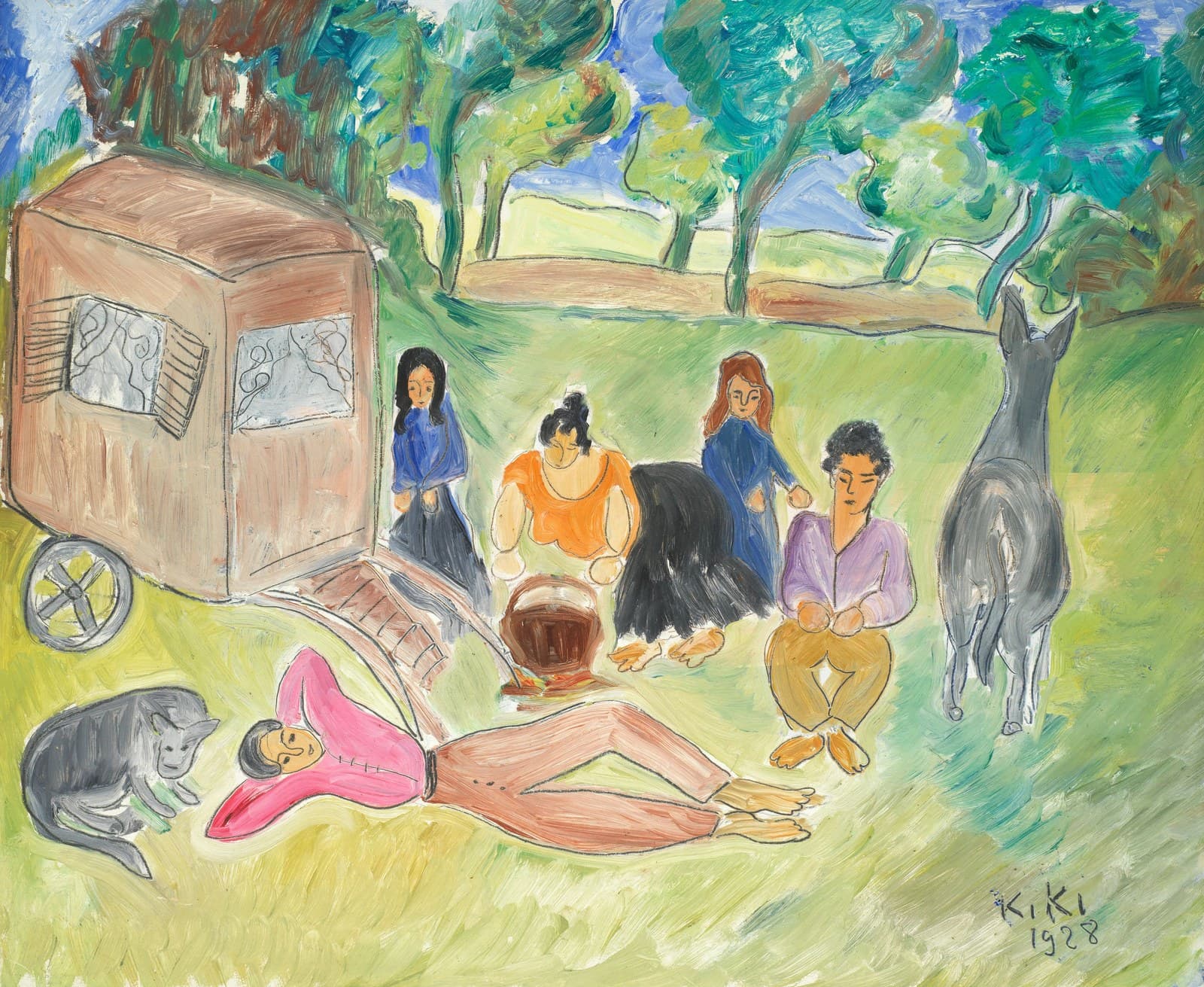
A caravan stands at the edge of a meadow with its wheel off, and five figures gather around a basket on the grass. A donkey waits at the right. One person lies stretched out across the whole foreground with a cat beside them. Kiki de Montparnasse painted it in 1928 and signed it KiKi at the lower right. It belongs to a private collection in the United Kingdom.
- 1928
- Oil on board
About Kiki de Montparnasse
What the painting shows
A pink-brown caravan fills the left third. Two windows are set into its side, each with a grey shutter and a loose brown scribble of a curtain behind the glass. A spoked wheel lies flat on the grass beneath it, off the axle. A slatted plank runs down from the door to the ground.
Five figures stand and crouch in the middle. A girl in a blue top waits by the caravan. A woman in an orange top bends forward with both hands hanging. A woman in a long black skirt bends across her, barefoot. A woman with auburn hair stands behind in blue, and a figure in a lilac shirt and ochre trousers squats with the hands clasped and the bare feet turned in.
A brown basket with a pale rim sits on the grass between them, on a strip of red and orange patterning. A grey donkey stands at the right, seen from behind with its head turned and one ear up.
Across the bottom a person lies full length. The head is at the left, turned up, the eyes closed or heavy, the dark hair short. The arm is folded over the head and the body runs right in pink and then in pale flesh colour to the edge of the board. A grey cat lies just beyond the head, facing it.
Behind everything are green and blue-green trees, a strip of pale field and a blue sky. The board measures 45.7 by 55.3 centimetres.
Her hand, not her face
Alice Prin, whom Montparnasse called Kiki de Montparnasse, is famous for pictures she did not make. Man Ray photographed her back as a violin, Tsuguharu Foujita painted her on a printed sheet, and Moïse Kisling, Chaïm Soutine and Maurice Mendjizky all worked from her. Those are works by other artists.
Gitans is the other side of that. She painted it herself, in oil on board, and signed it in capitals at the lower right with the date beneath. The subject is a halted travelling family rather than a studio nude.
The figure lying across the foreground is worth looking at twice. It takes the reclining pose that Foujita and Man Ray had made her famous in — head back, one arm over it, the body running the width of the picture. Here the figure is dressed, asleep, and set at the bottom of a scene that is busy with other people.
How it is painted
Every shape is drawn first in a dark line and then filled. The line is visible around the caravan, around each figure and around the donkey, and it does not always meet the colour it encloses. Faces are three or four marks. Hands and feet are blocks with a few strokes for fingers and toes.
The grass is laid in with short strokes of yellow-green and blue-green that run in different directions in each patch. The trees are dabbed on. Nothing recedes: the caravan, the standing figures and the far treeline are stacked up the board rather than set back into it.
Billy Klüver and Julie Martin place her painting alongside her singing at Le Jockey and her book, as one of the things she actually did rather than one of the things done to her. The Musée du Pays Châtillonnais made the same case in 2026, hanging her own paintings and drawings in the town where she was born.
Where it has been
The board surfaced at an anonymous sale at Sotheby's in London on 22 and 23 March 1995, as lot 151. It then entered a private collection in the United Kingdom.
Bonhams sold it as lot 188 in 2019 for 7,562 pounds and 50 pence with the buyer's premium. It remains in private hands, and no museum is known to hold it.
Close reading
Reading the work, detail by detail
A halted caravan and the people camped around it. Follow the shuttered windows, the wheel lying off the axle and the plank ramp, then the basket the figures are bent over, the donkey at the right, and the sleeper and the cat across the foreground.
1.The caravan windows
Both windows are drawn in dark line and filled with pale grey. The brown scribbles behind them stand for curtains, made with a few continuous loops rather than any pattern, and they are the only decoration on the whole vehicle.
2.The wheel on the grass
The wheel is off the vehicle and lying flat, drawn as a circle with five spokes and a hub. A caravan with a wheel on the ground is not about to move, which is what fixes the scene as a halt rather than a journey.
3.The plank ramp
The ramp is drawn with a row of short parallel slats, like a ladder laid down. It connects the caravan to the group on the grass, and it is the only thing in the painting that reads as depth rather than as stacking.
4.The woman in orange
Her hands hang open and empty at the end of straight arms, and her face is drawn with three marks. The orange is the strongest colour in the picture and pulls the eye to the middle of the group.
5.The basket
Everyone in the group is bent toward this object. It is painted as a dark brown bowl with a lighter rim, set on a narrow strip of red and orange marks that reads as a mat or a rug laid on the grass.
6.The figure in lilac
This is the only figure sitting down and the only one whose hands are joined. The feet are drawn flat with the toes turned in toward each other, which is how Kiki de Montparnasse draws every bare foot in the painting.
7.The donkey
The animal is seen from behind with the head turned back, so the body is a plain grey mass and the ear is the only detail. It stands apart from the group and is the tallest thing in the painting after the caravan.
8.The figure lying down
The pose is head back with one arm looped over it and the body across the full width of the picture. That is the reclining pose Kiki de Montparnasse had held for other painters through the 1920s; here she paints it herself, clothed and asleep.
9.The cat
The cat is drawn with one continuous grey outline and a pale wedge for the face. Its head is up and pointed at the sleeper, which makes it the only creature in the painting paying attention to anyone.
10.The signature
The signature is in block capitals with a small i between two large Ks, and the date sits directly under it. She signed at the right here and at the left on The Acrobat of the previous year.
Timeline
1927
Kiki de Montparnasse exhibits her own paintings for the first time, at the Galerie au Sacre du Printemps in Paris in March; the show sells out.
1928
Gitans painted, signed and dated on the lower right.
1929
Souvenirs appears from Henri Broca in Paris, reproducing twenty of her paintings.
1995
Sold anonymously at Sotheby's, London, 22–23 March, as lot 151.
2019
Sold at Bonhams as lot 188 for 7,562 pounds and 50 pence with premium.
Where to see it
A viewing location has not yet been listed for this work.
Frequently asked questions
Who painted Gitans?
Kiki de Montparnasse — Alice Prin — painted it herself in 1928 and signed it KiKi at the lower right. She is usually met as the model in other artists' work, and this is one of the paintings that are hers.
What does Gitans show?
A halted caravan at the edge of a meadow, with a spoked wheel lying off it on the grass. Five figures are gathered around a brown basket and a grey donkey stands at the right, seen from behind. A person lies full length across the foreground with a cat beside them.
Where is Gitans by Kiki de Montparnasse?
In a private collection in the United Kingdom. It passed through an anonymous sale at Sotheby's in London in March 1995 and was sold again at Bonhams in 2019. No museum holds it and it is not on public view.
What is Gitans painted on?
Oil on board, 45.7 by 55.3 centimetres — about 18 by 21 3/4 inches, in landscape format. Board rather than canvas, which is what she used for several of the pictures of this size that survive.
How much did Gitans sell for?
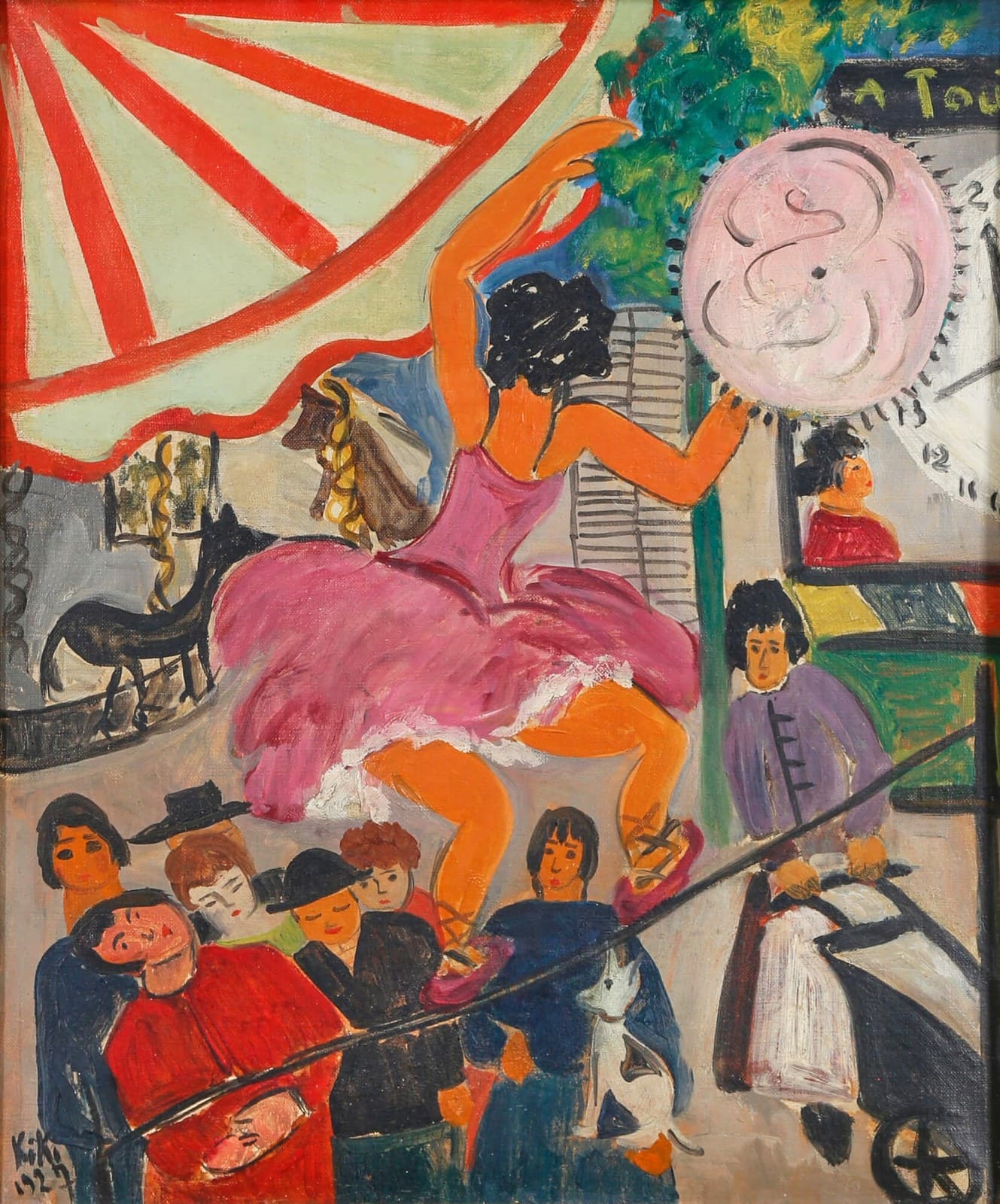
7,562 pounds and 50 pence including the buyer's premium, at Bonhams in 2019, as lot 188. Her auction record is held by a different picture, The Acrobat of 1927, which made 19,275 euros at FauveParis in 2021.
Who is the person lying down in Gitans?
The painting does not say, and no catalogue identifies the figure. What can be said is the pose: head back, one arm folded over it, the body running the full width of the picture. It is the reclining pose that Tsuguharu Foujita and Man Ray had made famous using Kiki de Montparnasse herself, here painted by her, clothed and asleep.
More by Kiki de Montparnasse
If you like Kiki de Montparnasse
Explore painters from the same movements and circles.
William S. Burroughs
American Beat novelist, essayist, performer and visual artist who completed Naked Lunch at the Beat Hotel in Paris and made cut-up writing a defining avant-garde method.
View artist
Leonora Carrington
English painter and writer who fled a debutante's future for Surrealist Paris at twenty, survived the war's wreckage of that life — internment for her lover Max Ernst, an asylum in Spain for her — and rebuilt herself in Mexico into one of the century's great painters of the uncanny.
View artist
Giorgio de Chirico
Italian painter whose metaphysical cityscapes helped shape Surrealism. The MNAC's 2018 Gala exhibition records that he valued her practical intelligence and asked her to act as his agent.
View artist
References
The sources below include collection records, catalogues, scholarly research, and primary materials that informed this page. They document Gitans, its making, and its place in cultural history.

1Kiki de Montparnasse (Alice Prin), Gitans (1928) — lot 188
WebsiteBonhams, 2019Used forAuction record for the painting: medium, dimensions, inscription, provenance and the result.
2Kiki's Paris: Artists and Lovers 1900–1930
BiographyHarry N. Abrams, 1989Used forThe standard account of Montparnasse and of her work as a painter alongside her singing and her writing.

3Kiki et le Montparnasse des années 1930 — Arts africains, sale catalogue, Drouot-Richelieu, 21 September 2018
Exhibition catalogueDe Baecque et associés and Lynda Trouvé, Paris, 2018Used forDescribes a copy of Souvenirs and lists reproductions of twenty paintings by the author among its contents.
4Kiki, Reine de Montparnasse — exhibition, 1 April to 30 December 2026
WebsiteMusée du Pays Châtillonnais – Trésor de Vix, Châtillon-sur-Seine, 2026Used forThe 2026 exhibition in her birthplace, which shows her own paintings and drawings.
5Kiki de Montparnasse s'expose à Châtillon-sur-Seine — exposition d'intérêt national
Official recordMinistère de la Culture, DRAC Bourgogne-Franche-Comté, 2026Used forThe Ministry of Culture notice granting that exhibition the exposition d'intérêt national label.
These references provide the documented foundation for this work's history and interpretation. Claim-level citations remain attached to the specific claims they support.
 Explore more resources