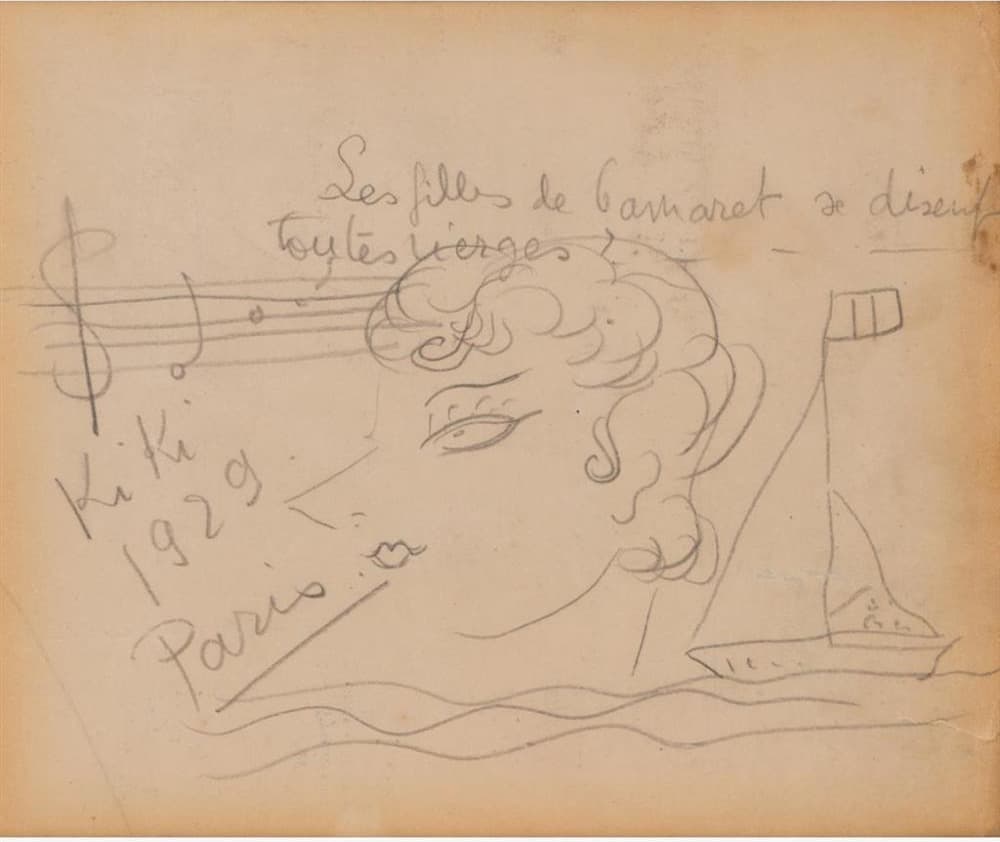
Les filles de Camaret se disent toutes vierges ?
Kiki de Montparnasse wrote the opening line of a bawdy sailors' song across the top of a small sheet. She drew a stave and a treble clef running in from the left. A woman's head in profile fills the middle, with a sailing boat on a two-line sea beside it. She signed and dated it Kiki 1929 Paris. The drawing is the only one of her works in the atlas that shows her singing and her drawing in the same gesture.
- 1929
- Pencil on paper
About Kiki de Montparnasse

What the drawing shows
The sheet is cream paper, tanned with age, with a brown stain at the upper right edge and a torn corner at the lower right. Everything on it is pencil.
Across the top, in her own hand, runs the line: Les filles de Camaret se disent toutes vierges ? It takes two lines, the second breaking after toutes vierges, and she closed it with a question mark and a long ruled dash.
A treble clef stands at the left edge with a five-line stave running right from it. Three or four note heads sit on the stave, one of them dotted. The stave carries on behind the head and stops.
A woman's head fills the centre in profile, facing left. The hair is a mass of drawn ringlets, each one a separate curl, with two long S-shaped curls hanging at the back of the neck. There is one eye with lashes and a brow above it, a nose reduced to a narrow V, and a small closed mouth. The neck runs down to a bare shoulder line.
At the right a sailing boat sits on the water: a hull with a row of short marks along it, a triangular sail leaning right, and a tall mast with a rectangular flag divided into panels at the top. Two wavy lines run the width of the sheet below the head and the boat for the sea.
Her signature is at the left, in three underlined lines: Kiki, 1929, Paris. The sheet is 13 by 16 centimetres.
The song she wrote down
Les filles de Camaret is a traditional French sailors' song, named for a fishing port on the Breton coast. Its first line claims that the women of Camaret all call themselves virgins, and every verse after it says otherwise. It is a bawdy song, sung in bars and on boats, and it was not a respectable thing for a woman to perform.
Kiki de Montparnasse sang for a living. She worked the Montparnasse cabarets, and the sale catalogue for a 2018 Drouot auction of her effects lists four Polydor 78s she cut with her accordionist. The titles on them are sailors' songs: Les marins de Groix, Le retour du marin, À Paimpol.
Writing the line at the top of the sheet and then drawing under it is not illustration of somebody else's material. It is her own repertoire, set down in her own handwriting, with the question mark added.
Made by her, not of her
Alice Prin — Kiki de Montparnasse in the quarter — is met most often as a subject. Man Ray's photograph of her back with violin f-holes painted on it, Tsuguharu Foujita's nude of her on a printed sheet, and the portraits by Moïse Kisling and Maurice Mendjizky are all works by other people.
She drew from an early age and sold quick portraits before she ever modelled. The pencil work here is confident and fast: the ringlets are made with single unbroken turns of the wrist, the nose is one angle, the boat is six lines.
Who the head is meant to be is not recorded. Piasa, which sold the drawing, gives it no sitter, and the curls and the small closed mouth match nothing in particular. The safe reading is a singer's doodle around her own song rather than a likeness of anyone.
Where it has been
Piasa sold the sheet in Paris on 10 June 2026, as lot 167 of a sale of modern art and Surrealism. Its recorded provenance is a private collection in Paris and nothing earlier.
It was sold together with a copy of her book Souvenirs inscribed to Colette. The condition report notes a two-centimetre tear towards the lower right corner, folds, and signs of sun exposure — the browning visible across the sheet.
Against an estimate of 600 to 800 euros it made 1,968 euros with the buyer's premium. It remains in private hands.
Close reading
Reading the work, detail by detail
A sung line, a stave and a head, all in pencil on one small sheet. Follow the writing across the top, the clef running in from the left, the eye and the ringlets, then the boat, the sea and the signature.
1.The line of the song
The words are written in her own hand, sloping and unruled, and the second line breaks after toutes vierges. She closed the sentence with a question mark, which the song itself does not have.
2.The stave
The stave is ruled freehand and the notes are drawn as open circles, without stems. It is enough to say that something is being sung and not enough to play, which fits a singer noting her own material rather than a copyist.
3.The eye
The eye is the most worked passage on the sheet. The lid is drawn twice, the lashes are three separate strokes, and the pupil is a small ring rather than a filled dot.
4.The nose and mouth
The whole profile below the eye is four strokes. The nose is a narrow angle with no nostril and no shading, and the mouth is two short curves that meet at each corner without opening.
5.The ringlets
Each curl is a single unbroken turn of the pencil and none of them is shaded. The two S-curls at the neck are drawn larger and clear of the mass, and they are the only part of the hair given its own space.
6.The signature
She signed with her working name, then the year, then the city, on three separate underlined lines. Piasa records the inscription as signed, dated and located, and the block sits inside the drawing rather than in a corner.
7.The boat
The boat is drawn in about six lines and sits on the water beside the head. Camaret is a fishing port on the Breton coast, and the song written above names it, so the boat belongs to the words rather than to the face.
8.The flag on the mast
The mast runs almost the full height of the sheet and ends in a plain rectangle split into three panels. Nothing identifies the flag, and it is drawn stiff rather than flying.
9.The sea
The sea is two wavy lines and nothing else. They run under both the head and the hull, which puts the profile in the water rather than on the shore, and the paper between them is left bare.
Timeline
1929
Drawn, signed, dated and located in Paris. The same year Souvenirs appears from Henri Broca, reproducing twenty of her paintings.
2018
A Drouot sale of Kiki de Montparnasse material catalogues four Polydor 78s she recorded with her accordionist, all of them sailors' songs.
2026
Sold at Piasa in Paris on 10 June as lot 167, with a copy of Souvenirs inscribed to Colette, for 1,968 euros with premium.
Where to see it
A viewing location has not yet been listed for this work.
Frequently asked questions
What does the writing on the drawing say?
Les filles de Camaret se disent toutes vierges ? — the first line of a traditional French sailors' song, meaning the girls of Camaret all say they are virgins. Kiki de Montparnasse wrote it across the top of the sheet in pencil, in her own hand, and added the question mark herself.
Did Kiki de Montparnasse draw this herself?
Yes. She signed it Kiki, dated it 1929 and wrote Paris underneath, all at the left of the sheet. She drew and painted throughout the 1920s and exhibited her own work three times, in 1927, 1930 and 1931.
Who is the woman in the drawing?
Nobody is named. Piasa's catalogue records no sitter, and the head is drawn in profile with ringlets, one lashed eye and a small closed mouth rather than as a likeness. It is best read as a drawing made around her own song.
Why is there a boat in the drawing?
Because the song is a sailors' song. Camaret is a fishing port in Brittany, and the sea and the boat belong to the words written above them. The sailors' repertoire runs through her recordings too: the 78s she made with her accordionist include Les marins de Groix and À Paimpol.
How big is the drawing and what is it made of?
Pencil on paper, 13 by 16 centimetres — smaller than a postcard is wide. The sheet has a two-centimetre tear at the lower right corner, folds, and browning from sun exposure.
Where is the drawing now?
In private hands. Piasa sold it in Paris on 10 June 2026 for 1,968 euros with the buyer's premium, against an estimate of 600 to 800 euros. Its only recorded earlier owner is a private collection in Paris.
More by Kiki de Montparnasse
If you like Kiki de Montparnasse
Explore painters from the same movements and circles.

William S. Burroughs
American Beat novelist, essayist, performer and visual artist who completed Naked Lunch at the Beat Hotel in Paris and made cut-up writing a defining avant-garde method.
View artist
Leonora Carrington
English painter and writer who fled a debutante's future for Surrealist Paris at twenty, survived the war's wreckage of that life — internment for her lover Max Ernst, an asylum in Spain for her — and rebuilt herself in Mexico into one of the century's great painters of the uncanny.
View artist
Giorgio de Chirico
Italian painter whose metaphysical cityscapes helped shape Surrealism. The MNAC's 2018 Gala exhibition records that he valued her practical intelligence and asked her to act as his agent.
View artist
References
The sources below include collection records, catalogues, scholarly research, and primary materials that informed this page. They document Les filles de Camaret se disent toutes vierges ?, its making, and its place in cultural history.


1Kiki de Montparnasse, Les filles de Camaret se disent toutes vierges ? (1929) — lot 167, Art moderne et surréalisme, 10 June 2026
WebsitePiasa, 2026Used forAuction record for the drawing: medium, dimensions, inscription, provenance, condition report and result.
2Art moderne et surréalisme, 10 June 2026 — sale catalogue and results
WebsitePiasa, 2026Used forThe sale it appeared in, which also carried two canvases by her catalogued only as Untitled, 1931.

3Kiki et le Montparnasse des années 1930 — Arts africains, sale catalogue, Drouot-Richelieu, 21 September 2018
Exhibition catalogueDe Baecque et associés and Lynda Trouvé, Paris, 2018Used forCatalogues her Polydor 78s of sailors' songs, and a copy of Souvenirs with its reproductions of twenty paintings.
4Kiki's Paris: Artists and Lovers 1900–1930
BiographyHarry N. Abrams, 1989Used forThe standard account of her singing in the Montparnasse cabarets and of her work as an artist.
5Kiki's Memoirs (Souvenirs)
MemoirHenri Broca, Paris, 1929Used forFirst-person evidence and historical context used in preparing the Les filles de Camaret se disent toutes vierges ? page.
These references provide the documented foundation for this work's history and interpretation. Claim-level citations remain attached to the specific claims they support.
 Explore more resources