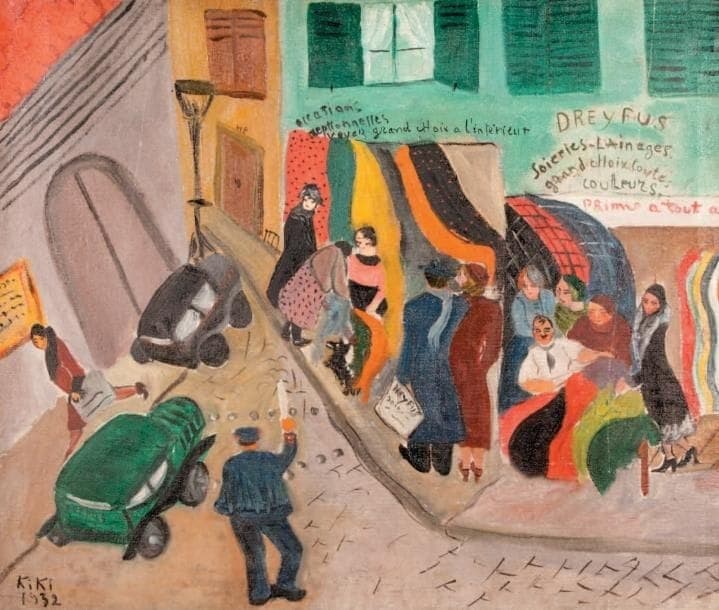
Le marché aux soieries à Paris
Bolts of cloth hang in bands of red, yellow, orange and black down the front of a Paris drapery. A crowd of women in coats and cloche hats presses along them. On the road at the left a policeman stands with his back turned, one arm raised with a white baton, between a parked black car and a green van. Kiki de Montparnasse signed and dated the canvas KiKi 1932 at the lower left.
- 1932
- Oil on canvas
About Kiki de Montparnasse
What the painting shows
The shop fills the right two thirds of the canvas, its front painted a flat green with dark green shutters and an open window above. Long bolts of cloth hang from the first floor down over the pavement, in bands of red with dark spots, green, yellow, grey, orange, black spotted with red, cream and red check.
Two blocks of hand lettering run across the green. The first reads occasions exceptionnelles, voyez grand choix à l'intérieur. The second, at the right, carries the shop's name DREYFUS in large capitals, then Soieries - Lainages, grand choix toutes couleurs, and a line in red, Prime à tout a, which runs off the edge of the canvas.
Between the cloth and the kerb stands a crowd of about a dozen women in coats and cloche hats, in blue, red, orange and green. One figure in a white shirt and grey bow tie smiles among them. A small black and white dog stands at the kerb, and a woman carries a folded white sheet with writing on it.
The road runs up the left side. A black car is seen from above with a white curtain across its rear window, a green van stands below it, and an orange poster with black lettering is fixed to the wall at the left edge. A line of round pale studs crosses the roadway.
A policeman stands in the road with his back to the viewer, in a dark blue cape and a flat navy cap, his right arm raised. In his hand is a white baton with an orange tip and a red band. The canvas is 54 by 65 centimetres, in landscape format.
The shop she lettered
The lettering is painted by hand and it is the most detailed thing in the picture. Kiki de Montparnasse wrote the trade — soieries and lainages, silks and woollens — the sales pitch, and the shop's name, all in her own script rather than in drawn type.
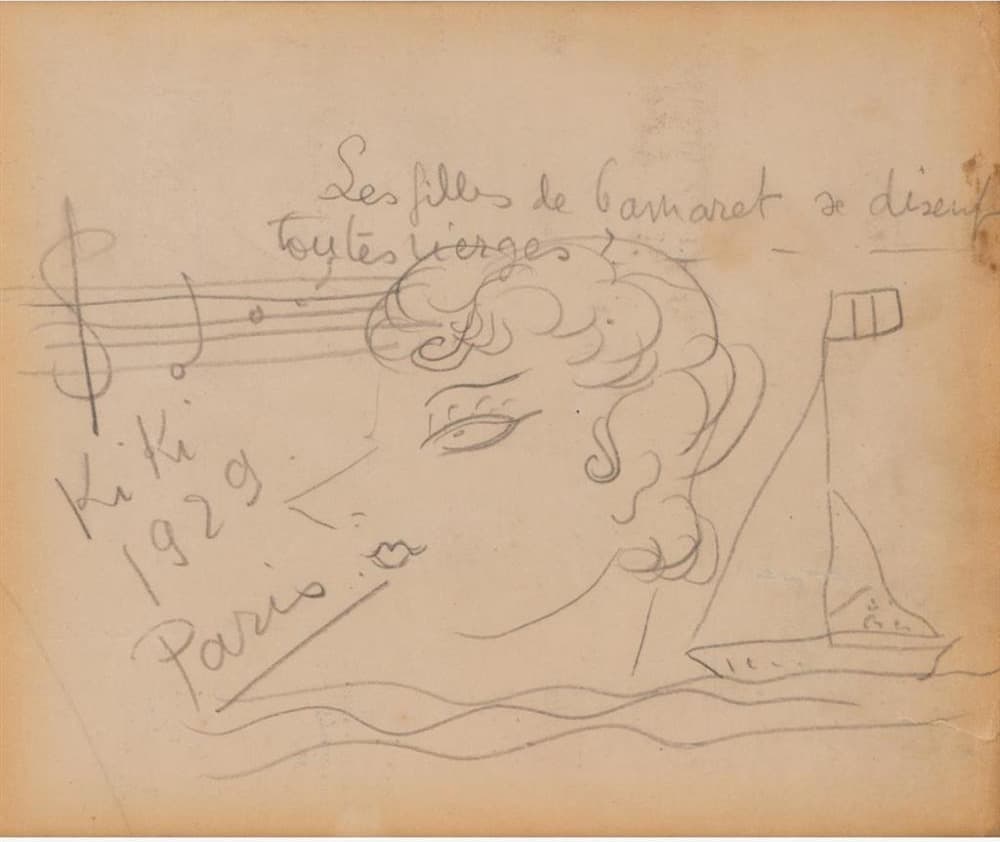
She had lettered a picture before. Les filles de Camaret se disent toutes vierges ?, the pencil sheet she made in Paris in 1929, carries the opening line of a sailors' song written across the top in the same hand. Writing into the picture is part of how she works.
The viewpoint is from above and to the left, so the road tips up and the shop front stands nearly flat. Nothing recedes. The bolts of cloth are the largest shapes on the canvas, and the crowd is fitted into the gaps between them.
Painted after the last show
Alice Prin — Kiki de Montparnasse was the name Montparnasse gave her — exhibited her own paintings three times: at the Galerie au Sacre du Printemps in March 1927, then in 1930 and 1931. Billy Klüver and Julie Martin record all three in the standard account of the quarter.
The date on this canvas is 1932, the year after the last of them. She went on painting after she had stopped showing, and the pictures from those years reached no gallery. Her Souvenirs of 1929 had already reproduced twenty of her canvases, which is how most people saw her work.
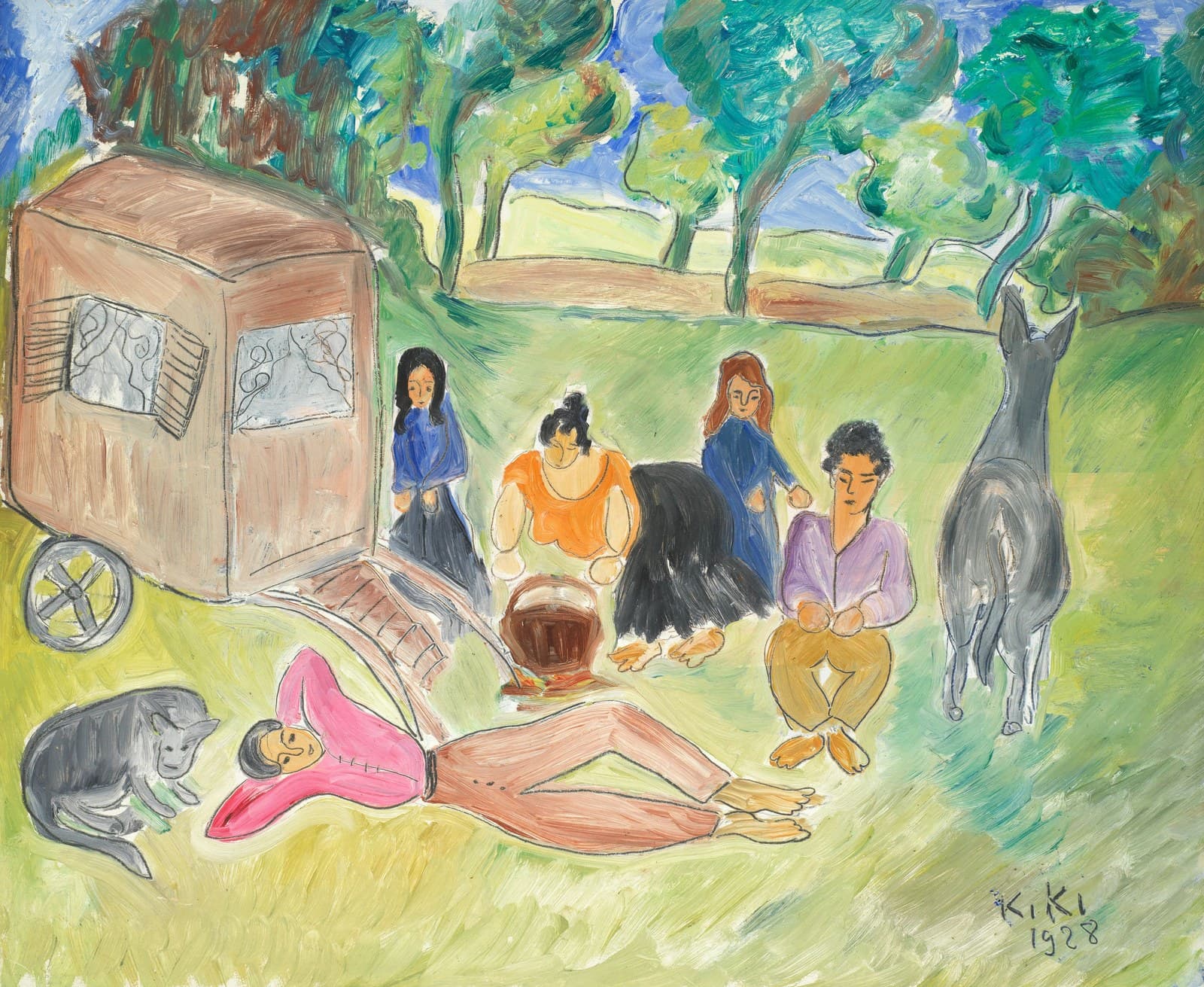
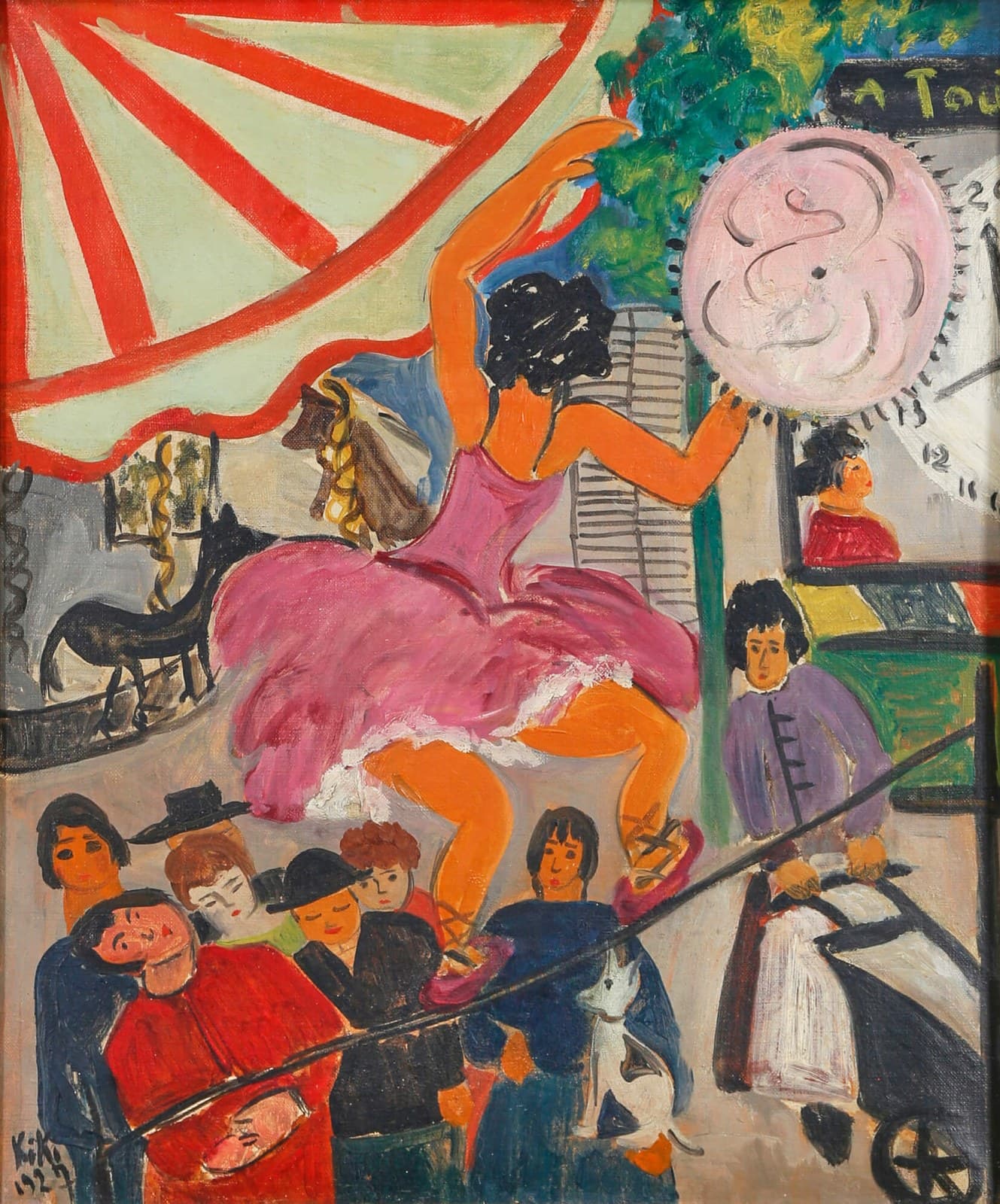
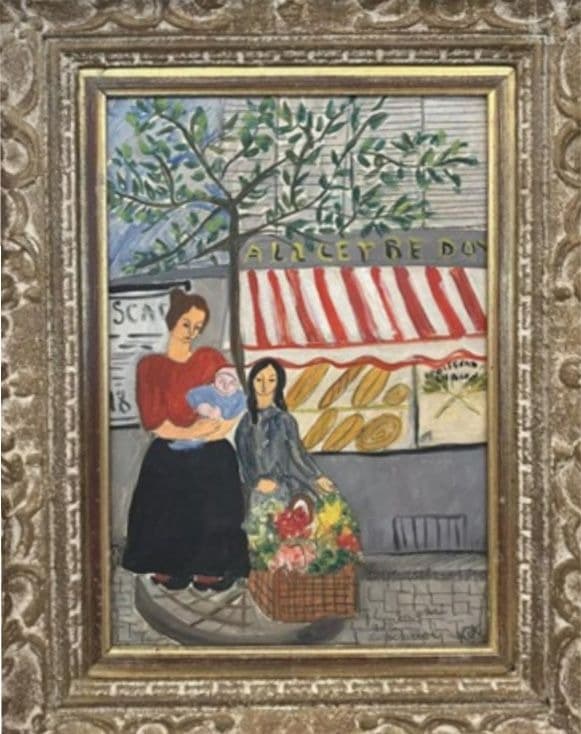
The subject is the same one she kept returning to: a crowd in a street, trade going on, nobody posed. The Acrobat of 1927 sets a dancer in front of a fairground, Gitans of 1928 a halted caravan at the edge of a field, and La marchande de fleurs a bakery with a flower basket in front of it.
Where it has been
Lombrail-Teucquam sold the painting at Drouot-Richelieu in Paris on Friday 25 May 2012, as lot 100 of Art moderne — Sculptures — Art contemporain, held in room 7. The estimate was 3,000 to 4,000 euros.
The house's results table records 3,500 euros for the lot. It does not say whether that figure includes the buyer's premium, so the atlas does not claim that it does.
It is in private hands. No museum holds it, and no public collection is known to hold any painting by Kiki de Montparnasse.
Close reading
Reading the work, detail by detail
A drapery front turned into a wall of colour, and the street working around it. Follow the hand lettering on the green, the open window above it and the bolts of cloth, then the crowd at the stall, the dog at the kerb and the paper in a shopper's hand. The last three views cross the road to the policeman, the two vehicles and the signature.
1.The shop's name
The name is lettered in tall separate capitals, wider spaced than the lines under it. Below come the trades, Soieries and Lainages, then grand choix toutes couleurs. A line in red begins Prime à tout a and runs off the right edge of the canvas before it finishes.
2.The offer written on the wall
The sales pitch is written freehand and the lines slope downward as they run right, the way a sign painter working fast leaves them. It reads occasions exceptionnelles, then voyez grand choix à l'intérieur.
3.The window above
The shutters are flat dark green panels and the curtain between them is a plain white shape divided by two dark strokes. Nothing inside the room is shown. The building above the shop is painted the same green as the shop front.
4.The bolts of cloth
Each bolt is one long curved band of flat colour running from the first floor to the ground. Two carry printed spots, one a red check. They are the largest shapes in the painting, and the shoppers are fitted into the gaps between them.
5.The crowd at the stall
The shoppers are packed shoulder to shoulder with no space between them, most seen from behind or in profile, handling the cloth. One face turns out of the group: a figure in a white shirt and grey bow tie, the only one in the picture that is smiling.
6.The dog at the kerb
The dog is painted in black with a white chest and a white patch on the muzzle, small enough to be missed. Beside it a shopper carries a folded white sheet covered in writing, too small in the reproduction to be read.
7.The policeman
He is the only figure in the painting with his back fully turned, and the tallest thing on the road. The raised baton is white with an orange disc at the tip, held above a line of round pale studs set across the roadway.
8.The car and the van
Both vehicles are seen from above and behind, drawn as rounded black and green shells on dark wheels. A white curtain is drawn across the car's rear window. The studs set across the road between them are painted as separate pale circles.
9.The poster on the wall
The poster is a flat orange rectangle filled with rows of short black strokes for text. Nothing on it can be read. A small figure in a red coat stands underneath, the only person on that side of the road apart from the policeman.
10.The signature
She signed KiKi on one line with 1932 under it, in the corner of the empty roadway. The letters are the same size as the marks she uses for lettering on the shop, and the same dark brown-black paint.
Timeline
1927
Kiki de Montparnasse exhibits her own paintings for the first time, at the Galerie au Sacre du Printemps in Paris in March; the show sells out.
1931
She exhibits her paintings for the third and last time in her life.
1932
Painted, signed and dated KiKi 1932 at the lower left.
2012
Sold at Lombrail-Teucquam, Drouot-Richelieu, Paris, 25 May, as lot 100, for 3,500 euros against an estimate of 3,000 to 4,000.
Where to see it
A viewing location has not yet been listed for this work.
Frequently asked questions
Who painted Le marché aux soieries à Paris?
Kiki de Montparnasse — Alice Prin — painted it in 1932 and signed it KiKi at the lower left with the date under her name. She is usually met as the model in other artists' pictures, and the atlas files this one under her as the artist.
What does Le marché aux soieries à Paris show?
A drapery shop with bolts of cloth hung down its front over the pavement, and a crowd of women in coats and cloche hats pressing along them. On the road at the left a policeman with his back turned raises a white baton between a parked black car and a green van.
What is written on the shop in the painting?
Two blocks of hand lettering. The first reads occasions exceptionnelles, voyez grand choix à l'intérieur. The second gives the shop's name, DREYFUS, then Soieries - Lainages, grand choix toutes couleurs, and a line in red beginning Prime à tout a, which runs off the edge of the canvas.
How big is Le marché aux soieries à Paris?
54 by 65 centimetres, oil on canvas, in landscape format. That makes it the largest painting by Kiki de Montparnasse in the atlas.
How much did Le marché aux soieries à Paris sell for?
The results table published by Lombrail-Teucquam records 3,500 euros for lot 100 at Drouot-Richelieu on 25 May 2012, against an estimate of 3,000 to 4,000 euros. The table does not say whether the figure includes the buyer's premium.
Did Kiki de Montparnasse still exhibit in 1932?
No. She showed her paintings three times — in 1927, 1930 and 1931 — and not again in her lifetime. This canvas is dated the year after the last of those shows, so she was painting without a gallery to take the work.
More by Kiki de Montparnasse
If you like Kiki de Montparnasse
Explore painters from the same movements and circles.

William S. Burroughs
American Beat novelist, essayist, performer and visual artist who completed Naked Lunch at the Beat Hotel in Paris and made cut-up writing a defining avant-garde method.
View artist
Leonora Carrington
English painter and writer who fled a debutante's future for Surrealist Paris at twenty, survived the war's wreckage of that life — internment for her lover Max Ernst, an asylum in Spain for her — and rebuilt herself in Mexico into one of the century's great painters of the uncanny.
View artist
Giorgio de Chirico
Italian painter whose metaphysical cityscapes helped shape Surrealism. The MNAC's 2018 Gala exhibition records that he valued her practical intelligence and asked her to act as his agent.
View artist
References
The sources below include collection records, catalogues, scholarly research, and primary materials that informed this page. They document Le marché aux soieries à Paris, its making, and its place in cultural history.


1Kiki de Montparnasse, Le marché aux soieries à Paris (1932) — lot 100, Art moderne, Sculptures, Art contemporain, Drouot-Richelieu, 25 May 2012
WebsiteLombrail-Teucquam, 2012Used forAuction record for the painting: title, medium, dimensions, inscription, estimate and result, with the house's own printed catalogue for the sale.
2Kiki's Paris: Artists and Lovers 1900–1930
BiographyHarry N. Abrams, 1989Used forThe standard account of Montparnasse and of her three exhibitions as a painter, the last of them in 1931.

3Kiki et le Montparnasse des années 1930 — Arts africains, sale catalogue, Drouot-Richelieu, 21 September 2018
Exhibition catalogueDe Baecque et associés and Lynda Trouvé, Paris, 2018Used forDescribes a copy of Souvenirs and lists reproductions of twenty paintings by the author among its contents.
4Kiki, Reine de Montparnasse — exhibition, 1 April to 30 December 2026
WebsiteMusée du Pays Châtillonnais – Trésor de Vix, Châtillon-sur-Seine, 2026Used forThe 2026 exhibition in her birthplace, which shows her own paintings and drawings alongside the portraits of her.
These references provide the documented foundation for this work's history and interpretation. Claim-level citations remain attached to the specific claims they support.
 Explore more resources