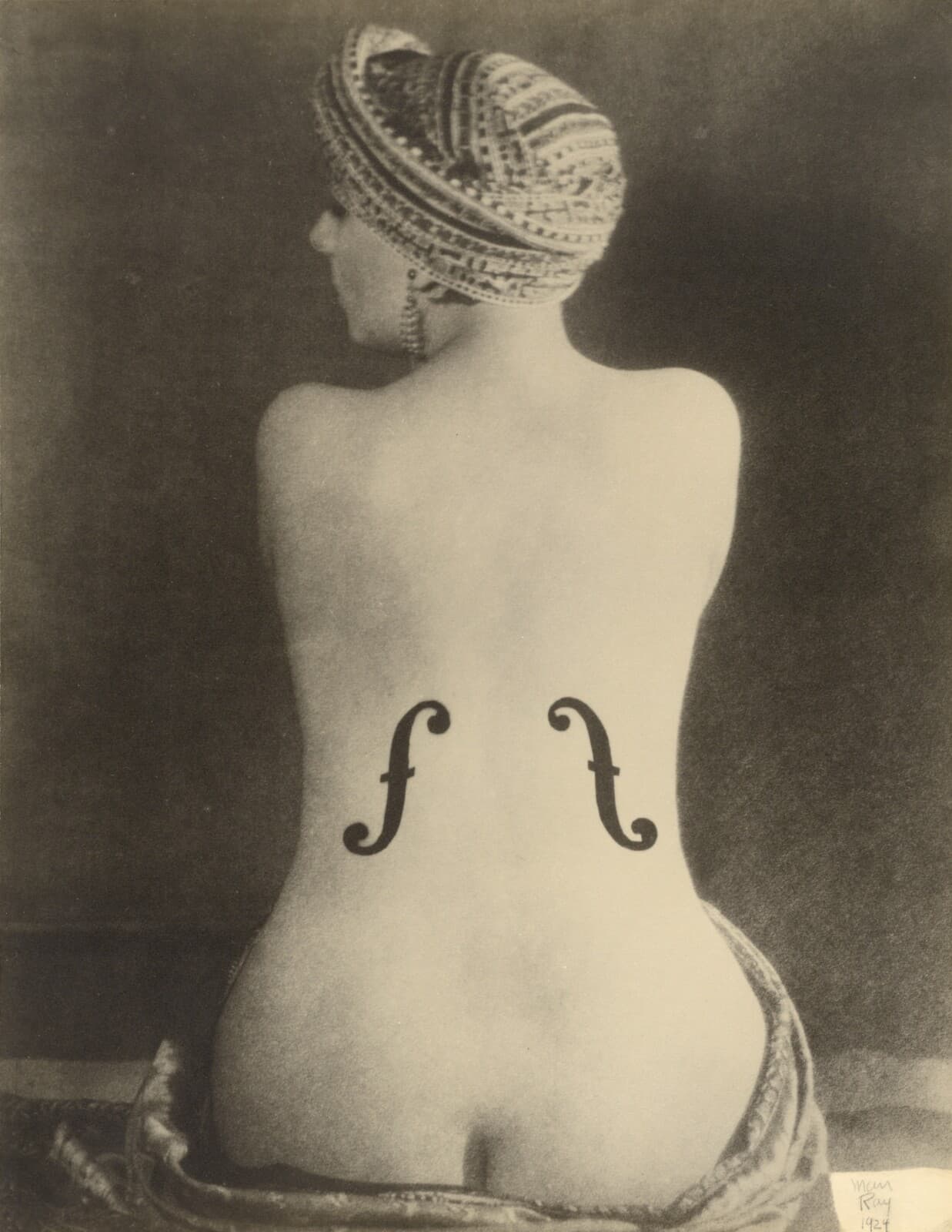
A woman sits with her back to the camera, bare to the hips, her head wrapped in a patterned turban and turned so that only the edge of her profile shows. Two black violin f-holes stand on her lower back. Man Ray, born Emmanuel Radnitzky, made the photograph in Paris in 1924 with Kiki de Montparnasse, born Alice Prin. The J. Paul Getty Museum holds this 1924 gelatin silver print as 86.XM.626.10.
The figure fills the centre of the frame from the shoulders down to the top of the buttocks. The back is turned square to the camera and lit from the front left, so the spine runs as a soft shadowed channel down the middle and the light falls away towards both flanks. The arms are not in the picture at all. They are cut by the frame at the shoulder, which is why the body reads as a shape rather than a person in a pose.
The head is wrapped in a cloth wound in overlapping diagonal bands. The pattern is a fine one — rows of dots and dashes, small stylised hooks and blocks — and a darker twist of it rises at the crown. A long earring of small beads hangs from under the wrap, drops clear of the jaw and ends in a slight flare. Of the face, only the brow, the nose and the line of the cheek are given.
Cloth is bunched under her at the hips and runs across the bottom of the frame, pale-grounded and patterned. Behind her the backdrop darkens steadily from left to right, and at the lower left a horizontal dark band marks where a floor meets a wall.
Two violin f-holes sit low on the back, one on each side of the spine. They are solid black, each with a small round eye at the top and another at the bottom and a short blunt nick cut into the shoulder at mid-height. They are not a matched pair. The right-hand one is set higher than the left, is slightly the larger of the two, and carries its nick at a different height.
How the f-holes got there, and what the museum says about it
The J. Paul Getty Museum's record for the 1924 print states the method plainly: Man Ray painted the f-holes of a stringed instrument onto the photographic print and then rephotographed the print. On that account the shapes were never on Kiki de Montparnasse's back and never on the negative. They were added to a finished photograph, and the picture everyone knows is a photograph of a photograph.
The print bears that out. At high magnification the black shapes carry the same grain and the same slightly softened edge as the skin around them. Nothing about them sits on top of the sheet. The nicks are blunt and unevenly weighted, and the upper eye of the left-hand hole has a faintly lighter core, both of which suit a loaded brush more than a cut edge.
The Getty's other print of the same image tells it differently. The record for 84.XM.1000.118 describes two violin f-holes that "have been cut out and positioned at the center of her back", which is a different operation with a different tool. One museum, two records, two accounts of the same marks. The atlas follows the 1924 record and notes the disagreement rather than choosing silently.
Man Ray was an admirer of Jean-Auguste-Dominique Ingres, and the Getty places the picture in a series of photographs of Kiki de Montparnasse in a turban made after Ingres's nudes. The title is a French idiom. Le violon d'Ingres means a hobby, from the story that Ingres liked playing the violin better than he liked being told he was a painter.
Which print, and how many
The Getty holds two prints of this image and they are three or four decades apart. The one described here is dated 1924, measures 29.6 by 22.7 centimetres, and was made in Paris. The other, 84.XM.1000.118, is dated by the museum "negative 1924; print probably 1950s–1960s" and measures 24.9 by 19.4 centimetres.
The later sheet announces itself. A violet rubber stamp reading REPRODUCTION is struck on the front, inside the picture, low on the left over the grey floor. The back carries the same word again above a second stamp, MAN RAY over PARIS. Above that, in graphite circled in red crayon, someone has written "Kiki – Le Violon d'Ingres 1924" and under it "man Ray – Paris", with a red line drawn through the date and a red annotation beginning "LB 197" at the top corner. At the foot, in blue crayon, are the letters DUCHAM, then CUT, then p 111 — a picture editor's marks for a book.
Both prints carry a signature reading Man Ray over 1924, and on both it is inside the picture, on the pale cloth at lower right, rendered in the same grain as everything else. It was written once, on the print that was rephotographed, and every print since has inherited it.
Prints of the image exist well outside Los Angeles, and the image's later market history is often attached to a 1924 print in private hands rather than to either Getty sheet. Christie's own published record of that sale could not be reached while this was written — the site refused automated requests and its search endpoints returned nothing — so no figure is repeated here.
Kiki de Montparnasse
The woman is Kiki de Montparnasse, born Alice Prin in Châtillon-sur-Seine in 1901. She was a singer, a painter and a memoirist as well as a model, and she is the subject of a large part of Man Ray's Paris work through the 1920s. The Getty names her in its record for this print and again in its record for Noire et Blanche of 1926, where she holds a carved mask beside her own face.
She is also the woman in L'Étoile de mer, the fifteen-minute film Man Ray made in 1928 from a poem by Robert Desnos. The Getty holds a still of her from it.
What the picture gives of her is a back, a wrapped head and an earring. The Getty's own text is direct about the cost of that: the transformation of her body into an instrument is funny, it says, and her armless form is also disturbing to contemplate.
Where it has been shown
The accession number puts the print's entry into the J. Paul Getty Museum in 1986, and it has been exhibited repeatedly since. It appeared in Rare States and Unusual Subjects: Photographs by Paul Strand, André Kertész, and Man Ray at the museum's Malibu site. It was shown again at the Getty Center in Photographers of Genius and in In Focus: The Nude. It then travelled in A Practical Dreamer: The Photographs of Man Ray, from the Getty Center to the Walker Art Center in Minneapolis and the Art Gallery of Ontario in Toronto.
It also travelled in Shared Intelligence: American Painting and the Photograph, shown at the Columbus Museum of Art and the Georgia O'Keeffe Museum in Santa Fe.
The museum's bibliography for the print runs from Man Ray: Photographe, published by Schirmer/Mosel in 1982 with an introduction by Jean-Hubert Martin, through the two Getty exhibition brochures — Weston J. Naef and Judith Keller in 1987, Katherine Ware in 1998–99 — to Mark Braude's Kiki Man Ray, where it is plate 8 of the 2023 German edition.
Close reading
Reading the work, detail by detail
The J. Paul Getty Museum's 1924 print is reproduced whole, with the sheet's own edges at the top and left. The tone is warm and the grain is coarse and even across the whole surface, the f-holes included, which is the first thing that tells you the black shapes were photographed rather than applied to this piece of paper.
1.Two f-holes, and the grain runs straight through them
The two marks are solid and dense, but their edges are not hard. At this magnification the same warm grain that covers the back runs right up to and across the boundary of each shape, and the black itself carries a faint unevenness rather than sitting flat. Nothing about them is raised off the sheet. They were on the surface that was rephotographed, not on this one.
2.The left hole's upper eye has a lighter core
Each f-hole ends top and bottom in a small round eye. The upper eye of the left-hand one is not evenly filled: its centre is a shade lighter than its rim, the way a pooled brushstroke dries. The lower eye, further from the start of the stroke, is denser and rounder. That difference across a single shape is a mark made by hand.
3.The right-hand hole sits higher, and is the larger
A violin's two f-holes are a matched mirrored pair. These are not. The right-hand shape begins higher up the back than the left, ends higher, and is a little the bigger of the two. Measured against the spine, the pair is also slightly off-centre. It is a hand-placed approximation of an instrument, not a template.
4.The nicks are blunt and unevenly weighted
Halfway down each shape a short bar crosses the stem — on a real violin, the notch that marks the stop of the string length. Here the two arms of the bar are not the same length or the same thickness, and the bar on the right-hand hole sits at a different height from the one on the left. Both read as afterthoughts added with the same loaded tool.
5.The turban is one cloth wound in overlapping bands
The wrap is not a hat but a single length of printed cloth turned about the head four or five times, each pass overlapping the one below and running diagonally up to the right. The pattern is small and busy: rows of dots and dashes, short hooks, little blocks. A darker twist of the same cloth is pushed up at the crown, and the whole thing reads much lighter than the skin.
6.A chain of small beads hangs clear of the jaw
From under the lowest turn of the wrap a narrow line of separate small beads drops straight down, passes the line of the jaw without touching it and finishes with a slight widening. The ear it hangs from is completely covered. It is the one ornament in the picture and the only thing that moves in it.
7.Of the face, only an edge
The head is turned so far that the face is almost gone. What is left is a sliver: the curve of the brow, the small point of the nose, the line of the cheek falling back to the jaw. No eye, no mouth, no expression. The picture is arranged so that the back is the subject and the person is a shape attached to it.
8.The light comes from the front left, and the spine is a channel
The lighting is a single soft source high and to the front left. It puts the brightest value on the left shoulder blade, runs a shallow shadowed groove down the spine, and lets both flanks fall away into mid grey. There is no second light and no fill, so the right side of the body loses detail before it reaches the contour.
9.The print still holds gradation at the top of its range
Below the f-holes the tone steps down from the highlight at the small of the back into the shadow at the hip without a break and without blocking up. On a warm-toned silver print of this date that is a printing decision as much as an exposure: the highlight has been held back rather than burnt through. It is why the body reads as volume and not as a cut-out.
10.Patterned cloth bunched under the hips
She is sitting on a length of the same kind of printed cloth as the turban — pale ground, small dark motifs — gathered into soft folds that run right across the bottom edge and up the right side. It stops the body at the hip and closes the composition. It is also where the signature sits.
11.The signature is inside the picture, in the picture's own grain
Three short lines on the pale cloth at lower right: Man, then Ray, then 1924. It is not ink on this sheet. It carries the same grain and the same slight softness as the cloth it sits on, which means it was written on the print that was then rephotographed. Every later print of the image inherits it, including the museum's second one.
12.The backdrop darkens to the right, and a floor line cuts the corner
The ground behind her is a plain backdrop, not a wall of the room, and it gets steadily darker from left to right until it is almost black at the right edge. At the lower left a horizontal dark band runs in from the frame — the join between floor and wall, left visible. It is the only straight line in a picture otherwise made of curves.
Timeline
1921
Man Ray arrives in Paris in July.
1924
Photographs Kiki de Montparnasse from behind in a turban, paints violin f-holes onto a print, and rephotographs it. The Getty's 1924 print, 86.XM.626.10, comes from that sequence.
1926
Photographs Kiki de Montparnasse again for Noire et Blanche, holding a carved mask beside her face; the Getty's print is 86.XM.626.14.
1928
Casts her as the woman in L'Étoile de mer, from a poem by Robert Desnos.
1950s–1960s
A second Getty print is made, stamped REPRODUCTION front and back and marked up for a book. It is 84.XM.1000.118.
1986
The 1924 print enters the J. Paul Getty Museum, whose accession number 86.XM.626.10 carries the year in its first two digits.
1998–99
Shown in A Practical Dreamer: The Photographs of Man Ray, whose brochure the museum dates 1998/1999, and which travels to Minneapolis and Toronto.
Where to see it
J. Paul Getty Museum
Los Angeles, United States
A public viewing address has not yet been confirmed for this holding.
A photograph on paper, shown in rotation rather than permanently. Check before travelling.
Frequently asked questions
Who is the woman in Le Violon d'Ingres?
Kiki de Montparnasse, born Alice Prin in 1901. She modelled for Man Ray through the 1920s, sang in the Montparnasse cabarets, painted, and published a memoir. She is also the woman in his 1928 film L'Étoile de mer.
Are the f-holes painted on her back?
No. The J. Paul Getty Museum records that Man Ray painted them onto a photographic print and then rephotographed the print. The shapes were never on her body and never on the negative. The museum's record for its second print of the image says instead that they were cut out and positioned, which is a different account of the same marks.
What does the title mean?
Le violon d'Ingres is a French idiom for a hobby. It comes from Jean-Auguste-Dominique Ingres, the painter, who is said to have prized his violin playing. Man Ray admired his nudes, and the Getty places the photograph in a series made after them.
Where is Le Violon d'Ingres?
The J. Paul Getty Museum in Los Angeles holds two prints. The 1924 one is 86.XM.626.10, a gelatin silver print of 29.6 by 22.7 centimetres. The other is 84.XM.1000.118, dated by the museum negative 1924, print probably 1950s to 1960s. Other prints are held elsewhere.
Why does the print carry a signature inside the picture?
Because the signature was written on the print that Man Ray then rephotographed. It reads Man Ray over 1924 and sits on the pale cloth at lower right, in the same grain as the rest of the image. Every later print inherits it rather than being signed again.
Is Le Violon d'Ingres in copyright?
Yes. Man Ray died on 18 November 1976, so the photograph is protected in the United States and across the European Union. The Man Ray Trust licenses it through the Artists Rights Society in the United States and ADAGP in France. The reproduction shown here is reduced and published under fair use for editorial commentary.
In the atlas
What the graph records about this work — every claim carries its citation.
The J. Paul Getty Museum names the sitter in both of its records of the image, and identifies her as Alice Prin on its record of Noire et Blanche of 1926. She is seen from behind, bare to the hips, her head in a wound turban and her face turned almost out of the frame; the two violin f-holes on her lower back were added to a print and the print rephotographed.
— Man Ray, Le Violon d'Ingres (Ingres's Violin), 1924 (86.XM.626.10) (1924), 86.XM.626.10; Man Ray, Noire et Blanche (Black and White), 1926 (86.XM.626.14) (1926), 86.XM.626.14
The sources below include collection records, catalogues, scholarly research, and primary materials that informed this page. They document Le Violon d'Ingres, its making, and its place in cultural history.
1Man Ray, Le Violon d'Ingres (Ingres's Violin), 1924 (86.XM.626.10)
Website
J. Paul Getty Museum, 1924
Used for
The 1924 print described here — title, date, medium, dimensions, credit line, the painted-and-rephotographed account, and the exhibition and publication history.
These references provide the documented foundation for this work's history and interpretation. Claim-level citations remain attached to the specific claims they support.



 View source