Larmes (Tears)
by Man Ray
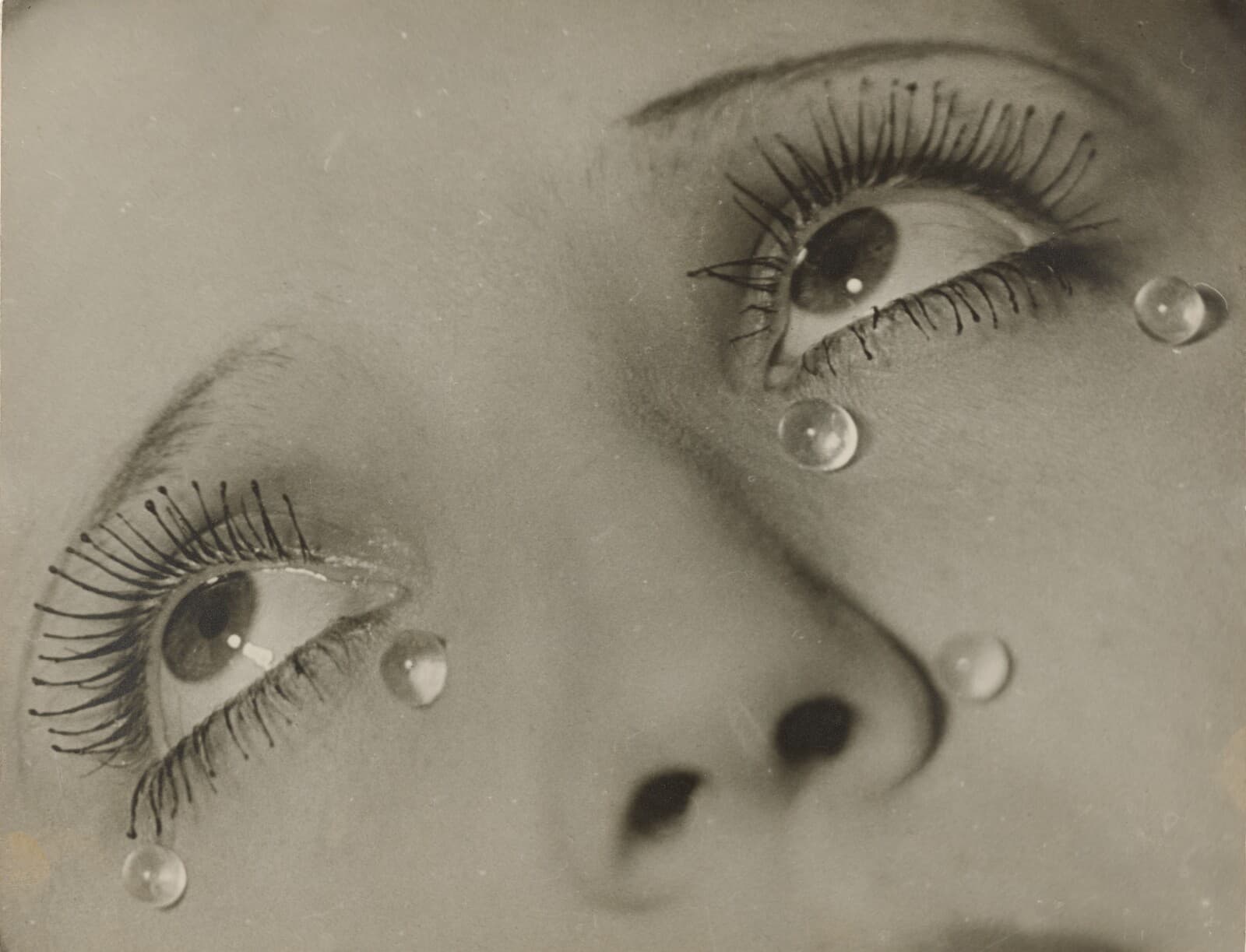
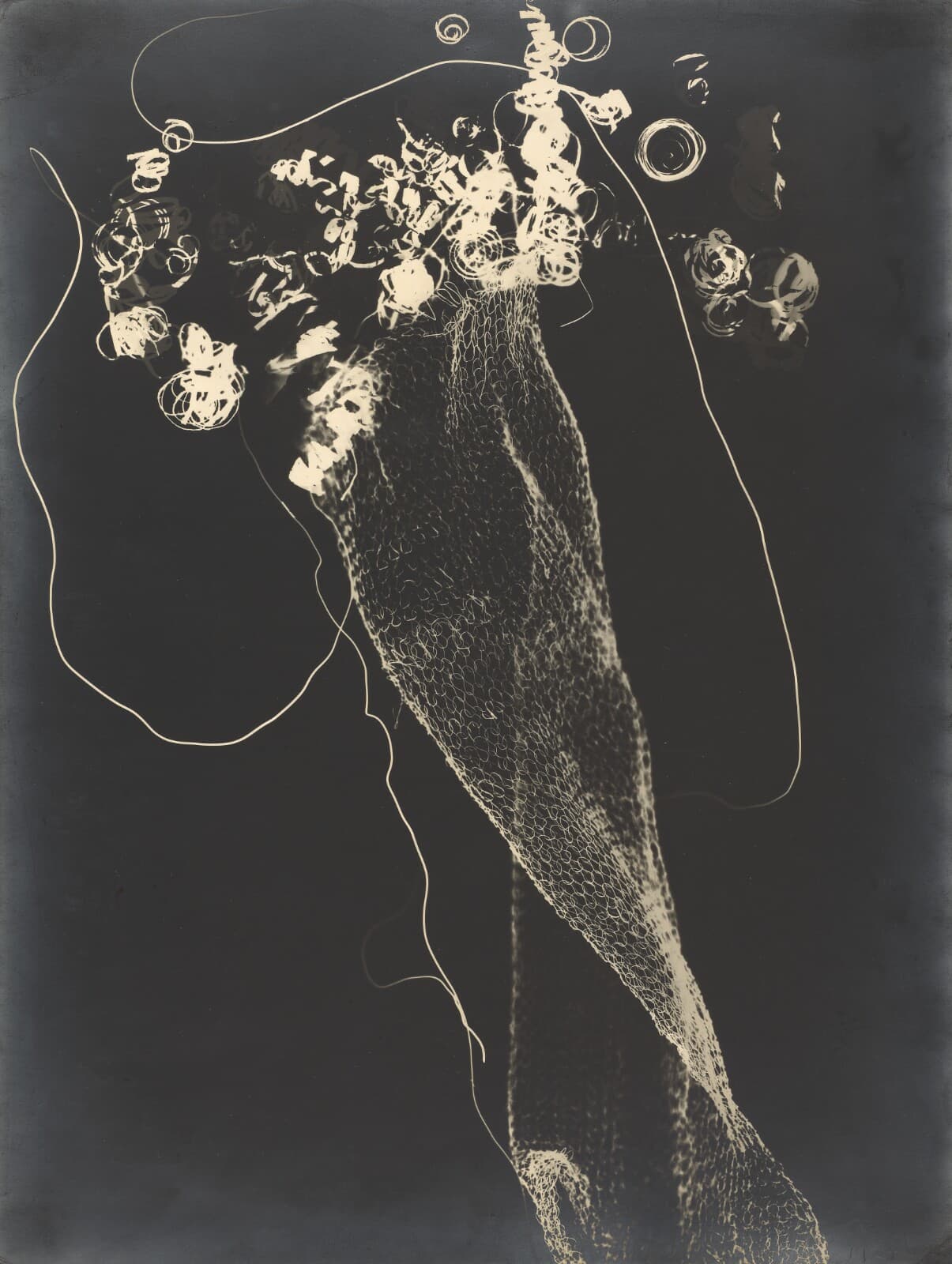
A close view of the upper half of a face, cut at the brow and again below the nose. The eyes look up and away to the right. Five clear glass spheres sit on the skin below them. Man Ray, born Emmanuel Radnitzky, made the photograph in Paris about 1932, and the J. Paul Getty Museum holds this gelatin silver print as 84.XM.230.2. Its title is French for tears.
- About 1932
- Gelatin silver print
- J. Paul Getty MuseumLos Angeles, United States
About Man Ray
What the photograph shows
The frame is filled by a face and nothing else. The top edge cuts across the brows; the bottom edge cuts below the nostrils. There is no hair, no neck, no background and no room. The head is tilted back, so the nose runs up the right of the frame and the two eyes sit at different heights.
Both eyes are open and turned up and to the right, away from the camera. The irises are a mid grey against a paler white, each with the pupil dark at its centre. Above and below each eye the lashes are heavily worked with mascara.
The two sets of lashes are not the same. On the right of the frame they stand apart as separate stiff spikes, widely spaced, each one ending in a rounded black bulb, and there are roughly twenty of them above the lid. On the left they are finer, much closer together, curved rather than straight, and doubled into two ranks, one standing clear and one lying flat along the lid.
Five clear spheres rest on the skin. One hangs from a lower lash on the right, low in the frame. One sits beside that eye at the temple. One is below the inner corner of the left eye, one further out on the cheek beside the bridge of the nose, and one at the far right edge. Each is a glass ball with a bright point inside it and a brighter crescent along one side.
The lower half of the left eye and the cheek beneath it carry visible pores and fine lines, so the surface is skin and not a mannequin's paint. The forehead is a broad empty field of even tone with a fine diagonal grain and a scatter of small white spots.
The tears are glass
The Getty is explicit about what is on the face: the sitter, it says, is a fashion model who cries tears of glistening, round glass beads, and the effect is to aestheticise the sentiment her tears would normally express.
The beads do not behave like water. They are perfectly spherical, they hold their shape on a sloping cheek, and each one refracts a compressed image of the lamp inside it. They also throw almost no shadow, which places the light almost square to the face rather than off to one side.
One bead is doing something the others are not. It hangs directly from a lower lash on the right, touching the lash tip, so that a single lash appears to be carrying it. That is the one contact in the picture that reads as a tear being shed rather than a bead lying on a cheek.
The lighting is legible in the eyes. The right eye carries two reflections, a small round point and, below it, a crisp oblong bar. The left eye carries only a single round point. Two different reflections in two eyes of one face is not what a single lamp does, and the oblong has the hard straight edges of a retoucher's mark.
Which print, and where the image went
The Getty dates the sheet "about 1932" and gives no separate printing date, so the museum is dating the image rather than distinguishing a later printing from an earlier one. It measures 22.9 by 29.8 centimetres and was made in Paris.
The image had a second life in a different crop. The museum records that a cropped version showing a single eye appeared as the first plate in a 1934 book of his photographs. That was the volume published in Hartford by James Thrall Soby. Dover reprinted it in 1979 as Photographs by Man Ray: 105 Works, 1920–1934, with texts by Paul Éluard, André Breton, Rrose Sélavy and Tristan Tzara, and the Getty cites that reprint on its own records.
The museum also notes that Man Ray put the picture inside other pictures of his own, and reasons from that habit of reuse that he must have counted it among his most successful photographs.
It has been discussed at length since. The Getty's bibliography lists Rosalind E. Krauss and Jane Livingston's L'Amour Fou: Photography and Surrealism, published for the Corcoran Gallery of Art in 1985, at page 118. It lists the Max Ernst Museum's Man Ray: Fotograf im Paris der Surrealisten of 2013 at page 165. It lists Bill Brown's Other Things, published by the University of Chicago Press in 2015, as plate 8.
Who is in it, and who is not
The Getty names nobody. Its text calls the face that of a fashion model and leaves it there, and no identification is asserted here either.
The museum does place the picture against a moment in his life. Man Ray made it in Paris around the time of his break with Lee Miller, the American photographer who had come to him in 1929, worked alongside him and left to open her own studio at 12 rue Victor Considérant. The Getty's own wording is careful: the woman's false tears may relate to that event. May, not did.
It is worth saying plainly that the connection is the museum's reading rather than a document. Nothing in the picture, and nothing in the Getty's record, ties the beads to Lee Miller.
Where it has been shown
The Getty records the print in Rare States and Unusual Subjects: Photographs by Paul Strand, André Kertész, and Man Ray, shown at its Malibu site. It also records it in Man Ray (Paris) at the Centre Georges Pompidou, and in In Focus: Making a Scene at the Getty Center.
It travelled in A Practical Dreamer: The Photographs of Man Ray, whose brochure the museum dates 1998/1999, from the Getty Center to the Walker Art Center in Minneapolis and the Art Gallery of Ontario in Toronto. It also went to the Max Ernst Museum Brühl des LVR for On the Look-out for Light — Man Ray's Photography in Surrealist Paris.
Close reading
Reading the work, detail by detail
The J. Paul Getty Museum's print is reproduced whole, with its own slightly cockled top-left corner and a stain at the bottom left. The tone is warm and the surface carries a fine diagonal grain. The picture is cropped so tightly that the frame cuts the brows at the top and the nostrils at the bottom.
1.Twenty lashes, each standing separately
On the right of the frame the upper lashes are a row of about twenty stiff spikes, each one clear of its neighbours with pale skin visible between them. They stand almost straight out rather than curling, which is what heavy mascara over a false strip does. Nothing about them is a natural lash line.
2.Every lash ends in a rounded black bulb
Each spike swells at its end into a small rounded blob, darker and fatter than the shaft below it. That is mascara gathering and drying at the tip. The blobs are what turn the lashes into a row of black pins in the print, and they are the single most artificial thing in the picture apart from the beads.
3.The other eye has finer lashes, in two ranks
The eye at the top of the frame is lashed differently. Its lashes are finer, far closer together and curved rather than straight, and they run in two ranks: an outer set standing clear and an inner set lying flat along the lid. The two eyes of one face have not been made up the same way.
4.One eye holds a round highlight and an oblong bar
In the lower eye the iris carries two highlights: a small round point, and below and to its right a crisp white bar with straight sides and square ends. A lamp makes the round one. The bar's edges are harder than anything else in the eye, which is the signature of a retoucher's brush rather than a reflection.
5.The other eye holds only a single round point
The upper eye carries one highlight only, a small round point low in the iris, plus a thin bright sliver at the inner corner where the cornea turns. There is no bar. Two eyes in one head, photographed in one exposure, should carry the same reflections. These do not, and the difference is not explained by the museum's record.
6.The lower lashes sweep out and down in a long comb
Below the lower eye the lashes are longer and finer than the uppers and all swept the same way, down and out towards the corner, making a comb that runs almost the width of the eye. They too are tipped with mascara but the tips are smaller. The comb ends at the one lash that is carrying a bead.
7.One bead hangs from a lash
Low on the left the last of the lower lashes meets a glass sphere, and the two touch. It is the only bead in the picture that is in contact with anything but skin, and it is the one that makes the conceit work: a single lash apparently carrying a tear. The others are simply resting on a cheek.
8.A bead at the temple, with the light inside it
Beside the lower eye, out towards the temple, a second sphere sits on the skin. It is not a drop of water: it holds a perfect circular outline on a sloping surface, and inside it a compressed bright crescent runs down one side with a small point of light at its centre. Glass refracts; a tear would have flattened and run.
9.A bead below the inner corner, with almost no shadow
Under the inner corner of the upper eye a third sphere rests on the cheek. What is almost missing is a shadow: only the faintest darkening shows at its lower edge where it meets the skin. That places the light nearly square to the face, which is also why the skin itself is so flat.
10.A fifth bead, half out of the frame
At the right edge sits the fifth sphere, and the frame very nearly cuts it. A second smaller brightness sits immediately beside it, which is the light the ball has bent and thrown onto the skin. Nothing else in the picture is that bright, the highlights in the eyes included.
11.The nostrils are the darkest tone in the frame
The nose runs up the right of the picture and the frame cuts it just below the nostrils. The two openings are the deepest black anywhere on the sheet, darker than the mascara. Everything else, skin and eyes and beads alike, sits in the upper half of the print's range, which is what gives the whole thing its bleached look.
12.Pores below the lower lid, so it is skin
Under the upper eye and out across the cheek the surface shows pores and a fine network of lines, sharply enough resolved to count. This matters because the face is so smooth elsewhere that it can be taken for a mannequin. It is not. The Getty's description — a fashion model — is borne out by the grain of her own skin.
13.The brow is a thin arc, and the frame cuts it
The eyebrow above the upper eye is a thin, even, plucked-and-pencilled arc of the 1930s, and it runs off the top of the frame within a centimetre of appearing. Cropping there removes the forehead and with it most of what would make the face a portrait.
14.A diagonal grain, and scattered white spots
The empty field of the forehead shows the sheet itself. There is a fine diagonal grain running up to the right — the paper's own texture rather than the film's — and scattered across it a dozen small white marks. They are spotting-out: retouching applied to the print to kill dust shadows, and left visible at this magnification.
Timeline
1929
Lee Miller arrives in Paris and begins working with Man Ray.
1930
Lee Miller opens her own studio at 12 rue Victor Considérant and works independently of him.
about 1932
Man Ray makes Larmes in Paris, with glass beads on a fashion model's face. The Getty dates the image and records no separate printing date.
1934
A cropped version showing a single eye appears as the first plate of the book of his photographs published by James Thrall Soby in Hartford.
1984
The print enters the J. Paul Getty Museum, whose accession number 84.XM.230.2 carries the year in its first two digits.
1985
Reproduced in Rosalind E. Krauss and Jane Livingston's L'Amour Fou: Photography and Surrealism, page 118.
1998–99
Travels in A Practical Dreamer: The Photographs of Man Ray to Minneapolis and Toronto.
Where to see it
J. Paul Getty Museum
Los Angeles, United States
A public viewing address has not yet been confirmed for this holding.
A photograph on paper, shown in rotation rather than permanently. Check before travelling.
Frequently asked questions
Are the tears real?
No. They are round glass beads laid on the skin, and the J. Paul Getty Museum says so directly. They hold a perfect sphere on a sloping cheek, refract a compressed image of the studio lamp inside themselves, and throw almost no shadow.
Who is the woman in Larmes?
The Getty names nobody and calls her a fashion model. No identification is made here. The museum notes that Man Ray made the picture in Paris around the time of his break with Lee Miller and suggests the false tears may relate to it, but that is a reading rather than a document.
What does the title mean?
Larmes is French for tears. The Getty's preferred title prints the French and the English gloss together as Larmes (Tears), and the picture is often called Glass Tears in English.
Where is Larmes?
The J. Paul Getty Museum in Los Angeles, accession number 84.XM.230.2. It is a gelatin silver print of 22.9 by 29.8 centimetres, made in Paris about 1932.
Why do the two eyes look different?
The lashes are not the same on both sides. On the right of the frame they stand apart as stiff separate spikes ending in rounded bulbs; on the left they are finer, closer and doubled into two ranks. The reflections differ too: the right eye carries a round highlight and a crisp oblong bar, the left only a round one.
Is Larmes in copyright?
Yes. Man Ray died on 18 November 1976, so the photograph is protected in the United States and across the European Union. The Man Ray Trust licenses it through the Artists Rights Society in the United States and ADAGP in France. The reproduction shown here is reduced and published under fair use for editorial commentary.
More by Man Ray
References
The sources below include collection records, catalogues, scholarly research, and primary materials that informed this page. They document Larmes (Tears), its making, and its place in cultural history.


1Man Ray, Larmes (Tears), about 1932 (84.XM.230.2)
WebsiteJ. Paul Getty MuseumUsed forThe print described here — title, date, medium, dimensions, credit line, the glass beads, the fashion model, the 1934 crop and the exhibition and publication history.
2Man Ray, Noire et Blanche (Black and White), 1926 (86.XM.626.14)
WebsiteJ. Paul Getty Museum, 1926Used forCited for the museum's bibliographic entry on the 1934 Soby volume, reprinted by Dover in 1979 with texts by Paul Éluard, André Breton, Rrose Sélavy and Tristan Tzara.

3Lee Miller — biography and chronology
ArchiveLee Miller Archives, Farleys House and GalleryUsed forThe Lee Miller Archives chronology, cited for her Paris years with Man Ray and the studio at 12 rue Victor Considérant.
4Man Ray (Emmanuel Radnitzky, dit)
WebsiteCentre Pompidou, Musée national d’art moderneUsed forThe Centre Pompidou's Man Ray holdings, cited for the French credit line © Man Ray Trust / Adagp, Paris.
5Encyclopaedia Britannica — Man Ray
WebsiteUsed forBiography, cited for the Paris studio years and the fashion work.
These references provide the documented foundation for this work's history and interpretation. Claim-level citations remain attached to the specific claims they support.
 Explore more resources