Profile and Hands
by Man Ray
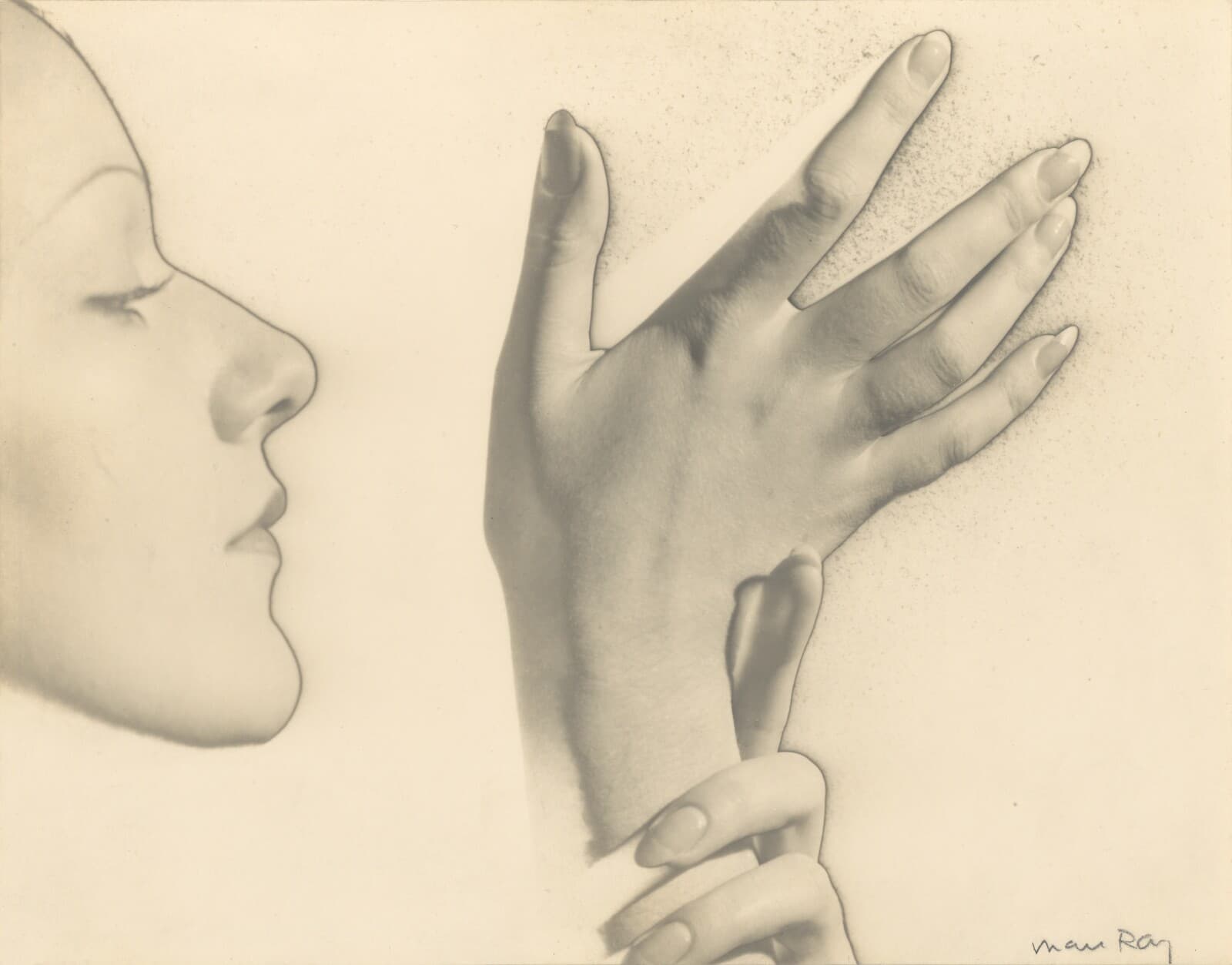
A woman's profile enters at the left edge, eyes closed. To the right of it, filling most of the frame, two hands rise: an upper hand with the fingers spread, and a lower one closed around its wrist. A fine black line runs round every contour. Man Ray, born Emmanuel Radnitzky, made the print in 1932, and the J. Paul Getty Museum catalogues it as a solarized gelatin silver print, accession number 84.XM.839.5.
- 1932
- Solarized gelatin silver print
- J. Paul Getty MuseumLos Angeles, United States
About Man Ray
What the print shows
The picture is held almost entirely in its top two stops. The ground is a flat pale cream, the skin a shade lighter than the ground, and the only genuinely dark things in it are a nostril, a lash line and the outline itself.
At the left, a head in profile is cut by the frame so that the crown and the back of the skull are lost. The eye is closed, the lashes reading as a short dark comb. The nose, the mouth and the chin are fully given; the cheek behind them is nearly blank.
The upper hand occupies the right two-thirds of the frame, seen from the back, held with the fingers apart and slightly curled, as though pressed against something that is not there. Each nail is a smooth pale oval with a darker crescent at its tip. The knuckle creases and the fine lines across the back of the hand are all resolved.
The second hand comes up from the bottom and closes around the first one's wrist, its own fingers curling over and away from the viewer. Where the forearm meets the pale ground the contour is a hard line; where it meets a soft grey shadow on the left it has no line at all and simply dissolves.
Man Ray signed the sheet in graphite at the lower right, inside the picture area, in a small hand: a lower-case m for the first name, a capital R for the second. The pencil is grey rather than black and breaks over the grain of the paper, so it was written on this sheet rather than copied from another print.
Where the Mackie line runs, and where it does not
Solarisation, properly the Sabattier effect, means exposing a print to light part-way through development and then carrying on. Some tones reverse, and a dark outline forms along the boundaries between light and dark areas. That outline is the Mackie line, and it is the whole subject of this sheet.
Here it runs as one continuous hairline down the forehead and over the brow. It carries on down the bridge of the nose, round the tip and under the nostril. It crosses the upper lip, rounds both lips, drops into the crease beneath the lower one and follows the underside of the chin. A second, separate line traces the hairline at the top of the head. Around both hands it does the same: every finger edge, the thumb, and the rim of every visible nail.
Where it does not run is just as informative. Nothing crosses the cheek, the jaw, the temple or the eye socket — inside the face there is no outline at all, only very soft gradient. The line dies at the wrist of the upper hand, and it dies again wherever one finger overlaps another rather than meeting the ground. Along the left edge of the lower forearm, where the arm meets shadow instead of light ground, it is absent entirely.
The rule the sheet obeys is simple: the line forms where a pale form meets the pale ground, and nowhere else. That is why a solarised portrait looks drawn. The reversal has selected exactly the contours a draughtsman would have chosen and has left every interior modelling tone alone.
The ground is not clean either. Between the index and middle fingers, and along the fingertips at the right, the paper carries a dense field of fine dark specks, thickest close to the hands and thinning away from them. That mottling is part of the reversal, not dust on the negative, and it is the other half of what solarisation does to a print.
Who found the technique, and why the accounts differ
The Sabattier effect is named for Armand Sabattier, and the Getty dates his discovery of it to 1862. It was therefore seventy years old when this print was made, and it is not Man Ray's invention.
What he said about it is a statement of purpose rather than of discovery. The Getty quotes him from a 1964 interview: "The [solarization] technique allowed me to get away from photography, to get away from banality...and here was a chance to produce a photograph that would not look like a photograph."
How it came into his darkroom is told differently depending on who is telling it. The Lee Miller Archives, which hold her papers, put it in her chronology without qualification: through an accident she re-discovers the Sabatier effect, which Man Ray calls Solarisation. Tate gives the credit jointly, saying the two of them discovered it accidentally and that Man Ray took it up as a way to escape from banality. The spelling of the Frenchman's name is not settled either — the Getty writes Sabattier, the Lee Miller Archives write Sabatier.
The accounts are not reconcilable from the sources, and the disagreement is worth leaving visible. The sequence is not in dispute. Lee Miller was working in his darkroom in Paris in 1929 and 1930, solarised prints run through his work from that point, and this sheet is dated two years after she set up on her own.
Who is in it
The Getty names nobody. The title it prints is Profile and Hands, and the record identifies neither the face nor the hands.
The museum has shown the print in Man Ray/Lee Miller: Partners in Surrealism at the Legion of Honor in San Francisco, which puts it in her company without putting her in the frame. An exhibition title is not an identification, and none is made here.
The print's own evidence is thin on the question. The head is cut by the frame, the eye is closed, and the solarisation has flattened the face to an outline and two soft shadows. Very little of what would identify a person survives the process, which may be part of why he liked it.
Where it has been shown and published
The Getty records the print in A Practical Dreamer: The Photographs of Man Ray, whose brochure the museum dates 1998/1999. That exhibition ran at the Getty Center, the Walker Art Center in Minneapolis and the Art Gallery of Ontario in Toronto. The print also went to Man Ray/Lee Miller: Partners in Surrealism at the Legion of Honor in San Francisco. It went to On the Look-out for Light — Man Ray's Photography in Surrealist Paris at the Max Ernst Museum Brühl des LVR.
Its published record starts earlier. The museum's bibliography lists it as number 48 in Man Ray, Photographs and Objects, published by the Birmingham Museum of Art in Birmingham, Alabama, in 1980. It lists it again at page 205 of the Max Ernst Museum's Man Ray: Fotograf im Paris der Surrealisten of 2013.
Solarised prints by him are held elsewhere too, and the credit lines on them do not always match. The Cleveland Museum of Art's Georges Braque of 1933 is also a solarized gelatin silver print. Its catalogue flags it as copyrighted and then carries no copyright notice at all, while nine other Man Ray records in the same collection carry a full one.
Close reading
Reading the work, detail by detail
The J. Paul Getty Museum's 1932 sheet is reproduced whole. It is catalogued as a solarized gelatin silver print, and almost the entire picture sits in the top two stops of its range: a cream ground, skin a shade lighter than the ground, and darks confined to a nostril, a lash line and the reversal line itself.
1.The Mackie line runs unbroken down brow and nose
A single hairline, even in width and unbroken, follows the forehead down over the brow ridge, down the bridge of the nose, round the tip and back under the nostril. That is the Mackie line: the dark border that forms where tones reverse during a solarised development. It behaves like a pen stroke but nothing was drawn.
2.It continues round both lips and under the chin
The same line carries on without a break over the upper lip, round the full curve of the lower one, into the crease beneath it and along the underside of the chin to the jaw. Its width does not change across any of it. Where the lips meet each other it doubles briefly and then resolves back to one.
3.Inside the face there is no line at all
The cheek, the temple and the jaw plane carry nothing. No outline, no contour, only a very soft gradient from cream to slightly less cream. The reversal has picked out exactly the silhouette and left every interior modelling tone alone, which is why a solarised head looks drawn rather than photographed.
4.The closed eye keeps its own short dark line
The eye is shut. The lashes make a short dark comb lying flat on the cheek, and above them a second, fainter line follows the fold of the lid. Both are boundaries between a light and a dark area, which is exactly what the process reverses. The brow above carries nothing.
5.A second line traces the hairline
A second line, distinct from the profile, runs back from the top of the forehead and describes the hairline before the frame cuts the crown away. Between the two lines the hair itself is a soft grey mass with no structure of its own. Two edges, two lines; one broad tone, none.
6.The thumb is outlined like a drawing
The thumb stands clear of the hand against the pale ground, and a crisp black line runs round its entire edge and again round the oval of the nail. Inside the line the thumb is almost blank. It is the clearest single demonstration on the sheet of what solarisation does: it converts a form into a contour.
7.Every nail keeps its own rim
At the right the fingers end in long oval nails, and each is separately rimmed by the same dark line, with a slightly heavier crescent at the free edge. The nails are the only place in the hand where the line encloses a shape rather than following an outside edge, and it holds there too.
8.A field of dark specks clouds the paper between the fingers
Between the index and middle fingers the ground is not clean. A dense field of fine dark specks clouds the paper, thickest close to the finger edges and thinning outwards, and the same field reappears along the fingertips at the right. This is the reversal breaking up unevenly in the near-white areas. It is not dust on the negative.
9.The line dies where one finger crosses another
Follow the outline along a finger and it stops the moment that finger passes behind its neighbour. Where skin meets skin there is only a soft grey edge. The line needs a light form against the light ground; put two light forms together and it has nothing to form along.
10.The second hand closes round the first one's wrist
The lower hand comes up from the bottom edge and takes the first one by the wrist, fingers curling over and away from the viewer so that three nails show as pale ovals in a diagonal row. The grip is loose: the fingers rest rather than press, and no flesh is displaced where they touch.
11.On the shadow side the contour simply dissolves
The right-hand edge of the forearm carries the hard line. The left-hand edge, where the arm meets a broad soft grey shadow instead of the pale ground, carries nothing at all and fades away without a boundary. The same limb, in the same print, outlined on one side and dissolved on the other.
12.A print held almost entirely in its top two stops
Most of the sheet is this: a flat cream, faintly mottled, with a scatter of fine dark specks. There is no mid grey to speak of and no black outside the outline and the nostril. A photograph normally spends its range on modelling; this one spends almost none of it, and puts everything into a line.
13.Man Ray in graphite, breaking over the paper grain
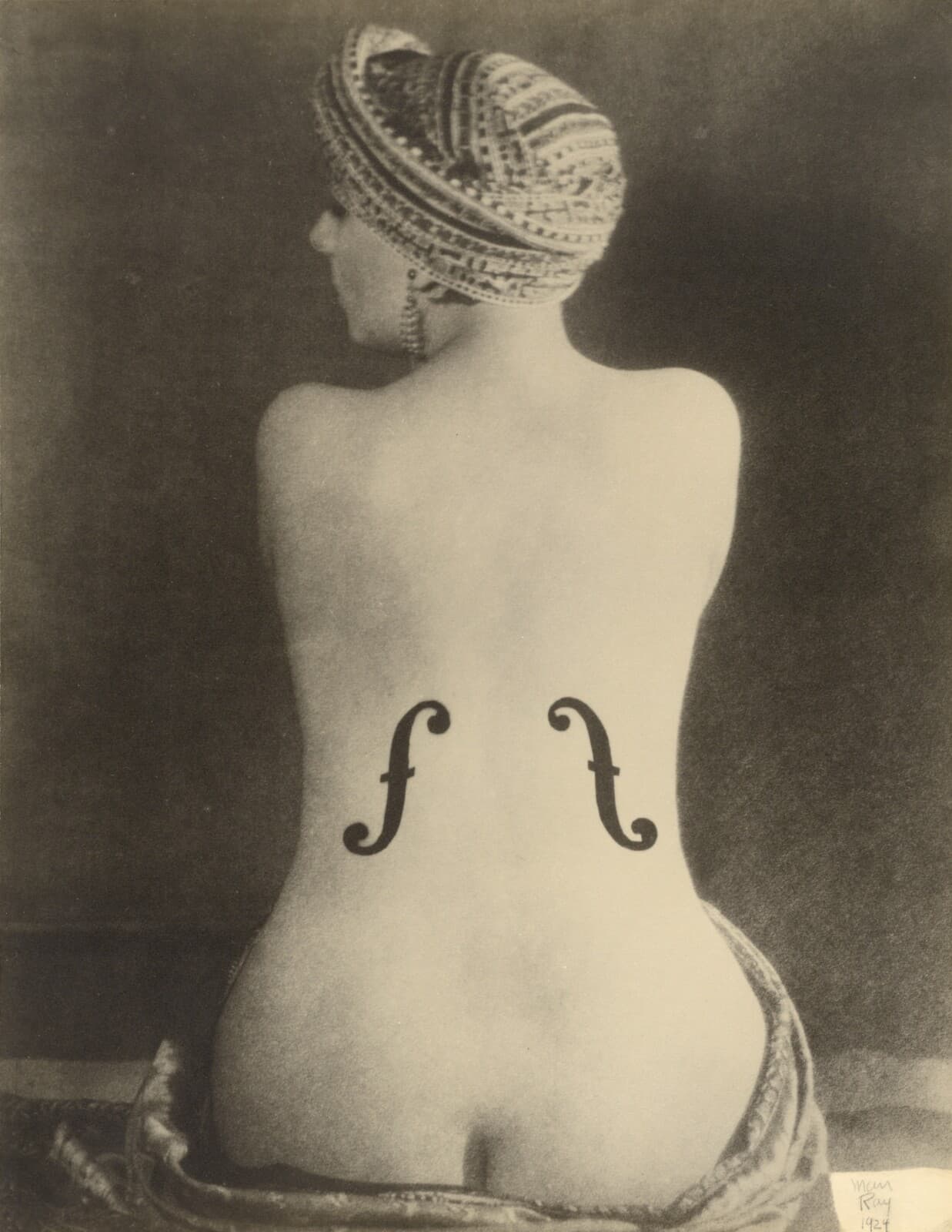
At the lower right, inside the picture area, the name is written small in graphite: a lower-case m for the first word, a capital R for the second. The stroke is grey rather than black and breaks up over the texture of the paper, so it is an autograph on this sheet. It is the opposite of the signature on Le Violon d'Ingres, which was photographed.
Timeline
1862
Armand Sabattier discovers the effect that carries his name, by the Getty's dating of it.
1929
Lee Miller arrives in Paris and begins working in Man Ray's darkroom.
1930
She opens her own studio at 12 rue Victor Considérant. The Lee Miller Archives credit her with re-discovering the Sabatier effect by accident during these years.
1932
Man Ray makes this solarised print and signs it in graphite at the lower right.
1964
Tells an interviewer the technique let him produce a photograph that would not look like a photograph.
1980
Published as number 48 in Man Ray, Photographs and Objects, Birmingham Museum of Art, Birmingham, Alabama.
1984
Enters the J. Paul Getty Museum, whose accession number 84.XM.839.5 carries the year in its first two digits.
1998–99
Travels in A Practical Dreamer: The Photographs of Man Ray to Minneapolis and Toronto.
Where to see it
J. Paul Getty Museum
Los Angeles, United States
A public viewing address has not yet been confirmed for this holding.
A photograph on paper, shown in rotation rather than permanently. Check before travelling.
Frequently asked questions
What is solarisation?
Exposing a print to light part-way through development and then continuing to develop it. Some tones reverse, and a dark outline called a Mackie line forms where light areas meet dark ones. Tate describes it as exposing a partially developed photograph to light before continuing processing, creating halo-like effects.
Did Man Ray invent it?
No. It is properly the Sabattier effect, named for Armand Sabattier, and the J. Paul Getty Museum dates his discovery to 1862 — seventy years before this print. Man Ray named the version he used solarisation and made it his own, which is a different claim.
Who discovered it in his darkroom?
The accounts differ and cannot be reconciled from the sources. The Lee Miller Archives state that Lee Miller re-discovered the Sabatier effect through an accident and that Man Ray named it solarisation. Tate gives the credit to both of them jointly. Man Ray's own recorded remarks are about why he used it rather than how it was found.
Where is the Mackie line in this print?
It runs as one unbroken hairline down the forehead, nose, lips and chin, a second line along the hairline, and round every finger, the thumb and the rim of each nail. It does not cross the cheek, the jaw or the eye socket, and it disappears wherever a form meets shadow rather than the pale ground.
Who is the woman in Profile and Hands?
The Getty names nobody, and no identification is made here. The museum has shown the print in Man Ray/Lee Miller: Partners in Surrealism, but an exhibition title is not an identification. The head is cut by the frame and the eye is closed.
Where is Profile and Hands?
The J. Paul Getty Museum in Los Angeles, accession number 84.XM.839.5. It is a solarized gelatin silver print of 17.9 by 22.9 centimetres, made in 1932 and signed in graphite at the lower right.
More by Man Ray
References
The sources below include collection records, catalogues, scholarly research, and primary materials that informed this page. They document Profile and Hands, its making, and its place in cultural history.


1Man Ray, Profile and Hands, 1932 (84.XM.839.5)
WebsiteJ. Paul Getty Museum, 1932Used forThe print described here — title, date, the solarized gelatin silver print medium line, dimensions, credit line, the 1964 quotation, the dating of Sabattier's discovery to 1862, and the exhibition and publication history.
2Art term: Solarisation
WebsiteTateUsed forTate's definition of the technique and its joint attribution of the accidental discovery to Man Ray and Lee Miller.

3Lee Miller — biography and chronology
ArchiveLee Miller Archives, Farleys House and GalleryUsed forThe Lee Miller Archives chronology, which credits her with re-discovering the Sabatier effect by accident and gives her Paris years and her own studio address.
4Man Ray, Georges Braque, 1933, solarized gelatin silver print (2019.26)
WebsiteCleveland Museum of Art, 1933Used forAnother solarised Man Ray photograph, flagged copyrighted and published with no copyright notice at all — cited for the inconsistency in printed credit lines.
5Man Ray (Emmanuel Radnitzky, dit)
WebsiteCentre Pompidou, Musée national d’art moderneUsed forThe Centre Pompidou's Man Ray holdings, cited for the French credit line © Man Ray Trust / Adagp, Paris, and for its own solarised holdings.
6Encyclopaedia Britannica — Man Ray
WebsiteUsed forBiography, cited for the Paris studio years and for solarisation among the processes he is known for.
These references provide the documented foundation for this work's history and interpretation. Claim-level citations remain attached to the specific claims they support.
 Explore more resources