Untitled Rayograph (Net and Shavings)
by Man Ray
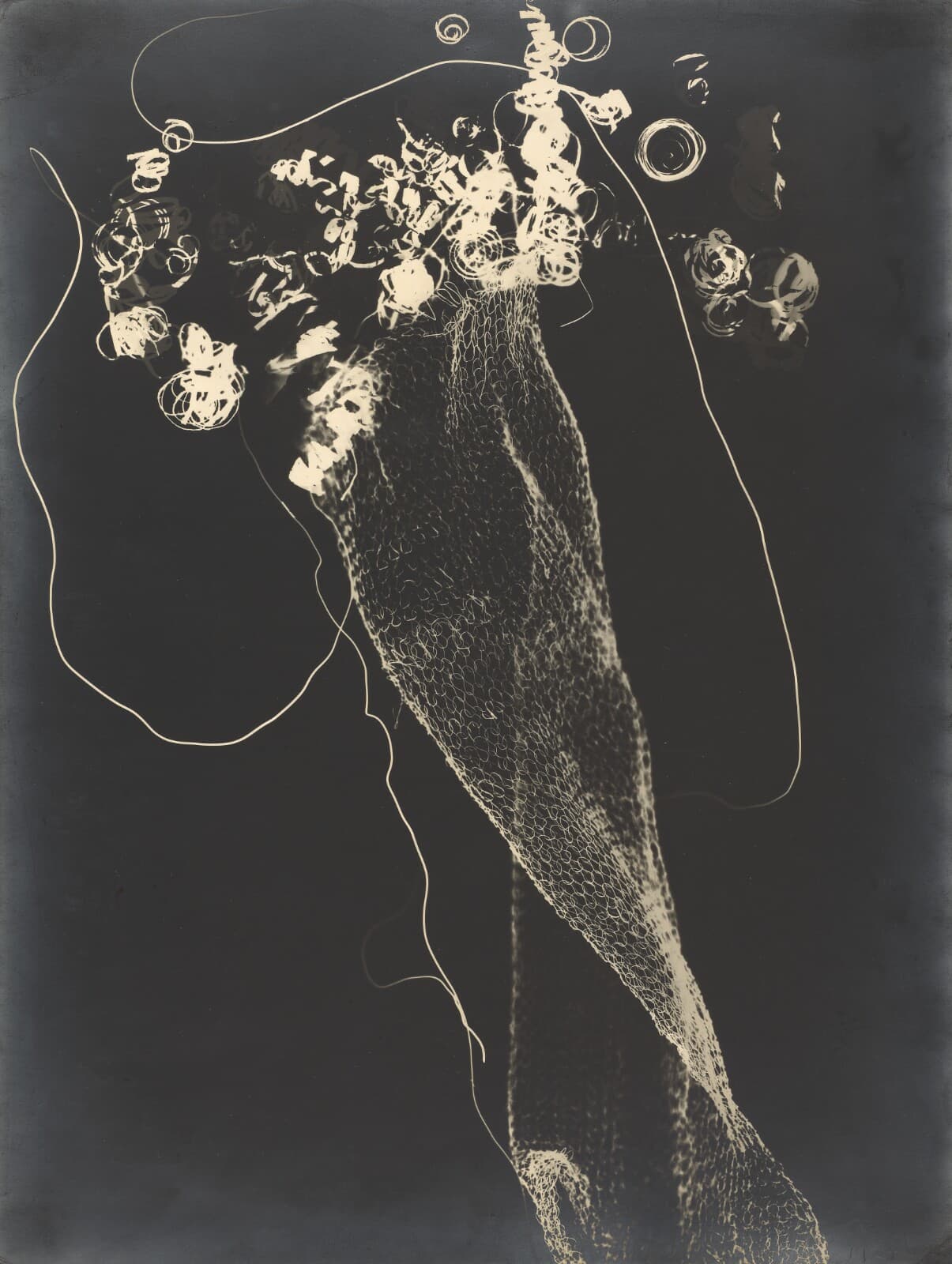
A long sleeve of netting falls down a black field, ringed by a single looping wire and crowned with a mass of curled wood shavings. No camera was used and no negative exists. Man Ray, born Emmanuel Radnitzky, laid the objects straight onto photographic paper and exposed it to light. The J. Paul Getty Museum holds the print as 84.XM.1000.161 and calls it a large one, at 39.8 by 29.8 centimetres.
- 1924
- Gelatin silver print
- J. Paul Getty MuseumLos Angeles, United States
About Man Ray
What the sheet shows
Everything pale in the picture is an object that blocked the light. Everything black is paper that the light reached. The J. Paul Getty Museum names the materials as net, wire and wood shavings.
The net is the spine of the composition. It enters at the top as a tight bunch, widens into a broad sleeve and falls diagonally to the bottom edge, where it runs off the sheet. It is a knitted mesh, and where it lies flat against the paper each loop of the stitch is drawn separately, a pale hairline circle no thicker than a hair.
A single wire loops around the whole thing. It comes in at the upper left, swings out in a long flat arc across the top, turns down the right side and runs off the bottom. It ties itself into one small ring near the left, where the filament crosses over itself and the crossing is plainly visible.
Across the top sits a bank of shavings — short curled ribbons of wood, each with a flat face and a twist along its length. Among them are three coils of a different kind. A small tight spiral of about three turns sits near the top centre. A broad open ring sits at the upper right. A flat coil of six or seven turns sits at the right edge, with a bright point at its middle. Two loose balls of shavings sit lower and further right.
The right third of the sheet is an almost featureless deep black with a faint sheen, and the field around the net carries a low mottling rather than an even tone.
What a rayograph is, and what it records
A rayograph is a photogram. Objects go on a sheet of photographic paper in the dark, a light is switched on and off, and the paper is developed. Wherever an object sat against the paper, no light arrived and the paper stays pale. Wherever nothing intervened, the paper goes black. There is no lens, no negative and no second copy: the sheet is the exposure, and it is unique.
That is why a rayograph carries no printing date the way an ordinary photograph does. The Getty dates this sheet 1924 with no second date, and there is no later printing to separate from it. The museum does hold Man Ray material where the two dates do come apart — 84.XM.840.5 is catalogued as a copy print of a rayograph, and a run of sheets in the same collection carries dates like "negative 1925; print 1963".
What the picture actually records is distance. An object touching the paper throws a hard edge; an object held above it throws a soft one, because the light arrives from a spread of angles. Both are legible here on the same object. Down the left flank of the net every loop of the knitting is separately resolved, so the fabric was lying flat. Along the right flank the same loops smear into soft grey blotches and lose their shape entirely, so that part of the net was lifted or doubled over.
The wire and the coils are the sharpest things on the sheet, which puts them flat on the paper. Behind and around them are mid-grey ghosts with no hard edge anywhere — a disc, a ring, a broad lump — objects held well clear of the paper, or thin enough to pass some light. Nothing in the composition is in front of or behind anything else in the ordinary sense. The stacking is entirely a matter of how far each thing sat from the sheet.
1922, and what came before this sheet
The first of them were gathered as Les champs délicieux, made in Paris in 1922. The J. Paul Getty Museum holds a copy as 84.XO.1241 and describes it as twelve tipped-in rayograms, a bound book in a blue slipcase, closed at 39.8 by 29.5 centimetres. The museum lists Tristan Tzara alongside Man Ray as its maker, and catalogues the twelve plates individually as 84.XO.1241.1 to .12, each a gelatin silver print. The Art Institute of Chicago describes its own sheet from the album, 1979.101, the same way.
This sheet is two years later and much bigger. The Getty's own note calls it a large print and picks out the spiral at the top as a motif that returns across the rayographs and into his paintings and assemblages.
The museum quotes Georges Ribemont-Dessaignes, writing about Dada in 1924, on what the method looked like from inside the movement: "Man Ray is a subtle chemist of mysteries who sleeps with the metrical fairies of spirals and steel wool. He invents a new world and photographs it to prove that it exists."
What is not recorded
The Getty states the materials and the date and stops there. No light source, no exposure time, no paper stock and no developer is given, and nothing is said about how many attempts preceded this one.
The sheet itself withholds the same things. Because the objects are gone and there is no negative, the only evidence of the making is the gradient of sharpness across each shape. That is enough to say what touched the paper and what did not. It is not enough to say how high anything was held, or in what order things were laid down.
The title is the museum's, not the artist's. Man Ray left the rayographs untitled, and "Net and Shavings" is a curatorial description in brackets, added so that one untitled sheet can be told from another.
Where it has been shown
The print has travelled widely for a sheet of paper. The Getty records it in Man Ray (Paris) at the Centre Georges Pompidou. It records it again in A Practical Dreamer: The Photographs of Man Ray, whose brochure the museum dates 1998/1999. That show ran at the Getty Center, then at the Walker Art Center in Minneapolis and the Art Gallery of Ontario in Toronto.
It was also lent to Drawing Surrealism, 1915–1945, shown at the Los Angeles County Museum of Art and then at the Morgan Library & Museum in New York. An exhibition of drawing is a fair place for a picture made by laying objects down and switching on a lamp.
Close reading
Reading the work, detail by detail
The J. Paul Getty Museum's 1924 sheet is reproduced whole. Everything pale in it is an object that stopped the light; everything black is paper the light reached. Because there is no lens, sharpness records nothing but distance from the paper, and the views below read the picture on that basis.
1.One wire, drawn from edge to edge
A single length of wire makes the largest drawing on the sheet. It comes in at the upper left, swings out in a long flat arc across the top, turns down the right side and leaves at the bottom. Its width never varies and its edge never softens, which puts it flat on the paper along its whole length.
2.The wire ties itself into one small ring
Near the left the filament crosses over itself and closes into a ring about the size of a coin. At the crossing the two passes stay separately legible rather than merging into a blob, so both lay on the paper at the same level. A raised crossing would have thickened and greyed at exactly that point.
3.A tight spiral of about three turns
Near the top centre, on its own against the black, is a small coil wound into about three turns. The gaps between the turns stay open and the inner end finishes in a hook. It is the motif the museum singles out as one that runs through the rayographs and into his paintings and assemblages.
4.A broad band, read at an angle
At the upper right is a much wider shape: a broad open ring with one side solidly pale and the other reduced to a thin crescent. That is what a band of material does when it is curled and standing at an angle rather than lying flat — where it is edge-on to the paper it blocks a narrow strip, where it is face-down it blocks a wide one.
5.A flat coil of six or seven turns, with a bright point at its middle
Hard against the right edge is a coil wound flat, six or seven turns of a thin ribbon, tightening to a small bright point at the centre. Every turn is separately resolved to the middle, so the whole spiral was in contact with the paper. It is the sharpest object on the sheet.
6.Curled ribbons with a flat face and a twist
The bank across the top is wood shavings, and each one is a short ribbon that has curled as it came off the blade. Where a shaving presents its flat face to the paper it reads as a solid pale patch; where it twists onto its edge it narrows to a line and greys. Several show both states within one ribbon.
7.Mid-grey forms with no hard edge anywhere
Behind and between the white shapes are forms in a flat mid grey — a disc, a ring, a broad lump — with no hard edge on any side. They were either held well above the paper, where the light reaches under them from every angle, or they were thin enough to pass part of it. They are the only depth in a picture that has none.
8.Where the net lay flat, every knitted loop is drawn
Down the left flank of the net the mesh is resolved stitch by stitch: each chain loop is its own pale hairline circle, and the thread that links them is continuous from loop to loop. Nothing in the picture is finer than this. It is the record of fabric lying dead flat on the paper.
9.Where it lifted, the same loops smear into grey
A hand's breadth to the right, the identical fabric has lost its structure completely. The loops have run together into soft grey blotches and the thread is nowhere legible. The net did not change; its distance from the paper did. One object, photographed once, holding both readings at the same time.
10.A bright band where the fabric doubles over
A brighter band runs down through the sleeve of netting where the fabric folds back on itself. Two thicknesses stop more light than one, so the doubled strip comes out paler than the single mesh on either side. The fold can be followed from the top of the sleeve to the bottom edge of the sheet.
11.The net runs off the bottom of the sheet
The net is not composed within the sheet. It carries on past the bottom edge and is simply cut there, which means the fabric was longer than the paper and he did not trouble to arrange an ending. The loops are still individually legible at the very edge, so it was still flat when it left.
12.The unobstructed paper, and what it is not
The right third of the sheet is where nothing was laid down, so the light reached the paper unobstructed. It is not an even black. There is a faint sheen across it and a low mottling that shifts slowly from top to bottom, which is the character of the emulsion rather than anything in the composition.
13.The edge of the paper is the edge of the picture
There is no border, no rebate and no margin. The tone runs to the cut edge of the paper on all four sides, because the sheet in the darkroom was the sheet on the wall. Nothing was cropped afterwards, and nothing could be: there is no negative to re-print from.
Timeline
1921
Man Ray arrives in Paris in July.
1922
Makes Les champs délicieux in Paris — twelve tipped-in rayograms, bound and slipcased, with Tristan Tzara listed beside him as its maker. The Getty's copy is 84.XO.1241.
1924
Makes this large sheet from net, wire and wood shavings. Georges Ribemont-Dessaignes publishes his line about the chemist of mysteries in the same year.
1984
Enters the J. Paul Getty Museum, whose accession number 84.XM.1000.161 carries the year in its first two digits.
1998–99
Travels in A Practical Dreamer: The Photographs of Man Ray, from the Getty Center to the Walker Art Center in Minneapolis and the Art Gallery of Ontario in Toronto.
Where to see it
J. Paul Getty Museum
Los Angeles, United States
A public viewing address has not yet been confirmed for this holding.
A photograph on paper, shown in rotation rather than permanently. Check before travelling.
Frequently asked questions
What is a rayograph?
A photograph made without a camera. Objects are laid on photographic paper in the dark, a light is switched on, and the paper is developed. Where an object blocked the light the paper stays pale; where nothing intervened it goes black. Man Ray named the process after himself.
What objects are in this one?
The J. Paul Getty Museum names net, wire and wood shavings. The netting is a knitted mesh that falls the length of the sheet, a single wire loops right around the composition, and curled shavings gather across the top, including two coils and a broad open ring.
Why are some shapes sharp and others blurred?
Because of how far each object sat from the paper. Something lying flat against the sheet casts a hard edge. Something held above it casts a soft one, since light reaches the paper from a spread of angles. On the left flank of the net every knitted loop is separately drawn; on the right flank the same loops smear into grey.
Is there a negative?
No. The sheet is the exposure. That makes each rayograph unique and means there is no later printing to distinguish from an earlier one, which is unusual for Man Ray — several of his photographs exist in prints made decades after the negative.
Where is it?
The J. Paul Getty Museum in Los Angeles, accession number 84.XM.1000.161. It is a gelatin silver print of 39.8 by 29.8 centimetres, which the museum itself calls large.
Did Man Ray title it?
No. He left the rayographs untitled. "Net and Shavings" is the museum's bracketed description, added so that one untitled sheet can be told from the next.
More by Man Ray
References
The sources below include collection records, catalogues, scholarly research, and primary materials that informed this page. They document Untitled Rayograph (Net and Shavings), its making, and its place in cultural history.


1Man Ray, Untitled Rayograph (Net and Shavings), 1924 (84.XM.1000.161)
WebsiteJ. Paul Getty Museum, 1924Used forThe print described here — title, date, medium, dimensions, credit line, the named materials, the Ribemont-Dessaignes quotation and the exhibition history.
2Man Ray, Les champs délicieux, 1922 (84.XO.1241)
WebsiteJ. Paul Getty Museum, 1922Used forThe 1922 album of twelve rayographs, cited for the earlier work and for the Paris dating of the individual plates.
3Man Ray, Untitled, 1922, from the album Champs Délicieux (1979.101)
WebsiteArt Institute of Chicago, 1922Used forA sheet from the same album in Chicago, described there as a gelatin silver print from the album Champs Délicieux.
4Man Ray, Untitled Rayograph, 1922 — catalogued as a copy print of a rayograph (84.XM.840.5)
WebsiteJ. Paul Getty MuseumUsed forCatalogued by the museum as a copy print of a rayograph, cited for the distinction between an exposure and a later copy.
5Man Ray, Rayograph, 1922 (2005.100.139)
WebsiteThe Metropolitan Museum of ArtUsed forA 1922 rayograph in New York, cited for the spread of the early sheets outside Paris.
6Encyclopaedia Britannica — Man Ray
WebsiteUsed forBiography, cited for the Paris years and the naming of the process.
These references provide the documented foundation for this work's history and interpretation. Claim-level citations remain attached to the specific claims they support.
 Explore more resources