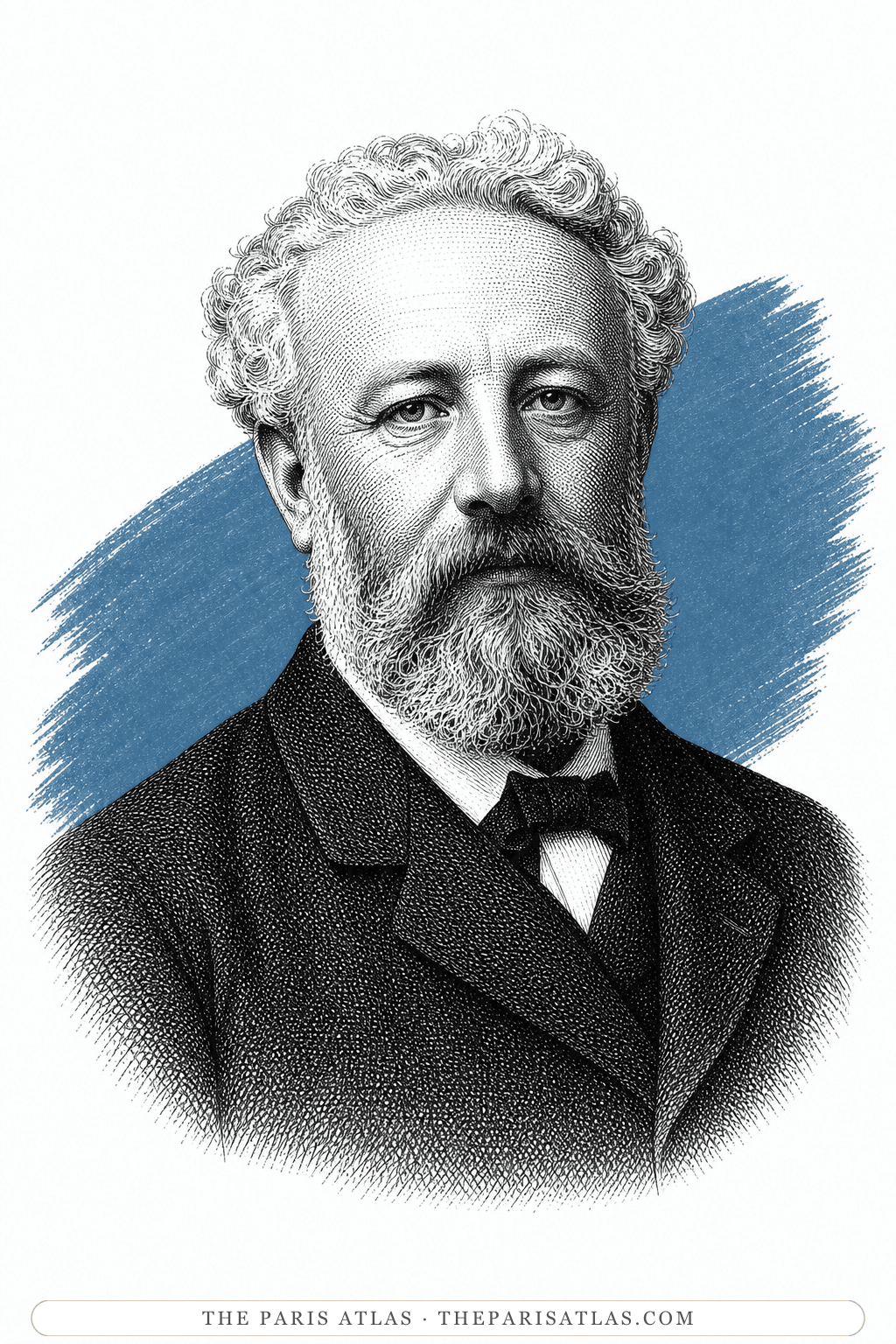
Around the World in Eighty Days
Jules Verne
Around the World in Eighty Days
Another Verne story built on a wager and a timetable, with a Frenchman at the centre of the fun.
Read our takeFrom the Earth to the Moon
Jules Verne
by Jules Verne
An American club of cannon-makers with no war left to fight decides to fire a shell at the Moon, and a Frenchman telegraphs from Paris to ask for a seat inside it.
The American Civil War is over, and the Gun Club of Baltimore, a society of artillery inventors, has nothing to do. Its president, Impey Barbicane, proposes that they fire a projectile to the Moon. The whole country takes up the idea, money arrives from around the world, and a cannon nine hundred feet long is cast in the ground in Florida. Barbicane's old rival, Captain Nicholl, bets that it will fail. Then a telegram arrives from Paris. A Frenchman named Michel Ardan asks for a hollow shell instead of a solid one and announces that he will ride in it. Jules Verne published the novel in the Paris newspaper Journal des Débats from 14 September to 14 October 1865.[1][2]
The Journal des Débats printed the novel in instalments in the autumn of 1865, and its issue of 14 October 1865 carries the launch. Pierre-Jules Hetzel published it the same year as a small volume of 302 pages. The sequel, Autour de la Lune (Around the Moon), ran in the same newspaper at the end of 1869 and came out as a book in 1870.[2][3][4]
Verne fills the book with figures: the distance to the Moon, the speed a shell would need, the weight of the powder, the length of the gun. The national library notes how much space the novel gives to the astronomy and artillery of its day. The library also points out that Verne's launch site, near Tampa on the Florida coast, is not far from Cape Canaveral. The United States chose that site a century later.[5]
Paris runs through the story. Michel Ardan's telegram is headed France, Paris, and dated 30 September, four in the morning. When the Gun Club asks the world for money, subscriptions open in Paris at the Crédit Mobilier bank. France, Verne writes, first laughed at the Americans and put on a score of comic plays about the Moon, then paid 1,253,930 francs for the joke. Georges Méliès, the Paris film-maker, later drew on this novel and its sequel for A Trip to the Moon in 1902.[6][1][5]
The Gun Club of Baltimore was founded during the Civil War by men who invented bigger and bigger guns. Many of its members have lost arms, legs or parts of their skulls; its secretary, J. T. Maston, has a steel hook for a hand and a gutta-percha plate on his head. With peace, they are bored. On 5 October Barbicane tells a meeting that he means to send a shot to the Moon. The hall goes wild. The Cambridge Observatory works out what speed is needed and when to fire.[1]
Money comes in from every country. Florida wins a bitter contest with Texas to host the launch, and the gun, named the Columbiad, is cast straight down into a nine-hundred-foot shaft at a place called Stones Hill near Tampa. Captain Nicholl, a maker of armour plate who has spent years in a contest with Barbicane between gun and armour, lays a series of bets that the plan will fail. Then Michel Ardan's telegram arrives. He sails from Europe on the steamer Atlanta and is greeted by a vast crowd in Tampa.[1]
At a mass meeting Ardan answers every objection with jokes and figures, and wins over the crowd. He learns that Barbicane and Nicholl have arranged to fight a duel with rifles in a Florida wood. He finds Nicholl there, his gun on the ground, freeing a small bird from a spider's web. Ardan brings the two enemies together and suggests that both of them come to the Moon with him. They agree. A hollow aluminium shell is built, its walls lined with thick leather padding on steel springs, with windows, food and room for two dogs.[1]
On 1 December, at 10 hours 46 minutes and 40 seconds in the evening, the Columbiad fires. The blast shakes Florida like an earthquake and throws the watching crowd to the ground. Smoke and cloud hide the Moon for several nights. J. T. Maston goes with the director of the Cambridge Observatory to the great telescope on Long's Peak in the Rocky Mountains.
On 12 December the observers there sight the projectile. The shell has missed the Moon but is caught by its pull, and is now going round it like a small new moon. The report ends by saying the experiment has so far added only a new star to the solar system. The novel stops there, with the three men in orbit. Verne left their fate to the sequel, Around the Moon, in which they circle the Moon and fall back to Earth.
Michel Ardan is the only European among the three travellers and the only one who has never made a gun. He has no plan and no figures. He simply wants to go, and he says so by telegram from Paris before anyone has thought of sending a person. At the Tampa meeting he wins the crowd with jokes. In the wood he stops a duel by admiring the man who is supposed to be fighting it.
His surname is the name of Nadar with the letters moved around. Nadar was the Paris photographer and balloonist whose studio stood on the Boulevard des Capucines. The sequel names him outright. On the way round the Moon, Ardan asks Barbicane whether the Moon's people might have poets, scientists, comic writers and photographers like Nadar.
Before any character leaves the ground, the book spends chapters on arithmetic. The Cambridge Observatory writes back with the speed a shell must reach, the time it will take and the best night to fire. The club argues about the shape of the shell, the metal of the gun and the kind of powder. Florida and Texas fight in the newspapers over which state lies far enough south. Verne presents all this as news reports and committee minutes, and the comedy comes from how seriously everyone takes it.
Barbicane opens his speech by listing the imaginary voyages to the Moon that came before his. He names Cyrano de Bergerac, Fontenelle and the Moon hoax of 1835, and ends with Hans Pfaal of Rotterdam, who reached the Moon by balloon in a story by Edgar Poe. Then he says that all those journeys were imaginary and that Americans will make a real one. The national library notes that Verne's choice of Florida as the best place to launch anticipated the Apollo missions.
Substitute for your spherical shell a cylindro-conical projectile. I shall go inside. Shall arrive by steamer 'Atlanta.'
France began by deriding the pretensions of the Americans. The moon served as a pretext for a thousand stale puns and a score of ballads, in which bad taste contested the palm with ignorance. But as formerly the French paid before singing, so now they paid after having had their laugh, and they subscribed for a sum of 1,253,930 francs.La France commença par rire de la prétention des Américains. La Lune servit de prétexte à mille calembours usés et à une vingtaine de vaudevilles, dans lesquels le mauvais goût le disputait à l'ignorance. Mais, de même que les Français payèrent jadis après avoir chanté, ils payèrent, cette fois, après avoir ri, et ils souscrivirent pour une somme de douze cent cinquante-trois mille neuf cent trente francs.
At some future time, our observations will be able to determine this point, but till then the experiment of the Gun Club can have no other result than to have provided our solar system with a new star.
The Moon shot is planned through letters, votes, subscriptions and newspaper quarrels, and the joke is how seriously everyone takes it.
The Parisian who invites himself aboard by telegram, charms a hostile crowd and talks two duellists into going to the Moon together.
Verne sends his shell from near Tampa, and the national library notes how close that is to where the Apollo missions left from.
Georges Méliès drew on this novel and its sequel for A Trip to the Moon in 1902.
President of the Baltimore Gun Club, calm and precise, who proposes firing a projectile to the Moon.
A Parisian adventurer who telegraphs that he will ride inside the shell, and talks everyone else into coming too.
A Philadelphia maker of armour plate and Barbicane's rival for years, who bets against the gun and ends up aboard its shell.
The Gun Club's secretary, with a steel hook for a hand and a gutta-percha plate in his skull, the loudest believer in the plan.
14 September 1865
The Journal des Débats in Paris begins printing the novel in instalments.
14 October 1865
The Journal des Débats prints the chapters describing the launch.
1865
Pierre-Jules Hetzel publishes the book in Paris, 302 pages.
1869
An English translation by J. K. Hoyt appears, the first in English.
1869–1870
The sequel, Autour de la Lune (Around the Moon), runs in the Journal des Débats and appears as a book.
1874
Scribner, Armstrong publish Louis Mercier and Eleanor E. King's translation of both novels in New York.
1902
Georges Méliès releases A Trip to the Moon, which draws on the novel and its sequel.

Around the World in Eighty Days
Jules Verne
Another Verne story built on a wager and a timetable, with a Frenchman at the centre of the fun.
Read our takeJourney to the Center of the Earth
Jules Verne
Verne's previous novel, which sends its travellers down instead of up.
Read our take
Edgar Allan Poe's collection containing Hans Phaall, the balloon voyage to the Moon that Barbicane names in his opening speech.
Read our take
Mark Twain's comic portrait of confident Americans, written a few years later.
Read our takeNo. The projectile misses the Moon and is caught in orbit around it, and this novel ends there. In the sequel, Around the Moon, the three men circle the Moon and fall back to Earth.
His name is Nadar's with the letters rearranged, and in the sequel Ardan mentions photographers like Nadar by name. Nadar was a Paris photographer and balloonist.
From Stones Hill, an invented site near Tampa in Florida, after Florida beats Texas for the honour. The national library points out that Tampa is not far from Cape Canaveral, where the Apollo missions were launched.
In instalments in the Journal des Débats, a Paris newspaper, from 14 September to 14 October 1865, and as a book by Pierre-Jules Hetzel the same year. The sequel followed in 1869 and 1870.
Yes. The national library says Georges Méliès took inspiration from the novel for his 1902 film, and Méliès himself named this book and its sequel. The film also borrows from other sources.
After the Rodman Columbiad, a heavy gun of the Civil War. In Chapter VII a club member recalls that it fired a half-ton shot six miles, and Barbicane's cannon is a far larger version.
Explore authors with a similar voice, perspective, and influence.

The doctor of the Paris slums who wrote the century's blackest, funniest novel — and changed the sound of French prose.
View author
The Brooklyn dropout who arrived in Paris broke at thirty-eight and wrote the exuberant, banned books that ended American censorship.
View author
French writer and philosopher whose novels, memoirs, and social analysis examined freedom, gender, responsibility, aging, and the material conditions that shape a life.
View authorThe sources below include the primary text, editions, scholarship, archival materials, and other records that informed this page. They document From the Earth to the Moon, its publication, and its place in literary history.


The 1874 New York edition of Louis Mercier and Eleanor E. King's translation, the English text quoted and followed for the plot.

The Journal des Débats issue carrying the launch chapters.
Catalogue record of the 1865 Hetzel edition, 302 pages.
Verne's French text, used for the Paris telegram, the subscriptions and the original of the quotation on France.
Publisher page for the Bantam Classics paperback.
The primary text represented by this page, used for descriptions of the work’s contents and for any quoted passages shown here.
The primary text is the baseline reference for every book page. Additional references document publication history, interpretation, and historical context where that evidence is available.
 Explore more resources