Twenty Thousand Leagues Under the Seas
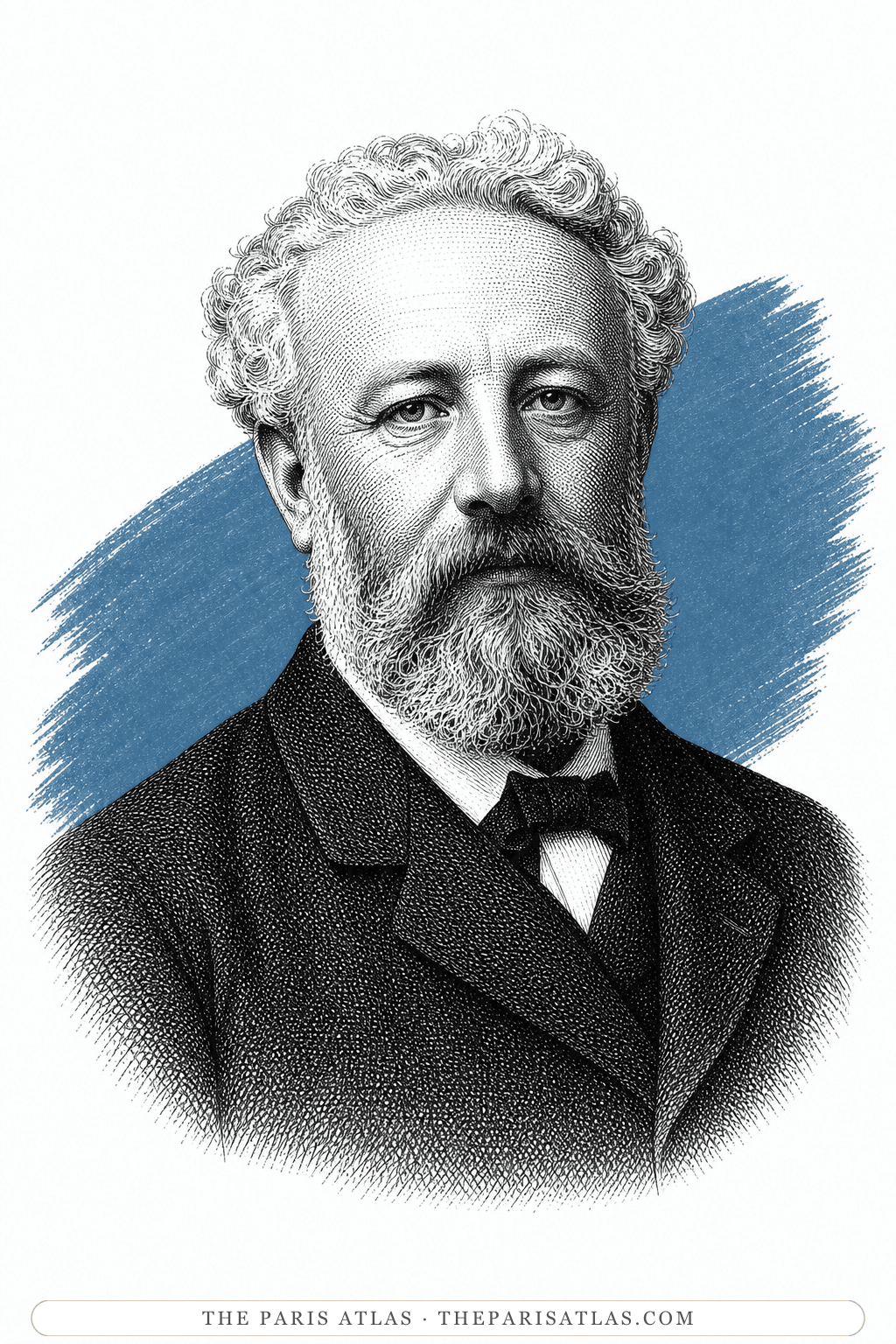
Jules Verne
Twenty Thousand Leagues Under the Seas
Verne's other descent into an unknown world, again told by a young scientist in the company of an older, obsessive one.
Read our takeJourney to the Center of the Earth
Jules Verne
by Jules Verne
A Hamburg professor decodes a medieval cipher, drags his nephew to Iceland and climbs down an extinct volcano to see what is underneath.
On 24 May 1863 Professor Otto Liedenbrock, a short-tempered professor of mineralogy in Hamburg, finds a slip of parchment in runic letters inside an old Icelandic book. His nephew Axel, who tells the story, works out that it is a Latin message written backwards. In it the sixteenth-century Icelandic scholar Arne Saknussemm says he reached the centre of the Earth through the crater of Snæfell, a volcano in Iceland. The professor sets off at once and takes the unwilling Axel with him. In Iceland they hire Hans, a silent eider-down hunter, as guide. The three men climb down into the crater and keep going. Jules Verne published the novel in Paris with Pierre-Jules Hetzel in 1864.[1][2]
Hetzel first published the book in 1864 as a small volume of 335 pages without pictures. In 1867 he brought out a larger illustrated edition with drawings by Édouard Riou. The Encyclopedia of Science Fiction says the 1867 text is an expanded version, with more action and gives more room to the travellers' argument about evolution. Most French and English editions today follow the longer text.[2][3][4]
Verne was living in Paris when the book came out, two years into his contract with Hetzel and seven years before he settled in Amiens. The story itself never goes near the city. The travellers move from an old house in Hamburg to Copenhagen, Reykjavik and western Iceland, then underground for most of the book. The Paris link is the publishing house. The national library lists the novel as the next of the Voyages extraordinaires after Five Weeks in a Balloon, and says the series' success cannot be separated from Hetzel's.[5][6][1]
The novel reached English readers in a bad state. An anonymous translation ran in The Boys' Journal in 1870. Another, published by Griffith and Farran in London in 1871, renamed the characters. Frederick Amadeus Malleson, a Church of England clergyman, made a much closer translation, published by Ward, Lock in London in the 1870s. Malleson's text is out of copyright and is the one quoted here.[4][7][1]
Professor Liedenbrock finds the parchment inside a manuscript of Snorri Sturluson's Heimskringla, the old Icelandic history of the kings of Norway. He cannot read it, and he locks the house so that nobody eats until he does. Axel solves it by accident while fanning himself with the paper and seeing the letters through the back. The message tells the traveller to go down the crater of Snæfell that the shadow of the peak Scartaris touches before the first of July. Axel is in love with the professor's ward, Gräuben, and she tells him to go.[1]
They travel by Copenhagen to Reykjavik and ride across Iceland with Hans to Snæfell. On 29 June the shadow of Scartaris falls on one of the three chimneys at the bottom of the crater, and they climb down it. Underground they follow old lava passages for weeks. Axel nearly dies of thirst until Hans hears a stream behind the rock, which the professor names the Hansbach. Later Axel loses his way in the dark. He finds the others again only because a curved gallery carries his voice to them across more than four miles of rock.[1]
They come out on the shore of a huge underground sea, lit by a glow in the rock ceiling and edged with a forest of mushrooms thirty or forty feet high. The professor names it the Liedenbrock Sea and has Hans build a raft. On the crossing they watch two sea reptiles of an age long past, an ichthyosaurus and a plesiosaurus, fight to the death. They pass a geyser on an island they name after Axel, and a storm drives them across the water. A ball of fire runs over the raft and magnetises every piece of iron on board.[1]
The storm lands them on the same shore they left, though the compass says otherwise. On a plain of bones they find the preserved body of a man from the distant past, and the professor lectures it as if to a scientific meeting. In a forest of ancient trees they see a man at least twelve feet tall watching over a herd of mastodons, and run. Then Axel finds the initials A. S. carved in the rock. Saknussemm has been there, and a passage beyond is blocked by fallen stone. They blow it open with guncotton. The explosion opens a chasm, the sea pours into it and carries their raft down.
The fall turns into a rise. Water and hot gas push the raft up a volcanic shaft, and the three men are thrown out on a mountainside among olive trees. A boy tells them the island is Stromboli, off Sicily. They go home to Hamburg by way of Messina and Marseille, and the professor is honoured as a great scientist. Axel finally works out why the compass lied: the ball of fire had reversed its poles. He marries Gräuben.
The opening chapters never leave the house on the Königstrasse in Hamburg. The professor copies out the runes and turns them into Roman letters, which make no sense. He tries reading them as Latin, Hebrew and every other language he knows. Axel tries too, and fails. The breakthrough comes when he fans himself with the sheet and sees the letters through the back. The message has been written backwards.
The Latin is deliberately bad, and Malleson prints it as Verne wrote it. Its last words, Quod feci, mean which I have done. Axel's first instinct is to burn the parchment, because he knows his uncle will want to go. Much of the book's comedy comes from that pairing: a nephew who can see every danger and an uncle who cannot be stopped by any of them.
Axel believes the scientists who say the Earth grows hotter the deeper you go, until everything melts. His uncle does not, and argues from the fact that the travellers have not been cooked yet. The two men go back and forth on the question all the way down. The professor sums up his attitude underground. Science, he tells Axel in Malleson's version, has been built on many errors, but errors worth making because they lead to the truth.
The creatures they meet come from the geology books of the 1860s. The underground sea holds reptiles known then only from fossils, and the shore holds the bones of extinct mammals. The Encyclopedia of Science Fiction says the 1867 edition widened the debate over evolution. The expanded chapters include the fossil human on the plain of bones and the giant watching over mastodons. The book never says who or what that giant is.
Many English readers met the book in the Griffith and Farran version of 1871, which Project Gutenberg keeps as ebook 18857. In it the professor is called Hardwigg, Axel becomes Harry and Gräuben becomes Gretchen. The Gutenberg editor's note calls it a rewrite with passages added and removed, not a translation. For a long time it was the most reprinted English text.
Frederick Amadeus Malleson signed his translator's preface F. A. M., from his vicarage at Broughton-in-Furness in the north of England. He writes that he has corrected a few errors in Verne's science with help from a member of the Geological Survey. He also asks readers to give to a relief fund for Iceland, where a volcanic eruption the previous Easter had ruined the farmland. His translation keeps the original names. William Butcher's for Oxford World's Classics and Frank Wynne's for Penguin Classics are complete modern versions, both in copyright.
Descend, bold traveller, into the crater of the jokul of Sneffels, which the shadow of Scartaris touches before the kalends of July, and you will attain the centre of the earth; which I have done, Arne Saknussemm.
Science, my lad, has been built upon many errors; but they are errors which it was good to fall into, for they led to the truth.La science, mon garçon, est faite d'erreurs, mais d'erreurs qu'il est bon de commettre, car elles mènent peu à peu à la vérité.
During the electric storm on the Liedenbrock sea, that ball of fire, which magnetised all the iron on board, reversed the poles of our magnet!
Axel is scared from the first page and says so. His fear makes the professor's certainty funnier and the dangers more real.
The first chapters are a code-breaking story set in one Hamburg house, with the household starved until the cipher gives way.
A lit cavern, a forest of giant mushrooms, a raft, sea reptiles at war and a storm, all miles below Iceland.
A Hamburg professor of mineralogy, impatient and brilliant, who will follow the cipher to the bottom of the world.
The professor's nephew and assistant, who tells the story and is afraid of almost every step of it.
An Icelandic eider-down hunter hired as guide, calm and nearly silent, who saves the expedition more than once.
The professor's ward in Hamburg, engaged in secret to Axel, who tells him to go and come back a man.
1864
Pierre-Jules Hetzel publishes Voyage au centre de la Terre in Paris as a 335-page volume without pictures.
1867
Hetzel publishes the expanded, illustrated edition with drawings by Édouard Riou.
1870
An anonymous English translation runs in The Boys' Journal in London.
1871
Griffith and Farran publish the London rewrite that renames the professor Hardwigg.
1876
Ward, Lock publish Frederick Amadeus Malleson's close translation in London.
December 1959
Twentieth Century-Fox releases Henry Levin's film, with James Mason as the professor and Pat Boone as his student.


Twenty Thousand Leagues Under the Seas
Jules Verne
Verne's other descent into an unknown world, again told by a young scientist in the company of an older, obsessive one.
Read our takeFrom the Earth to the Moon
Jules Verne
Verne's next novel, published the following year, which sends travellers the other way.
Read our take
Edgar Allan Poe's voyage into the unknown, which Verne admired and later continued in Le Sphinx des glaces (1897).
Read our take
Mary Shelley's novel of a scientist who will not stop, written almost fifty years earlier.
Read our takeBoth are used. Verne's French title is Voyage au centre de la Terre. British editions print Centre, as Penguin and Oxford do. American editions and the 1959 film use Center.
No. They follow Arne Saknussemm's route until a rockfall blocks it, blast the rock, and are carried up a volcanic shaft. They come out on Stromboli, an island volcano off Sicily.
Because of the Griffith and Farran English version of 1871, which renamed the characters. In it the professor is Hardwigg, Axel is Harry and Gräuben is Gretchen. Verne's names are Liedenbrock, Axel and Gräuben.
An invented sixteenth-century Icelandic scholar and alchemist. His coded message starts the expedition, and his initials carved deep underground prove that he got there first.
In Hamburg, at the professor's house on the Königstrasse. The travellers go by Copenhagen to Reykjavik and ride to Snæfell, a volcano on Iceland's west coast, where they climb down into the crater.
The AFI Catalog record describes it opening in Edinburgh in 1880, with James Mason as Professor Oliver Lindenbrook. In the novel the professor is Otto Liedenbrock of Hamburg and the year is 1863.
Explore authors with a similar voice, perspective, and influence.
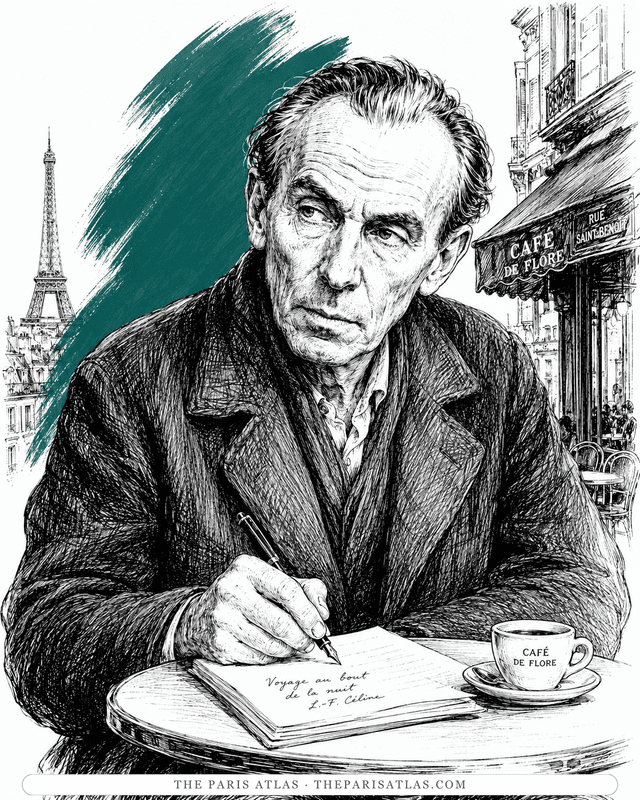
The doctor of the Paris slums who wrote the century's blackest, funniest novel — and changed the sound of French prose.
View author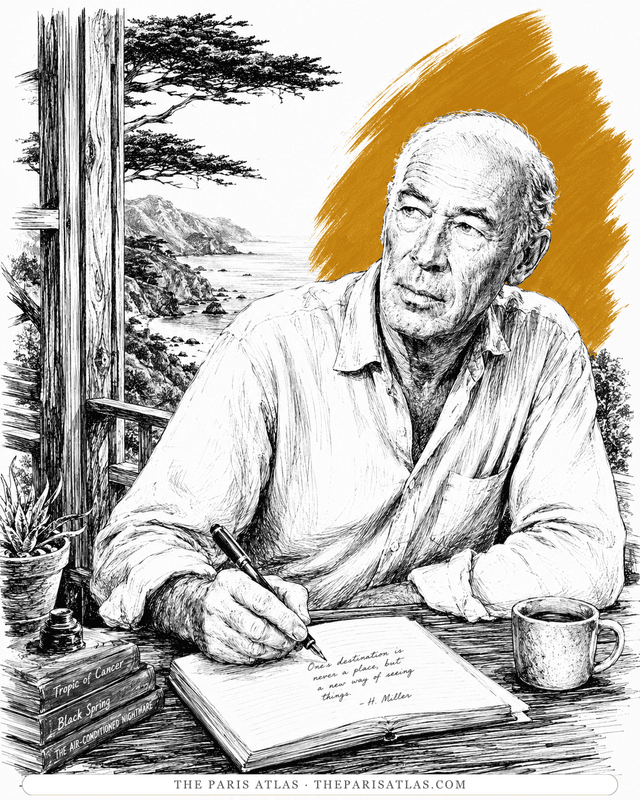
The Brooklyn dropout who arrived in Paris broke at thirty-eight and wrote the exuberant, banned books that ended American censorship.
View author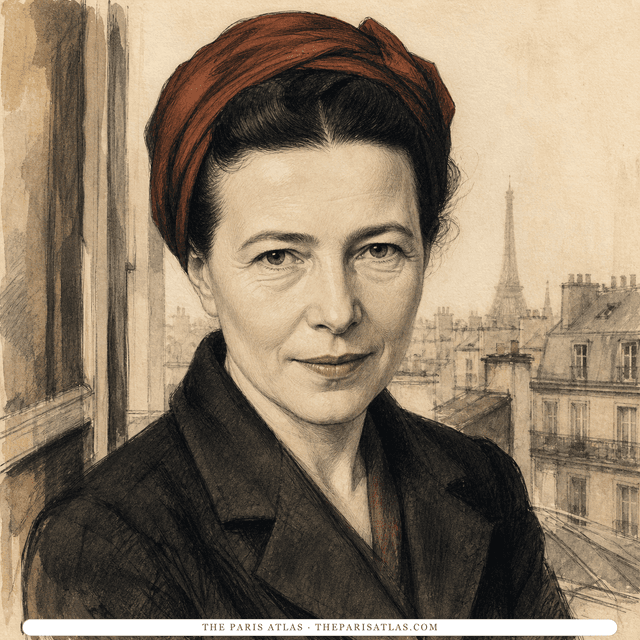
French writer and philosopher whose novels, memoirs, and social analysis examined freedom, gender, responsibility, aging, and the material conditions that shape a life.
View authorThe sources below include the primary text, editions, scholarship, archival materials, and other records that informed this page. They document Journey to the Center of the Earth, its publication, and its place in literary history.

Catalogue record of the 1867 illustrated edition with drawings by Riou.

The national library on the order of the early Voyages extraordinaires and the Hetzel partnership.
The Verne centre at Amiens on the 1862 contract with Hetzel and the move to Amiens in 1871.
The 1871 Griffith and Farran English version, used for its changed names and the editor's note on it.
Verne's French text in the expanded version, used for the original of the quotation on science.
Open Library record of William Butcher's Oxford World's Classics translation.
Publisher page for Frank Wynne's Penguin Classics translation.
Release, director, cast and setting of the 1959 film.
The primary text represented by this page, used for descriptions of the work’s contents and for any quoted passages shown here.
The primary text is the baseline reference for every book page. Additional references document publication history, interpretation, and historical context where that evidence is available.
 Explore more resources