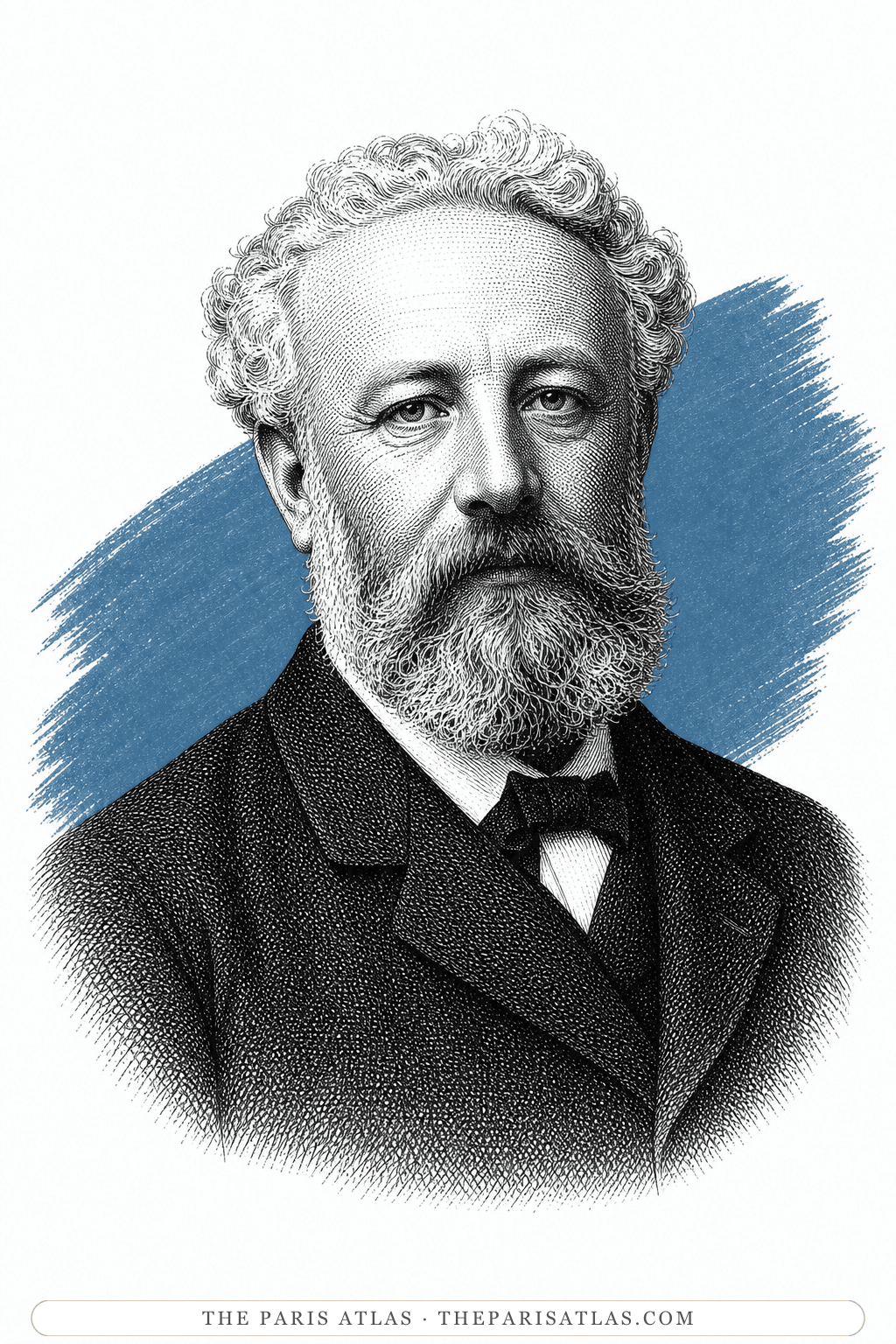
The Mysterious Island
Jules Verne
The Mysterious Island
Verne's sequel of 1875, in which Captain Nemo reappears, tells his story and dies.
Read our takeTwenty Thousand Leagues Under the Seas
Jules Verne
by Jules Verne
A Paris museum professor is taken prisoner aboard an electric submarine and spends ten months crossing the world's oceans with the man who built it.
In 1866 ships around the world report a huge, fast object in the sea, and most people decide it is a whale. Pierre Aronnax, a professor at the natural history museum in Paris, joins an American frigate sent to hunt it. He, his servant Conseil and the harpooner Ned Land are thrown overboard and land on the creature's back. The creature is a submarine, the Nautilus, run on electricity by a man who calls himself Captain Nemo. Nemo keeps the three men aboard for ten months while he crosses the Pacific, the Indian Ocean, the Red Sea, the Mediterranean, the Atlantic and the waters of the South Pole. Jules Verne published the novel in instalments in Pierre-Jules Hetzel's magazine from March 1869 to June 1870.[1][2]
The idea came partly from George Sand. In 1865 the novelist wrote to Jules Verne that she hoped he would soon take his readers into the depths of the sea, in diving machines his science could improve. Verne wrote the book in 1868 and 1869, and told his publisher while he was at it that he had never had a finer subject in his hands. The Bibliothèque nationale de France holds two manuscripts of the novel, a rough draft and a corrected fair copy.[2][3]
The story first ran in the Magasin d'éducation et de récréation, the family magazine Pierre-Jules Hetzel published in Paris, from 20 March 1869 to 20 June 1870. Hetzel issued it as a two-volume book without pictures in 1869 and 1870. In 1871 he brought out the large illustrated edition, with 111 drawings by Alphonse de Neuville and Édouard Riou, in the red and gold cloth binding that made his Verne books popular presents.[1][4][2]
The narrator is a Parisian. Pierre Aronnax is a professor at the Muséum d'histoire naturelle, the natural history museum in the Jardin des Plantes. When the American invitation reaches him in New York, he has just come back from an expedition and wants nothing more than his country, his friends, his small lodging at the Jardin des Plantes and his collections. He goes anyway. Captain Nemo later asks him whether his study at the museum was ever as quiet as the Nautilus library.[5][6]
Through 1866 and 1867 ships report a long, glowing object that moves faster than any whale, and several are holed by it. The American frigate Abraham Lincoln, under Commander Farragut, sails from New York to hunt it. Aboard are Pierre Aronnax, his servant Conseil and Ned Land, a Canadian harpooner. After months of searching they find the thing in the Pacific. In the fight that follows, all three men go overboard and end up clinging to its back, which is made of riveted metal plates.[6]
They are taken inside the Nautilus. Its commander calls himself Captain Nemo and tells them they will never leave. The submarine runs entirely on electricity and carries a salon of paintings, an organ and a library of twelve thousand books. Its motto is Mobilis in mobili, roughly moving within the moving element. Nemo takes Aronnax on walks across the sea floor in diving suits and on a hunt in an undersea forest off the island of Crespo. They visit the reef at Vanikoro where the French explorer La Pérouse was wrecked. After a crewman dies, Nemo buries him in a coral cemetery on the ocean floor.[6]
The voyage continues westward. Off Ceylon, now Sri Lanka, Nemo saves an Indian pearl diver from a shark and gives him a bag of pearls. He takes the Nautilus from the Red Sea into the Mediterranean through an underground passage he calls the Arabian Tunnel. He shows Aronnax the Spanish treasure galleons sunk in Vigo Bay, whose gold he sends to oppressed peoples, and the drowned ruins of Atlantis. On 21 March 1868 he stands at the South Pole and plants a black flag with an N on it. On the way back north the ice closes over the submarine, and the crew nearly suffocate before they cut their way out.[6]
In the Atlantic, giant squid attack the Nautilus and kill one of the crew. Soon after, a warship with no flag fires on the submarine. Nemo raises his own black flag and drives the Nautilus's steel ram through the warship below the waterline, and Aronnax watches the ship sink with everyone aboard. Nemo then goes to his cabin, looks at a portrait of a young woman and two small children, and weeps. His guests learn nothing more about him.
Ned Land has been planning an escape for months. Off the coast of Norway, as the three men slip into the submarine's small boat, the Nautilus is caught by the Maelstrom, the great whirlpool of those waters. Aronnax passes out. He wakes in a fisherman's hut in the Lofoten Islands with Ned Land and Conseil beside him. He never learns whether the Nautilus survived or what Nemo's name was. In the last lines he claims that only two men alive can answer the Bible's question about the depths of the sea: Captain Nemo and himself.
The title is a distance, not a depth. Aronnax says so in the last chapter: in less than ten months he has crossed twenty thousand leagues under the sea. Verne's own arithmetic in Part Two makes 250 leagues equal to 540 miles, so his league is about four kilometres. The voyage therefore runs to roughly eighty thousand kilometres, about twice around the Earth. In Part One, Aronnax gives the average depth of the ocean as about seven kilometres.
In the French, Aronnax lists the waters he has crossed: the Pacific, the Indian Ocean, the Red Sea, the Mediterranean, the Atlantic, and the southern and northern seas. The first English translation drops that list and keeps only the figure. Readers who meet the book in English often assume the leagues are fathoms straight down, and the missing sentence is one reason.
Nemo is Latin for nobody, and the book keeps him that way. He speaks French, English, German and Latin, owns paintings and scores by European masters, and has cut every tie with the land. He tells Aronnax his twelve thousand books are the only things that still bind him to the Earth. He saves a poor Indian pearl diver at the risk of his own life and later sinks a warship with its whole crew. Verne gives both scenes the same care, and does not say which is the real man.
The national library notes that Verne and Pierre-Jules Hetzel wrote to each other at length about the character while the book was being made. The Encyclopedia of Science Fiction adds that Hetzel pressed Verne to tone down his manuscripts, and that the first English translators cut further. Nemo's reasons stay hidden until Verne's later novel The Mysterious Island. There, in 1875, he is revealed as an Indian prince who fought the British in 1857.
The most famous scene is the fight with the giant squid, which the first English translation calls poulps. The crew go out on the deck with axes to cut the arms away from the hull. The national library points out that the scene recalls Gilliatt's fight with an octopus in Victor Hugo's The Toilers of the Sea, published by the same Paris house three years earlier. The library also notes that the giant squid had been described by scientists in 1857 but was still half a legend in 1869.
Alphonse de Neuville and Édouard Riou drew the engravings for the 1871 edition, and their picture of the crew fighting the squid with axes is one of the best known. Many readers remember that picture more clearly than the chapter. The writer Georges Perec said the long lists of fish in the book read to him like a poem, the way a catalogue can.
The first English version was published by Sampson Low in London in 1872. The 1876 printing names no translator on its title page. The Encyclopedia of Science Fiction identifies him as the Reverend Lewis Page Mercier and says he left out more than a fifth of the text, sometimes for political reasons, and copied many of Verne's figures wrongly. Project Gutenberg offers that text free as ebook 164, and the wording matches the Sampson Low printing of 1876 scanned by the Internet Archive.
Small changes are easy to see by setting the two texts side by side. In Verne's last paragraph, Aronnax recalls a question the Book of Ecclesiastes asked six thousand years ago. The Sampson Low text makes it three thousand years. Complete modern translations exist, among them William Butcher's for Oxford World's Classics and David Coward's for Penguin Classics. Both are in copyright.
What I now affirm is, that I have a right to speak of these seas, under which, in less than ten months, I have crossed 20,000 leagues in that submarine tour of the world, which has revealed so many wonders.Ce que je puis affirmer maintenant, c'est mon droit de parler de ces mers sous lesquelles, en moins de dix mois, j'ai franchi vingt mille lieues, de ce tour du monde sous-marin qui m'a révélé tant de merveilles
Twelve thousand, M. Aronnax. These are the only ties which bind me to the earth.Douze mille, monsieur Aronnax. Ce sont les seuls liens qui me rattachent à la terre.
There is a powerful agent, obedient, rapid, easy, which conforms to every use, and reigns supreme on board my vessel. Everything is done by means of it. It lights it, warms it, and is the soul of my mechanical apparatus. This agent is electricity.
And to the question asked by Ecclesiastes three thousand years ago, “That which is far off and exceeding deep, who can find it out?” two men alone of all now living have the right to give an answer—— CAPTAIN NEMO AND MYSELF.Aussi, à cette demande posée, il y a six mille ans, par l'Ecclésiaste: «Qui a jamais pu sonder les profondeurs de l'abîme?» deux hommes entre tous les hommes ont le droit de répondre maintenant. Le capitaine Nemo et moi.
He saves a pearl diver from a shark and sinks a warship with all hands. The book gives no name, no country and no explanation, and the narrator leaves without one.
The Pacific, Vanikoro, Ceylon, the Red Sea, a tunnel under Suez, Atlantis, Vigo Bay, the South Pole and the Maelstrom, all in ten months.
Pierre Aronnax works at the natural history museum in the Jardin des Plantes and names every fish he sees. His delight is half the book.
The captain comes back in The Mysterious Island, where his real name and his reasons are finally given.
The builder and commander of the Nautilus, who has broken with the land for reasons he will not give.
The narrator, a natural history professor at the Paris museum, who is half prisoner and half delighted guest.
A Canadian harpooner, hot-tempered and homesick, who spends ten months planning an escape.
Aronnax's servant, calm and loyal, who classifies every creature he sees and follows his master everywhere.
1865
George Sand writes to Jules Verne hoping he will take his readers into the depths of the sea.
1868–1869
Verne writes the novel. The national library keeps a draft and a corrected fair copy.
20 March 1869
The first instalment appears in Pierre-Jules Hetzel's Magasin d'éducation et de récréation in Paris.
20 June 1870
The last instalment appears. Hetzel has already begun issuing the text as a two-volume book.
1871
Hetzel publishes the illustrated edition with 111 drawings by Alphonse de Neuville and Édouard Riou.
1872
Sampson Low publishes the first English translation in London, cut by more than a fifth.
1875
The Mysterious Island reveals Captain Nemo's identity and ends his story.
23 December 1954
Walt Disney's film, directed by Richard Fleischer with James Mason as Nemo and Kirk Douglas as Ned Land, is released.


The Mysterious Island
Jules Verne
Verne's sequel of 1875, in which Captain Nemo reappears, tells his story and dies.
Read our take
Victor Hugo's 1866 novel with its fight against an octopus, which the national library links to the squid attack here.
Read our take
Edgar Allan Poe's sea novel heading for the South Pole. Verne later wrote a sequel to it, Le Sphinx des glaces (1897).
Read our takeJourney to the Center of the Earth
Jules Verne
Verne's earlier journey into an unknown world, told by another young scientist trailing an older, stubborn one.
Read our take
Alexandre Dumas's novel of a man with a hidden fortune and a private war against those who wronged him.
Read our takeThe distance travelled, not the depth. The narrator says in the last chapter that he crossed twenty thousand leagues under the sea in less than ten months. The distance comes to roughly eighty thousand kilometres, about twice around the Earth.
In this novel nobody finds out. Nemo is Latin for nobody. Verne revealed his story in The Mysterious Island (1875): he is Prince Dakkar, an Indian prince who fought the British in the rising of 1857 and lost his family.
Verne's French title is Vingt mille lieues sous les mers, and mers is plural. The Sampson Low edition printed in London in the 1870s says Under the Seas. Many later English editions, and the 1954 Disney film, use Under the Sea.
In instalments in Pierre-Jules Hetzel's Paris magazine from 20 March 1869 to 20 June 1870, then as a book in 1869 and 1870. The illustrated edition followed in 1871.
A modern complete one, such as William Butcher's for Oxford World's Classics or David Coward's for Penguin Classics. The free 1872 text on Project Gutenberg is readable but leaves out more than a fifth of the book.
Yes. The Mysterious Island (1875) brings Captain Nemo back and explains who he was.
The narrator, Pierre Aronnax, is a professor at the natural history museum in the Jardin des Plantes. The novel was published in Paris by Pierre-Jules Hetzel, first in his magazine and then as books.
Explore authors with a similar voice, perspective, and influence.

The doctor of the Paris slums who wrote the century's blackest, funniest novel — and changed the sound of French prose.
View author
The Brooklyn dropout who arrived in Paris broke at thirty-eight and wrote the exuberant, banned books that ended American censorship.
View author
French writer and philosopher whose novels, memoirs, and social analysis examined freedom, gender, responsibility, aging, and the material conditions that shape a life.
View authorThe sources below include the primary text, editions, scholarship, archival materials, and other records that informed this page. They document Twenty Thousand Leagues Under the Seas, its publication, and its place in literary history.


Catalogue record of the autograph manuscripts, dated 1868–1869.
Catalogue record of the 1871 illustrated Hetzel edition.

Verne's French text, used for the conclusion, the Paris details and the originals of the quotations.
Scan of an 1876 Sampson Low printing, used to confirm the Gutenberg text and that the title page names no translator.
Open Library record of the Oxford World's Classics edition translated by William Butcher.
Publisher page for the Penguin Classics translation by David Coward.
Release date, director and cast of the 1954 Disney film.
The primary text represented by this page, used for descriptions of the work’s contents and for any quoted passages shown here.
The primary text is the baseline reference for every book page. Additional references document publication history, interpretation, and historical context where that evidence is available.
 Explore more resources