

Tales of the Grotesque and Arabesque
Poe's early collection develops related problems of confinement, fearful perception, and narrators who cannot fully establish what they have witnessed.
Read our take
A young stowaway's voyage moves from mutiny and shipwreck into an Antarctic world his account cannot explain.
The Narrative of Arthur Gordon Pym of Nantucket is Edgar Allan Poe's novel of maritime adventure, published in 1838. Pym leaves home secretly aboard a whaling brig, survives mutiny and starvation, and joins an expedition farther south. Detailed accounts of ships, provisions, and navigation gradually give way to unfamiliar water, landscapes, and signs. A fictional preface presents the voyage as an authentic account, making the reader's trust part of the story.
The voyage begins with a misleading lesson. Pym and his friend Augustus Barnard nearly die during a drunken sailing excursion, yet danger increases Pym's desire to travel. When Augustus helps him hide aboard the Grampus, the adventure first means confinement: a dark hold, spoiled food, thirst, and a message he can scarcely read.[1]
Poe repeatedly makes an apparent rescue uncertain. Defeating the mutineers does not make the damaged brig safe. A passing vessel brings renewed hope before its terrible condition becomes clear. Even the rescue by the Jane Guy begins another journey toward danger. The suspense comes partly from practical problems, including how to reach food through a flooded ship or descend a cliff without proper equipment.[1]
The novel also stages problems of interpretation. Pym judges strangers, reads marks in rock, and tries to account for extraordinary physical conditions. His account of Tsalal uses racial categories and hostile descriptions of its inhabitants; those judgments belong to the fictional narrator. The closing editorial note challenges his conclusions while claiming to defend his story.[1]
Arthur Gordon Pym grows up in Nantucket and becomes fascinated by Augustus Barnard's stories of the sea. After a dangerous outing in Pym's small boat, he still wants a longer voyage. Augustus conceals him in the hold of the Grampus, which Augustus's father commands. A mutiny prevents Augustus from bringing the supplies and help he has promised.[1]
Augustus eventually reaches Pym. They join Dirk Peters, a crew member who has protected Augustus, and plan to recover the vessel. Pym disguises himself as a recently dead sailor to terrify the mutineers. Their attack succeeds, but a storm leaves the survivors clinging to the disabled ship.[1]
Starvation leads the survivors to draw lots to decide who will be killed and eaten. Richard Parker draws the fatal lot. The others recover some provisions, but Augustus dies from his wounds and deprivation. The Jane Guy rescues Pym and Peters, who accompany its trading and sealing voyage into southern waters.[1]
The expedition reaches Tsalal, where an apparently friendly reception ends in an ambush. Pym and Peters survive the collapse of a ravine because they have entered a side opening. They remain hidden, escape from the heights, and seize a canoe. An islander whom they take captive, Nu-Nu, travels with them toward the south.[1]
The sea grows warmer and milky, a white substance falls around the canoe, and an immense curtain of vapor rises ahead. Nu-Nu dies. Pym and Peters rush toward a cataract, where an enormous shrouded human figure appears. Pym's narrative stops at this encounter.
An unsigned note then claims that Pym has died after returning home and that his final chapters have been lost. It says Peters survives in Illinois but cannot presently be found. These statements belong to the novel's fictional framing. They do not supply a narrated return journey or a settled explanation of the white figure.
The preface introduces Pym as a returned traveler and makes a writer named Poe responsible for an earlier, supposedly fictional version of his adventures. The arrangement reverses the reader's ordinary expectation: apparent fiction is offered as a disguise for fact. Pym's admission that memory can exaggerate startling events complicates the reassurance before the voyage begins.
Measurements, dates, provisions, and descriptions of navigation then encourage a habit of trusting particulars. That habit becomes harder to sustain as the voyage enters unfamiliar conditions. The novel asks how much authority precise detail can establish when the person selecting and explaining it remains the same uncertain witness.
Pym's first escape from a reckless sailing excursion makes him more eager for adventure. Later, retaking the Grampus does not make the ship seaworthy or provide adequate food. Even the approach of another vessel produces a dreadful reversal when the survivors discover what is aboard it.
This pattern denies danger a simple upward progression toward safety. A local problem may be solved while the conditions producing peril remain. The effect depends on material needs: thirst, spoiled provisions, injuries, and inaccessible supplies force attention back to bodies even when Pym imagines discovery and glory. Survival requires knowledge his desire for adventure has not supplied.
On Tsalal, Pym describes the inhabitants through racial categories and interprets their behavior within expectations of treachery. The visitors also pursue trade and geographical discovery on their own terms. The resulting account gives the reader far more access to the voyagers' fears than to the islanders' understanding of the encounter.
The later contrast between the dark island and the overwhelming whiteness of the final scene makes color impossible to treat as neutral scenery. Those images admit different interpretations, but uncertainty about a symbol should not obscure the racial hierarchy through which Pym describes other people. His confident judgments need examination alongside his questionable measurements and explanations.
The enormous white figure appears just before Pym's narrative stops. An unsigned note then claims that he returned home, died, and left missing chapters. It offers interpretation of the rock formations while admitting that the available witnesses cannot supply the missing account.
The note creates the impression that an explanation exists somewhere outside the reader's reach. Yet it belongs to the novel's invented presentation, just as the preface does. It should not be mistaken for an editor reporting the actual loss of Poe's concluding chapters. The book ends by making the promise of verification one more uncertain part of the story.
Primary text: the fictional preface, Grampus episodes, Tsalal chapters, final scene, and unsigned note.
I had swooned, and Peters had caught me as I fell.
The more earnestly I struggled not to think, the more intensely vivid became my conceptions, and the more horribly distinct.
A blocked trapdoor, a scrap of writing, and a rope made from clothing become immediate problems of survival. The narrative makes the reader follow how each attempted solution works.
The early chapters concern ships and mutineers. The southern voyage gradually introduces conditions that navigation and ordinary observation cannot explain.
Pym records mistakes, impaired perception, and episodes of panic. The preface and final note give readers further reasons to examine how his account asks to be believed.

The young Nantucket stowaway who narrates the voyage and repeatedly struggles to understand what he experiences.

Pym's friend, the captain's son, whose help makes the secret voyage possible.
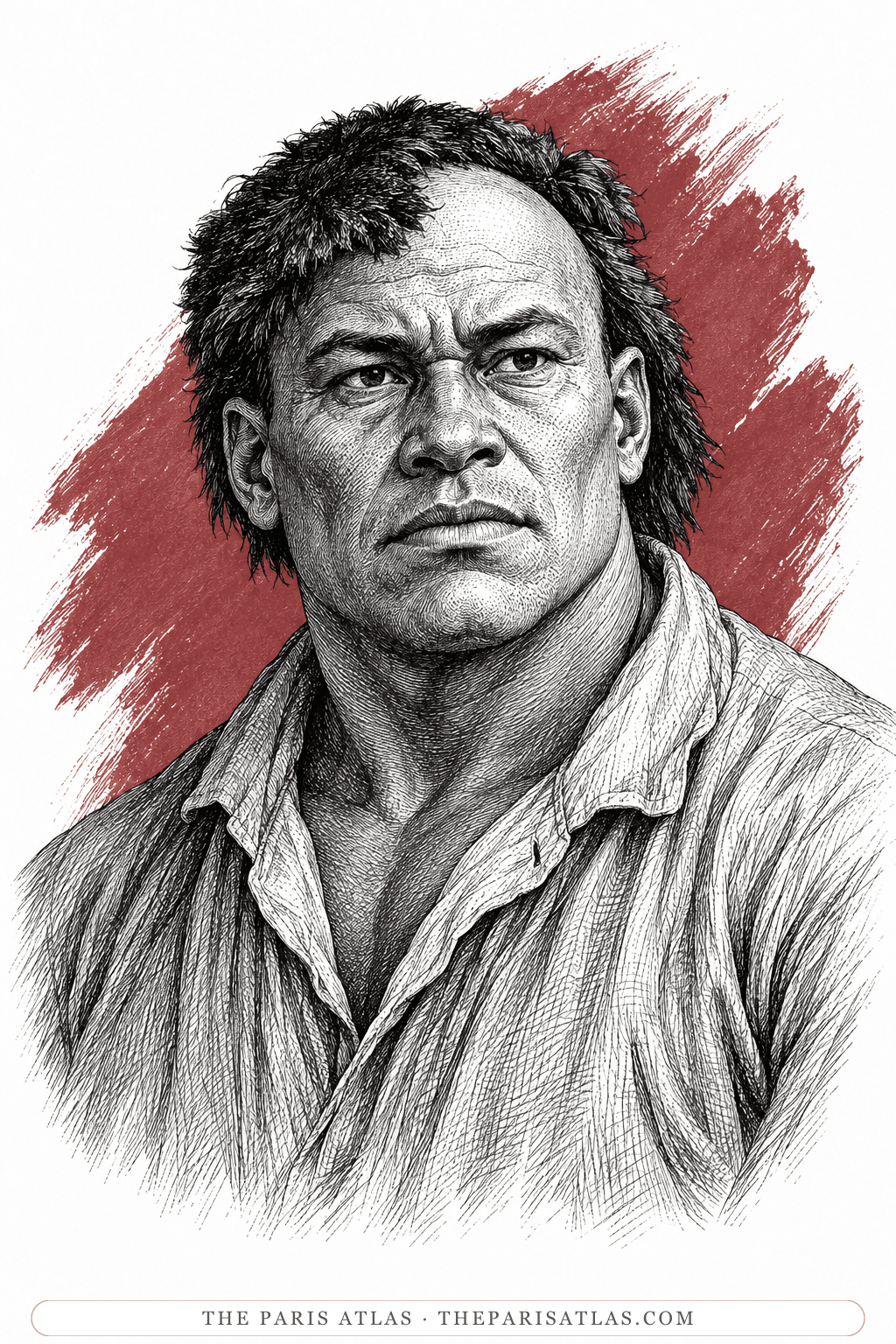
A powerful crew member whose protection and practical skill repeatedly preserve Augustus and Pym.
1837
The Southern Literary Messenger publishes the opening installments in January and February. These precede the completed book.
1838
Harper & Brothers issues the novel in New York. Its preface is dated July 1838.
1999
Penguin Classics publishes the selected reading edition with Richard Kopley's introduction and notes.

Poe's early collection develops related problems of confinement, fearful perception, and narrators who cannot fully establish what they have witnessed.
Read our take
The poems offer a shorter form of Poe's interest in recurring thoughts, uncertain signs, and the imagination under strain.
Read our take
Hemingway's much later sea narrative also gives close attention to physical effort and survival, with a markedly different voice and structure.
Read our takeNo. It is a novel that imitates a true travel account. The preface signed by Pym and the unsigned final note are fictional devices, even though the narrative also uses geographical and nautical information.
A young Nantucket man secretly joins a whaling voyage, survives mutiny and shipwreck, and travels into increasingly strange southern waters. His attempt to describe the journey becomes as important as the adventure itself.
Dirk Peters is a crew member who protects Augustus and later becomes Pym's companion. His strength and practical skill repeatedly help them survive. Pym's descriptions of him should be read as the narrator's judgments.
The final encounter is followed by a fictional editorial note claiming that Pym's concluding chapters have been lost. The published novel supplies no complete return journey or single explanation of the encounter.
The book was published in 1838. Its opening installments appeared in 1837, and the first edition also carries an 1837 copyright registration. Those earlier dates do not date the book's release.
The selected reading edition is Penguin Classics' 1999 paperback, ISBN 9780140437485, with Richard Kopley's introduction and notes. Its 288-page count includes the edition's supporting material.
Explore authors with a similar voice, perspective, and influence.

The doctor of the Paris slums who wrote the century's blackest, funniest novel — and changed the sound of French prose.
View author
The Brooklyn dropout who arrived in Paris broke at thirty-eight and wrote the exuberant, banned books that ended American censorship.
View author
American poet and novelist of Los Angeles rooming houses, racetracks and the post office, who quit his job to write when a publisher offered him a hundred dollars a month. He came to Paris once, in September 1978, drank his way through a live television book programme and walked off the set — and French television has been replaying it ever since.
View authorThe sources below include the primary text, editions, scholarship, archival materials, and other records that informed this page. They document The Narrative of Arthur Gordon Pym of Nantucket, its publication, and its place in literary history.


First-edition publication and bibliographic history.

Selected edition's date, contributor, ISBN, and page count.
Library catalogue confirms Richard Kopley's introduction and notes.
The primary text is the baseline reference for every book page. Additional references document publication history, interpretation, and historical context where that evidence is available.
 Explore more resources