
The Narrative of Arthur Gordon Pym of Nantucket
Edgar Allan Poe's novel of 1838 also starts from Nantucket and takes a whaling brig into strange southern waters.
Read our takeMoby-Dick
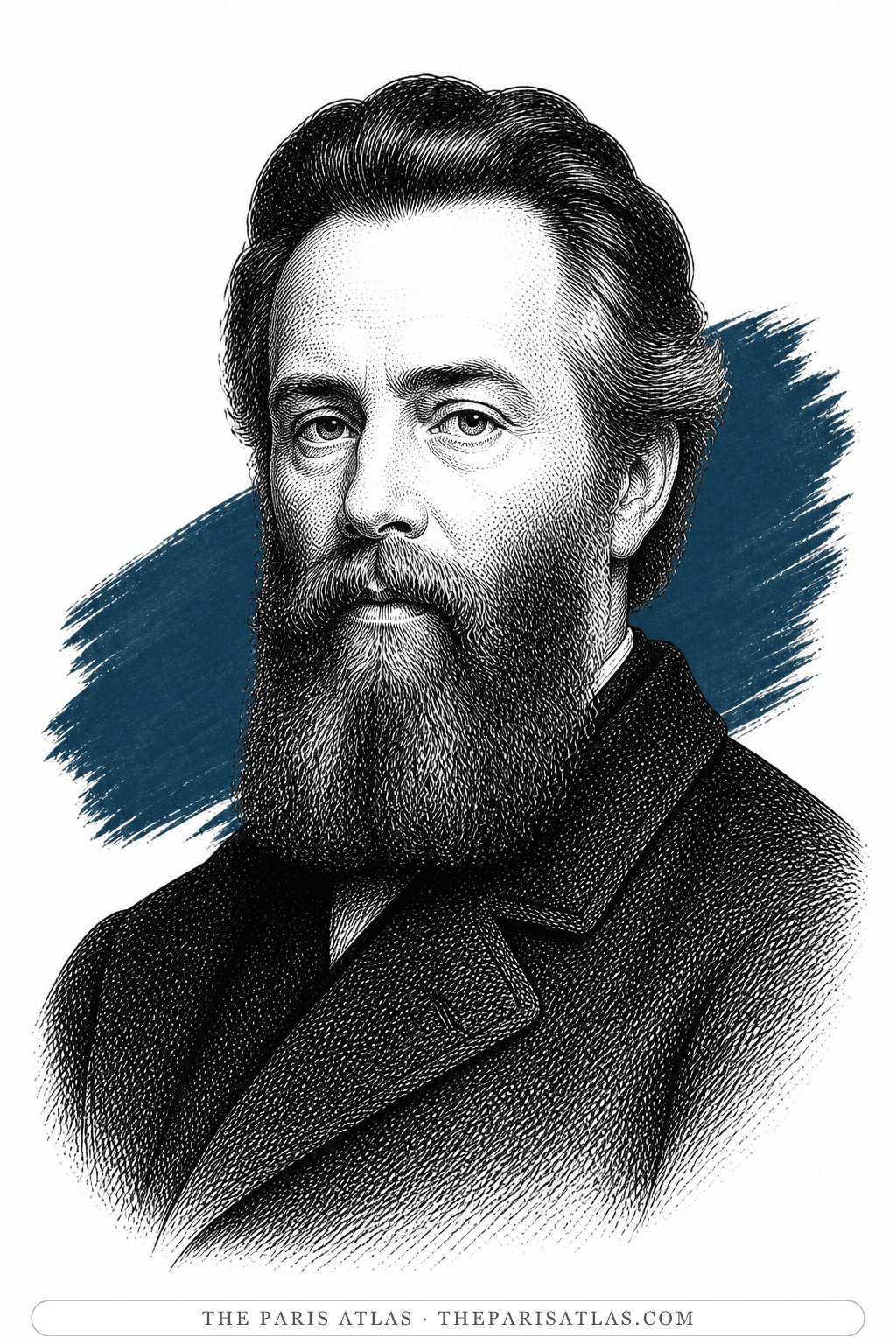
Herman Melville
A young sailor signs onto a Nantucket whaler whose captain means to spend the whole voyage hunting one white whale.
Herman Melville's sixth book follows Ishmael, a restless young man who ships out of Nantucket on the whaler Pequod. Her captain, Ahab, lost a leg to a white sperm whale called Moby Dick. He turns a business voyage into a private hunt for that one animal. Between the chases the book stops to explain how whaling worked, from the boats to the boiling of the oil. Richard Bentley published the novel in London as The Whale on 18 October 1851. Harper & Brothers published it in New York as Moby-Dick on 14 November 1851.
Melville knew the work at first hand. On 3 January 1841 he sailed from Fairhaven, Massachusetts, on the whaler Acushnet, bound for the Pacific. He spent about fifteen months aboard her, the last six of them out of sight of land.[1] Nine years later he wrote the novel at Arrowhead, the farmhouse outside Pittsfield, Massachusetts, where he could see Mount Greylock from the window.[2]
The book opens on land. Ishmael arrives in New Bedford in winter, shares a bed at the Spouter-Inn with Queequeg, a harpooner from a South Sea island, and hears Father Mapple preach on Jonah in the whalemen's chapel. The two men sign onto the Pequod at Nantucket, and the ship sails on Christmas Day. Ahab stays in his cabin for days before anyone sees him.[3]
The story then keeps stopping. Whole chapters explain how a whale is classified, how the boats are lowered, how the blubber is cut in and how the oil is boiled in the try-works on deck. Some chapters are written like scenes from a play, with stage directions. Readers who expect a sea adventure find a manual, a sermon and a tragedy in the same covers.[3]
Melville put Nathaniel Hawthorne's name at the front. The dedication reads "In token of my admiration for his genius, this book is inscribed to Nathaniel Hawthorne." The two writers had met the summer before, on a picnic up Monument Mountain in the Berkshire hills.[3][2]
Ishmael goes to sea whenever he feels grim and restless. In New Bedford he is put to share a bed with Queequeg, a tattooed harpooner, and the two become close friends. At Nantucket they sign onto the Pequod with her part-owners, Captain Peleg and Captain Bildad. A ragged stranger named Elijah warns them about the ship's captain.[3]
Out at sea Ahab finally comes on deck, standing on a leg made of whale ivory. In Chapter XXXVI he gathers the crew, nails a Spanish gold coin to the mainmast, and promises it to the first man who sights the white whale that took his leg. Starbuck, the careful first mate, objects that revenge on an animal is madness. The rest of the crew cheer.[3]
The Pequod hunts other whales on the way, and the book follows every stage of the work. Ahab has smuggled aboard his own boat crew, led by a silent man named Fedallah. The ship meets other whalers, and Ahab asks each captain the same question: has he seen the white whale? Queequeg falls ill and has the carpenter make him a coffin, then recovers.[3]
Late in the voyage the Pequod meets the Rachel. Her captain, Gardiner, lost a boat the day before in a chase after Moby Dick, and his twelve-year-old son was in it. He begs Ahab to help search for the missing boat. Ahab refuses and sails on after the whale.[3]
The chase lasts three days. On the first day Moby Dick bites Ahab's boat in half. On the second he smashes more boats, and Fedallah disappears. On the third day the whale rams and sinks the Pequod. Ahab throws his last harpoon, and the line catches him round the neck and pulls him under.
Ishmael has been thrown from a boat and is floating at the edge of the wreck. Queequeg's coffin, made into a life-buoy, shoots up out of the sea beside him. He clings to it for a day and a night. On the second day the Rachel, still searching for her captain's lost son, picks him up. He is the only survivor.
The Acushnet was a new ship of 359 tons, built in 1840. Under Captain Pease she sailed from Fairhaven on 3 January 1841 and came home in May 1845 with 850 barrels of sperm oil. Melville was not aboard for the return. He had deserted her in the Marquesas Islands, the story he told in his first book, Typee.
The biographer Raymond Weaver noticed how Melville changed the details. The real ship left Fairhaven, across the river from New Bedford, a few days into January. The Pequod leaves Nantucket on Christmas Day. Weaver also found that the Acushnet was wrecked on St. Lawrence Island on 31 August 1851, within a month of the time Melville finished the novel.
The American edition was set in type straight from Melville's manuscript, but it could not come out first. A book by a foreign author had to be published first in Britain to be protected by copyright there. So the proofs went to Richard Bentley in London, whose editors cut passages they thought too blasphemous or too bawdy.
Bentley brought the book out in three volumes as The Whale on 18 October 1851, in an edition of only 500 copies. Harper & Brothers published it in New York as Moby-Dick on 14 November 1851, in 2,915 copies. Harper's premises burned in 1853. Partly for that reason, small new printings followed in 1855, 1863 and 1871. In the forty years before Melville died, only one British and one American edition appeared.
Few people read it. The New Bedford Daily Mercury called the American edition "a bulky, queer looking volume, in some respects 'very like a whale' even in outward appearance." Hawthorne was one reader who understood it. He wrote to praise the book, and Melville answered from Pittsfield: "A sense of unspeakable security is in me this moment, on account of your having understood the book."
In the same letter Melville wrote, "I have written a wicked book, and feel spotless as the lamb." Hawthorne's own letter does not survive.
When Melville died in 1891, the obituaries were surprised mainly that he had still been alive. The next year his literary executor, Arthur Stedman, reissued Moby-Dick. Other editions followed in 1899 and in the Everyman's Library series.
In 1923 D. H. Lawrence gave the book a chapter in Studies in Classic American Literature. He found it tiresome in places and said so. Then he called it "a great book, a very great book, the greatest book of the sea ever written."
In 1930 the Lakeside Press published a three-volume edition with 280 drawings by Rockwell Kent, in an aluminium slipcase. Random House brought out a one-volume version the same year. Kent's drawings, with their brawny, craggy Ahab, became the best-known pictures of the book.
In 1956 Warner Bros. released John Huston's film, written by Ray Bradbury and Huston, with Gregory Peck as Ahab and Orson Welles as Father Mapple. The harbour town of Youghal in Ireland stood in for New Bedford. The film opened in New Bedford itself on 27 June 1956.
Melville spent about eight days in Paris in late 1849, the year before he started work on the novel. He could not speak French and was often lonely. His journal records one building he loved, the Hôtel de Cluny. He called it "the house just the house I'd like to live in."
The house turns up in Chapter XLI, the chapter that explains Ahab. The narrator says the reader has only seen the upper rooms of Ahab's mind. He tells the reader to leave "this spiked Hotel de Cluny where we here stand" and go down to "those vast Roman halls of Thermes" underneath. There, he says, sits a buried king, the real core of the man.
The standard French translation was made in Provence and published in Paris. Gallimard issued it in 1941, translated by Lucien Jacques, Joan Smith and the novelist Jean Giono. The same year Gallimard published Giono's own short book about Melville, Pour saluer Melville. A Gallimard printing of 1951 is already marked the 121st. A second French translation, by Armel Guerne, came out from Le Sagittaire in Paris in 1955.
Call me Ishmael.
It is not down in any map; true places never are.
from hell’s heart I stab at thee; for hate’s sake I spit my last breath at thee.
The book has a reputation for weight, but the opening chapters are comic. Ishmael sharing a bed with a stranger at the Spouter-Inn is one of the funniest scenes in American writing.
Ahab turns a whaling business into a private hunt, and the crew follow him. The book watches how one man's obsession takes over a ship full of people who need their wages.
Melville spent about fifteen months on a real whaler. The chapters on boats, harpoons and boiling oil are written by someone who had done the work.
Chapter XLI sends the reader down through the Hôtel de Cluny into Roman halls beneath it. Melville had seen the house in Paris in December 1849.
The narrator, a schoolmaster turned sailor, who goes to sea whenever he feels grim. He tells the story, then slips into the background.
The Pequod's captain, who lost a leg to the white whale and walks on one made of whale ivory. He means to kill Moby Dick whatever it costs.
A huge white sperm whale, famous among whalemen for wrecking the boats that chase him.
A harpooner from an island in the South Seas, covered in tattoos. He becomes Ishmael's closest friend.
The first mate, a careful Nantucket Quaker. He is the only officer who argues with Ahab.
The second mate, always calm and always smoking his pipe, even in the middle of a chase.
The third mate, a short, stubborn young man who treats whales as personal enemies.
The silent leader of the boat crew Ahab smuggles aboard. The sailors distrust him.
A former harpooner turned preacher, who climbs a rope ladder into his pulpit in New Bedford and preaches on Jonah.
3 January 1841
Melville sails from Fairhaven, Massachusetts, on the whaler Acushnet, bound for the Pacific.
December 1849
In Paris for about eight days, Melville visits the Hôtel de Cluny and calls it the house he would like to live in.
1850
Melville settles near Pittsfield, Massachusetts, meets Nathaniel Hawthorne on Monument Mountain, and works on the whaling book.
18 October 1851
Richard Bentley publishes the novel in London as The Whale, in three volumes and 500 copies.
14 November 1851
Harper & Brothers publish Moby-Dick in New York, dedicated to Hawthorne.
1853
A fire at Harper & Brothers destroys stock. Only small reprintings follow in Melville's lifetime.
1892
A year after Melville's death, his literary executor Arthur Stedman reissues the novel.
1923
D. H. Lawrence calls it the greatest book of the sea ever written, in Studies in Classic American Literature.
1930
The Lakeside Press publishes Rockwell Kent's illustrated edition, and Random House a one-volume version.
1941
Gallimard publishes the French translation by Lucien Jacques, Joan Smith and Jean Giono, and Giono's Pour saluer Melville.
27 June 1956
John Huston's film, written by Ray Bradbury and Huston, opens in New Bedford, Massachusetts.

Edgar Allan Poe's novel of 1838 also starts from Nantucket and takes a whaling brig into strange southern waters.
Read our take
Ernest Hemingway's short novel is another duel between one old man and one huge fish, told with none of Melville's digressions.
Read our take
Victor Hugo's sea novel of 1866, in which one fisherman spends weeks alone on a reef to save a ship's engine.
Read our takeTypee
Herman Melville
Melville's first book, about deserting the whaler Acushnet in the Marquesas, the same ship whose voyage lies behind Moby-Dick.
Read our takeBilly Budd
Herman Melville
Melville's last sea story, written forty years later, about another captain whose sense of duty destroys a young sailor.
Read our takeA whaling voyage that its captain turns into a private hunt. Ishmael signs onto the Nantucket whaler Pequod. Her captain, Ahab, lost a leg to a white whale called Moby Dick and means to kill it. Around the chase Melville explains how whaling worked, in close detail.
The London edition came first, to protect the copyright in Britain, and Richard Bentley published it as The Whale on 18 October 1851. The New York edition from Harper & Brothers came out on 14 November 1851 as Moby-Dick; or, The Whale.
In part. Melville sailed on the whaler Acushnet in January 1841 and spent about fifteen months aboard. The whaling work in the novel comes from that voyage. Ahab, the Pequod and the white whale are his own inventions.
Nathaniel Hawthorne. The dedication reads "In token of my admiration for his genius, this book is inscribed to Nathaniel Hawthorne." The two writers had become friends in the Berkshire hills in 1850.
Yes. Melville visited the Hôtel de Cluny in Paris in December 1849 and loved it. In Chapter XLI he uses the house and the Roman halls beneath it to describe Ahab's mind. The standard French translation, by Lucien Jacques, Joan Smith and Jean Giono, was published by Gallimard in Paris in 1941.
No. The London edition was 500 copies and the New York edition 2,915. Only one British and one American edition appeared in the forty years before Melville died. The book's reputation grew after 1892, when Arthur Stedman reissued it.
ISBN 9780142437247 is the Penguin Classics paperback, 720 pages, with an introduction by Andrew Delbanco and notes by Tom Quirk. The publisher says it uses the Northwestern-Newberry text.
Explore authors with a similar voice, perspective, and influence.

The doctor of the Paris slums who wrote the century's blackest, funniest novel — and changed the sound of French prose.
View author
American novelist and composer whose expatriate fiction explores dislocation, unstable intimacy, fatalism, and North Africa.
View author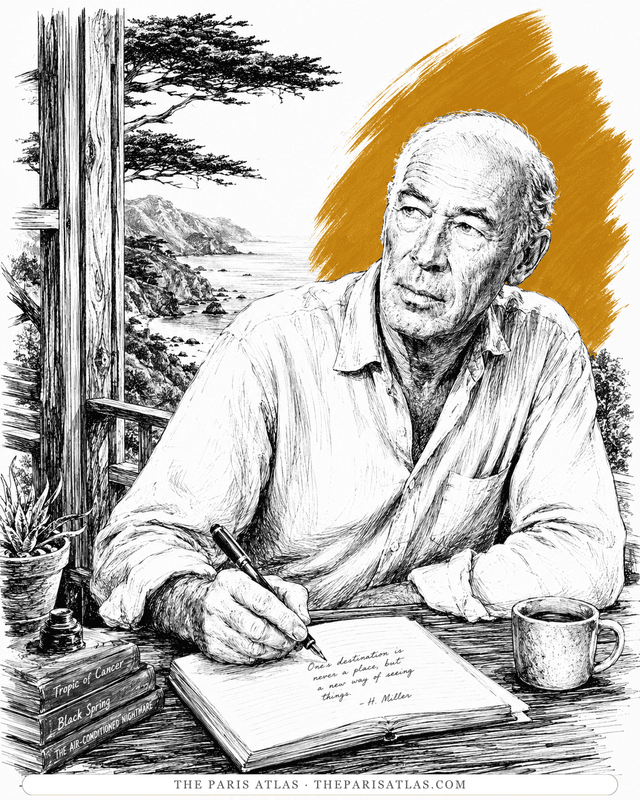
The Brooklyn dropout who arrived in Paris broke at thirty-eight and wrote the exuberant, banned books that ended American censorship.
View authorThe sources below include the primary text, editions, scholarship, archival materials, and other records that informed this page. They document Moby-Dick, its publication, and its place in literary history.


The Acushnet voyage, the Paris journal of 1849, and Melville's letter to Hawthorne about the book.
Mary K. Bercaw Edwards on the London and New York first editions, their dates and print runs, the first reviews, and the later illustrated editions.

D. H. Lawrence's 1923 verdict on the novel.
Credits, locations and opening dates of John Huston's 1956 film.
Catalogue record for the first edition of the Jacques, Smith and Giono translation.
Catalogue record for Jean Giono's book about Melville.
Catalogue record for a 1951 printing marked the 121st.
Catalogue record for Armel Guerne's translation.
Selected ISBN, page count, on-sale date, editors and text basis.
Library record confirming ISBN 9780142437247 as the Penguin Classics edition.
The primary text represented by this page, used for descriptions of the work’s contents and for any quoted passages shown here.
The primary text is the baseline reference for every book page. Additional references document publication history, interpretation, and historical context where that evidence is available.
 Explore more resources