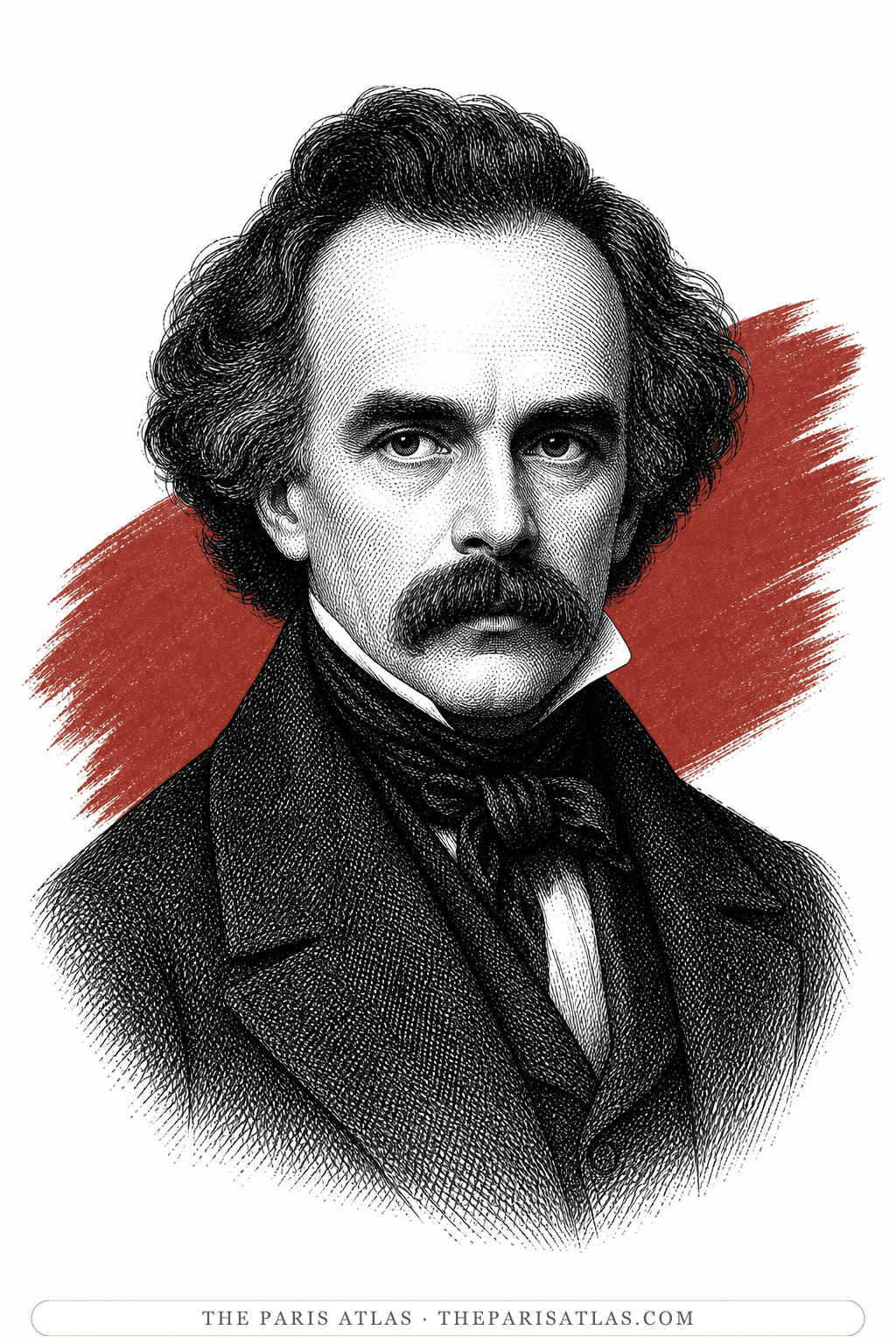
Author of Moby-Dick, who spent about eight days in Paris in the winter of 1849 in a fifth-floor room on the Rue de Bussy, spoke no French, went twice to look at the corpses on display at the public Morgue, and wrote of the medieval Hôtel de Cluny that it was "the house just the house I'd like to live in." He was thirty. Two years later the whale book appeared, failed, and buried him for seventy years.
5 books on our shelves
Details
Lived
1819–1891
Born
1819
Birthplace
New York City
Died
1891
Place of death
New York City
Nationality
American
Profession
Novelist, poet and customs inspector
Major works
Typee, Moby-Dick, Bartleby the Scrivener, Billy Budd
Married
Elizabeth Shaw · 1847–1891
Roles
AuthorPoet
About Herman Melville
Herman Melville crossed to Paris in the last week of November 1849, a young American novelist with a modest reputation, on a business trip to sell a book to London publishers. He stayed roughly eight days, spoke no French, was lonely most of the time, and left on 6 December closing the day's journal entry with a single word: "Selah!" What he wrote down while he was there is oddly, specifically his — not the palaces but the public Morgue on the Île de la Cité, where the unclaimed dead of Paris were laid out behind glass for anyone to walk in and look at, and the Hôtel de Cluny, the fifteenth-century abbot's mansion built over Roman baths, which he decided was "the house just the house I'd like to live in." A man who would shortly write a novel about hunting an unknowable thing across the ocean spent his week in Paris looking at bodies and at a house with a Roman ruin underneath it.
Back in America he bought a farmhouse in the Berkshire hills of Massachusetts, called it Arrowhead, met Nathaniel Hawthorne at a mountain picnic, and in that farmhouse wrote Moby-Dick (1851), which he inscribed to Hawthorne "in token of my admiration for his genius." It sold badly, the reviews were bewildered, and the books that followed sold worse. From 1866 to 1886 he supported his family as a customs inspector on the New York docks, writing poetry nobody read. He died in 1891 leaving a short novel, Billy Budd, in a drawer in manuscript. Thirty years later a young Columbia professor named Raymond Weaver went looking for him, and by 1923 D. H. Lawrence was calling Moby-Dick "the greatest book of the sea ever written."
The sailor who wrote it down
Melville was born in New York City on 1 August 1819 into a merchant family that lost everything: his father went bankrupt and died when Herman was twelve, and the boy was pulled out of school. He clerked, taught country school, and at nineteen went to sea. In 1841 he shipped out of Massachusetts aboard the whaler Acushnet for the Pacific, deserted in the Marquesas Islands, lived several weeks among the Typee people, worked his passage home through Tahiti and Honolulu and came back after nearly four years at sea with material no American writer had.[1]
He turned it into books immediately. Typee (1846) and Omoo (1847) — South Seas narratives half reportage, half romance — made him famous fast; readers wanted to know how much of it was true, and he became, briefly, the most talked-about young writer in the country. He married Elizabeth Shaw, daughter of the Chief Justice of Massachusetts, in 1847. By 1849 he had published four books in four years, had a wife and an infant son to support, and had discovered the permanent problem of his career: the books he wanted to write were not the books that sold.[1]
Paris, November–December 1849
On 11 October 1849 he went aboard the Southampton, a regular London liner lying in the North River, to go and place his new novel, White-Jacket, with a British publisher in person — American authors had no British copyright protection, and the trip was strictly business. London went badly; publishers lectured him about the copyright laws and made no offers he liked. He was homesick and slept badly. On 27 November he abruptly left England for France.[1]
Two days later he was, in his own words, "right snugly roomed in the fifth story of a lodging house No. 12 & 14 Rue de Bussy, Paris." It was eleven at night; the chambermaid had lit a wood fire and a candle and left him alone; on the table he found a sealed bottle of dark liquid, a decanter of water and a paper of loaf sugar that he was fairly sure had not been in the bond, and which he charitably ascribed to the benevolence of his "most polite, pleasant and Frenchified landlady" below, Madame Capelle. "I shall try the brandy before writing more," he noted, "and now to resume my Journal." Six years later he gave the whole scene to the hero of his novel Israel Potter, who arrives in revolutionary Paris and finds the same bottle waiting for him.[1]
The brandy did not make him happy. "Fire made, and tried to be comfortable," he wrote. "But this is not home and — but no repinings." He spoke no French at all, which shut most of the city's pleasures against him. His one companion was George Adler, a German-born philologist from New York whom he had met on the crossing and argued metaphysics with for months. On the evening of 2 December he left Adler after brandy and cigars and "strolled out into a dark rainy night and made my melancholy way across the Pont (rather a biscuit's toss of the Morgue)" to his room — where the tapestry over the closet door unsettled him.[1]
The Morgue he crossed the bridge past was not a metaphor. The Paris Morgue stood on the riverbank beside Notre-Dame, and it was a public exhibition of the dead: a room open from the street through folding gates, with a plate-glass window running to the ground, the unidentified bodies laid out on two rows of inclined planes behind it and their clothes hung above them from the ceiling. Anyone could walk in. Charles Dickens, who kept going back, wrote that whenever he was in Paris he was "dragged by invisible force into the Morgue," and described the crowd running in off the street after a body was carried up. On 3 December Melville "looked in at the Morgue," and then "bought two pair of gloves and one pair of shoes for Lizzie" — his wife — and dined with Adler, and "talked high German metaphysics till ten o'clock." The morgue, the gloves and the metaphysics sit in the journal one after another, without comment, which is exactly how he wrote fiction too.[2]
The house just the house I'd like to live in.
The one building that took him was the Hôtel de Cluny, the late-medieval Paris mansion of the abbots of Cluny on the Left Bank, built over the vaulted remains of a Roman bath-house and by then a museum of the Middle Ages. A house with an older ruin underneath it was, for Melville, an idea as much as an address; two years later, in Moby-Dick, he would tell readers that to reach a man's real nature you must descend past the state rooms into the buried Roman foundations. He also made a half-hearted attempt to see Rachel, the great tragedienne of the Théâtre-Français, and failed to get in. On 6 December he hurried out of Paris, closing the record with "Selah!" He went on to Brussels and up the Rhine, and by 13 December he was back in his old room over the Thames. Paris had taken eight days and cost him, on the evidence of the journal, one museum he loved, two visits to a display of corpses, a pair of gloves for his wife and a great deal of loneliness.[1]
Arrowhead, Hawthorne, and the whale
Home by February 1850, Melville took his family to Pittsfield in the Berkshire hills of western Massachusetts for the summer and stayed. In August, at a walking picnic up Monument Mountain that turned into a thunderstorm and a long lunch, he met Nathaniel Hawthorne, fifteen years older and the most admired writer in America since The Scarlet Letter had appeared that spring. The two struck up an immediate, intense friendship. That autumn Melville bought a gambrel-roofed farmhouse on Holmes Road, named it Arrowhead, and lived there until 1863. It was at Arrowhead, with a view of Mount Greylock from the study window, that he wrote Moby-Dick.[3]
Here is the book, plainly. A young man calling himself Ishmael signs onto a Nantucket whaling ship, the Pequod, out of restlessness and poverty. The ship is commanded by Ahab, a captain whose leg was taken off by a white sperm whale called Moby Dick and who has secretly converted the entire voyage — a commercial expedition owned by other people, crewed by men who need the wages — into a private hunt for that one animal. The whale is not evil; it is a whale. Ahab needs it to mean something, and the need destroys everything he commands. Around this, Melville built a novel that keeps stopping to explain the whaling trade in exact detail — how the boats are lowered, how the blubber is stripped, how the oil is boiled — so that when the metaphysics arrive they arrive standing on facts. It is a working manual and a tragedy in the same covers.
It was published in London in 1851 as The Whale and in New York the same year as Moby-Dick; or, The Whale, and Melville put Hawthorne's name on the front: "In token of my admiration for his genius, this book is inscribed to Nathaniel Hawthorne." Reviewers were baffled; readers did not buy it. Pierre followed in 1852 and was worse received still — and then a fire at his American publisher's warehouse in 1853 destroyed the standing stock and the plates. He wrote the great short fiction of the 1850s for magazines — Bartleby, the Scrivener appeared in Putnam's Monthly in 1853 and Benito Cereno in the same magazine in 1855 — sold Arrowhead in 1863, and by his mid-forties had effectively stopped publishing prose.[4]
Nineteen years on the docks
On 5 December 1866 Melville was appointed an inspector of customs in New York, and he worked the job for nineteen years, until 1 January 1886. He was an outdoor inspector — the man on the wharf checking cargo as it came off the ships — stationed for years at the foot of Gansevoort Street on the North River, a street carrying the name of his mother's family, the Gansevoorts of Albany. Twice the department proposed moving him to the East River and twice a friend at the office intervened to keep him where he was. He was sixty-seven when he resigned, and only then because a legacy of his wife's had made it possible.[5]
He never stopped writing; he stopped publishing commercially. Battle-Pieces (1866) collected his poems of the Civil War. Clarel (1876) is a long, intricate philosophical poem in two volumes about faith and doubt among pilgrims in the Holy Land. His last two books of verse, John Marr and Other Sailors (1888) and Timoleon (1891), were privately printed in editions of twenty-five copies each. He finished a short novel a few months before his death and left it in manuscript. Melville died in New York on 28 September 1891; the funeral was attended by his wife and his two surviving daughters. Obituary notices were brief and several got his name wrong.
The rediscovery
The centenary of Melville's birth in 1919 brought a handful of essays by critics who noticed that a major American writer had gone missing. Raymond Weaver, a young professor at Columbia University, went into the family papers and published Herman Melville, Mariner and Mystic in 1921 — the first full biography, and the book that put the case that the long silence was not madness but refusal. Among those papers Weaver found the manuscript of Billy Budd, Sailor, unpublished for thirty years: a sea story about an innocent sailor hanged for a killing everyone including his executioner knows to be no murder. It appeared in print in 1924.
The reassessment came fast after that. In Studies in Classic American Literature (1923), D. H. Lawrence gave Moby-Dick a chapter and delivered the verdict that stuck: "one of the strangest and most wonderful books in the world … a great book, a very great book, the greatest book of the sea ever written." Within a generation Melville had moved from a footnote about South Seas travel books to the centre of the American canon, and Arrowhead, the Pittsfield farmhouse where he wrote the whale, had become a museum. The eight days in Paris are a small thing in that life. But the journal he kept there is one of the few places you can watch him at thirty, unfamous, cold, unable to speak to anyone, going to look at the dead and then buying gloves for his wife.[6]
Life events
1819
Born in New York City on 1 August, into a merchant family that soon loses everything.
— Raymond M. Weaver, Herman Melville, Mariner and Mystic (1921)
1841
Ships out aboard the whaler Acushnet for the Pacific; deserts in the Marquesas and returns after nearly four years at sea.
— Raymond M. Weaver, Herman Melville, Mariner and Mystic (1921)
1846
Typee makes him briefly famous; Omoo follows in 1847, as does his marriage to Elizabeth Shaw.
— Raymond M. Weaver, Herman Melville, Mariner and Mystic (1921)
1849
Sails from New York on 11 October aboard the Southampton to place White-Jacket with a British publisher; leaves England on 27 November and reaches Paris two days later, taking a fifth-floor room at No. 12 & 14 Rue de Bussy.
— Raymond M. Weaver, Herman Melville, Mariner and Mystic (1921)
1849
3 December: "looked in at the Morgue," then buys gloves and shoes for his wife. He visits the Hôtel de Cluny — "the house just the house I'd like to live in" — and leaves Paris on 6 December with a one-word sign-off: "Selah!"
— Raymond M. Weaver, Herman Melville, Mariner and Mystic (1921)
1850
Meets Nathaniel Hawthorne at a picnic on Monument Mountain in the Berkshires, and that autumn buys the Pittsfield farmhouse he names Arrowhead.
— Herman Melville and Arrowhead — the museum's account of the Pittsfield years; Raymond M. Weaver, Herman Melville, Mariner and Mystic (1921)
1851
Moby-Dick is published in London as The Whale and in New York under its own title, inscribed to Hawthorne "in token of my admiration for his genius." It does not sell.
— Herman Melville, Moby-Dick; or, The Whale (Project Gutenberg etext, dedication and text) (1851)
1853
A fire at his American publisher's warehouse destroys the stock of Pierre; the reading public, already lost, stops buying him altogether.
— Raymond M. Weaver, Herman Melville, Mariner and Mystic (1921)
1863
Sells Arrowhead after thirteen years and moves the family back to New York.
— Herman Melville and Arrowhead — the museum's account of the Pittsfield years
1866
Appointed inspector of customs in New York on 5 December — an outdoor inspector on the wharf at the foot of Gansevoort Street. He holds the post nineteen years. Battle-Pieces, his Civil War poems, appears the same year.
— Raymond M. Weaver, Herman Melville, Mariner and Mystic (1921); Gansevoort-Lansing collection, 1650–1919 — finding aid, Manuscripts and Archives Division
1886
Resigns the customs post on 1 January, at sixty-seven, after a legacy makes it possible.
— Raymond M. Weaver, Herman Melville, Mariner and Mystic (1921)
1891
Dies in New York on 28 September, leaving the manuscript of Billy Budd finished a few months earlier and unpublished.
— Raymond M. Weaver, Herman Melville, Mariner and Mystic (1921)
1921
Raymond Weaver publishes the first Melville biography and finds Billy Budd among the family papers; the revival begins.
— Raymond M. Weaver, Herman Melville, Mariner and Mystic (1921)
1923
D. H. Lawrence calls Moby-Dick "the greatest book of the sea ever written" in Studies in Classic American Literature.
— D. H. Lawrence, Studies in Classic American Literature (Project Gutenberg #60547) (1923)
People Herman Melville Knew
Relationships with other people, with sources for each connection.
At a walking picnic up Monument Mountain in the Berkshire hills in the summer of 1850, the year both writers settled there. Melville was thirty-one and midway through the whale book; Hawthorne was forty-six and newly famous for The Scarlet Letter.
— Herman Melville and Arrowhead — the museum's account of the Pittsfield years; Raymond M. Weaver, Herman Melville, Mariner and Mystic (1921), Chapter XV, A Neighbour of Hawthorne's
Who Inspired Herman Melville
People whose work inspired Herman Melville. They did not necessarily meet or know one another.
Melville met Hawthorne in the summer of 1850 while writing Moby-Dick, and put his name on the front of the finished book. The dedication is the evidence in Melville's own words.
— Herman Melville, Moby-Dick; or, The Whale (Project Gutenberg etext, dedication and text) (1851), Dedication; Raymond M. Weaver, Herman Melville, Mariner and Mystic (1921), Chapter XV, A Neighbour of Hawthorne's
A well-loved young sailor on a British warship is falsely accused of plotting mutiny, and answers with a single blow.
4.4
Questions about Herman Melville
Was Herman Melville ever in Paris?
Once, briefly, and he wrote it down. He crossed from England on 27 November 1849 and was in a fifth-floor lodging at No. 12 & 14 Rue de Bussy two days later; he left on 6 December. That is about eight days. He spoke no French, was homesick, and had one companion in the city, the German-American scholar George Adler. His journal records visits to the public Morgue, to the medieval Hôtel de Cluny, and a failed attempt to see the actress Rachel at the Théâtre-Français.
Why did Melville go to the Paris Morgue?
Because in 1849 it was something visitors went to see. The Paris Morgue stood on the riverbank by Notre-Dame and was open to the street through folding gates: behind a plate-glass window running down to the floor, unidentified bodies lay on two rows of inclined planes with their clothes hung above them, so that anyone might come in and name them. Charles Dickens, describing the same room, wrote that whenever he was in Paris he was "dragged by invisible force into the Morgue," and watched crowds run in off the street behind a newly arrived body. Melville passed it on the rainy night of 2 December on his way home and went in on the 3rd — "looked in at the Morgue," the journal says, before recording that he then bought two pairs of gloves and a pair of shoes for his wife.
What is Moby-Dick actually about?
A whaling voyage that a captain hijacks for a private revenge. Ishmael, a restless young man, signs onto the Nantucket whaler Pequod; her captain, Ahab, lost a leg to a white sperm whale called Moby Dick and has secretly turned the whole commercial voyage into a hunt for that one animal. The whale is not malevolent — it is an animal — but Ahab requires it to mean something, and that requirement kills his ship. Around this Melville packs long, exact chapters on how whaling actually worked, so the philosophy stands on a trade. It was published in 1851 and sold poorly for the rest of his life.
Why was Moby-Dick a failure when it came out?
Readers had bought Melville for South Seas adventure and got a book that stops every few chapters to anatomise a whale, quote scripture and stage soliloquies. Reviewers did not know what to do with it and the public did not buy it. Sales never recovered; his next novel, Pierre (1852), did worse, and a fire at his American publisher's warehouse in 1853 destroyed its stock. By his forties Melville had stopped publishing prose, and by 1866 he was inspecting cargo on the New York docks for a living.
What did Melville do for a living after he stopped publishing?
He inspected cargo. On 5 December 1866 he was appointed an outdoor inspector of customs in New York, working the wharves — for years at the foot of Gansevoort Street, named after his mother's family — and he held the post nineteen years, resigning on 1 January 1886 when a legacy of his wife's made it possible. He wrote throughout: the Civil War poems of Battle-Pieces, the 18,000-line pilgrimage poem Clarel, two small privately printed volumes of verse, and Billy Budd, left in a drawer.
How was Melville rediscovered?
The centenary of his birth in 1919 prompted a few critics to ask what had happened to him. Raymond Weaver, a Columbia professor, went into the family papers and published the first biography, Herman Melville, Mariner and Mystic, in 1921 — and found the manuscript of Billy Budd, unpublished since Melville's death in 1891. It was printed in 1924. In 1923 D. H. Lawrence devoted a chapter of Studies in Classic American Literature to Moby-Dick and called it "the greatest book of the sea ever written." Within twenty years Melville was central to American literature.
What was Melville's relationship with Nathaniel Hawthorne?
The decisive friendship of his writing life, and a short one. They met in the summer of 1850 on a walking picnic up Monument Mountain in the Berkshires, where both had just settled, and became close at once — Melville was thirty-one and unsure of the book he was writing, Hawthorne forty-six and newly famous for The Scarlet Letter. Melville dedicated Moby-Dick to him "in token of my admiration for his genius" and wrote him letters of startling intensity. Hawthorne moved away from the Berkshires in 1851 and the intimacy cooled; they met again only rarely.
Connections and Sources
Herman Melville’s connections to people, places, and works, with the sources behind each one.
At a walking picnic up Monument Mountain in the Berkshire hills in the summer of 1850, the year both writers settled there. Melville was thirty-one and midway through the whale book; Hawthorne was forty-six and newly famous for The Scarlet Letter.
— Herman Melville and Arrowhead — the museum's account of the Pittsfield years; Raymond M. Weaver, Herman Melville, Mariner and Mystic (1921), Chapter XV, A Neighbour of Hawthorne's
Melville met Hawthorne in the summer of 1850 while writing Moby-Dick, and put his name on the front of the finished book. The dedication is the evidence in Melville's own words.
— Herman Melville, Moby-Dick; or, The Whale (Project Gutenberg etext, dedication and text) (1851), Dedication; Raymond M. Weaver, Herman Melville, Mariner and Mystic (1921), Chapter XV, A Neighbour of Hawthorne's
References
References
The sources below include biographies, scholarly essays, interviews, and primary materials that informed this page. They reflect both the historical record and ongoing critical conversations about Herman Melville and their work.
These references anchor the page in the documented record and in the scholarly conversations around Herman Melville. Every claim on this page traces back to one or more of the works listed here.



 View source