
Benito Cereno
Herman Melville
Benito Cereno
Printed beside Bartleby in The Piazza Tales. Another story told by a well-meaning man who cannot see what is in front of him.
Read our takeBartleby, the Scrivener
Herman Melville
A Wall Street lawyer hires a quiet copyist, who one day answers an ordinary request with "I would prefer not to" and never stops.
Bartleby is a copyist, or scrivener, in a small law office on Wall Street. The elderly lawyer who hired him tells the story. At first Bartleby copies documents day and night. Then he begins to refuse, mildly and politely, anything else he is asked to do, and later the copying too. The lawyer cannot bring himself to throw him out. Herman Melville published the story in two parts in Putnam's Monthly Magazine in November and December 1853. In 1856 he collected it in The Piazza Tales under the shorter title Bartleby.
The narrator is a comfortable lawyer who draws up deeds and other documents. He admits that he never argues before a jury, and that everyone who knows him thinks him "an eminently safe man." The state of New York had also given him a well-paid post as a Master in Chancery, until a new state constitution abolished the office.[1]
His office already has three employees. Turkey is an English copyist about the lawyer's own age, careful in the morning and reckless after lunch. Nippers is younger, ambitious and irritable in the morning. Ginger Nut is a twelve-year-old office boy who fetches cakes and apples for the two copyists. Their bad moods take turns, so the office just about works.[1]
Bartleby arrives in answer to an advertisement, one summer morning. The lawyer gives him a desk behind a folding screen, beside a window that looks out on a brick wall about three feet away. For the first days he copies an enormous amount, silently and without a break.[1]
Melville wrote the story two years after Moby-Dick. The story came out in Putnam's Monthly, a New York magazine, as Bartleby, the Scrivener: A Story of Wall-Street.[2] When Dix & Edwards published The Piazza Tales in New York in 1856, the story was simply called Bartleby.[3]
On the third day the lawyer calls Bartleby to help check a copy against the original. Bartleby answers from behind his screen, "I would prefer not to." The lawyer is too surprised to act, and lets it go. Soon Bartleby will not check any copies, run errands or answer questions. He keeps saying he would prefer not to.[1]
One Sunday morning, on his way to Trinity Church, the lawyer stops at his office and finds it locked from inside. Bartleby is living there. He never leaves, and he seems to eat nothing but ginger-nut cakes. The lawyer feels pity and fear at once. Soon Turkey and Nippers start using the word "prefer" without noticing it.[1]
Then Bartleby stops copying altogether. He stands at the window looking at the brick wall. The lawyer tells him to leave within six days and offers him money. Bartleby stays. For a while the lawyer decides it is his mission to give Bartleby office room. But his professional friends start to talk.[1]
The lawyer cannot bring himself to call the police, so he moves his own office instead. Bartleby stays behind in the empty rooms. When the new tenant puts him out, he sits on the stairs by day and sleeps in the entry at night. The lawyer offers him jobs as a clerk, a bartender, a bill collector and a travelling companion. Bartleby turns them all down, saying each time that he is not particular. The lawyer even invites him home. Bartleby would prefer not to make any change.[1]
The lawyer flees and spends days driving around the edges of the city in his carriage. When he returns, the landlord has had Bartleby taken to the Tombs, New York's prison, as a vagrant. The lawyer visits him and pays the grub-man, who sells prisoners better meals, to feed him well. Bartleby answers, "I prefer not to dine to-day."
A few days later the lawyer finds him huddled at the foot of a wall in the prison yard, his knees drawn up. Bartleby is dead. When the grub-man asks whether he is asleep, the lawyer answers, "With kings and counselors." Months later he hears a rumour that Bartleby had worked in the Dead Letter Office in Washington, sorting letters that could not be delivered and would be burned. He closes the story: "Ah Bartleby! Ah humanity!"
Between 1853 and 1856 Melville published a string of stories and sketches in two New York magazines, Putnam's Monthly and Harper's New Monthly. Bartleby, the Scrivener was the first of them, in the November and December 1853 issues of Putnam's.
The Piazza Tales (1856) gathers six of those pieces. The book was published in New York by Dix & Edwards, at 321 Broadway, and in London by Sampson Low. The contents run The Piazza, Bartleby, Benito Cereno, The Lightning-Rod Man, The Encantadas and The Bell-Tower.
Two things changed on the way into the book. The subtitle, A Story of Wall-Street, was dropped, and so was "the Scrivener". The punctuation was also made heavier, with many more commas. The quotations here follow the magazine version as transcribed by Project Gutenberg.
The story is really about the narrator as much as the clerk. The lawyer is kind, vain and afraid of trouble, and he tells on himself. He offers Bartleby twenty dollars extra to leave. He decides to put up with him because, in his own words, "Here I can cheaply purchase a delicious self-approval."
At one point he reads Jonathan Edwards on the freedom of the will and Joseph Priestley on necessity, two books arguing that people's choices are fixed in advance. They comfort him. He decides that Bartleby was sent to him by Providence, and that his own mission in life is to give Bartleby office room. The mood lasts until the other lawyers in the building start to gossip.
Bartleby never explains himself. Asked why he has stopped copying, he says only "Do you not see the reason for yourself." The lawyer notices that his eyes look dull and glazed and guesses he has strained them. The story leaves that guess unconfirmed.
Pierre Leyris translated the story for Gallimard in Paris as Bartleby l'écrivain, in a volume with The Encantadas. The national library holds a second edition dated 1945. In 1951 Gallimard reprinted his version in Benito Cereno et autres contes de la véranda, his French title for The Piazza Tales.
French television adapted it twice. Bartleby écrivain, adapted by Jacques Armand and Claude Barma, was first broadcast on 13 September 1957. Maurice Ronet directed a second version, written with Yvan Bostel and Jacques Quoirez, with Michael Lonsdale in the cast. Antenne 2 first showed it on 16 December 1976.
Michèle Causse made a new translation, published in Paris by Le Nouveau commerce in 1976. In 1989 Flammarion reissued it with The Encantadas and The Bell-Tower and an afterword by the philosopher Gilles Deleuze.
I would prefer not to.
pallidly neat, pitiably respectable, incurably forlorn! It was Bartleby.
I like to be stationary. But I am not particular.
"I would prefer not to" is polite, calm and impossible to argue with. Melville builds the whole story around what happens when someone keeps saying it.
The office scenes with Turkey, Nippers and Ginger Nut are comedy. The story ends in a prison yard.
The lawyer thinks he is telling a story about a strange clerk. He is also showing how far his kindness goes before it runs out.
The Melville House edition is 64 pages. The story is the easiest way into Melville.
The narrator, an elderly Wall Street lawyer who likes a quiet life. He never gives his name.
A pale, silent copyist who answers most requests with "I would prefer not to." Nothing is known about where he came from.
An English copyist about the lawyer's own age, careful in the morning and flushed and reckless after lunch.
A younger copyist, ambitious and bad-tempered in the mornings, always adjusting the height of his desk.
The twelve-year-old office boy, named after the cakes he fetches for the clerks.
The man who sells better meals to prisoners in the Tombs, if their friends pay.
November 1853
The first half of Bartleby, the Scrivener: A Story of Wall-Street appears in Putnam's Monthly Magazine.
December 1853
Putnam's prints the second half.
1856
Dix & Edwards publish The Piazza Tales in New York, with the story retitled Bartleby.
1945
Gallimard in Paris issues a second edition of Pierre Leyris's French translation, Bartleby l'écrivain.
13 September 1957
French television first broadcasts Bartleby écrivain, adapted by Jacques Armand and Claude Barma.
16 December 1976
Antenne 2 shows Maurice Ronet's television film Bartleby, with Michael Lonsdale in the cast.
1989
Flammarion publishes Michèle Causse's translation in Paris with an afterword by Gilles Deleuze.
2004
Melville House publishes the story on its own in The Art of the Novella series.


Benito Cereno
Herman Melville
Printed beside Bartleby in The Piazza Tales. Another story told by a well-meaning man who cannot see what is in front of him.
Read our takeMoby-Dick
Herman Melville
The novel Melville wrote two years earlier. Ahab will not stop, and Bartleby will not start.
Read our take
Franz Kafka's novel of a man caught in a legal system that never explains itself.
Read our take
Franz Kafka's story of a clerk who can no longer work, and of the people who have to decide what to do with him.
Read our take
Fyodor Dostoevsky's former civil servant, living alone, who insists on his right to refuse what reason demands.
Read our takeA Wall Street lawyer hires a copyist named Bartleby, who works hard at first and then begins to refuse tasks with the words "I would prefer not to." The lawyer cannot bring himself to fire him or throw him out, and the story follows what happens to the lawyer and his clerk.
On the surface, a polite refusal. Bartleby never raises his voice, never gives a reason and never says he will not. The story never explains why he refuses, which is why readers still argue about it.
In two parts, in the November and December 1853 issues of Putnam's Monthly Magazine in New York. Melville collected it in The Piazza Tales in 1856 under the shorter title Bartleby.
A clerk who copied legal documents by hand. Before typewriters and photocopiers, every deed and contract a law office produced had to be written out and then checked, word by word, against the original.
Bartleby's employer, an elderly lawyer who never gives his name. He describes himself as a safe man who avoids trouble, and he tells the story partly to make sense of his own behaviour.
Through its French readers. Pierre Leyris translated it for Gallimard, Maurice Ronet filmed it for French television in 1976, and in 1989 Flammarion published Michèle Causse's translation with an afterword by the philosopher Gilles Deleuze.
ISBN 9780974607801 is the Melville House paperback of 2004, in The Art of the Novella series, 64 pages. The Library of Congress record is LCCN 2004007995.
Explore authors with a similar voice, perspective, and influence.
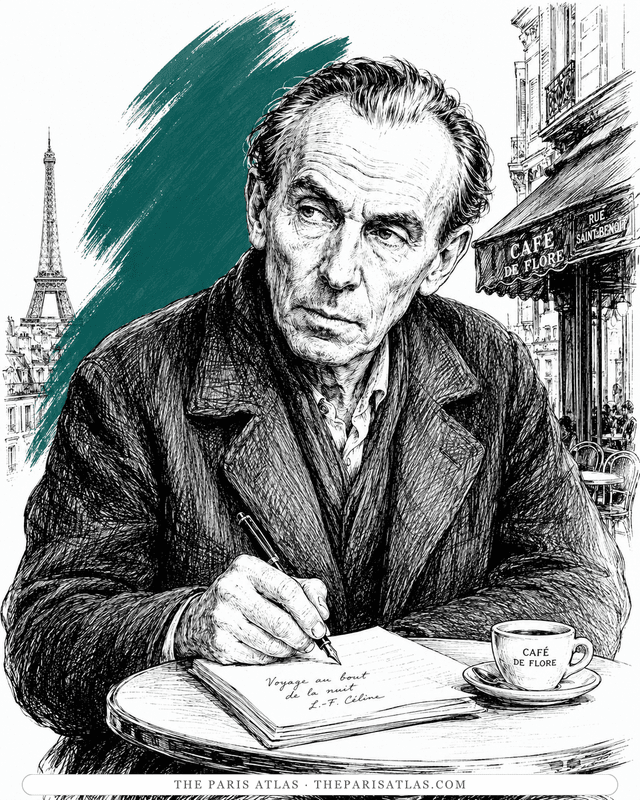
The doctor of the Paris slums who wrote the century's blackest, funniest novel — and changed the sound of French prose.
View author
American novelist and composer whose expatriate fiction explores dislocation, unstable intimacy, fatalism, and North Africa.
View author
The Brooklyn dropout who arrived in Paris broke at thirty-eight and wrote the exuberant, banned books that ended American censorship.
View authorThe sources below include the primary text, editions, scholarship, archival materials, and other records that informed this page. They document Bartleby, the Scrivener, its publication, and its place in literary history.


Dates of the Putnam's printing and the London and New York publishers of The Piazza Tales.
The 1856 book text, used for the retitling and the contents of The Piazza Tales.

Catalogue record for Pierre Leyris's translation.
Catalogue record for Leyris's French Piazza Tales.
Archive record for the 1957 television adaptation and its first broadcast.
Archive record for Maurice Ronet's script and its first broadcast.
Catalogue record for the video release, with the cast.
Catalogue record for Michèle Causse's translation.
Catalogue record for the Flammarion edition with Gilles Deleuze's afterword.
Library record confirming ISBN 9780974607801 as the Melville House edition.
Edition record with the same ISBN, series and page count.
Contents, text basis and on-sale date of the Penguin Classics collection.
The primary text represented by this page, used for descriptions of the work’s contents and for any quoted passages shown here.
The primary text is the baseline reference for every book page. Additional references document publication history, interpretation, and historical context where that evidence is available.
 Explore more resources