The Paris AtlasCharting the artists, works, and places worth returning to.
Cover of Tales of the Grotesque and Arabesque by Edgar Allan Poe

Tales of the Grotesque and Arabesque

by Edgar Allan Poe

Poe's first collected tales place Gothic terror beside comic exaggeration, literary parody, and speculative adventure.

Published
1839
Setting
England, Italy
Era
Shelf rating
4.6

About Edgar Allan Poe

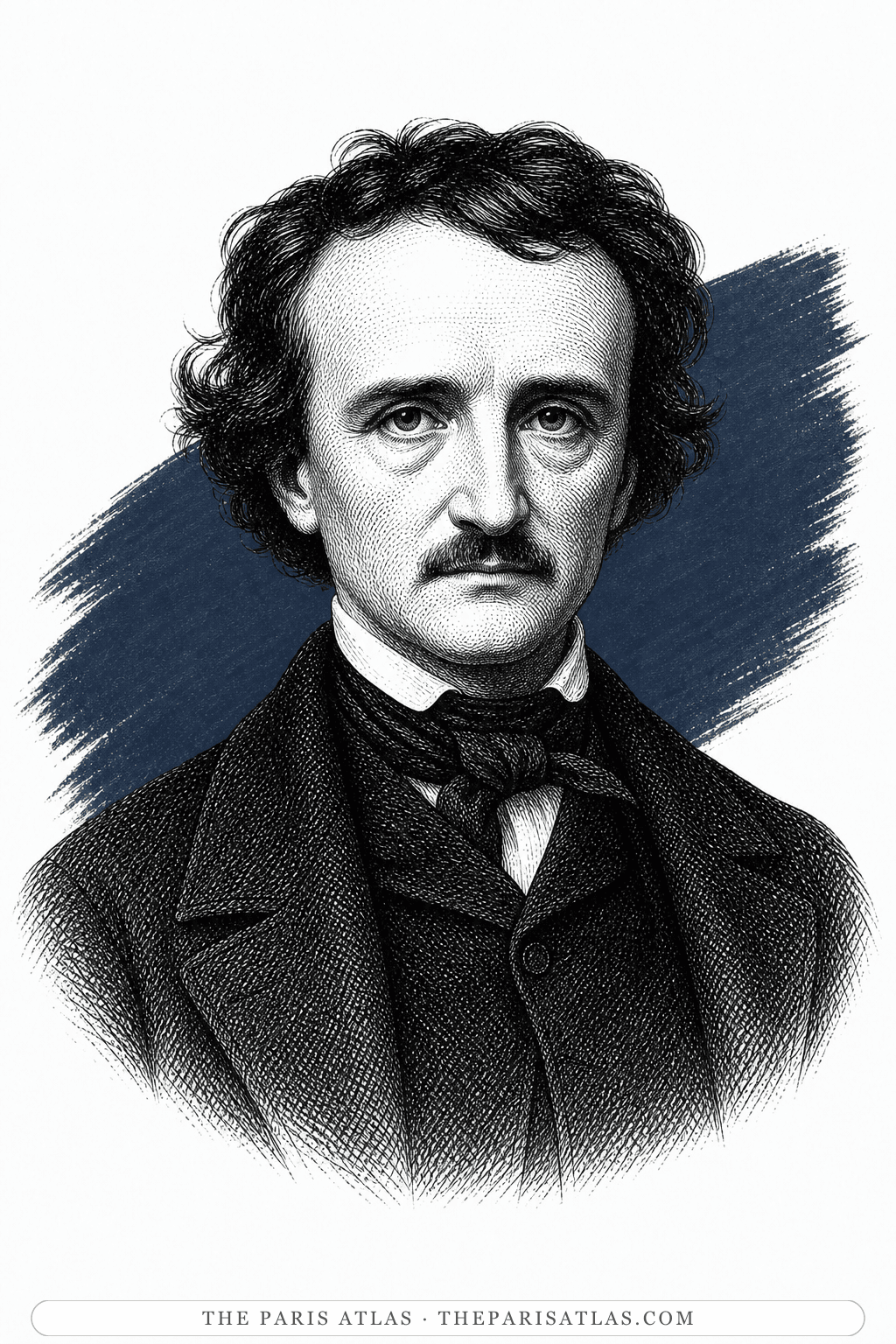
Illustrated portrait of Edgar Allan Poe
Edgar Allan Poe

3 books shelved

The story, briefly

Spoiler-free

Tales of the Grotesque and Arabesque collects twenty-five stories by Edgar Allan Poe in two volumes. Lea & Blanchard issued the set in 1839 with 1840 on its title pages. It includes The Fall of the House of Usher, William Wilson, and Ligeia, alongside tales that mock fashionable writing and mechanical progress. The collection shows how closely Poe's frightening and comic inventions could resemble one another.

The story, in more detail

The serious tales often begin with an account whose authority is already uncertain. William Wilson conceals his real name while explaining his downfall. The narrator of Ligeia remembers his first wife intensely but cannot establish basic facts about their meeting. In The Fall of the House of Usher, a visitor tries to understand an atmosphere of fear before he knows what has happened inside the house.

Other stories make exaggerated narration the joke. The Signora Zenobia seeks instruction in producing an impressive magazine article, learning to value extraordinary sensations and borrowed quotations. The Scythe of Time gives her a grotesquely literal opportunity to practice. The Man That Was Used Up delays a simple explanation of its celebrated general until the narrator sees him being assembled from artificial parts.

The title therefore covers more than a single Gothic mood. The preface defends deliberate composition and rejects the idea that Poe's terror merely imitates German writing. In the second volume, The Conversation of Eiros and Charmion moves beyond an individual household to imagine the destruction of the world. Its dialogue joins speculation about the atmosphere to an account told after death.

What's inside the original collection

Volume I contains fourteen stories, beginning with Morella and ending with the connected Signora Zenobia and Scythe of Time. William Wilson, The Man That Was Used Up, The Fall of the House of Usher, MS. Found in a Bottle, and Ligeia appear in this volume. Comic pieces sit among the accounts of obsession, death, and uncertain perception.

Volume II contains eleven stories, including Hans Phaall, Metzengerstein, Berenice, The Visionary, and The Conversation of Eiros and Charmion. An appendix discusses Hans Phaall; it is not an additional twenty-sixth story. The original tables of contents are useful when comparing later editions with different selections or revised titles.

This collection predates such stories as The Tell-Tale Heart, The Black Cat, and The Cask of Amontillado. Those familiar titles may appear in later Poe anthologies, but they do not belong to the original twenty-five-story set.

Quotes from Tales of the Grotesque and Arabesque

Quoted verbatim from the text, each line verified against its source.

These many pieces are yet one book.
Edgar Allan Poe, Tales of the Grotesque and Arabesque, Preface (1840 title-page date)
We have put her living in the tomb!
Edgar Allan Poe, The Fall of the House of Usher, in Tales of the Grotesque and Arabesque (1840 title-page date)

Why we recommend it

  1. The early stories in their original company

    Usher and Ligeia appear beside comic and experimental pieces. Reading across that range changes the impression left by a selection devoted only to horror.

  2. Different kinds of unreliable narration

    Concealed names, uncertain memories, evasive explanations, and exaggerated self-importance make each speaker's authority a question. The tales achieve different effects with those limitations.

  3. Poe examining the making of stories

    The preface argues for careful composition, while the Zenobia stories parody a recipe for sensational prose. Together they let readers compare a stated artistic purpose with a comic demonstration.

What this book explores

Inside the book

Selected works from this book, with notes on each.

The Fall of the House of Usher

A visitor enters the isolated home of Roderick and Madeline Usher. The reflected building, its fissure, and the visitor's growing alarm connect the house's condition with the family's collapse. A story read aloud becomes difficult to separate from sounds elsewhere in the mansion.

William Wilson

A narrator using a false name describes a rival who shares his name and repeatedly interrupts his conduct. The final confrontation makes resemblance impossible to dismiss. The narrator's language of persecution leaves readers to examine what the rival has actually prevented.

The Man That Was Used Up

A narrator admires a celebrated soldier but cannot obtain a direct account of his past. The eventual explanation turns praise of modern invention into a joke about a body reconstructed with manufactured parts. Repeated conversational interruptions delay the discovery.

Ligeia

A widower remembers his learned first wife and later watches over his second wife's body. His uncertain memory and altered perceptions complicate the apparent return he describes. Attention to hair, eyes, and bodily movement becomes his method of identification.

The Signora Zenobia and The Scythe of Time

These are two connected stories, later known as How to Write a Blackwood Article and A Predicament. Zenobia learns a formula for sensational writing, then narrates an encounter with a clock's moving hand. Her continued narration after bodily catastrophe exposes the absurdity of the formula.

The Conversation of Eiros and Charmion

Two speakers meet after death, and Eiros recounts the world's destruction during a comet's approach. Each stage changes how people interpret the danger. Scientific reassurance, temporary exhilaration, and final catastrophe unfold through a survivor's impossible retrospective account.

Timeline

  1. 1839

    Lea & Blanchard agrees to publish the collection. Its September 28 letter sets out the proposed arrangement with Poe.

  2. 1839–1840

    The two volumes appear in 1839 with 1840 on their title pages. By November 20, 1839, the publisher is already declining to buy Poe's copyright.

  3. 1984

    Library of America publishes Patrick F. Quinn's Poetry & Tales, the larger reading volume listed here.

Book editions

Hardcover
Hardcover
Lea & Blanchard
1839
Original two-volume collection of twenty-five tales. Both title pages are dated 1840; the set was already issued in 1839.
Hardcover edition cover
Hardcover
Library of America
1984
ISBN-13
9780940450189
Selected reading volume: Poetry & Tales, edited by Patrick F. Quinn, 1,408 pages. This is a larger chronological omnibus containing the stories in revised texts, not a facsimile of the original collection or its order.

Reader reviews

Loading reviews…

Tales of the Grotesque and Arabesque: frequently asked questions

Was Tales of the Grotesque and Arabesque published in 1839 or 1840?

It was issued in 1839 with 1840 printed on its title pages. The Poe Society places its likely appearance in early November 1839, and a November 20 publisher's letter confirms that publication had already occurred.

How many stories are in the original collection?

There are twenty-five: fourteen in Volume I and eleven in Volume II. The second volume also includes an appendix about Hans Phaall, which is not a twenty-sixth story.

Does it contain The Tell-Tale Heart?

No. The original collection predates The Tell-Tale Heart, The Black Cat, and The Cask of Amontillado. A modern anthology that includes those stories has a different selection.

Is the whole collection horror?

No. It combines Gothic terror with comic exaggeration, literary parody, and speculative stories. The Signora Zenobia and The Scythe of Time, for example, make a joke of sensational magazine writing.

Are The Signora Zenobia and A Predicament different stories?

The Signora Zenobia is the original collection's title for the story later called How to Write a Blackwood Article. Its companion, The Scythe of Time, later became A Predicament. The original volume presents the two connected pieces separately.

Which modern edition is listed?

The selected ISBN identifies Library of America's 1984 Poetry & Tales, edited by Patrick F. Quinn. It contains the stories within a much larger chronological collection and uses revised texts. It does not reproduce the original two-volume layout.

If you like Edgar Allan Poe

Explore authors with a similar voice, perspective, and influence.

  • Illustrated portrait of Louis-Ferdinand Céline

    Louis-Ferdinand Céline

    The doctor of the Paris slums who wrote the century's blackest, funniest novel — and changed the sound of French prose.

    View author
  • Illustrated portrait of Charles Bukowski

    Charles Bukowski

    American poet and novelist of Los Angeles rooming houses, racetracks and the post office, who quit his job to write when a publisher offered him a hundred dollars a month. He came to Paris once, in September 1978, drank his way through a live television book programme and walked off the set — and French television has been replaying it ever since.

    View author
  • Illustrated portrait of Simone de Beauvoir

    Simone de Beauvoir

    French writer and philosopher whose novels, memoirs, and social analysis examined freedom, gender, responsibility, aging, and the material conditions that shape a life.

    View author
References

References

The sources below include the primary text, editions, scholarship, archival materials, and other records that informed this page. They document Tales of the Grotesque and Arabesque, its publication, and its place in literary history.

  1. 1Tales of the Grotesque and Arabesque: First-Edition Bibliography

    Archive
    Edgar Allan Poe Society of Baltimore
    Used for

    Publication history, title-page date, and publisher correspondence.

    View source
  2. 2Tales of the Grotesque and Arabesque, Volume I (1840 title-page date)

    Archive
    Lea & Blanchard; transcription by the Poe Society, 1840
    Used for

    Original first-volume selection and primary passages for the reading guide.

    View source
  3. 3Tales of the Grotesque and Arabesque, Volume II (1840 title-page date)

    Archive
    Lea & Blanchard; transcription by the Poe Society, 1840
    Used for

    Second-volume selection, appendix, and final story.

    View source
  1. 4Preface to Tales of the Grotesque and Arabesque

    Essays
    Lea & Blanchard; transcription by the Poe Society, 1840
    Used for

    Poe's statement of purpose and the verified preface quotation.

    View source
  2. 5Edgar Allan Poe: Poetry & Tales

    Website
    Library of America, 1984
    Used for

    Selected omnibus's editor, contents, revised-text policy, ISBN, and length.

    View source
  3. 6Edgar Allan Poe: Poetry & Tales (Library of America No. 19): Edition Details

    Website
    MIT Press Bookstore
    Used for

    Publication date and bibliographic details for the selected omnibus.

    View source
i
Why these sources are here

The primary text is the baseline reference for every book page. Additional references document publication history, interpretation, and historical context where that evidence is available.

Explore more resources