
The Scarlet Letter
Nathaniel Hawthorne
The Scarlet Letter
The novel Hawthorne published the year before, also set among Massachusetts Puritans and their idea of sin.
Read our takeThe House of the Seven Gables
Nathaniel Hawthorne
A wizard's curse from the Salem witch trials hangs over a family house for two hundred years, until the last Pyncheons open a cent-shop.
The House of the Seven Gables is the novel Nathaniel Hawthorne wrote after The Scarlet Letter, published in Boston in 1851. In the 1690s Colonel Pyncheon has Matthew Maule hanged as a wizard and takes his land. Maule curses him from the scaffold, and the Colonel dies in his new house on the day it opens. A century and a half later the house belongs to Hepzibah Pyncheon, a poor, proud old woman who has to open a small shop in a front room. Her brother Clifford comes home after thirty years in prison, and their rich cousin, Judge Jaffrey Pyncheon, wants something from him. Hawthorne wrote the novel at Lenox in the Berkshire hills of Massachusetts. The book's title came from a real house in Salem that belonged to his cousin, now a museum.
Hawthorne began the book at Lenox in the autumn of 1850. On 1 October he told his publisher, James T. Fields, that he was no good for writing until after the first autumn frost. He tried out titles in his letters: The House of the Seven Gables, The Seven-Gabled House, simply The Seven Gables, or The Old Pyncheon House. He finished in January 1851 and put the manuscript on the express to Boston himself. He told Fields that he had no copy except the wildest scribble of a first draft.[1]
He thought it was better than The Scarlet Letter and expected it to be less popular. He also found it harder to write. The earlier book had been all in one tone, he wrote, while this one needed passages finished with the minuteness of a Dutch picture.[1] Henry James agreed that it was the longest and most elaborate of Hawthorne's American novels. He also found it less complete, more like a prologue to a great novel than a great novel itself.[2]
The preface, dated Lenox, 27 January 1851, sets out Hawthorne's idea of a romance. A novel, he wrote, aims at faithful detail about ordinary life. A romance may present the truth of the human heart under circumstances of the writer's own choosing. He also names the book's moral: the wrong-doing of one generation lives on into the next. He asks readers to treat the house and the family as imaginary, and not to look for them in Salem.[3]
The first chapter tells the family history. Colonel Pyncheon wants the plot of land owned by Matthew Maule, a poor man. During the witch trials he helps have Maule condemned as a wizard. At the gallows Maule points at the Colonel and says God will give him blood to drink. The Colonel builds a great seven-gabled house on Maule's land, and Maule's son works on it as a carpenter. On the day of the house-warming the Colonel is found dead in his chair, with blood on his beard. A deed to a vast tract of land in Maine is never found.[3]
In Hawthorne's own day the house is decaying on Pyncheon Street. Hepzibah Pyncheon, an old unmarried woman with no money, opens a cent-shop in a front room and serves her first customers in misery. Her young country cousin Phoebe arrives and turns out to be good at everything Hepzibah is bad at. A lodger named Holgrave, a young daguerreotypist with radical opinions, rents a room in one of the gables.[3]
Hepzibah's brother Clifford comes home, broken, after thirty years in prison for the death of their uncle. Phoebe looks after him. Their cousin Judge Jaffrey Pyncheon is a rich, smiling public man who hopes to be governor. He insists on seeing Clifford, because he believes Clifford knows where the uncle's hidden wealth is. Holgrave reads Phoebe a story he has written about Alice Pyncheon, a proud girl of an earlier generation. A carpenter named Matthew Maule puts her in a trance and humiliates her, and she dies after walking home through the snow.[3]
The Judge comes to the house and threatens to have Clifford shut up in a public asylum unless he talks. While Hepzibah fetches her brother, the Judge dies in the old Colonel's chair, of the same inherited disorder that killed his ancestor. Clifford and Hepzibah run away on a train in a panic and then come home. The uncle, it turns out, also died of that disorder thirty years earlier. The young Jaffrey had been searching his uncle's papers when it happened, and he arranged things so that Clifford was blamed.
Holgrave and Phoebe declare their love. He shows the others a spring behind the Colonel's portrait, and the portrait falls to reveal a recess with the lost Indian deed to the Maine lands, now worthless. Holgrave then tells Phoebe he is a descendant of Matthew Maule. His ancestor, the carpenter, hid the deed there while building the house. The Judge's fortune passes to Hepzibah, Clifford and Phoebe, and they all leave for the Judge's country house, taking old Uncle Venner with them.
The house that gave the book its title still stands on Turner Street in Salem. Captain John Turner, a sea captain and merchant, built it in 1668. Captain Samuel Ingersoll bought it in 1782, and it passed to his daughter Susanna, Hawthorne's cousin. The museum that runs it today says his visits to her house inspired the novel's setting and title.
Caroline Emmerton, a Salem philanthropist, bought the house in 1908. She had the architect Joseph Everett Chandler restore it to how it might have looked in the 1600s, partly guided by the novel. The house opened to the public in April 1910. Ticket money paid for a settlement house that helped immigrant families in the neighbourhood.
The novel annoyed some real people. In May 1851 Hawthorne told Fields that a Boston gentleman had written to complain. There had been a real Pyncheon family in Salem, and the man thought the book made his grandfather infamous. Hawthorne said he had never heard of them and had chosen the name because it suited the tone of the book.
Hawthorne's own ancestor John Hathorne was a magistrate at the Salem witch trials of 1692. George Parsons Lathrop, who edited Hawthorne's collected works, pointed out the link in his introduction to the novel. The record shows that Hathorne was especially harsh to one accused woman. Her husband said God would take revenge on her persecutors, and Lathrop found the family believed a curse had been laid on them.
Holgrave says the book's argument out loud. In Chapter XII he tells Phoebe that the past lies on the present like a giant's dead body. He complains that a dead man sits on every judge's seat, and that people live in dead men's houses. By the end he has fallen in love with a Pyncheon and agreed to live in the Judge's country house.
Émile Daurand Forgues, a Paris critic, discussed the novel in his 1852 essay on Hawthorne in the Revue des Deux Mondes. In his view it was perhaps not Hawthorne's best book. He thought it was the one that made most use of Hawthorne's own particular gift. Forgues's translation, La Maison aux sept pignons, was published in Paris by Hachette in 1865, in 371 pages.
A new French translation came out in Paris in 1945, from Nouvelles éditions latines. The translator was Marie Canavaggia. From 1936 until his death in 1961 she was the literary secretary of Louis-Ferdinand Céline, and she saw his manuscripts through to publication.
God will give him blood to drink!
It lies upon the Present like a giant’s dead body!
the wrong-doing of one generation lives into the successive ones, and, divesting itself of every temporary advantage, becomes a pure and uncontrollable mischief
the book may be read strictly as a Romance, having a great deal more to do with the clouds overhead than with any portion of the actual soil of the County of Essex.
The Turner-Ingersoll house on Turner Street in Salem, built in 1668, is open to visitors as The House of the Seven Gables.
He told his publisher he thought it better than The Scarlet Letter, though he did not expect it to be as popular.
Hepzibah's first morning behind the shop counter, and the narrator talking to the dead Judge in his chair, are among Hawthorne's best comic writing.
The curse at the heart of the book goes back to the trials of 1692, where Hawthorne's own ancestor John Hathorne was a judge.
The poor, proud old woman who lives alone in the house and opens a cent-shop in a front room. Her nearsighted scowl frightens people who do not know how kind she is.
Hepzibah's brother, a gentle lover of beautiful things, who comes home broken after thirty years in prison for a death he did not cause.
A cheerful young cousin from the country who comes to stay, runs the shop better than Hepzibah, and cares for Clifford.
A rich, smiling judge and candidate for governor. He let Clifford go to prison for a death he himself had witnessed, and now wants the family's hidden wealth.
The young daguerreotypist who lodges in one of the gables and talks about sweeping away the past. He turns out to be a descendant of Matthew Maule.
The Puritan founder of the family, who helped hang Matthew Maule as a wizard, built the house on his land, and died in his chair on the day it opened.
An old odd-job man of Pyncheon Street who calls himself a philosopher and plans to retire to the poorhouse, which he calls his farm.
1668
Captain John Turner builds the Salem house later known as The House of the Seven Gables.
1850
Hawthorne begins the novel at Lenox, Massachusetts, in the autumn, after The Scarlet Letter.
1851
He finishes it in January and signs the preface at Lenox on 27 January. Ticknor, Reed and Fields publish it in Boston.
1852
Émile Daurand Forgues discusses the novel in the Revue des Deux Mondes in Paris.
1865
Hachette publishes Forgues's French translation, La Maison aux sept pignons, in Paris.
1910
Caroline Emmerton opens the restored Salem house to the public in April.
1945
Marie Canavaggia's new French translation is published in Paris.


The Scarlet Letter
Nathaniel Hawthorne
The novel Hawthorne published the year before, also set among Massachusetts Puritans and their idea of sin.
Read our takeMosses from an Old Manse
Nathaniel Hawthorne
His stories of the 1840s, including "Young Goodman Brown", about a young man's night among the witches of Salem village.
Read our takeTwice-Told Tales
Nathaniel Hawthorne
His first collection, full of old Boston and Salem legends like the ones behind the Pyncheon curse.
Read our take
Arthur Miller's play about the Salem witch trials of 1692, the event behind Matthew Maule's curse.
Read our take
Edgar Allan Poe's stories include "The Fall of the House of Usher", another American tale of a doomed family and its house.
Read our takeAn old Salem family, the Pyncheons, living under a curse. In the 1690s Colonel Pyncheon had Matthew Maule hanged as a wizard and took his land, and Maule cursed him. In the 1850s the last Pyncheons are a poor old woman, her brother just out of prison, a young cousin, and a rich judge who wants the family's lost fortune.
Yes. The Turner-Ingersoll house on Turner Street in Salem, Massachusetts, was built in 1668 and belonged to Hawthorne's cousin Susanna Ingersoll. The museum there says his visits inspired the book's setting and title. The house has been open to the public since 1910.
Judge Pyncheon dies suddenly in the old Colonel's chair. Holgrave reveals he is a descendant of Matthew Maule and finds the lost land deed, now worthless, behind the Colonel's portrait. He and Phoebe plan to marry, and the family leaves the house for the Judge's country estate.
From the gallows Matthew Maule said that God would give Colonel Pyncheon blood to drink. The Colonel died in his chair with blood on his beard. Holgrave later explains that the family suffers from an inherited disorder that makes them choke on blood.
His preface says a novel aims at faithful detail about ordinary life. A romance may show the truth of the human heart under circumstances the writer chooses or invents. He also asks Salem readers to treat the family and the house as imaginary.
Through its translations. The Paris critic Émile Daurand Forgues wrote about the book in 1852 and translated it for Hachette in 1865. Marie Canavaggia, later known as Louis-Ferdinand Céline's secretary, published a new translation in Paris in 1945.
Explore authors with a similar voice, perspective, and influence.

The doctor of the Paris slums who wrote the century's blackest, funniest novel — and changed the sound of French prose.
View author
American novelist and composer whose expatriate fiction explores dislocation, unstable intimacy, fatalism, and North Africa.
View author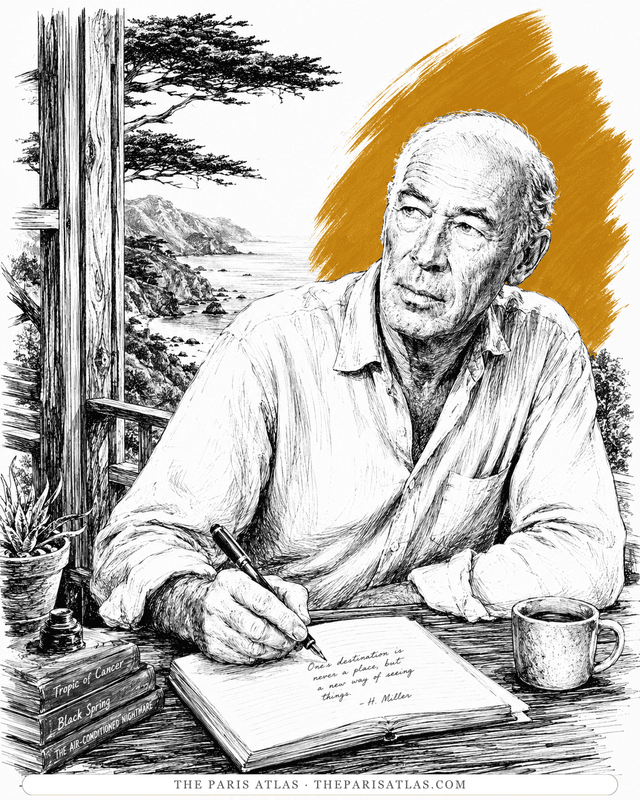
The Brooklyn dropout who arrived in Paris broke at thirty-eight and wrote the exuberant, banned books that ended American censorship.
View authorThe sources below include the primary text, editions, scholarship, archival materials, and other records that informed this page. They document The House of the Seven Gables, its publication, and its place in literary history.


Henry James's judgement of the novel.
The museum's history of the Turner-Ingersoll house, Susanna Ingersoll and Caroline Emmerton's restoration.
A scan of the 1851 Ticknor, Reed, and Fields first edition.

Émile Daurand Forgues's 1852 essay, as transcribed on French Wikisource.
The Bibliothèque nationale de France record for Forgues's 1865 translation.
The BnF record for Marie Canavaggia's 1945 translation, naming her as translator with her dates, 1896 to 1976.
For Marie Canavaggia's work as Céline's secretary.
Library catalogue records for every modern ISBN listed.
The primary text represented by this page, used for descriptions of the work’s contents and for any quoted passages shown here.
The primary text is the baseline reference for every book page. Additional references document publication history, interpretation, and historical context where that evidence is available.
 Explore more resources