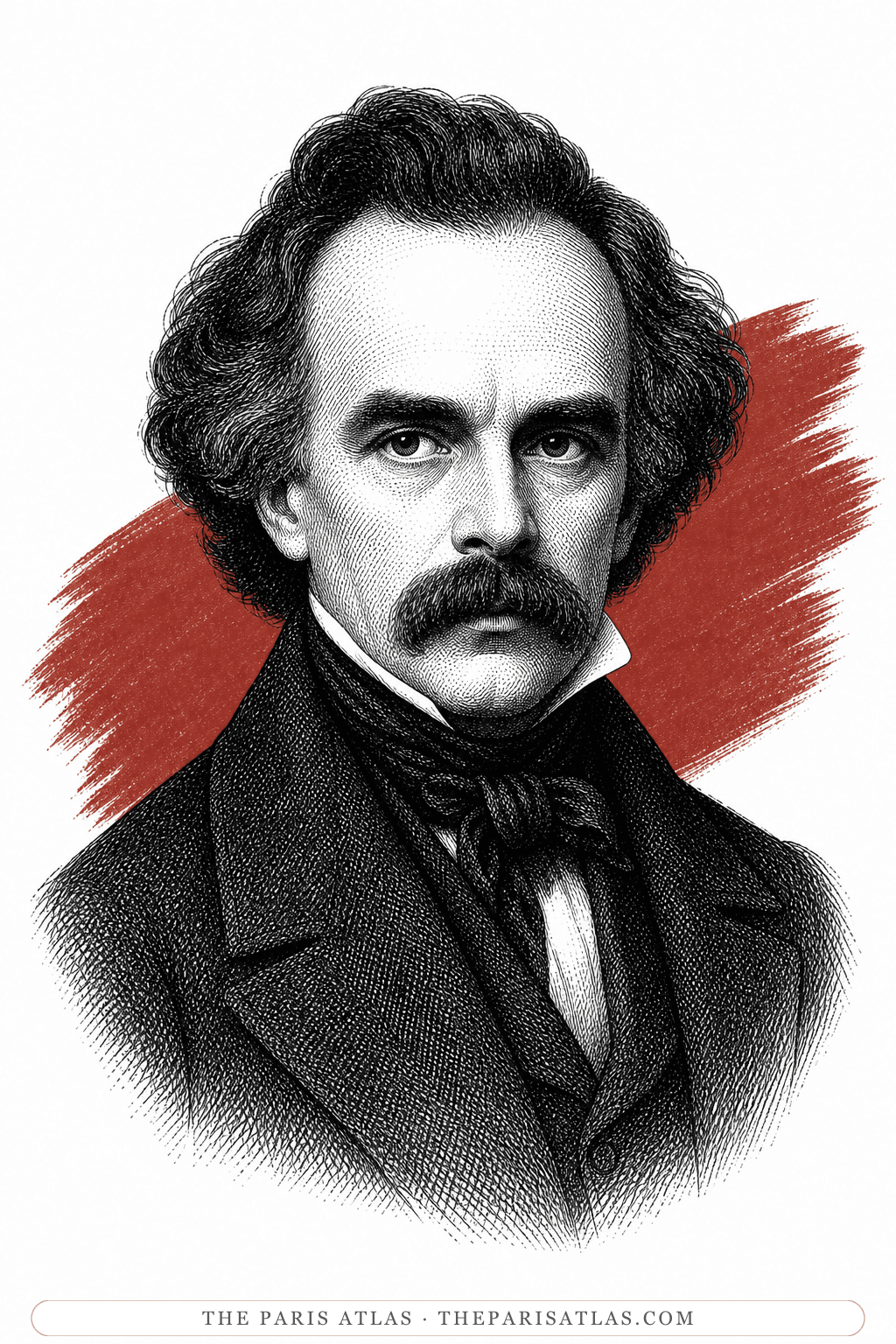
Young Goodman Brown
A young Puritan spends one night in the forest near Salem village and finds his neighbours, his minister and perhaps his wife at a witches' meeting.
Mosses from an Old Manse
Nathaniel Hawthorne
The collection that holds "Young Goodman Brown", a young Puritan's night in the forest among his neighbours at a witches' meeting.
Mosses from an Old Manse is Nathaniel Hawthorne's second collection of stories and sketches, published in New York in 1846. The title comes from the Old Manse in Concord, Massachusetts, the parsonage where he lived with his wife, Sophia, from 1842. The best-known story is "Young Goodman Brown". A young husband in Salem village leaves his wife, Faith, for one night in the forest and finds the town's most respected people at a witches' meeting. "Rappaccini's Daughter" is about a young student in Padua who falls in love with a girl raised among poisonous plants. In "The Birth-Mark" a scientist tries to remove a small mark from his wife's cheek. Herman Melville's review of the book, published anonymously in 1850, is one of the most famous pieces ever written about Hawthorne.
Hawthorne married Sophia Peabody in July 1842, and they rented the Old Manse in Concord. The house had been built in 1765 for the Reverend William Emerson, grandfather of Ralph Waldo Emerson. Emerson had written his book Nature in its small back study, and Hawthorne wrote in the same room. George Parsons Lathrop, who edited Hawthorne's works, recorded lines the couple scratched on the study window with a diamond in 1843. One, signed by Sophia, reads "Man's accidents are God's purposes."[1]
Several of the pieces were older and had appeared in magazines before he moved to Concord. The newer tales, such as "Rappaccini's Daughter" and "The Celestial Rail-road", first ran in the Democratic Review. Wiley and Putnam of New York published the book in two parts in 1846, just as the Hawthornes were leaving the Manse.[1][2]
The opening essay, "The Old Manse", describes the house, the river and the garden. At the end Hawthorne admits he had hoped to write a great book there and produced only these tales. He also notes that Providence has led him from the Old Manse into a custom house.[3] He had just become Surveyor of the port of Salem.[4] Ticknor and Fields published a revised edition in two volumes in 1854, adding "Feathertop".[5]
"Young Goodman Brown" is set in Salem village in Puritan times. Goodman Brown kisses his young wife, Faith, goodbye at sunset. She wears pink ribbons in her cap and begs him to stay home that night. He goes into the forest to keep an appointment with a traveller who carries a staff shaped like a black snake. On the path he is shocked to meet people he has trusted all his life. They include Goody Cloyse, the old woman who taught him his catechism, as well as the minister and Deacon Gookin. All are on their way to a meeting in the woods.[3]
In "Rappaccini's Daughter" Giovanni Guasconti, a young student at the University of Padua, looks down from his window into a strange garden. The garden belongs to Dr. Rappaccini, a scientist, whose beautiful daughter Beatrice tends the plants. Giovanni sees a lizard die when a drop from one of her flowers falls on it. He thinks he sees an insect die at her breath. He falls in love with her anyway. An older professor, Pietro Baglioni, warns him about her father.[3]
In "The Birth-Mark" a brilliant scientist named Aylmer marries the beautiful Georgiana. She has a small crimson mark on her cheek shaped like a tiny hand. He cannot stop looking at it, and she agrees to let him try to remove it. Among the other pieces are "The Celestial Rail-road", a comic update of The Pilgrim's Progress, and "Earth's Holocaust", in which the world burns everything it has outgrown on a great bonfire. "Roger Malvin's Burial" is about a man who leaves a dying friend in the wilderness, and "The Artist of the Beautiful" follows a watchmaker who builds a mechanical butterfly.[3]
At the meeting in the forest Brown finds Faith among the converts. A dark figure tells the two of them that evil is the nature of mankind. Brown cries out to Faith to look up to heaven and resist, and suddenly he is alone in the quiet forest. The story never says whether it was a dream. Brown goes home a stern, distrustful man, shrinks from his wife and his neighbours for the rest of his life, and dies in gloom.
Giovanni discovers that he too has become poisonous. He brings Beatrice an antidote from Baglioni and turns on her bitterly. She drinks it first. Because poison has been her life, the antidote kills her. Her last words ask Giovanni whether there was not more poison in his nature than in hers.
Aylmer's potion works. The mark fades from Georgiana's cheek, and she dies as it disappears.
The story works on two levels at once. Faith is the name of Brown's wife, and faith is also what he loses. When he finds one of her pink ribbons caught on a branch in the forest, he cries out that his Faith is gone. "There is no good on earth," he says, "and sin is but a name."
Brown learns that the devil knew his family well. The traveller says he helped Brown's grandfather lash a Quaker woman through the streets of Salem. He also helped Brown's father set fire to a Native American village in King Philip's War. Hawthorne's own ancestor John Hathorne was a judge at those trials.
The ending refuses to settle anything. The narrator asks whether Brown fell asleep in the forest and only dreamed of a witch-meeting. The answer is "Be it so if you will." Either way, the night ruins him. He can no longer hear a hymn without hearing sin in it, and he turns away from Faith for the rest of his life.
Herman Melville read the Mosses in the summer of 1850. On 5 August he met Hawthorne for the first time, at a picnic on Monument Mountain in the Berkshire hills. His essay "Hawthorne and His Mosses" ran in two parts in The Literary World in New York, on 17 and 24 August 1850. The essay was signed only "By a Virginian Spending July in Vermont".
Melville wrote that behind the sunny side of Hawthorne's writing there was a side shrouded in a blackness, ten times black. He traced its force to the Calvinist sense of innate depravity and original sin. He then compared Hawthorne with Shakespeare.
In the second part he admitted he had not yet read "Young Goodman Brown" when he started. He warned readers not to be fooled by the plain title, which sounded like a children's tale. He said the story was "deep as Dante".
Edgar Allan Poe was less kind. Reviewing the Mosses in Godey's Lady's Book in November 1847, he said Hawthorne was infinitely too fond of allegory. He told him to mend his pen, get a bottle of visible ink and come out from the Old Manse.
"Rappaccini's Daughter" first appeared in the Democratic Review in December 1844 under the heading "Writings of Aubépine". The story comes with a mock preface presenting it as a translation from a French author, M. de l'Aubépine. Aubépine is the French word for hawthorn.
The joke is in the details. The preface lists this French writer's works, and they are Hawthorne's own stories with French titles. Contes deux fois racontées is Twice-Told Tales, and Le Voyage Céleste a Chemin de Fer is "The Celestial Rail-road". The story itself is said to come from Beatrice; ou la Belle Empoisonneuse, published in an imaginary journal called La Revue Anti-Aristocratique. The preface also sets the Frenchman's few readers against the brilliant success of the Paris novelist Eugène Sue.
Paris took the pen name seriously. Writing in the Revue des Deux Mondes in 1852, the critic Émile Daurand Forgues told French readers that Hawthorne had published his first stories under the French pseudonym of a supposed M. de l'Aubépine. "Rappaccini's Daughter" and "The Birth-Mark" were translated in Paris in 1876, in Contes étranges, as "La Fille aux poisons" and "La Marque de naissance".
My Faith is gone! There is no good on earth; and sin is but a name. Come, devil; for to thee is this world given.
Evil is the nature of mankind. Evil must be your only happiness. Welcome again, my children, to the communion of your race.
they carved no hopeful verse upon his tombstone, for his dying hour was gloom.
Herman Melville said the story was "deep as Dante", and warned readers not to be fooled by its plain title.
"Young Goodman Brown", "Rappaccini's Daughter" and "The Birth-Mark" are all here, with lesser-known tales such as "Feathertop" and "The Artist of the Beautiful".
"Hawthorne and His Mosses" was written about this collection in 1850, the same summer the two writers met.
The preface to "Rappaccini's Daughter" presents Hawthorne as a neglected French author named M. de l'Aubépine, the French word for hawthorn.
A young Puritan spends one night in the forest near Salem village and finds his neighbours, his minister and perhaps his wife at a witches' meeting.
A student in Padua falls in love with a scientist's daughter who has been raised among poisonous flowers. First printed in the Democratic Review in December 1844.
A scientist cannot bear the one small mark on his wife's cheek and sets out to remove it.
The long opening essay about the Concord parsonage, its river and garden, and the three years the Hawthornes spent there.
A dream in which pilgrims travel to the Celestial City by train, on a railway built by people who find the old road too hard.
Reformers pile the world's titles, weapons, liquor and books onto one great bonfire on the western prairie.
A young man leaves his wounded companion to die in the woods, promises to return, and does not.
A watchmaker spends years building a perfect mechanical butterfly.
A witch brings a scarecrow to life and sends it courting. Added in the revised edition of 1854.
1842
Hawthorne marries Sophia Peabody in July and moves into the Old Manse in Concord.
1843
Hawthorne and Sophia scratch their names and a motto on a window of the study with a diamond.
1844
"Rappaccini's Daughter" appears in the Democratic Review in December, as a translation from the invented French author M. de l'Aubépine.
1846
Wiley and Putnam publish the book in New York in two parts, as the Hawthornes leave the Manse and he becomes Surveyor of the port of Salem.
1847
Edgar Allan Poe reviews it in Godey's Lady's Book and tells Hawthorne to come out from the Old Manse.
1850
Herman Melville's "Hawthorne and His Mosses" appears in The Literary World on 17 and 24 August.
1854
Ticknor and Fields publish a revised edition in two volumes, adding "Feathertop".
1876
"Rappaccini's Daughter" and "The Birth-Mark" appear in French in Contes étranges, published in Paris.


Twice-Told Tales
Nathaniel Hawthorne
Hawthorne's first collection, with "The Minister's Black Veil" and "Dr. Heidegger's Experiment".
Read our takeThe Scarlet Letter
Nathaniel Hawthorne
The novel he wrote four years later, taking the theme of "Young Goodman Brown", hidden sin in a Puritan town, to full length.
Read our takeThe House of the Seven Gables
Nathaniel Hawthorne
His Salem novel about a curse laid during the witch trials, the same world as Goodman Brown's forest.
Read our take
Arthur Miller's play about the Salem witch trials of 1692, set in the same village and the same world of Puritan fear.
Read our take
Edgar Allan Poe's stories. Poe reviewed the Mosses in 1847 and told Hawthorne to give up allegory.
Read our takeMosses from an Old Manse, Nathaniel Hawthorne's collection of 1846. The story is also printed in the Library of America volume Tales and Sketches.
A young Puritan leaves his wife, Faith, for a night in the forest near Salem village. There he finds the most respected people of the town, and apparently Faith herself, at a witches' meeting. He cries out to her to resist and suddenly finds himself alone.
Hawthorne does not say. The narrator asks whether Brown only dreamed it and answers, "Be it so if you will." Either way Brown becomes a stern, distrustful man who shrinks from his wife, and he dies in gloom.
A student in Padua, Giovanni, falls in love with Beatrice, whose scientist father has raised her among poisonous plants until she is poisonous herself. When Giovanni turns against her, she drinks an antidote and it kills her.
The Old Manse was the parsonage in Concord, Massachusetts, where Hawthorne lived with his wife from 1842. In the opening essay he describes the moss-grown old house. He presents the stories as things gathered there, some new and some much older.
Herman Melville, though it appeared anonymously in The Literary World in August 1850, signed "By a Virginian Spending July in Vermont". Melville had met Hawthorne for the first time at a picnic on 5 August.
Hawthorne himself. The preface to "Rappaccini's Daughter" pretends the story is translated from a French writer of that name. Aubépine is French for hawthorn, and the French titles it lists are Hawthorne's own stories.
Explore authors with a similar voice, perspective, and influence.
The doctor of the Paris slums who wrote the century's blackest, funniest novel — and changed the sound of French prose.
View author
American novelist and composer whose expatriate fiction explores dislocation, unstable intimacy, fatalism, and North Africa.
View author
The Brooklyn dropout who arrived in Paris broke at thirty-eight and wrote the exuberant, banned books that ended American censorship.
View authorThe sources below include the primary text, editions, scholarship, archival materials, and other records that informed this page. They document Mosses from an Old Manse, its publication, and its place in literary history.


George Parsons Lathrop's note on the Old Manse, the window inscriptions and where the stories first appeared.
A scan of the 1846 Wiley and Putnam first edition, for its publisher, date and contents.
For Hawthorne's post as Surveyor of the port of Salem from 1846.
A scan of the revised 1854 Ticknor and Fields edition, which prints the Aubépine preface and adds "Feathertop".

A scan of the magazine issue in which "Rappaccini's Daughter" first appeared, under the heading "Writings of Aubépine".
The first part of Herman Melville's essay, as printed in The Literary World.
The second part, with Melville on "Young Goodman Brown".
Edgar Allan Poe's review of the Mosses in Godey's Lady's Book, November 1847.
For John Hathorne's part in the Salem witch trials.
Émile Daurand Forgues's 1852 essay in the Revue des Deux Mondes, as transcribed on French Wikisource.
The contents of the 1876 Paris selection Contes étranges.
James T. Fields's account of the Monument Mountain picnic of 5 August 1850, with Hawthorne and Melville.
Larousse French-English dictionary, for aubépine meaning hawthorn.
Library catalogue records for every modern ISBN listed.
The primary text represented by this page, used for descriptions of the work’s contents and for any quoted passages shown here.
The primary text is the baseline reference for every book page. Additional references document publication history, interpretation, and historical context where that evidence is available.
 Explore more resources