Tales
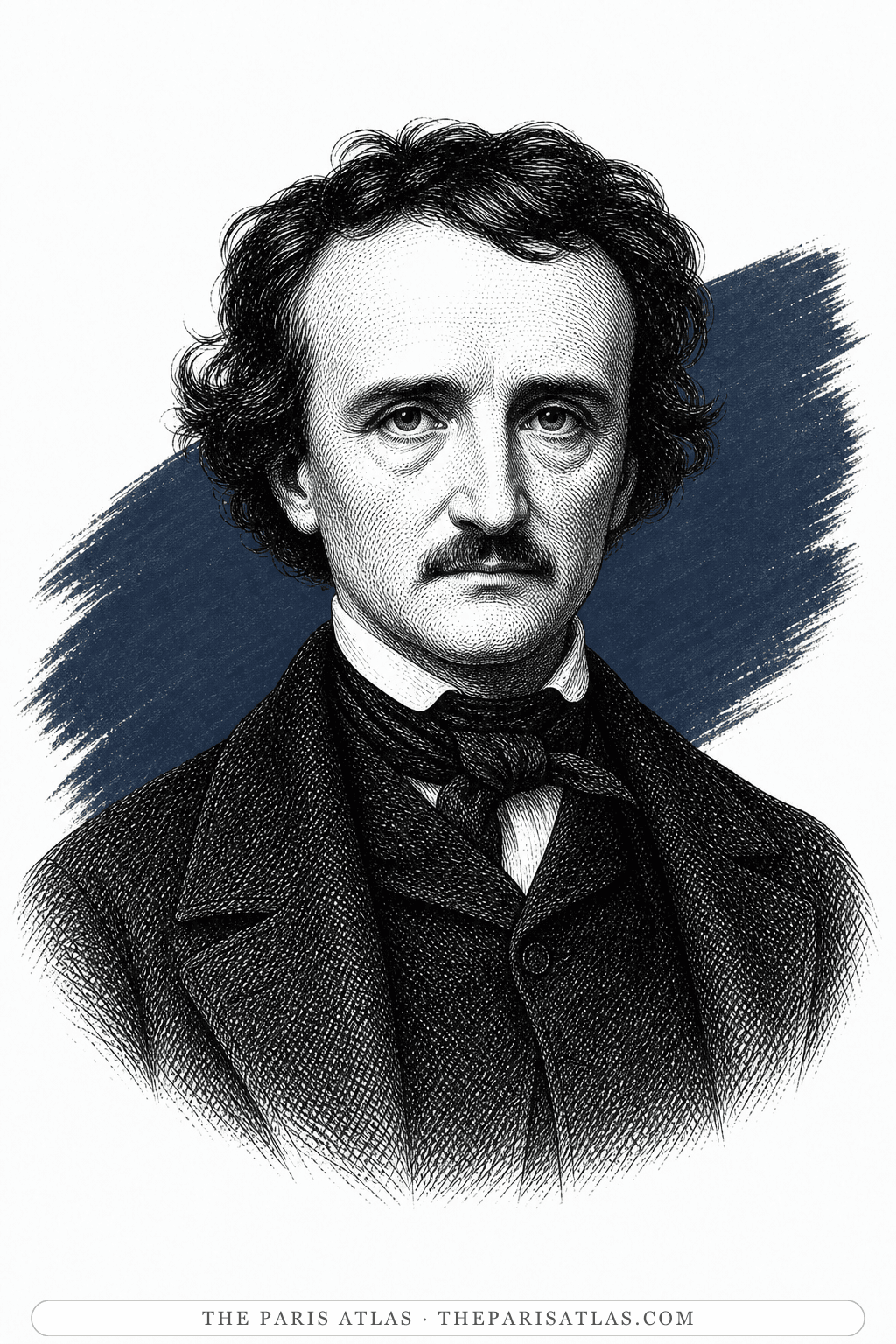
Edgar Allan Poe
Tales
Poe's 1845 collection, which prints this story beside the two later Dupin stories, The Mystery of Marie Rogêt and The Purloined Letter.
Read our takeThe Murders in the Rue Morgue
Edgar Allan Poe
Two women are killed in a locked room on a Paris street that does not exist, and a poor young reader named C. Auguste Dupin works out how.
The Murders in the Rue Morgue is Edgar Allan Poe's story of a double killing in a locked fourth-floor room in Paris, and of the man who solves it by thinking. C. Auguste Dupin is a poor young gentleman who reads all day and walks the city at night. The police arrest the wrong man, and Dupin finds the answer in details they ignored. Poe published the story in Graham's Magazine in Philadelphia in April 1841. The story is usually called the first modern detective story. Poe never went to Paris, and there is no Rue Morgue.
Poe was an editor at Graham's Magazine in Philadelphia when he wrote the story. The story ran in the April 1841 issue, which went on sale in the middle of March. The manuscript survives in the Free Library of Philadelphia. The manuscript has more crossings-out than most of Poe's, and Thomas Ollive Mabbott, who edited the standard scholarly edition of Poe's tales, concluded that Poe wrote the story in a hurry.[1]
In July 1843 a Philadelphia publisher, William H. Graham, brought the story out as a thin book in paper covers. The Prose Romances of Edgar A. Poe, No. I cost twelve and a half cents and held two stories, this one and The Man That Was Used Up. No second number ever appeared. About fourteen copies survive, and one sold at Christie's in December 2000 for $259,000.[2] Poe collected the story again in Tales in 1845, with many small revisions.[2][3]
Poe had never been to Paris. After a childhood stay in England and Scotland he never left the United States again.[4] His Paris is built from real names used loosely. The Palais Royal, the Théâtre des Variétés and the Jardin des Plantes are real, and so are the Rue Montmartre, the Rue Richelieu and the Rue St. Roch. Mabbott notes that Poe borrowed those street names "with little regard for geography."[1]
The Rue Morgue itself is invented, and named after the Paris mortuary. In the manuscript Poe first called it the Rue Trianon, and he changed the name when the story was almost finished. Mabbott thought Dupin's unusual first names came from C. Auguste Dubouchet, a man Poe knew who was looking for work as a French teacher. The surname probably came from André-Marie-Jean-Jacques Dupin, a French politician Poe had read about in a book he reviewed in the same issue of Graham's.[1]
The story opens with a few pages on what Poe calls the analytical mind, and on why a good whist player notices more than a good chess player. Then the narrator, a visitor to Paris, explains how he met Dupin. The two were hunting for the same rare book in a small library in the Rue Montmartre. They took a crumbling old house together in the Faubourg St. Germain, kept the shutters closed all day, and went out walking at night.[5]
One night Dupin answers a thought the narrator never said out loud, about a cobbler named Chantilly who had tried to become a tragic actor. Dupin then retraces every step of his friend's thinking over the last fifteen minutes. The chain began when a fruit-seller knocked the narrator onto a pile of paving stones.[5]
Soon afterwards the evening paper reports a horror in the Rue Morgue. At three in the morning neighbours heard shrieks from the fourth floor of a house belonging to Madame L'Espanaye, who lived there with her daughter Camille. They broke in and found the back room wrecked and locked from inside. A bloody razor lay on a chair, and thick grey hair torn out by the roots lay on the hearth. Nearly four thousand francs in gold were still on the floor in two bags.[5]
The daughter's body had been forced head downwards up the chimney. The mother lay in the yard behind the house, her throat cut so deeply that her head fell off when she was lifted. On the stairs, the neighbours had heard two voices. One was a gruff Frenchman swearing. The other was shrill, and every witness took it for a different foreign language, one he did not speak himself.[5]
The police arrest Adolphe Le Bon, the bank clerk who delivered the gold three days earlier. Dupin once owed Le Bon a favour, so he gets permission from the Prefect of Police to see the house. He studies the street, the back of the building and the rooms, and says nothing until the next day. Then he explains his reasoning while waiting, pistols ready, for a visitor he expects to answer a newspaper advertisement.[5]
Dupin shows that the murderer left by a window at the back. A hidden spring made the window lock itself, and the nail that seemed to hold it shut had been broken long before. Only a climber of astonishing agility could have reached the window from the lightning rod by swinging on a wide open shutter. The gold was left behind, so there was no motive. From Madame L'Espanaye's clenched fingers Dupin has taken a tuft of tawny hair that is not human. He then shows the narrator a passage by the French naturalist Georges Cuvier about the orangutan of the East Indies.
At the foot of the lightning rod Dupin found a greasy ribbon tied in a sailor's knot. His advertisement in Le Monde, a shipping paper, says that a large orangutan has been caught in the Bois de Boulogne and can be claimed by its owner, a sailor from a Maltese ship. The sailor comes. Dupin locks the door, lays a pistol on the table and tells him he knows he is innocent of the killings.
The sailor had brought the ape back from Borneo to sell. He came home to find it at his mirror with his razor, copying the way he shaved. The ape ran into the street, climbed the lightning rod and swung into Madame L'Espanaye's lit window. The sailor, clinging to the rod, watched it wave the razor at her like a barber and then kill Madame L'Espanaye and her daughter. When the ape saw its master's face at the window, it panicked. The ape pushed the daughter up the chimney and threw the mother out of the window. The gruff voice on the stairs was the sailor crying out in horror.
Le Bon is released. The sailor catches the ape himself and sells it for a large sum to the Jardin des Plantes. The Prefect of Police, annoyed, remarks that people should mind their own business. Dupin lets him talk, and says the Prefect is "somewhat too cunning to be profound."
Dupin's first clue is a disagreement. A Frenchman, an Englishman, a Spaniard, an Italian and a Dutchman all heard the shrill voice, and each was sure it belonged to a foreigner. Dupin notices that each man named a language he could not speak. The police saw confused witnesses. Dupin saw a voice that no one could place, with no words in it at all.
He tells the narrator that the police have mistaken the unusual for the difficult. A strange crime, in his view, is easier to solve than an ordinary one, because the strangeness points the way. The mind-reading scene with the fruit-seller at the start of the story is practice for this. Dupin follows small, physical facts one at a time until they add up.
Mabbott traced the method to Voltaire's Zadig, whose hero describes a dog he has never seen from its tracks in the sand. Poe himself was modest about it. In a letter of August 1846 to his friend Philip Pendleton Cooke, he asked where the cleverness was in "unravelling a web which you yourself (the author) have woven for the express purpose of unravelling."
Almost every part of the later detective story is already here. The detective is an amateur genius, and a loyal friend tells the story and never quite keeps up. The police are busy but wrong, and an innocent man is locked up. The crime happens in a room locked from inside, and the solution is explained at the end.
Mabbott was careful about the claim. He wrote that the story "may not be the first detective story, but it is the first story deliberately written as such to attain worldwide popularity." Poe wrote two more Dupin stories, The Mystery of Marie Rogêt and The Purloined Letter, and collected all three in Tales in 1845.
French readers saw the change early. On 16 July 1856, after reading Poe, the brothers Edmond and Jules de Goncourt wrote in their journal that his stories showed "a new literary world." In their view the interest of the story had moved "from the heart to the head."
The story reached Paris in 1846 without Poe's name on it. Gustave Brunet printed one adaptation in the newspaper La Quotidienne in June. The critic E. D. Forgues printed another in Le Commerce in October. Two days later the paper La Presse pointed out the likeness as if one had copied the other.
Forgues answered that his source was an American writer, Edgar Poe. He then sued La Presse, and a court threw the case out on 9 December 1846. Mabbott wrote that the quarrel gave Poe's name more publicity in France. On 31 January 1847 Isabelle Meunier published a shortened translation that did name Poe, in the paper La Démocratie pacifique.
In 1856 Charles Baudelaire put the story first in Histoires extraordinaires, his volume of Poe's tales for the Paris publisher Michel Lévy. He called it Double assassinat dans la rue Morgue, and dedicated the book to Maria Clemm, Poe's aunt and mother-in-law. In a footnote to the translation Baudelaire asked whether he really needed to point out that Poe had never come to Paris.
Books, indeed, were his sole luxuries, and in Paris these are easily obtained.
Truth is not always in a well.
The depth lies in the valleys where we seek her, and not upon the mountain-tops where she is found.
Dupin and the friend who tells his story are the first of a long line of such pairs, decades before Sherlock Holmes and Dr Watson or Hercule Poirot and Captain Hastings.
The clues are all on the page before Dupin explains them: the voice no witness can place, the gold left on the floor, the nail and the shutter.
Real places like the Palais Royal and the Jardin des Plantes sit beside a street Poe made up and named after the mortuary.
The story can be read in an evening, and the complete 1845 text is free on the Edgar Allan Poe Society of Baltimore's website.
A young Parisian from a good family, now poor, who reads all day and walks the city at night. Solves the case from the newspapers, the witnesses and one visit to the house.
Dupin's unnamed friend and housemate, a visitor to Paris. Tells the story, pays the rent and never guesses the answer.
A big, sunburnt French sailor who answers Dupin's advertisement. Knows more about the killings than anyone else in Paris.
An old woman who owns the house in the Rue Morgue and is said by neighbours to tell fortunes. Withdrew four thousand francs in gold three days before her death.
Madame L'Espanaye's daughter, who lived with her mother in near-total seclusion. A neighbour had seen her only five or six times in six years.
The head of the Paris police, who knows Dupin and lets him see the house. Not pleased to be beaten.
The bank clerk who carried the gold to the house and is arrested for the murders. Dupin owes him a favour.
1841
The story appears in the April issue of Graham's Magazine in Philadelphia, on sale in the middle of March.
1843
William H. Graham of Philadelphia publishes it as a book, The Prose Romances of Edgar A. Poe, No. I, priced at twelve and a half cents.
1845
Poe collects it, revised, in Tales, published in New York by Wiley and Putnam with the two other Dupin stories.
1846
Two adaptations in Paris newspapers, printed without Poe's name, lead to a quarrel over plagiarism and a lawsuit, dismissed on 9 December, that spreads Poe's name in France.
1847
Isabelle Meunier's shortened French translation, crediting Poe, appears on 31 January in La Démocratie pacifique.
1856
Charles Baudelaire's translation, Double assassinat dans la rue Morgue, opens Histoires extraordinaires, published in Paris by Michel Lévy.
2000
A copy of the 1843 Prose Romances sells at Christie's on 14 December for $259,000.

Tales
Edgar Allan Poe
Poe's 1845 collection, which prints this story beside the two later Dupin stories, The Mystery of Marie Rogêt and The Purloined Letter.
Read our take
Poe's first collection of stories, from 1840, a year before Dupin, with The Fall of the House of Usher.
Read our take
Voltaire's tale of a wise man who reads the tracks of a dog he has never seen. Mabbott named its hero as the source of Dupin's method.
Read our take
Agatha Christie's first Hercule Poirot mystery, narrated by his admiring friend Captain Hastings, the same arrangement as Dupin and his narrator.
Read our takeNo. Poe made it up and named it after the Paris mortuary. The manuscript first called it the Rue Trianon, and Poe changed the name when the story was nearly finished.
No. After a childhood stay in England and Scotland, Poe never left the United States again. His Paris came from books, and Charles Baudelaire said so in a footnote to his French translation.
The story is usually called the first modern one. Thomas Ollive Mabbott, who edited Poe's tales, wrote that it "may not be the first detective story, but it is the first story deliberately written as such to attain worldwide popularity."
The detective of the story: a young Parisian from a good family, now poor, who reads all day and walks the city at night. He solves the case by reasoning from small facts the police ignored. He returns in The Mystery of Marie Rogêt and The Purloined Letter.
Yes. In July 1843 William H. Graham of Philadelphia published it with The Man That Was Used Up as The Prose Romances of Edgar A. Poe, No. I, for twelve and a half cents. Poe collected it again in Tales in 1845.
Two Paris newspapers printed versions without Poe's name in 1846, which led to a public quarrel over plagiarism. Isabelle Meunier's translation, crediting Poe, followed in January 1847. Charles Baudelaire's translation opened his Histoires extraordinaires in 1856.
Explore authors with a similar voice, perspective, and influence.

The doctor of the Paris slums who wrote the century's blackest, funniest novel — and changed the sound of French prose.
View author
The Brooklyn dropout who arrived in Paris broke at thirty-eight and wrote the exuberant, banned books that ended American censorship.
View author
American poet and novelist of Los Angeles rooming houses, racetracks and the post office, who quit his job to write when a publisher offered him a hundred dollars a month. He came to Paris once, in September 1978, drank his way through a live television book programme and walked off the set — and French television has been replaying it ever since.
View authorThe sources below include the primary text, editions, scholarship, archival materials, and other records that informed this page. They document The Murders in the Rue Morgue, its publication, and its place in literary history.


Thomas Ollive Mabbott's introduction and notes: the manuscript, the invented street, Dupin's name, Zadig, the Paris quarrel of 1846, and Baudelaire's footnote.

Title page and contents of Tales (1845), where the story was collected with the other Dupin tales.
The Poe Society's chronology, for Poe's time in Philadelphia and the fact that he never went to France.
The Bibliothèque nationale de France record of Baudelaire's Histoires extraordinaires, with its dedication and contents.
Publisher's page for the Modern Library edition: ISBN, date, length and introduction.
Catalogue record confirming the same ISBN and edition.
The primary text is the baseline reference for every book page. Additional references document publication history, interpretation, and historical context where that evidence is available.
 Explore more resources