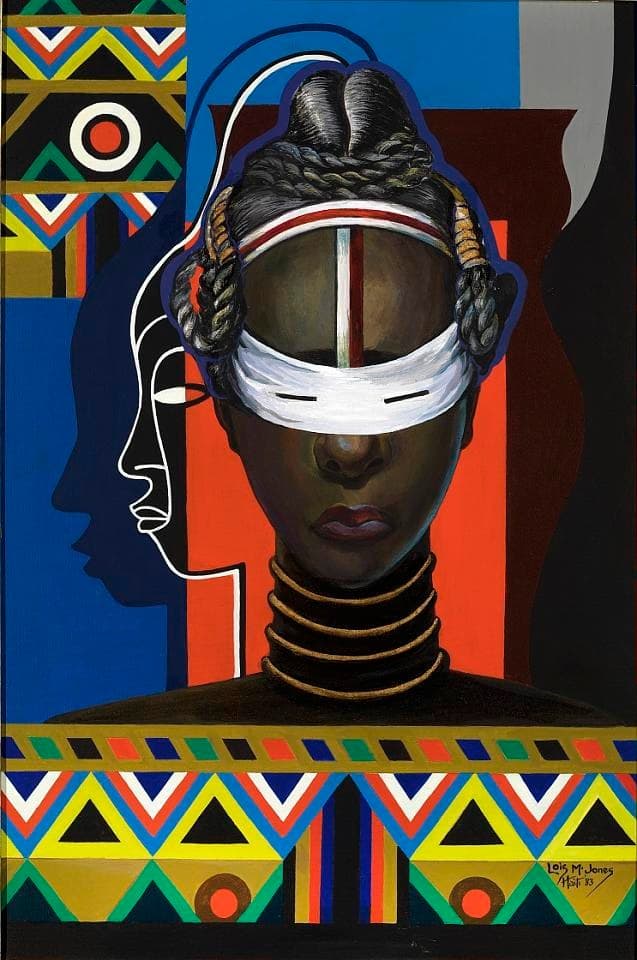
Painting · Late Pan-African period
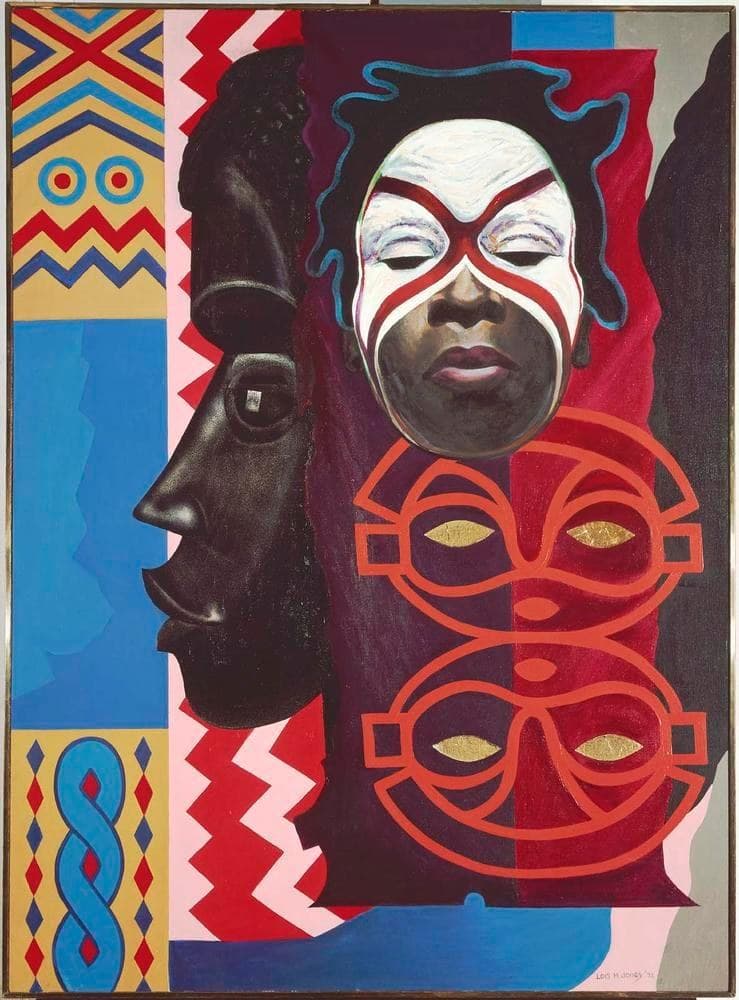
Initiation, Liberia
Masked figures and hard-edged pattern drawn from Liberian initiation traditions, painted at seventy-seven — Jones's late style at full strength, now in the Smithsonian American Art Museum.
Boston-born painter and Howard University professor for forty-seven years, whose 1937–38 year at the Académie Julian in Paris produced Les Fétiches and opened a seven-decade career spanning French landscape, African design and Haitian colour.
Loïs Mailou Jones painted across seven decades: New England watercolours, Paris streets, African masks, Haitian markets. All the while she taught design and painting at Howard University, from 1930 to 1977, and generations of Black American artists passed through her classroom.
Paris was the hinge. On sabbatical in 1937–38 she studied at the Académie Julian, worked at her easel along the Seine, and painted Les Fétiches, the oil of five African masks now in the Smithsonian American Art Museum. She described the French year as her first taste of working free of the daily racial discrimination that hemmed her American career, and she returned to France for the rest of her life.[1]
Jones was born in Boston on 3 November 1905, to a building superintendent who became a lawyer and a cosmetologist mother, and trained at the School of the Museum of Fine Arts in Boston. She began not as a painter but as a textile designer — successful and anonymous, since the firms that bought her patterns had no idea of, or interest in, the designer's race. Wanting her name on her work, she turned to painting and teaching.[2]
In 1930 she joined the art department of Howard University in Washington, D.C., and stayed forty-seven years, teaching design and watercolour until 1977. The position made her one of the most influential art teachers in Black America: her students went on to careers across painting, design and academia, and her own work anchored the university's place in twentieth-century American art.[2]
A sabbatical fellowship took her to Paris in 1937, to the Académie Julian — the private academy that had trained generations of foreigners the École des Beaux-Arts excluded. She painted the city and the French countryside en plein air, exhibited in Paris salons, and later said the year gave her a freedom to work and be judged as a painter that the segregated United States had never offered.[3]
The year's landmark is Les Fétiches (1938): five African masks turning in a dark space, painted at the moment Paris modernism and the Négritude movement were both looking hard at African art. It is now in the Smithsonian American Art Museum, and it marks the turn in her work from French landscape toward the African design vocabulary she developed for the rest of her career.[1]
In 1953 she married the Haitian graphic designer Louis Vergniaud Pierre-Noël, and Haiti's colour and pattern entered her painting for good. From the 1970s she travelled and taught across Africa, folding textile pattern, mask forms and saturated colour into large canvases. She kept painting into her nineties and died in 1998, aged ninety-two, with work in the Smithsonian, the National Museum of Women in the Arts, and museums across the United States.[2][3]
Born in Boston on 3 November.
Joins the art faculty of Howard University in Washington, D.C.
Sails for Paris on sabbatical to study at the Académie Julian.
Paints Les Fétiches, five African masks in a dark space, now in the Smithsonian American Art Museum.
Marries the Haitian designer Louis Vergniaud Pierre-Noël; Haitian colour enters her work.
Retires from Howard after forty-seven years of teaching.
Dies at ninety-two.
Painting · Late Pan-African period
Masked figures and hard-edged pattern drawn from Liberian initiation traditions, painted at seventy-seven — Jones's late style at full strength, now in the Smithsonian American Art Museum.
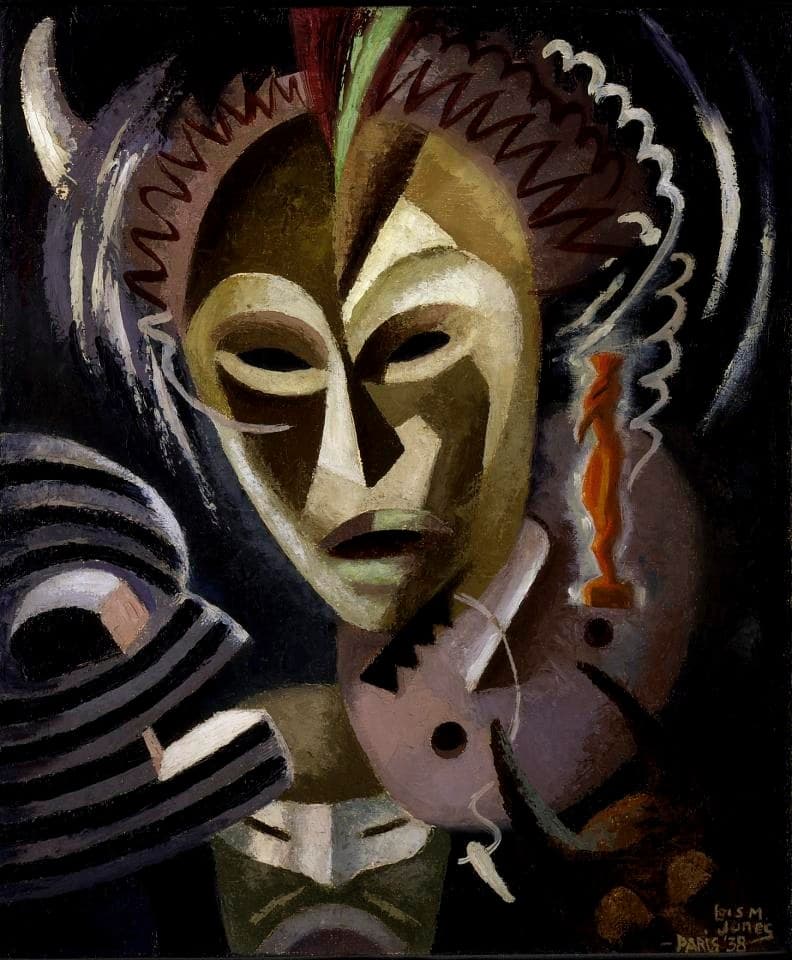
Painting · Paris modernism and the Négritude years
Five African masks turning through a dark void, painted in Paris in 1938 during Jones's Académie Julian year. Now in the Smithsonian American Art Museum, it marks the turn of her career toward African design.
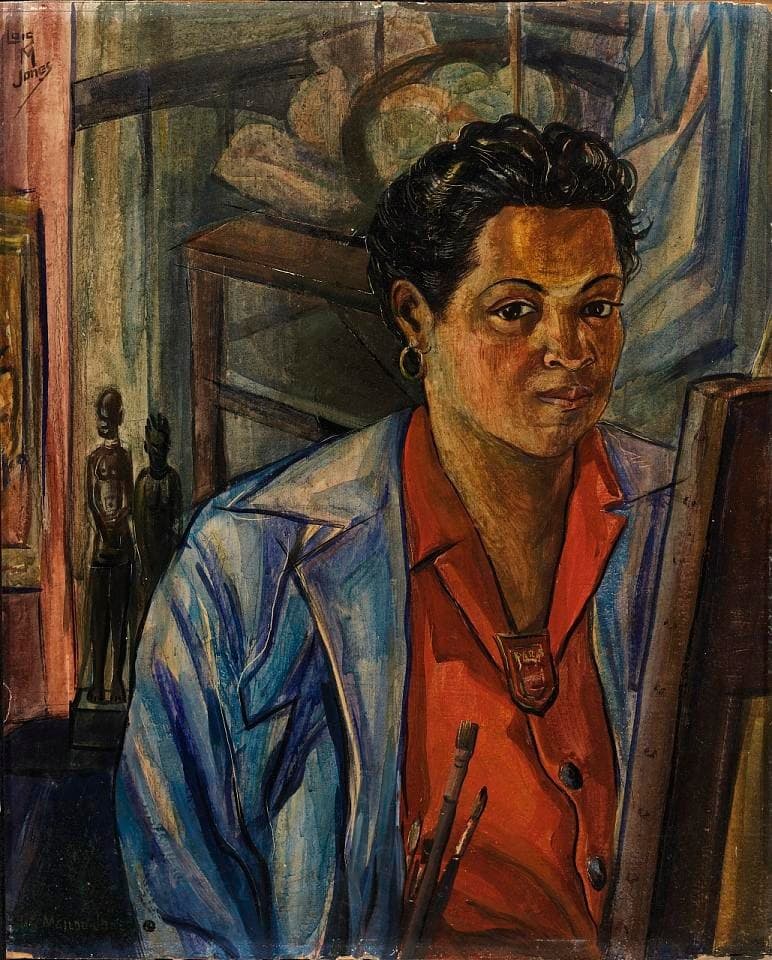
Painting · Between Paris and Howard
Jones at thirty-four, brushes in hand at the easel — painted in 1940, two years after her Paris breakthrough. Now in the Smithsonian American Art Museum.
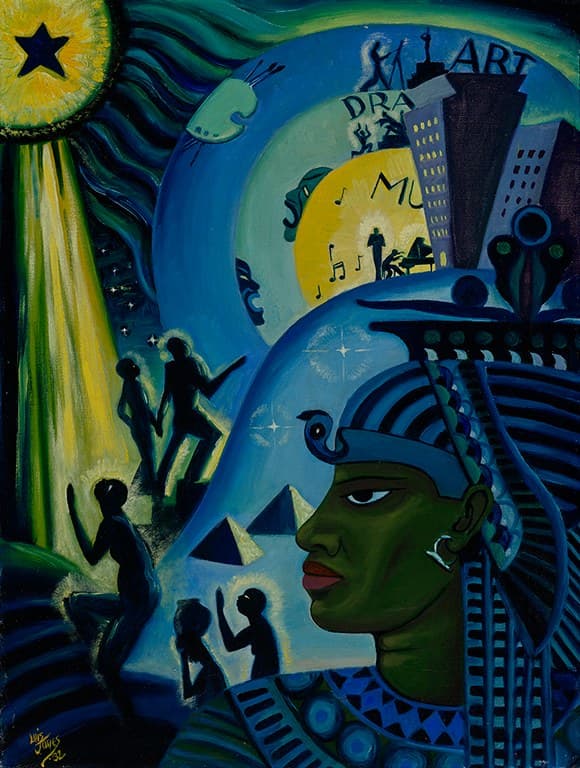
Painting · Harlem Renaissance
Jones's 1932 vision of Black history as one ascending line — from an Egyptian profile at the base to music, drama and art shining in the modern city. Now in the Milwaukee Art Museum.
Painting · Pan-African period
A young woman's face painted for initiation, set beside Congolese masks and bold pattern — the centrepiece of Jones's post-1970 African canvases, now at the Museum of Fine Arts, Boston.
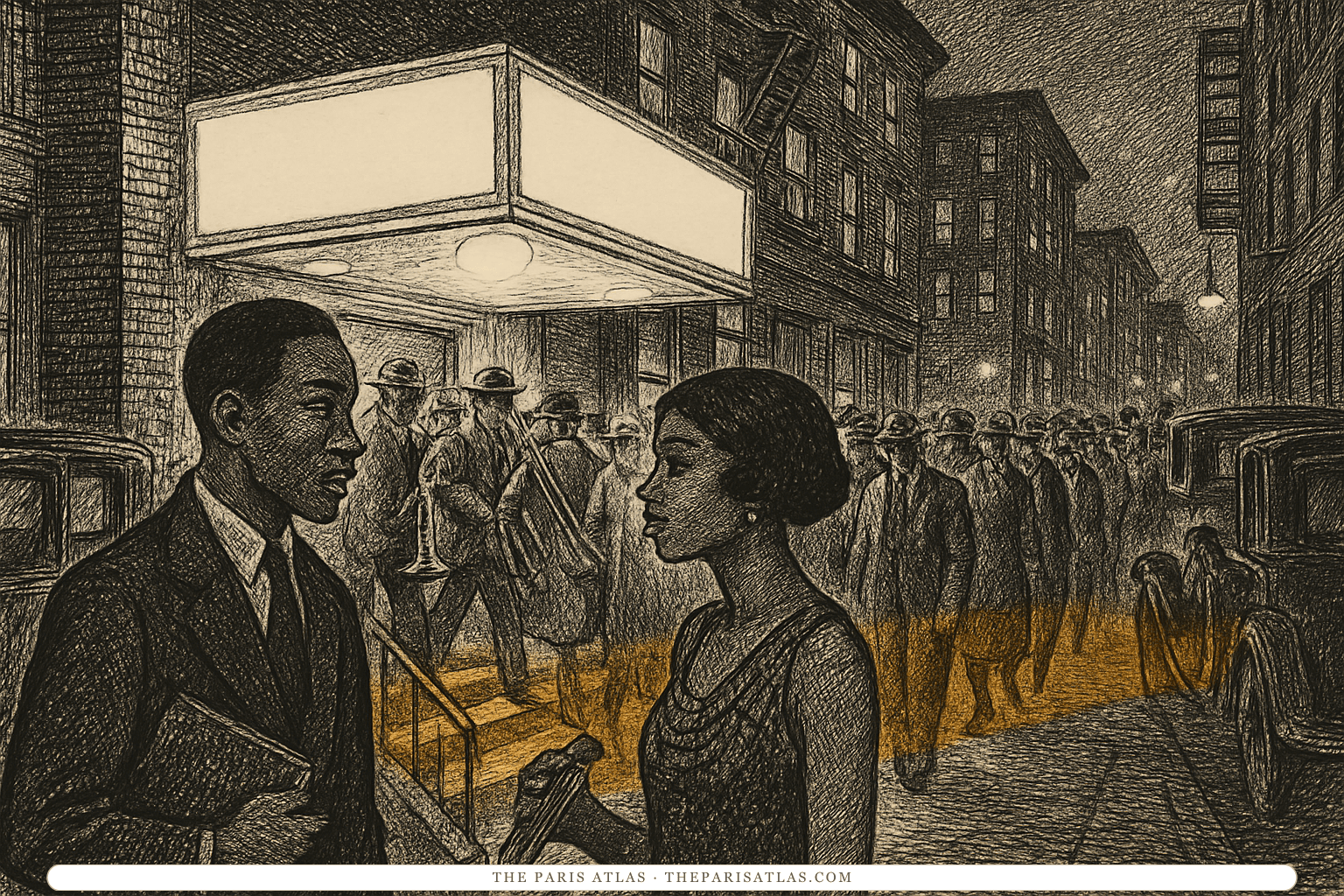
Cultural movement · c. 1918 – mid-1930s
Jones spent formative summers in Harlem as the movement rose, and museums including the Studio Museum in Harlem present her among its artists; she outlived virtually all of her Harlem Renaissance contemporaries.
For a seven-decade painting career that moved from New England watercolours through Paris landscapes to canvases built on African mask forms and Haitian colour. She also taught at Howard University from 1930 to 1977, shaping generations of Black American artists. Les Fétiches (1938) is her most famous single painting.
An oil painting Jones made in Paris in 1938: five African masks turning through a dark space, painted during her Académie Julian year at the moment modernism and the Négritude writers were both engaging African art. It belongs to the Smithsonian American Art Museum in Washington, D.C.
A sabbatical fellowship from Howard University took her to the Académie Julian for 1937–38. She painted outdoors across the city and countryside, showed in Paris salons, and described the year as her first experience of being received simply as a painter, free of the discrimination that framed her career at home.
At Howard University in Washington, D.C., from 1930 to 1977 — forty-seven years of design and watercolour teaching that made her one of the most influential art educators in the country.
The Smithsonian American Art Museum holds Les Fétiches and other works; the National Museum of Women in the Arts in Washington also collects her, as do American museums from Boston to Atlanta. Her scrapbooks are in the Smithsonian's Archives of American Art.
Associated with
Jones spent formative summers in Harlem as the movement rose, and museums including the Studio Museum in Harlem present her among its artists; she outlived virtually all of her Harlem Renaissance contemporaries.
The sources below include biographies, scholarly essays, interviews, and primary materials that informed this page. They reflect both the historical record and ongoing critical conversations about Loïs Mailou Jones and their work.

Web source consulted for documented facts and historical context presented on the Loïs Mailou Jones page.
These references anchor the page in the documented record and in the scholarly conversations around Loïs Mailou Jones. Every claim on this page traces back to one or more of the works listed here.
 Explore more resources