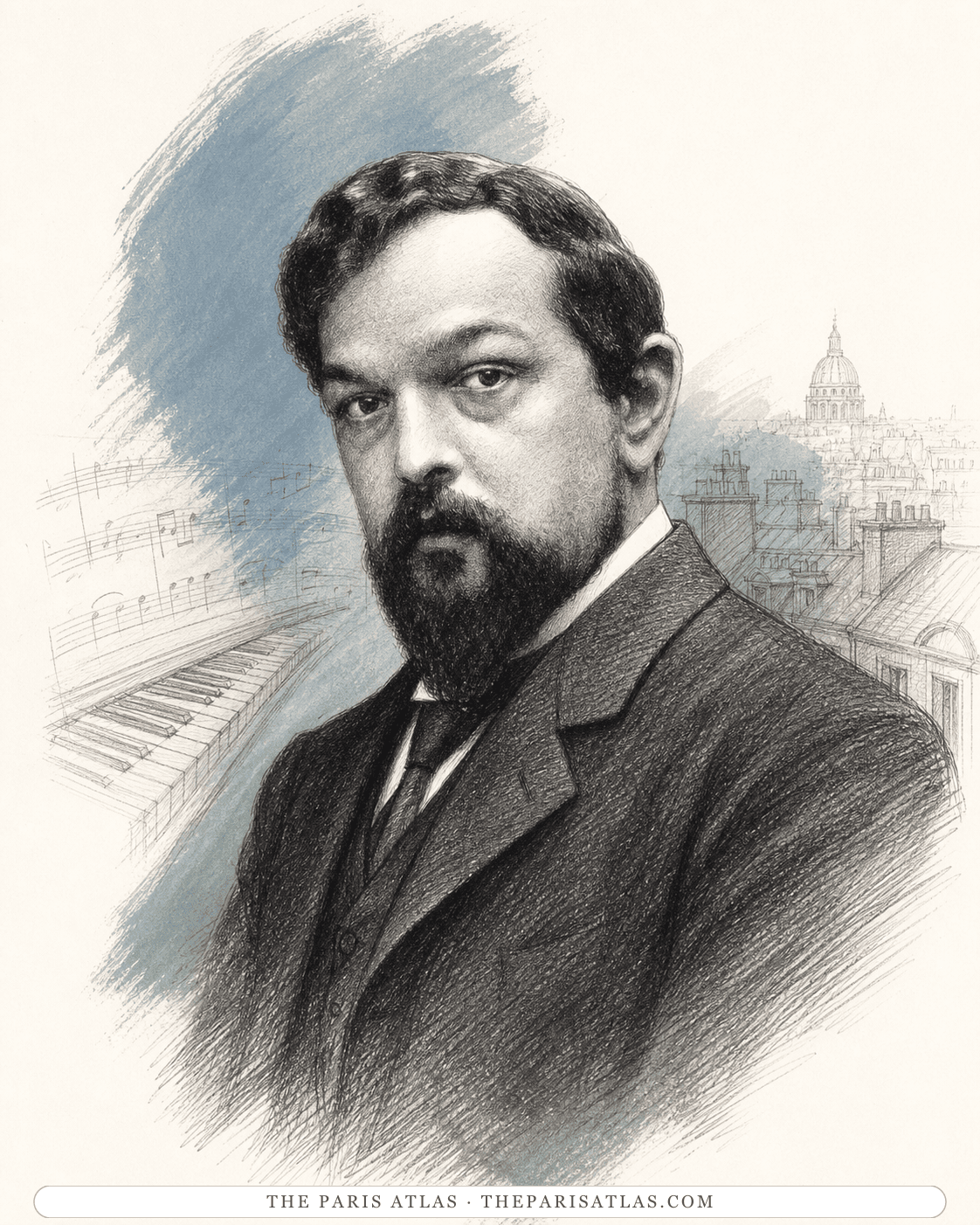
Claude Debussy
Mussorgsky showed Debussy an alternative to conventional Western European operatic declamation and formal development. Boris Godunov was particularly important to the formation of Pelléas et Mélisande.
Russian composer of Boris Godunov and Pictures at an Exhibition, whose speech-shaped writing reached Paris through Debussy, Diaghilev and Ravel's 1922 orchestration.
Modest Mussorgsky was a Russian composer, born on 21 March 1839 at Karevo in the Pskov region and dead at forty-two in a St Petersburg military hospital on 28 March 1881. He was one of The Five, the group of largely self-taught St Petersburg composers who set out to build a Russian national music on folk song and the rhythms of Russian speech rather than on German conservatory training.
His two best-known works are the opera Boris Godunov and the piano suite Pictures at an Exhibition. The opera comes from Alexander Pushkin's play about a guilty tsar. The suite was written in three weeks in 1874, after a memorial show of drawings and designs by his friend Viktor Hartmann. Neither reached the public in the form he left it. Nikolai Rimsky-Korsakov re-orchestrated and cut much of his work after his death, and those versions held the stage for decades.
Mussorgsky never went to Paris, but Paris made his reputation. Claude Debussy praised him in print in 1901 and absorbed the vocal writing of Boris Godunov into Pelléas et Mélisande. Sergei Diaghilev staged Boris at the Paris Opéra in 1908 with Feodor Chaliapin, the first performance of the opera outside Russia. Maurice Ravel's 1922 orchestration of Pictures at an Exhibition, commissioned and premiered in Paris, is the version most of the world now knows.
Modest Petrovich Mussorgsky was born on 21 March 1839 by the Western calendar, or 9 March by the Julian calendar Russia then used, at the family estate of Karevo in Pskov Governorate, about 400 kilometres south of St Petersburg. His family were landowning nobility, and his grandmother had been a serf. His mother, Yulia Chirikova, was a trained pianist and gave him his first lessons at six.[1]
In an autobiographical sketch written near the end of his life, Mussorgsky said the deepest early influence was his nurse's Russian folktales rather than his lessons. He tried to reproduce them at the piano before he knew the rules of playing. The technique came quickly anyway. He was playing small Franz Liszt pieces at seven, and at nine performed a John Field concerto for the family's guests. He published a first composition at about thirteen.[2]
Mussorgsky was taken to St Petersburg at ten and entered the Cadet School of the Guards in 1852. He graduated in 1856 and was commissioned into the Preobrazhensky Regiment, the most fashionable regiment in the Russian army. In October of that year, on duty at a military hospital, he met Alexander Borodin, a doctor who was also a composer.
The meeting that redirected his life came at the musical evenings of Alexander Dargomyzhsky, where he met Mily Balakirev, César Cui, and the critic Vladimir Stasov, who became his closest ally. Balakirev began teaching him. In 1858 Mussorgsky resigned his commission to give his whole time to music, an unusual step for a young officer of his class and one that left him without a profession.[1]
The circle that formed around Balakirev between 1856 and 1862 came to include Cui, Mussorgsky, Nikolai Rimsky-Korsakov and Borodin. They were young, largely self-trained, and opposed to what they saw as the imported German academicism of the new St Petersburg Conservatory. Their programme was a Russian national music built from village song, church chant and dance. Vladimir Stasov gave them their name in May 1867, praising a "mighty little handful" of Russian musicians in a review of a Balakirev concert. In English they are usually called The Five.
The emancipation of the serfs in 1861 cost the family half its estate, and by 1863 Mussorgsky needed a salary. He entered the civil service that December as a clerk in the engineering department of the Ministry of Communications. He spent nearly all of his remaining years in one government office or another. From about 1868 it was the forestry department of the Ministry of Imperial Domains, and from 1878 the state audit office, where Stasov had arranged him a lenient superior. He was finally dismissed early in 1880. His mother died in 1865, the year of his first serious bout of drinking.[2]
Mussorgsky began Boris Godunov in 1868, working from Alexander Pushkin's drama about the tsar who was believed to have murdered a child heir to reach the throne, and from Nikolai Karamzin's history of Russia. He finished a first version in 1869. On 10 February 1871 the committee of the Imperial Theatres rejected it by six votes to one, the stated objection being that the opera had no leading female role.[3]
He rewrote it, adding a Polish act that gave the pretender to the throne a love interest, and finished the revision in June 1872. Three scenes were staged at the Mariinsky Theatre in February 1873 to real enthusiasm, and the complete opera followed there on 8 February 1874, conducted by Eduard Nápravník. The house was sold out and the composer took around twenty curtain calls. The reviews were harsh, and the one that wounded him came from inside his own circle: César Cui called it an immature work, superb in parts and feeble in others.
What the opera did that was new was to build its vocal lines out of the shapes of ordinary Russian speech instead of conventional operatic melody, and to give the crowd itself a leading part. Mussorgsky had written to a friend in 1868 that his music must be an artistic reproduction of human speech in all its finest shades. Boris Godunov is where he carried that through at full length.
Viktor Hartmann was an architect and designer and one of Mussorgsky's closest friends. He died of an aneurysm on 4 August 1873, aged thirty-nine. The following February and March, Vladimir Stasov organised a memorial exhibition of more than four hundred of Hartmann's drawings, watercolours and designs at the Imperial Academy of Arts in St Petersburg, and Mussorgsky walked through it.[4]
Between 2 and 22 June 1874 he wrote a suite for solo piano built on ten of the pictures, linked by a recurring Promenade that represents the composer himself moving between them. The ten are The Gnome, The Old Castle, Tuileries, Cattle, Ballet of the Unhatched Chicks, "Samuel" Goldenberg and "Schmuÿle", Limoges Market, Catacombs, The Hut on Hen's Legs, and The Great Gate of Kiev. He dedicated it to Stasov.[4]
Most of Hartmann's work has since been lost. Only about six of the originals behind the movements can still be identified. They include the costume design for the unhatched chicks, the watercolour of the Paris catacombs, the clock in the shape of Baba Yaga's hut, and the unbuilt design for a great gate at Kiev. The suite was never played in public in Mussorgsky's lifetime and was not printed until 1886, when it appeared in an edition by Rimsky-Korsakov.[4]
Mussorgsky kept writing through the later 1870s. The song cycles Sunless (1874) and Songs and Dances of Death (1875 and 1877) both set poems by his relative Arseny Golenishchev-Kutuzov. He also worked for eight years on a second large opera, Khovanshchina, about a rebellion in Moscow in 1682, and never orchestrated it. His drinking, which had become serious in 1865, got steadily worse, and after he lost his government post early in 1880 he told a friend there was nothing left but begging.[5]
In February 1881 he suffered a run of seizures with delirium tremens. Friends found him a comfortable room in the Nikolaevsky Military Hospital in St Petersburg. There, at Stasov's urging, the painter Ilya Repin came and painted him over four sittings in early March. No easel was available, so Repin propped the canvas on a table. The result is one of the most famous portraits in Russian art: a swollen, red-nosed, wild-haired man in a dressing gown, looking away from the viewer, entirely alive and plainly dying. Pavel Tretyakov bought it for 400 roubles without having seen it, and Repin gave the money towards a monument to the composer. It hangs in the Tretyakov Gallery in Moscow.
Mussorgsky died in the hospital on 28 March 1881, one week after his forty-second birthday, of the complications of alcoholism. He was buried at the Tikhvin Cemetery of the Alexander Nevsky Monastery in St Petersburg.
No source records Mussorgsky ever visiting Paris. His music went without him, and France did more for his standing than Russia had. Writing in La Revue blanche in April 1901, Claude Debussy reviewed the song cycle The Nursery and said that nobody had ever spoken to what is best in us with a more tender and more profound accent. He admired an art without devices and without drying formulas. The speech-shaped vocal writing of Boris Godunov fed directly into Debussy's own opera, Pelléas et Mélisande, first performed in 1902.
Sergei Diaghilev did the rest. He brought five Historical Russian Concerts to the Paris Opéra in May 1907, and returned on 19 May 1908 with a staging of Boris Godunov, with Feodor Chaliapin in the title role and costumes by Alexander Golovin. It was the first production of the opera anywhere outside Russia and it was a triumph. A French line from the time had it that the Russians took Paris twice, once in March 1814 and again in May 1908 when Chaliapin sang Boris. The production used Rimsky-Korsakov's edition, which is what the world then knew.
In 1922 the conductor Serge Koussevitzky commissioned Maurice Ravel to orchestrate Pictures at an Exhibition, and conducted the premiere at the Paris Opéra that October. Ravel's version turned a piano suite that had never been performed in its composer's lifetime into one of the most played pieces in the orchestral repertory. Mussorgsky's own scores came back slowly: Pavel Lamm's edition of Boris Godunov in 1928 and David Lloyd-Jones's in 1975 eventually displaced Rimsky-Korsakov's, and Dmitri Shostakovich's 1959 version of Khovanshchina became the standard one.
Born on 21 March (9 March, Old Style) at Karevo in Pskov Governorate; his mother, a trained pianist, gives him his first lessons.
Enters the Cadet School of the Guards in St Petersburg and publishes a first composition at about thirteen.
Commissioned into the Preobrazhensky Guards; meets Alexander Borodin at a military hospital in October.
Meets Mily Balakirev, César Cui and the critic Vladimir Stasov at Alexander Dargomyzhsky's musical evenings, and begins study with Balakirev.
Resigns his Guards commission to devote himself to music.
The emancipation of the serfs costs the family half its estate.
Enters the civil service in December as a clerk in the engineering department of the Ministry of Communications.
His mother dies; he has his first serious bout of drinking.
Finishes St John's Night on Bald Mountain on 23 June; Balakirev rejects it and it is never performed in his lifetime. In May, Stasov coins the name The Mighty Handful.
Begins Boris Godunov and the song cycle The Nursery, and writes that his music must be an artistic reproduction of human speech in all its finest shades.
Completes the first version of Boris Godunov in December.
On 10 February the Imperial Theatres committee rejects Boris Godunov by six votes to one, citing the absence of a leading female role.
Completes the revised Boris Godunov in June, with a new Polish act; begins Khovanshchina.
Three scenes of Boris are staged at the Mariinsky in February; his friend the architect Viktor Hartmann dies of an aneurysm on 4 August, aged thirty-nine.
Boris Godunov has its full premiere at the Mariinsky Theatre on 8 February under Eduard Nápravník, to some twenty curtain calls and hostile reviews.
Visits Stasov's memorial exhibition of over four hundred Hartmann works and composes Pictures at an Exhibition between 2 and 22 June; writes the cycle Sunless.
Writes the first three Songs and Dances of Death, completing the cycle in 1877.
Stasov has him transferred to the Office of Government Control, under a superior willing to tolerate his absences.
Dismissed from government service early in the year, and left dependent on small stipends from friends.
Suffers seizures and delirium tremens in February and is taken to the Nikolaevsky Military Hospital in St Petersburg.
Ilya Repin paints his portrait in the hospital over four sittings in early March; Pavel Tretyakov buys it for 400 roubles unseen.
Dies in the hospital on 28 March (16 March, Old Style), one week after his forty-second birthday, and is buried at the Tikhvin Cemetery of the Alexander Nevsky Monastery.
Rimsky-Korsakov's arrangement of Night on Bald Mountain premieres in October and becomes the standard version; Pictures at an Exhibition is published for the first time, also in his edition.
Rimsky-Korsakov completes his first full revision and re-orchestration of Boris Godunov, the version that holds the world's stages for half a century.
Claude Debussy praises the song cycle The Nursery in La Revue blanche in April.
Sergei Diaghilev stages Boris Godunov at the Paris Opéra on 19 May with Feodor Chaliapin, the opera's first production outside Russia.
Serge Koussevitzky conducts the Paris premiere of the orchestration of Pictures at an Exhibition he commissioned from Maurice Ravel.
David Lloyd-Jones publishes his critical edition of Boris Godunov, and Mussorgsky's own versions displace Rimsky-Korsakov's.
Mussorgsky showed Debussy an alternative to conventional Western European operatic declamation and formal development. Boris Godunov was particularly important to the formation of Pelléas et Mélisande.
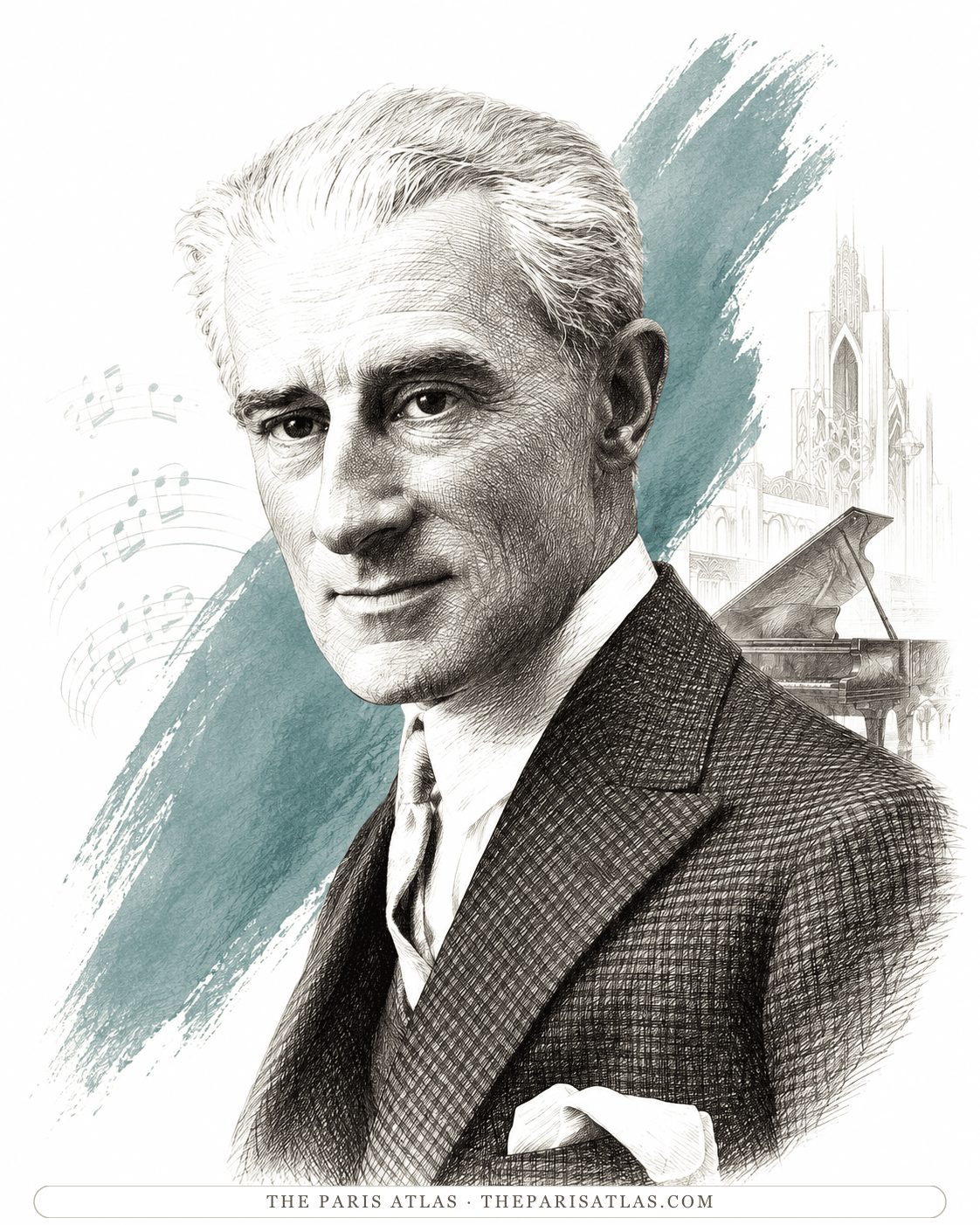
Serge Koussevitzky commissioned Ravel to orchestrate Pictures at an Exhibition, and conducted the premiere at the Paris Opera in October 1922. Ravel's version turned a piano suite that was never performed in Mussorgsky's lifetime into one of the most played works in the orchestral repertory.
The opera Boris Godunov, first performed complete in 1874, and the piano suite Pictures at an Exhibition, written in 1874 and known worldwide through Maurice Ravel's 1922 orchestration. He also wrote Night on Bald Mountain, the unfinished opera Khovanshchina, and three song cycles. He was one of The Five, the circle of Russian composers who set out to build a national music independent of German training.
No. He wrote it for solo piano between 2 and 22 June 1874, and it was not published until 1886, five years after his death. The orchestral version almost everyone knows was made by Maurice Ravel in 1922 on a commission from the conductor Serge Koussevitzky, who conducted the premiere at the Paris Opéra that October.
Drawings and designs by Viktor Hartmann, an architect and designer who was one of Mussorgsky's closest friends and who died in 1873 aged thirty-nine. Vladimir Stasov mounted a memorial exhibition of more than four hundred of his works in St Petersburg in 1874, and Mussorgsky set ten of them, linked by a recurring Promenade. Only about six of those originals can still be identified today; most of Hartmann's work is lost.
Of the complications of alcoholism. After a run of seizures and delirium tremens in February 1881 he was taken to the Nikolaevsky Military Hospital in St Petersburg, where he died on 28 March 1881, one week after turning forty-two. He is buried at the Tikhvin Cemetery of the Alexander Nevsky Monastery.
Ilya Repin, in the hospital ward, over four sittings in early March 1881, days before the composer died. There was no easel, so Repin worked with the canvas propped on a table. Pavel Tretyakov bought the picture for 400 roubles without seeing it, and Repin put the money towards a monument to Mussorgsky. It hangs in the Tretyakov Gallery in Moscow.
Mily Balakirev, César Cui, Modest Mussorgsky, Nikolai Rimsky-Korsakov and Alexander Borodin. They were largely self-taught St Petersburg composers who came together between 1856 and 1862 to build a Russian national music on folk material and speech rhythms, in opposition to the German conservatory tradition. The critic Vladimir Stasov named them in a review in May 1867.
Mussorgsky wrote two himself. The Imperial Theatres rejected the 1869 original for having no leading female role, so he added a Polish act and finished a revision in 1872, which was premiered in 1874. After his death Nikolai Rimsky-Korsakov cut and re-orchestrated the opera, in 1896 and again in 1908, and his smoother versions dominated for decades until the editions of Pavel Lamm in 1928 and David Lloyd-Jones in 1975 restored Mussorgsky's own.
No source records him ever going there, but Paris made his international reputation. Claude Debussy praised his songs in print in 1901 and took the speech-shaped vocal writing of Boris Godunov into Pelléas et Mélisande. Sergei Diaghilev staged Boris at the Paris Opéra on 19 May 1908 with Feodor Chaliapin, its first performance outside Russia. Maurice Ravel's orchestration of Pictures at an Exhibition was commissioned and premiered in Paris in 1922.
Influenced
Mussorgsky showed Debussy an alternative to conventional Western European operatic declamation and formal development. Boris Godunov was particularly important to the formation of Pelléas et Mélisande.
Influenced · 1922
Serge Koussevitzky commissioned Ravel to orchestrate Pictures at an Exhibition, and conducted the premiere at the Paris Opera in October 1922. Ravel's version turned a piano suite that was never performed in Mussorgsky's lifetime into one of the most played works in the orchestral repertory.
The sources below include biographies, scholarly essays, interviews, and primary materials that informed this page. They reflect both the historical record and ongoing critical conversations about Modest Mussorgsky and their work.


Web source consulted for documented facts and historical context presented on the Modest Mussorgsky page.
Record of Repin's hospital portrait, its sittings, Tretyakov's purchase for 400 roubles and its place in the Tretyakov Gallery.
Reference article cross-checked for the chronology, the family, the civil-service posts, the drinking and the death.
Composition history of the opera, including the 1871 rejection, the 1872 revision, the 1874 premiere and the later editions.
The source for the Hartmann exhibition, the composition dates of June 1874, the ten movements and the Ravel orchestration.
The text of Debussy's April 1901 notice on The Nursery, collected in Monsieur Croche.
Web source consulted for documented facts and historical context presented on the Modest Mussorgsky page.
Web source consulted for documented facts and historical context presented on the Modest Mussorgsky page.
Web source consulted for documented facts and historical context presented on the Modest Mussorgsky page.
Web source consulted for documented facts and historical context presented on the Modest Mussorgsky page.
Web source consulted for documented facts and historical context presented on the Modest Mussorgsky page.
Web source consulted for documented facts and historical context presented on the Modest Mussorgsky page.
Web source consulted for documented facts and historical context presented on the Modest Mussorgsky page.
Web source consulted for documented facts and historical context presented on the Modest Mussorgsky page.
Web source consulted for documented facts and historical context presented on the Modest Mussorgsky page.
Web source consulted for documented facts and historical context presented on the Modest Mussorgsky page.
Web source consulted for documented facts and historical context presented on the Modest Mussorgsky page.
Web source consulted for documented facts and historical context presented on the Modest Mussorgsky page.
Web source consulted for documented facts and historical context presented on the Modest Mussorgsky page.
These references anchor the page in the documented record and in the scholarly conversations around Modest Mussorgsky. Every claim on this page traces back to one or more of the works listed here.
 Explore more resources