The Paris AtlasCharting the artists, works, and places worth returning to.
  • Singer
  • Actor
  • Activist
· American · 1898–1976

Paul Robeson

American bass-baritone and actor — the title role in Shakespeare's Othello on Broadway, "Ol' Man River" from the musical Show Boat, a shelf of British films — who spoke for a few minutes at a peace congress in the Salle Pleyel concert hall in Paris in April 1949. A dispatch from the Associated Press, the news agency that supplied reports to American newspapers, carried words he disputed having said, and the United States took his passport for eight years.

Details

Lived
1898–1976
Born
1898
Birthplace
Princeton, New Jersey
Died
1976
Nationality
American
Profession
Concert singer, actor, and political activist
Roles
SingerActorActivist

About Paul Robeson

Paul Robeson was, by about 1945, one of the most widely admired Americans alive: a bass-baritone who filled concert halls on four continents, the star of the longest Broadway run Shakespeare's Othello had ever had, a film actor, a lawyer by training, and a college athlete good enough for the College Football Hall of Fame, the sport's American roll of honour. Then, in April 1949, he spent a few minutes at a microphone in a Paris concert hall, and the Associated Press — the news agency whose reports were printed by newspapers across the United States — sent out a single paragraph of copy that ended all of it.

The hall was the Salle Pleyel at 252 rue du Faubourg Saint-Honoré, and the occasion was the Congrès mondial des partisans de la paix — the World Congress of the Partisans of Peace — which met there from 20 to 23 April 1949 under a poster carrying a dove drawn by the Spanish painter Pablo Picasso. What Robeson said about Black Americans and a war against the Soviet Union, and what the wire services reported him as saying, are not the same set of words, and scholars have spent decades on the difference. It did not matter at the time. Eighty-five concerts were cancelled, his income collapsed, a mob attacked an audience that came to hear him sing in Peekskill, New York, and in August 1950 the State Department — the department of the United States government that handles foreign affairs and issues passports — cancelled his. He did not get it back until 1958.

Rutgers, and a young man who could do everything

Paul Robeson was born in Princeton, New Jersey, on 9 April 1898, the son of a man who had escaped slavery. He went to Rutgers College in New Brunswick, New Jersey, on an academic scholarship as the university's third Black student and its first Black football player, and proceeded to win fifteen varsity letters — the awards American universities give for playing a sport at the highest college level — across football, basketball, baseball and track. He was twice named an All-American, one of the small number of players chosen each year for an honorary national team, and he is in the College Football Hall of Fame; he was elected to Phi Beta Kappa, the national academic honour society, and to Cap and Skull, Rutgers' own society for a handful of outstanding seniors; and he graduated in 1919 as valedictorian — the student chosen to speak for the class.

The valedictory address, delivered at the Second Reformed Church in New Brunswick, was called "The New Idealism", and its argument was the one he never dropped: that unity is impossible without freedom, and that freedom presupposes a reverence for the individual. His senior thesis had been on the Fourteenth Amendment — the constitutional guarantee of equal protection, which he called the sleeping giant of the American Constitution. He then took a law degree at Columbia Law School in New York and, having qualified, declined to practise. He had a voice, and the theatre wanted it.

Ol' Man River, Othello, and the British films

The stage came first. In 1921 he appeared briefly in Shuffle Along, the first Broadway musical written, produced and performed by African Americans — the show that also had Josephine Baker in its chorus line and that the Library of Congress puts at the centre of its account of the Harlem Renaissance, the flowering of Black American writing, music and art between the world wars. Broadway leads followed in two plays by the dramatist Eugene O'Neill, The Emperor Jones and All God's Chillun Got Wings. From his professional singing debut in 1925 he did something no one had done before: he built a formal concert career out of the spirituals — the sacred songs made by enslaved African Americans — and sang them in recital halls as art music.

He spent much of the 1930s in Britain, where there was more work for him and the colour bar — the unwritten rules that kept Black performers out of parts, hotels and halls — sat lower, and he made a run of films there, among them Song of Freedom (1936), directed by J. Elder Wills. Show Boat, the 1927 musical by the composer Jerome Kern and the lyricist Oscar Hammerstein II, gave him "Ol' Man River", the song audiences would demand of him for the rest of his life. The peak was Othello — Shakespeare's tragedy of a Black general in the service of Venice who is destroyed by a subordinate's lies. His Broadway run of 1943–44 was the longest any Shakespeare play had had on Broadway, and he came back to the part in 1959 at Stratford-upon-Avon, the English town where Shakespeare was born and where a company performs his plays year-round. In 1937 he helped found the Council on African Affairs, a New York organisation that campaigned against colonial rule — the government of African territories from European capitals — the political commitment that would later be used against him.

Salle Pleyel, 20 April 1949

The Salle Pleyel is a concert hall at 252 rue du Faubourg Saint-Honoré in the 8th arrondissement, one of the twenty administrative districts of Paris; it was built for the piano manufacturer Pleyel by its director Gustave Lyon and inaugurated on 18 October 1927, and it has been a listed monument historique — a protected historic building — since 2002. From 20 to 23 April 1949 it held not a concert but a political meeting: the Congrès mondial des partisans de la paix, the World Congress of the Partisans of Peace, an assembly of writers, scientists and performers, organised largely by people sympathetic to the Soviet Union, and called against the Cold War — the confrontation between the United States and the Soviet Union and their allies that had hardened since the end of the Second World War. Picasso drew the dove that went on its poster, and the bird became the peace symbol of the next half century.

Robeson was in the hall, and an Associated Press photographer took the picture the Library of Congress — the national library of the United States — still holds: Robeson at the microphone, half-length, facing slightly left, addressing the congress. He spoke briefly. His subject was whether Black Americans would fight a war against the Soviet Union, the communist state he had visited more than once and whose treatment of him as a Black man he contrasted loudly with his own country's — and which had by then become the fixed point of American political fear.

What the wire reported, and what the transcripts say

The Associated Press dispatch that reached American newsrooms had Robeson saying that it was unthinkable that American Negroes — the wire's wording, and the ordinary usage of 1949 — would go to war on behalf of those who had oppressed them for generations against the Soviet Union, which in one generation had lifted their people to full human dignity. Printed under his name, in that form, it read as a declaration that fifteen million Black Americans, roughly the Black population of the United States at the time, would refuse to defend their own country. The New York Public Library's catalogue of its Robeson papers — kept at its Schomburg Center for Research in Black Culture, the library's Harlem research collection on Black history — states plainly that his words were distorted at home; the account published by the University of Pennsylvania's Graduate School of Education goes further, and says the wire falsely reported that he had compared the United States government to Hitler's.

The historian Martin Duberman, writing the standard biography of Robeson in 1988, went back to the French-language transcripts of the session — the written record of what was actually said in the hall, taken down as it was spoken. What they record is longer, and different in emphasis: that the wealth of America was acquired on the backs of the poor whites of Europe and of millions of Black people; that it should be shared equitably among all America's children; that Robeson wanted no hysterical stupidity about participating in a war against anybody, whoever it might be; that he was determined to fight for peace and did not wish to fight the Soviet Union. The distance between the two versions is the distance between a man refusing a war and a man refusing his country.

The correction never caught up. Within months two of the most prominent Black leaders in the country had publicly disowned him: Walter White, the executive secretary of the National Association for the Advancement of Colored People, the leading American civil rights organisation, and Adam Clayton Powell Jr., the Harlem clergyman who represented the district in Congress. In August 1949 a crowd attacked concertgoers at an open-air performance he gave near Peekskill, in upstate New York, injuring hundreds. Smithsonian Magazine, the magazine of the Smithsonian Institution in Washington, added up the cost in 2011: eighty-five booked concerts cancelled, and an annual income that fell from more than $150,000 to under $3,000.

Eight years inside his own country

In August 1950 the State Department cancelled his passport, so that he could no longer leave the country. He was offered it back if he would sign an affidavit — a written statement sworn to be true — declaring that he was not a communist, and he refused to sign; the demand itself, he held, was the illegitimate thing. The National Archives, the keeper of the United States government's own records, sets the revocation down flatly: his passport was taken in 1950 on the ground that he was a threat to national security, and the travel ban ran until 1958. He could still move inside the United States, and did — the "Birthday Tours" of 1952 to 1956 took him through more than twenty-five cities on networks of union halls, churches and Black community organisations that would still book him.

He was summoned before the House Un-American Activities Committee, the congressional body then investigating Americans suspected of disloyalty, and gave it nothing: he declined to answer its questions about his politics and turned them back on the members. In 1958 he published Here I Stand, part memoir and part manifesto, and in the same year — after eight years of petitions, legal challenges and protest campaigns mounted abroad — the passport came back. The concert career resumed in Europe and the Othello returned to Stratford in 1959, but his health did not hold. He withdrew from public life in the 1960s and died in 1976, aged seventy-seven, his reputation still darkened by the paragraph the wires had carried out of Paris.

The papers went to two great collections, and the split says something about the man: the Schomburg Center for Research in Black Culture in Harlem, part of the New York Public Library, holds a Robeson collection covering 1925 to 1956, and the Moorland-Spingarn Research Center at Howard University in Washington — the research library of one of the country's historically Black universities — holds six linear feet of papers, about two metres of shelved documents, gathered with those of his wife, the chemist, anthropologist and writer Eslanda Goode Robeson. His Harlem apartment is a National Historic Landmark, the federal designation for buildings of national historical importance.

Life events

  1. 1898

    Born in Princeton, New Jersey, on 9 April, the son of a man who had escaped slavery.

    Paul Robeson collection, 1925-1956; About Paul Robeson

  2. 1919

    Graduates from Rutgers College as valedictorian, having won fifteen varsity letters and been named an All-American footballer twice; delivers the address "The New Idealism" in New Brunswick.

    About Paul Robeson; Paul Robeson's 1919 Rutgers Commencement

  3. 1921

    Appears briefly in Shuffle Along, the first Broadway musical written, produced and performed by African Americans, whose chorus line included Josephine Baker.

    The Harlem Renaissance (African American Odyssey)

  4. 1925

    Professional singing debut; begins the concert career that put the spirituals of enslaved African Americans on the recital platform as art music.

    Paul Robeson collection, 1925-1956

  5. 1936

    Stars in Song of Freedom, directed by J. Elder Wills — one of the run of British films he made in the 1930s.

    Song of Freedom (1936)

  6. 1937

    Helps found the Council on African Affairs, the New York body that campaigned against colonial rule in Africa.

    Paul Robeson collection, 1925-1956

  7. 1943

    Opens as Othello on Broadway; the 1943–44 run was the longest any Shakespeare play had had there.

    Paul Robeson collection, 1925-1956

  8. 1949

    Speaks at the Congrès mondial des partisans de la paix in the Salle Pleyel, Paris, which met from 20 to 23 April under a poster carrying Picasso's dove. The Associated Press photographs him at the microphone — and reports words he disputed having said.

    Pablo Picasso, La Colombe (MP3414) (1949); Paul Robeson, half-length portrait, facing slightly left, addressing the World Conference of Partisans of Peace in Paris (1949); Gilbert King, What Paul Robeson Said (2011)

  9. 1949

    A mob attacks concertgoers at his open-air performance near Peekskill, New York, in August; eighty-five booked concerts are cancelled and his income falls from over $150,000 a year to under $3,000.

    Gilbert King, What Paul Robeson Said (2011); Paul Robeson Home, New York

  10. 1950

    The State Department cancels his passport in August after he refuses to sign an affidavit swearing he is not a communist; the federal record gives national security as the ground.

    Paul Robeson collection, 1925-1956; Paul Robeson

  11. 1952

    Begins the "Birthday Tours", four years of concerts in more than twenty-five American cities booked through unions, churches and Black community organisations — the only circuit still open to him.

    Paul Robeson collection, 1925-1956

  12. 1958

    Publishes Here I Stand, and — after eight years of legal challenge and international protest — recovers his passport. European touring resumes.

    Paul Robeson collection, 1925-1956; Paul Robeson, Part III: Freedom's Price; Paul Robeson

  13. 1959

    Plays Othello again, at Stratford-upon-Avon in England.

    Paul Robeson collection, 1925-1956

  14. 1976

    Dies, having withdrawn from public life in the 1960s. His papers are divided between the Schomburg Center in Harlem and the Moorland-Spingarn Research Center at Howard University.

    Paul Robeson collection, 1925-1956; Robeson, Paul and Eslanda Collection, 1907-1988

Movements

The artistic and literary currents this life ran through.

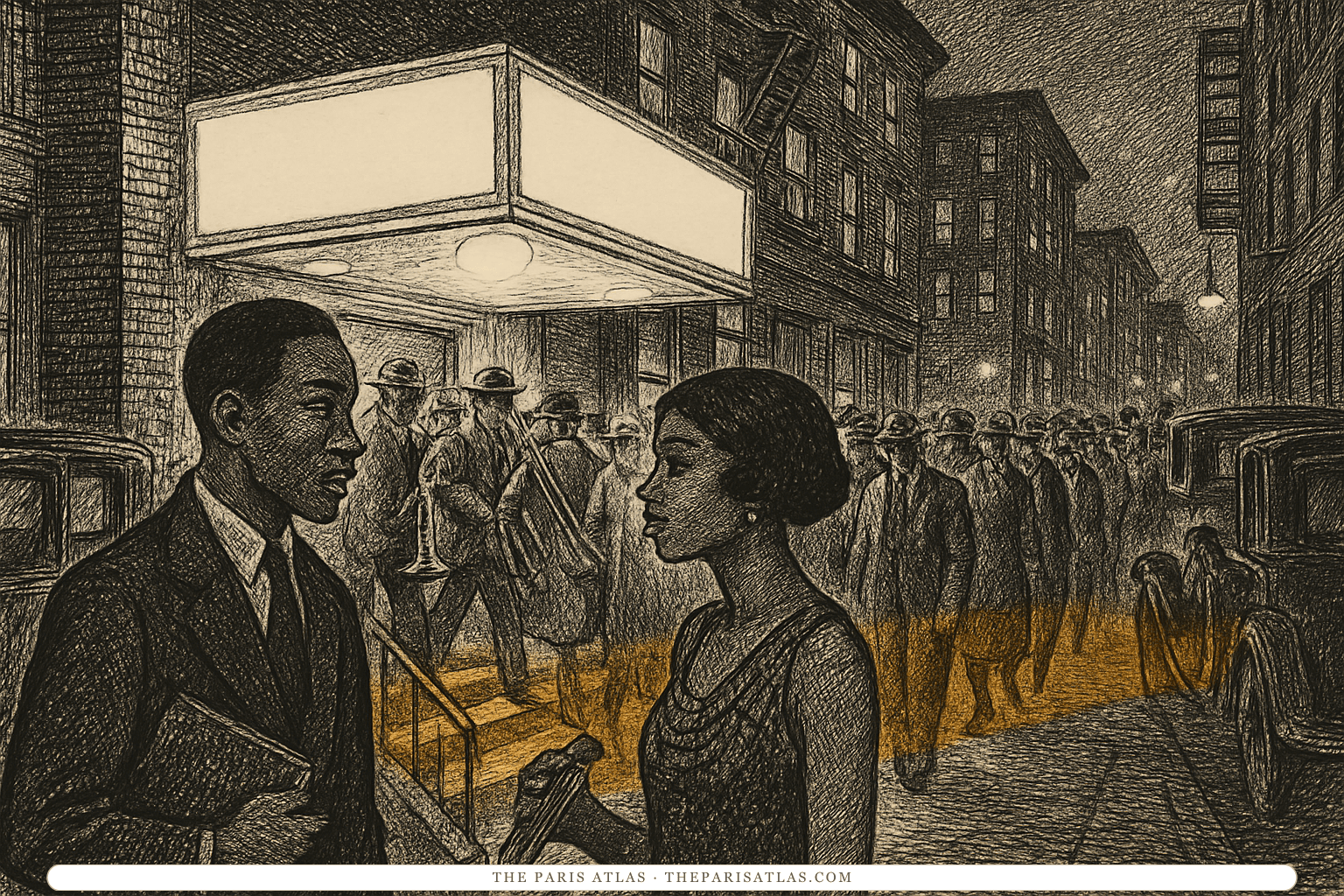
Pen-and-ink illustration of a 1920s Harlem avenue at night: a young Black poet holding a book talks with a woman in a beaded dress while musicians carry a trumpet and trombone into a club under a glowing marquee, the crowd and brownstones behind them swept with one gold brush stroke

Cultural movement · c. 1918 – mid-1930s

The Harlem Renaissance

The Library of Congress's account of the Harlem Renaissance places Robeson in the cast of Shuffle Along (1921) — the first Broadway musical written, produced and performed by African Americans, whose chorus line included Josephine Baker. The National Archives records the Broadway leads that followed, in Eugene O'Neill's The Emperor Jones and All God's Chillun Got Wings, and the Schomburg Center dates his professional singing debut to 1925 and credits him with pioneering the concert performance of spirituals. No single source calls him a Harlem Renaissance figure in those words; the label is the atlas's, and the participation is the sources'.

The Harlem Renaissance (African American Odyssey); Paul Robeson; Paul Robeson collection, 1925-1956

Questions about Paul Robeson

What did Paul Robeson actually say in Paris in 1949?

There are two versions, and the difference is the whole story. The Associated Press dispatch — the report the news agency sent to American papers — had him saying it was unthinkable that American Negroes, in the wire's wording of the day, would go to war on behalf of those who had oppressed them for generations against the Soviet Union, which in one generation had lifted their people to full human dignity. That read in American papers as a promise of mass disloyalty. When the historian Martin Duberman went back to the French-language transcripts of the session for his 1988 biography, he found a longer passage whose emphasis falls elsewhere: that America's wealth was built on the backs of poor Europeans and of millions of Black people and should be shared equitably; that Robeson wanted no hysterical stupidity about a war against anybody at all; that he was determined to fight for peace and did not wish to fight the Soviet Union. The Schomburg Center's own catalogue records that his words were distorted at home.

Where was the speech given?

In the Salle Pleyel, the concert hall at 252 rue du Faubourg Saint-Honoré in the 8th arrondissement of Paris, built for the Pleyel piano firm and opened on 18 October 1927. From 20 to 23 April 1949 it hosted the Congrès mondial des partisans de la paix — the World Congress of the Partisans of Peace — whose poster carried the dove the painter Pablo Picasso had drawn that January. An Associated Press photograph of Robeson speaking there is in the Library of Congress, the national library of the United States.

Why did the United States take Paul Robeson's passport?

The State Department, the government department that issues American passports, cancelled it in August 1950, in the wave of anti-communist suspicion that followed the Paris reports. He was told he could have it back if he signed an affidavit — a sworn written statement — swearing he was not a communist, and he refused, on the ground that the government had no business demanding it. The National Archives records the revocation as made on national-security grounds. He was left able to travel inside the United States but not out of it — an exile served at home.

When did Robeson get his passport back?

In 1958, after eight years of court challenges and protest campaigns, much of them mounted abroad by musicians and unions who wanted him to perform. He published Here I Stand the same year and resumed touring in Europe, returning to Othello at Stratford-upon-Avon in 1959.

What was Paul Robeson famous for before the politics?

Almost everything. He was a bass-baritone who made a formal concert career out of the spirituals of enslaved African Americans, a Broadway lead in Eugene O'Neill's The Emperor Jones and All God's Chillun Got Wings, the singer of "Ol' Man River" in the musical Show Boat, the star of a run of British films including Song of Freedom (1936), and the Othello whose 1943–44 Broadway run was the longest any Shakespeare play had had on Broadway. Before any of that he was a Rutgers valedictorian, a twice-named All-American footballer, and a Columbia-trained lawyer.

Did Paul Robeson really go to Rutgers?

Yes, on an academic scholarship, as the university's third Black student and its first Black football player. He collected fifteen varsity letters across four sports, was twice named an All-American in football, joined Phi Beta Kappa and Rutgers' Cap and Skull society, and graduated as valedictorian of the class of 1919. He is in the College Football Hall of Fame.

What is Here I Stand?

The book Robeson published in 1958, part autobiography and part political statement, written during the passport years and setting out his case in his own words rather than the wires'. It appeared in the same year the passport was restored.

Where are Paul Robeson's papers?

In two places. The Schomburg Center for Research in Black Culture, part of the New York Public Library in Harlem, holds a Paul Robeson collection covering 1925 to 1956. The Moorland-Spingarn Research Center at Howard University in Washington holds six linear feet — about two metres of shelved documents — of Robeson material dated 1907 to 1988, gathered together with the papers of his wife, the chemist, anthropologist and writer Eslanda Goode Robeson.

Sourced claims

Every connection the graph holds for Paul, with the evidence behind it.

Associated with · 1921

The Harlem Renaissance

The Library of Congress's account of the Harlem Renaissance places Robeson in the cast of Shuffle Along (1921) — the first Broadway musical written, produced and performed by African Americans, whose chorus line included Josephine Baker. The National Archives records the Broadway leads that followed, in Eugene O'Neill's The Emperor Jones and All God's Chillun Got Wings, and the Schomburg Center dates his professional singing debut to 1925 and credits him with pioneering the concert performance of spirituals. No single source calls him a Harlem Renaissance figure in those words; the label is the atlas's, and the participation is the sources'.

The Harlem Renaissance (African American Odyssey); Paul Robeson; Paul Robeson collection, 1925-1956

References

References

The sources below include biographies, scholarly essays, interviews, and primary materials that informed this page. They reflect both the historical record and ongoing critical conversations about Paul Robeson and their work.

  1. 1Paul Robeson collection, 1925-1956

    Schomburg Center for Research in Black Culture, The New York Public Library

    The Schomburg Center's finding aid and biographical note.

    View source
  2. 2About Paul Robeson

    Rutgers University, Robeson Centennial

    Rutgers on its own graduate.

    View source
  3. 3What Paul Robeson Said

    Smithsonian Magazine, 2011

    The wire copy against the transcripts, and the cost.

    View source
  4. 4Paul Robeson: A Biography

    Alfred A. Knopf, 1988

    The standard biography, and the source of the French transcripts.

  1. 5La Colombe (MP3414)

    Musée national Picasso-Paris, 1949

    The congress's venue and dates, from the poster's catalogue record.

    View source
  2. 6Paul Robeson

    National Archives and Records Administration

    The federal record of the passport revocation.

    View source
  3. 7Robeson, Paul and Eslanda Collection, 1907-1988

    Moorland-Spingarn Research Center, Howard University

    The Howard University papers.

    View source
i
Why these sources are here

These references anchor the page in the documented record and in the scholarly conversations around Paul Robeson. Every claim on this page traces back to one or more of the works listed here.

Explore more resources