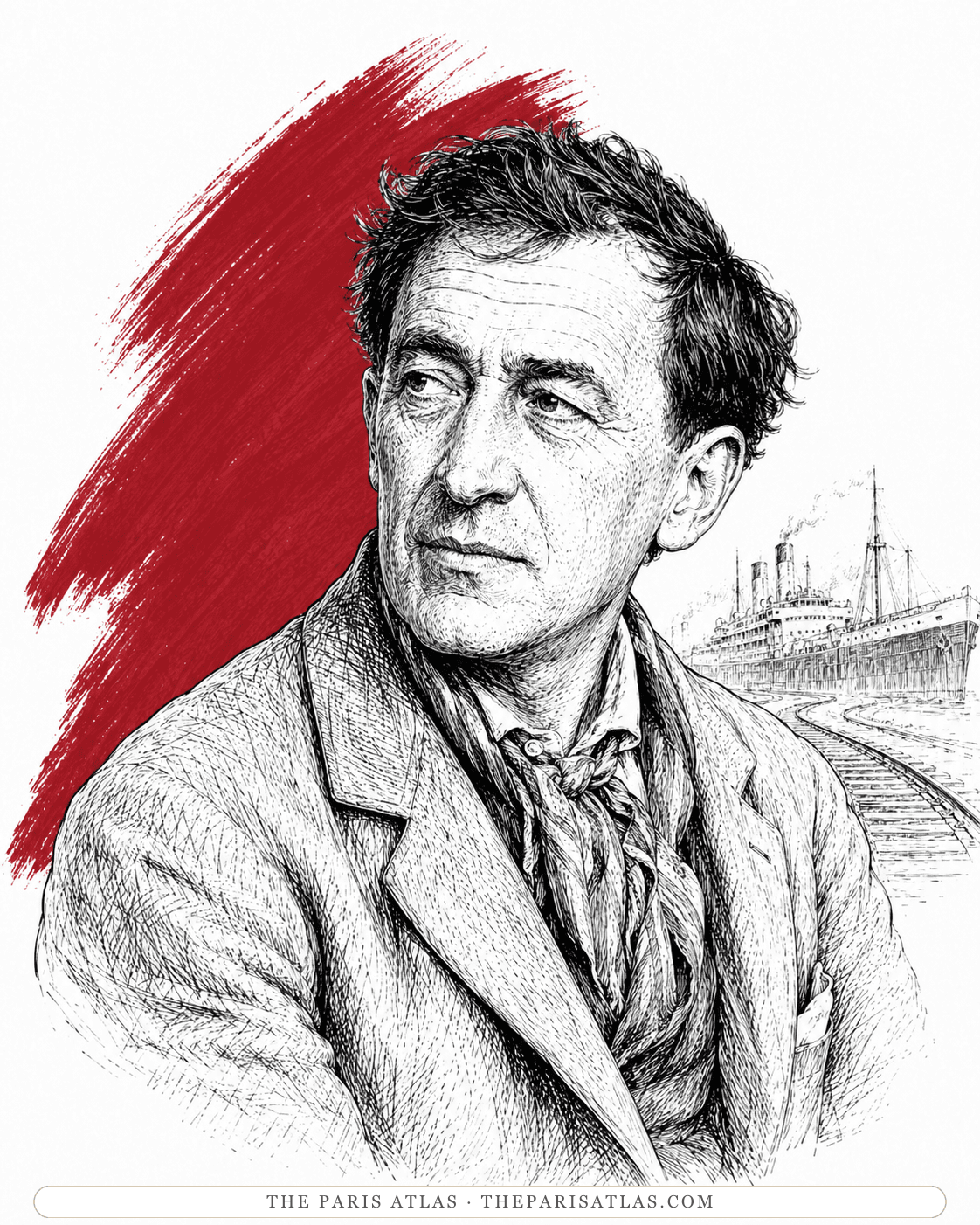
The Paris AtlasCharting the artists, works, and places worth returning to.
  • Photographer
· French · 1912–1994

Robert Doisneau

The photographer of the Paris nobody puts on a postcard — a boy from Gentilly, just outside the city gates, who trained as an engraver, spent five years shooting production lines at the Renault factory until he was sacked for turning up late, and then spent half a century photographing the suburbs, the bistros and the street. He took the kiss the whole world knows — Le Baiser de l'hôtel de ville, 'the kiss at the city hall' — in 1950 for Life magazine — and it was set up, with two young drama students he had hired.

Details

Lived
1912–1994
Born
14 April 1912
Birthplace
Gentilly, just south of Paris
Died
1 April 1994 · aged 81
Place of death
Paris
Nationality
French
Profession
Photographer
Children
Annette Doisneau, Francine Deroudille
Roles
Photographer

About Robert Doisneau

Robert Doisneau was born in 1912 at Gentilly, a small town pressed against the southern edge of Paris, and the geography is the whole story. He trained as an engraver and lithographer, drifted into photography through a lettering job and a pharmaceutical studio, and spent five years as an industrial photographer at the Renault car works at Billancourt before the company dismissed him in 1939 for repeated lateness. What he did with the rest of his life was photograph the ordinary parts of the Paris region — the banlieue, the working suburbs; the bistros; children in the street; the Liberation of the city in August 1944 — and he left roughly 450,000 negatives when he died in 1994.

One picture escaped the rest. Le Baiser de l'hôtel de ville, a young couple kissing on a crowded pavement outside the Paris city hall, was made in 1950 on a commission from the American magazine Life and turned, three decades later, into a poster that sold in enormous numbers. It was also arranged: Doisneau engaged two drama students and paid them to kiss for the camera, a fact that surfaced publicly only in the early 1990s, when strangers who believed they were the couple sued him. The revelation is the reason his work is worth arguing about — whether the affection in it is honest observation or a Paris made pleasant to order — and the estate his daughters run in Montrouge, just south of the city, answers that the tenderness was always cover for something harder.

Gentilly: the Paris the postcards leave out

He was born on 14 April 1912 at Gentilly, in what is now the Val-de-Marne: not Paris, but close enough to see it — one of the ring of communes just beyond the city's old fortifications where the workshops, the cheap housing and the industry sat. That ring is the banlieue, the French word for the suburbs, and it carried then, as it does now, a suggestion of somewhere visitors do not go. Doisneau spent his working life photographing it, and the town returned the compliment: since 1996 Gentilly has run a public photography centre in his name, the Maison de la Photographie Robert Doisneau, whose declared subjects are the suburbs and humanist photography — the postwar French school that took the ordinary lives of ordinary people as its proper material.

The training was a trade, not an art school. Between 1925 and 1929 he studied at the École Estienne in Paris, the city's school for the book trades, and came out with a diploma in engraving and lithography — printmaking skills, learned in order to be employable. In 1930 he was drawing lettering and picking up pharmaceutical photography at the Atelier Ullmann; in 1931 he was working as camera operator for the photographer and designer André Vigneau; in 1932, at twenty, he sold his first picture story to the Paris daily L'Excelsior. Nothing in that sequence suggests a career. It suggests a young man taking the work that came.

Five years at Renault, and the sack for turning up late

From 1934 to 1939 Doisneau was the industrial photographer at the Renault motor works at Billancourt, on the Seine at the western edge of Paris — the company's great car plant, and the emblem of French mass production. The job meant photographing what the company wanted photographed: the production lines, the machines, the finished cars, the pictures a firm uses to sell itself. He did it for five years, and in 1939 Renault dismissed him. The stated reason, in his own estate's official chronology, is chronic lateness: licencié pour retards répétés — sacked for repeated lateness.

It is a good story and it is also the hinge of his career, because being sacked made him a freelance. In the same year he met Charles Rado, the founder of the Rapho picture agency, and became an independent photographer for the first time. Rapho was an agency in the older sense — set up and run by men whose business was placing pictures, Rado first and from the 1940s Raymond Grosset, rather than by the photographers themselves. Doisneau stayed with it, on and off, for the rest of his life. It is the standing contrast with Henri Cartier-Bresson, who in 1947 helped found Magnum Photos precisely so that photographers would own the agency that sold their work.

The Liberation, and the suburbs with Blaise Cendrars

In August 1944 Paris rose against the German occupation, and Doisneau photographed it. The Musée Carnavalet, the city's museum of its own history, holds his pictures of those days — among them a print catalogued as Libération de Paris, 23 août 1944: French Forces of the Interior, the internal Resistance army, crouched behind a sandbag barricade at the corner of the boulevards Saint-Michel and Saint-Germain, beside the Roman baths of Cluny in the 5th arrondissement. Rifles, pistols, an unpaved street, and a group portrait of armed men in a quarter they lived in.

In 1945 he met the poet and novelist Blaise Cendrars at Aix-en-Provence — a Swiss-born writer in the French language, famous for having lost his right arm in the First World War and for a restless, sensory kind of prose — and the meeting produced the book that framed Doisneau's subject for good. La Banlieue de Paris set Cendrars's text against Doisneau's photographs of austere postwar working-class neighbourhoods on the city's edge. Cendrars, writing about how Doisneau worked, likened him to a thief intent on his target. In 1946 Doisneau went back to Rapho, now run by Raymond Grosset; in 1947 he met the poet Jacques Prévert and the writer Robert Giraud, chroniclers of the same bars and streets, and won the Kodak Prize.

Le Baiser de l'hôtel de ville, and what actually happened

In the spring of 1950 the American picture magazine Life sent Doisneau out on a light assignment: young couples kissing in public in Paris, a city where, the resulting article cheerfully claimed, lovers kiss wherever they want. The pictures ran in Life on 12 June 1950. One of them shows a young man and a young woman kissing on the pavement outside the Hôtel de Ville — the Paris city hall — while the crowd walks past them, blurred with movement. Nothing happened to it for thirty years. Then, in the 1980s, it was printed as a poster, and it sold in enormous numbers: a shorthand for Paris, for youth, and for the accidental beauty of the street.

The accident was arranged. Doisneau had not caught two strangers; he had engaged two young drama students, Françoise Delbart — later, by marriage, Françoise Bornet — and Jacques Carteaud, and paid them to kiss for his camera. He kept it to himself, and the picture spent decades being admired as a snatched instant of real life. In the early 1990s that became a legal problem: people who believed they recognized themselves in the photograph went to court against Doisneau, seeking damages and a share of what the image had earned. The cases forced the making of the picture into the open, and the answer was that the photographer had set it up. The claims failed, and Doisneau died in 1994 with the argument still going.

It is worth being exact about what the staging does and does not mean. Doisneau was on a magazine commission with a brief to fill, not making a documentary claim; hiring models for a picture story was and is ordinary magazine practice, and he never captioned it as a chance encounter. What he did do was let a picture built to order become the world's evidence that Paris looks like that. The photograph is not a lie about a couple. It is a photograph about a city, made the way advertisements are made, that spent forty years being read as a photograph about a couple.

Tenderness, and the argument about it

The commercial work continued alongside the personal work throughout: a contract with the fashion magazine Vogue from 1949 to 1951, then decades of assignments, while he went on hoarding pictures nobody had asked him for. He won the Prix Niépce — named for Nicéphore Niépce, who made the earliest surviving photograph — in 1956, the Grand Prix national de la photographie in 1983 and the Prix Balzac in 1986. His own account of the method was that he cruised obstinately where, as he put it, there is nothing to see — the furtive corners, the small pleasures lit by sun bouncing off city asphalt.

The charge against him has always been sentimentality: that the accordion players and kissing couples and grinning schoolboys add up to a Paris made agreeable for export, and that the staged Kiss proves it. The defence, put by the estate his daughters run, is that the tenderness was the surface and not the content — that it concealed the depth of his thinking, an irreverence toward power and authority, and a relentlessly free-thinking mind. Both can be true. The photographer who charmed the poster market is the same one who spent five years inside the Renault works and decades more in the suburbs, photographing a working France that fashionable photography had no use for.

He died in Paris on 1 April 1994, two weeks short of eighty-two, leaving about 450,000 negatives. His daughters Annette Doisneau and Francine Deroudille turned his flat at Montrouge — another commune on the southern rim, where he had worked for more than fifty years — into the Atelier Robert Doisneau, which conserves the archive and licenses the work; it is not open to the public. His own summary of the career is the one his estate still prints: he had fun throughout his lifetime, he said, building his own small theatre.

Life events

  1. 1912

    Born on 14 April at Gentilly, a commune on the southern edge of Paris.

    Robert Doisneau: Full Biography — the official dated chronology

  2. 1925–1929

    Studies at the École Estienne in Paris, the school of the book trades, and takes a diploma in engraving and lithography.

    Robert Doisneau: Full Biography — the official dated chronology

  3. 1930

    Works as a lettering designer at the Atelier Ullmann, learning pharmaceutical photography on the job; the following year he becomes camera operator for the photographer and designer André Vigneau.

    Robert Doisneau: Full Biography — the official dated chronology

  4. 1932

    Sells his first picture story to the Paris daily L'Excelsior, aged twenty.

    Robert Doisneau: Full Biography — the official dated chronology

  5. 1934–1939

    Industrial photographer at the Renault motor works at Billancourt, photographing production lines and finished cars.

    Robert Doisneau: Full Biography — the official dated chronology

  6. 1939

    Dismissed by Renault for repeated lateness; meets Charles Rado, founder of the Rapho agency, and turns freelance.

    Robert Doisneau: Full Biography — the official dated chronology

  7. 1944

    Photographs the Liberation of Paris in August; the Musée Carnavalet holds his picture of Resistance fighters behind a barricade at the boulevards Saint-Michel and Saint-Germain on 23 August.

    Libération de Paris – 23 août 1944 – F.F.I. derrière une barricade à l'angle des boulevards Saint-Michel et Saint-Germain, photograph by Robert Doisneau (inv. PH25234) (1944)

  8. 1945

    Meets the poet Blaise Cendrars at Aix-en-Provence; their book La Banlieue de Paris pairs Cendrars's text with Doisneau's photographs of the postwar working-class suburbs.

    Robert Doisneau: Full Biography — the official dated chronology; Gareth Harris, Meet Blaise Cendrars: the one-armed poet who worked with Sonia Delaunay, Fernand Léger and Robert Doisneau (2022)

  9. 1946

    Returns to the Rapho agency, by then headed by Raymond Grosset, and stays with it for the rest of his career.

    Robert Doisneau: Full Biography — the official dated chronology

  10. 1947

    Meets Jacques Prévert and Robert Giraud, and wins the Kodak Prize.

    Robert Doisneau: Full Biography — the official dated chronology

  11. 1949–1951

    Under contract to the fashion magazine Vogue — the commercial work running alongside the suburbs.

    Robert Doisneau: Full Biography — the official dated chronology

  12. 1950

    Shoots Le Baiser de l'hôtel de ville for an American magazine assignment on Parisian lovers, published in Life on 12 June; the couple are two drama students he engaged and paid.

    Speaking of Pictures: In Paris young lovers kiss wherever they want — Life, vol. 28, no. 24, 12 June 1950, pp. 16–18 (1950); Peter Hamilton, Robert Doisneau: A Photographer's Life (1995)

  13. 1956

    Wins the Prix Niépce; the Grand Prix national de la photographie follows in 1983 and the Prix Balzac in 1986.

    Robert Doisneau: Full Biography — the official dated chronology

  14. 1994

    Dies in Paris on 1 April, leaving roughly 450,000 negatives; his daughters turn his Montrouge flat into the Atelier Robert Doisneau.

    Robert Doisneau: Full Biography — the official dated chronology; An organization dedicated to conservation and branding — the Atelier Robert Doisneau at Montrouge

People they knew

Documented connections — every one carries its source.

Illustrated portrait of Blaise Cendrars

Blaise Cendrars

  • Author
  • Poet

Collaborated with · 1945

Doisneau met Cendrars at Aix-en-Provence in 1945, and the two made La Banlieue de Paris - Cendrars's text set against Doisneau's photographs of austere postwar working-class neighbourhoods on the edge of the city. Cendrars, writing about the way Doisneau worked, likened him to a thief intent on his target. The book fixed the suburbs as Doisneau's subject.

Robert Doisneau: Full Biography — the official dated chronology; Gareth Harris, Meet Blaise Cendrars: the one-armed poet who worked with Sonia Delaunay, Fernand Léger and Robert Doisneau (2022)

Organizations

Worked for · 1949–1951

Vogue

Doisneau held a contract with the fashion magazine Vogue from 1949 to 1951, according to his estate's official chronology - the commercial half of a career whose personal half was spent photographing the Paris suburbs. The Life assignment that produced Le Baiser de l'hotel de ville falls inside the same two years.

Robert Doisneau: Full Biography — the official dated chronology

Questions about Robert Doisneau

Who was Robert Doisneau?

A French photographer, born in 1912 at Gentilly on the southern edge of Paris and died in Paris in 1994, best known for warm black-and-white pictures of everyday life in and around the city — children, bistros, workers, the suburbs, the Liberation of Paris in 1944 — and above all for Le Baiser de l'hôtel de ville, the 1950 photograph of a couple kissing outside the city hall. He trained as an engraver, worked five years as Renault's factory photographer, and left about 450,000 negatives.

Is Doisneau's Kiss real or staged?

Staged. The photograph was made in the spring of 1950 for the American magazine Life, which had commissioned a light story about young couples kissing in public in Paris; it appeared in the issue of 12 June 1950. The couple were not strangers caught by chance. Doisneau engaged two young drama students and paid them to kiss for the camera. He did not announce this, and for thirty years the picture was admired as a snatched instant of real life.

Who are the couple in Le Baiser de l'hôtel de ville?

Françoise Delbart, who later married and became Françoise Bornet, and Jacques Carteaud — two drama students Doisneau engaged for the assignment. Their identity became public in the early 1990s, when other people who believed they were the couple in the picture sued Doisneau for damages and a share of what the image had earned. The court cases forced the staging into the open. The claims failed.

Why was Doisneau fired from the Renault factory?

For turning up late, repeatedly. He was the industrial photographer at Renault's works at Billancourt from 1934 to 1939, shooting the production lines and the cars, and the company let him go in 1939 — his own estate's official chronology records the reason as licencié pour retards répétés, dismissed for repeated lateness. He met Charles Rado of the Rapho picture agency the same year and became a freelance, which is the career he is remembered for.

What was the Rapho agency, and how did it differ from Magnum?

Rapho was the picture agency Doisneau worked through for most of his life, founded by Charles Rado and later run by Raymond Grosset — an agency of the older kind, set up and directed by people whose business was selling photographs. Magnum Photos, founded in 1947 by Henri Cartier-Bresson, Robert Capa, David Seymour, George Rodger and William Vandivert, was the opposite arrangement: a cooperative owned by its photographer members, so that they kept their negatives and chose their own stories. The two men are usually paired as the faces of French humanist photography — the postwar school that made ordinary life its subject; they sold their work through very different machines.

Was Doisneau's Paris sentimental?

That is the standing argument about him, and it is fair to put both sides. The accordion players, the kissing couples and the grinning schoolboys have been read as a Paris made pleasant for export, and the staged Kiss is the strongest evidence for the charge. Against it: he spent five years photographing inside the Renault works and decades photographing the suburbs, subjects fashionable photography ignored, and his estate argues the tenderness was surface — that it concealed the depth of his thinking, an irreverence toward power and authority, and a relentlessly free-thinking mind.

Where can you see Robert Doisneau's photographs in Paris?

The Musée Carnavalet, the city's museum of the history of Paris, holds Doisneau photographs including his pictures of the Liberation in August 1944. At Gentilly, the town he was born in, the Maison de la Photographie Robert Doisneau has been running since 1996 as a public photography centre devoted to the suburbs and to humanist photography — though it holds no Doisneau collection of its own, since the archive is with his estate. The Atelier Robert Doisneau at Montrouge, run by his daughters in the flat where he worked for over fifty years, keeps the negatives and is not open to visitors.

Sourced claims

Every connection the graph holds for Robert, with the evidence behind it.

Collaborated with · 1945

Blaise Cendrars

Doisneau met Cendrars at Aix-en-Provence in 1945, and the two made La Banlieue de Paris - Cendrars's text set against Doisneau's photographs of austere postwar working-class neighbourhoods on the edge of the city. Cendrars, writing about the way Doisneau worked, likened him to a thief intent on his target. The book fixed the suburbs as Doisneau's subject.

Robert Doisneau: Full Biography — the official dated chronology; Gareth Harris, Meet Blaise Cendrars: the one-armed poet who worked with Sonia Delaunay, Fernand Léger and Robert Doisneau (2022)

Worked for · 1949–1951

Vogue

Doisneau held a contract with the fashion magazine Vogue from 1949 to 1951, according to his estate's official chronology - the commercial half of a career whose personal half was spent photographing the Paris suburbs. The Life assignment that produced Le Baiser de l'hotel de ville falls inside the same two years.

Robert Doisneau: Full Biography — the official dated chronology

References

References

The sources below include biographies, scholarly essays, interviews, and primary materials that informed this page. They reflect both the historical record and ongoing critical conversations about Robert Doisneau and their work.

  1. 1Robert Doisneau: Full Biography — the official dated chronology

    Atelier Robert Doisneau, Montrouge

    The estate's official dated chronology — the source for every year on this page.

    View source
  2. 2The photographer Robert Doisneau — the estate's account of his subjects and method

    Atelier Robert Doisneau, Montrouge

    The estate's account of his method, subjects and temperament.

    View source
  3. 3An organization dedicated to conservation and branding — the Atelier Robert Doisneau at Montrouge

    Atelier Robert Doisneau, Montrouge

    The Montrouge studio-archive: founders, holdings, access.

    View source
  4. 4Présentation — Maison de la Photographie Robert Doisneau, Gentilly

    Établissement public territorial Grand-Orly Seine Bièvre

    The public photography centre at Gentilly, on his birthplace and on humanist photography.

    View source
  5. 5Libération de Paris – 23 août 1944 – F.F.I. derrière une barricade à l'angle des boulevards Saint-Michel et Saint-Germain, photograph by Robert Doisneau (inv. PH25234)

    Musée Carnavalet – Histoire de Paris / Paris Musées Collections, 1944

    Musée Carnavalet's catalogue record for one of his Liberation photographs.

    View source
  1. 6Meet Blaise Cendrars: the one-armed poet who worked with Sonia Delaunay, Fernand Léger and Robert Doisneau

    The Art Newspaper, 2022

    On the Cendrars collaboration and La Banlieue de Paris.

    View source
  2. 7Robert Doisneau: A Photographer's Life

    Abbeville Press, New York, 1995

    The standard English-language biography, published the year after his death.

  3. 8Speaking of Pictures: In Paris young lovers kiss wherever they want — Life, vol. 28, no. 24, 12 June 1950, pp. 16–18

    Life (Time Inc., New York), 1950

    The Life article the Kiss was made for, and where it first appeared.

  4. 9About Magnum: Overview — the cooperative's own account of its founding

    Magnum Photos

    For the contrast between Rapho and the photographer-owned Magnum.

    View source
i
Why these sources are here

These references anchor the page in the documented record and in the scholarly conversations around Robert Doisneau. Every claim on this page traces back to one or more of the works listed here.

Explore more resources