The Paris AtlasCharting the artists, works, and places worth returning to.

In their own words

Victor Hugo quotes

6 quotations, each verified against its source and credited to the work it comes from — the wording as Victor Hugo wrote or said it, not as the internet passes it around.

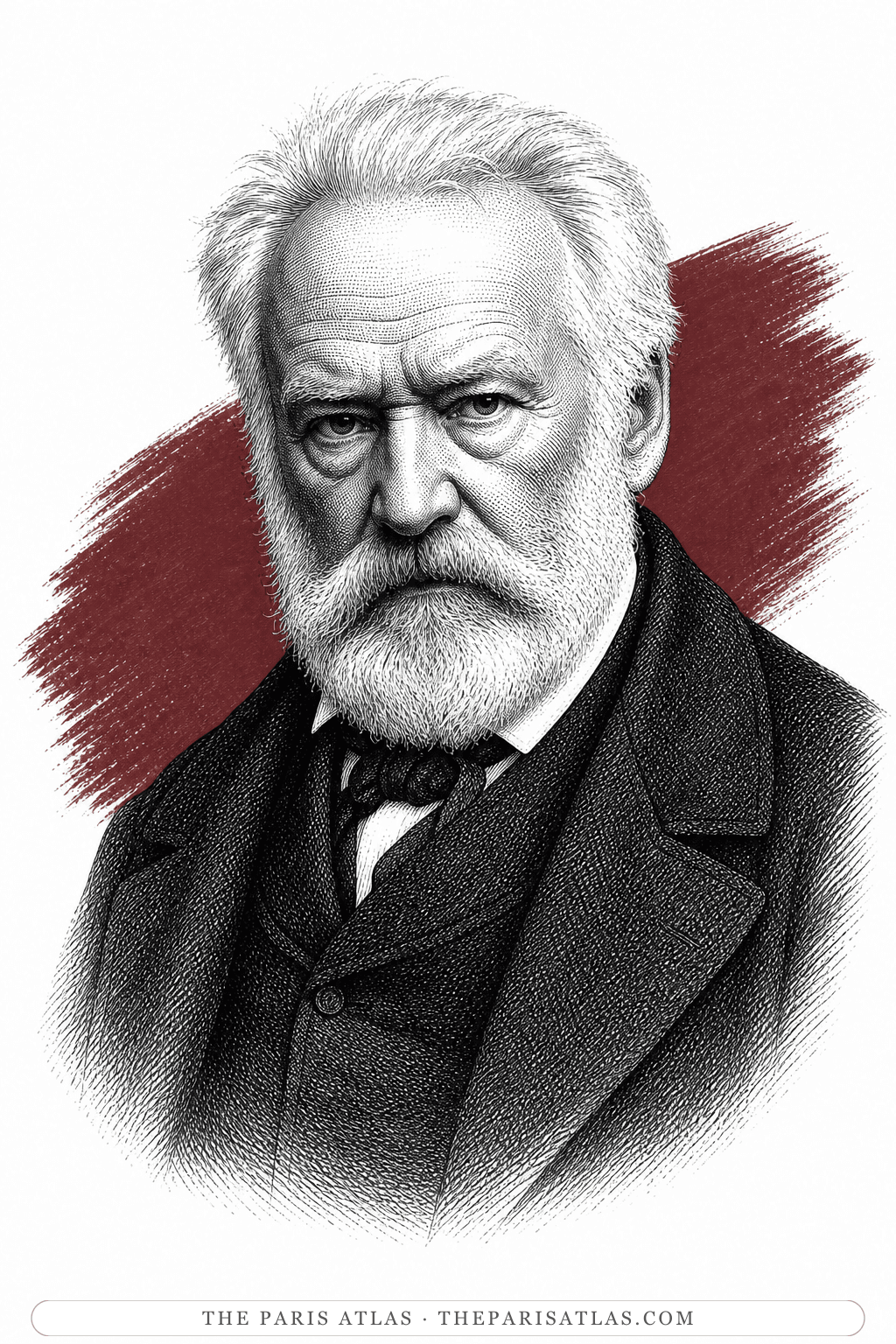
Illustrated portrait of Victor Hugo

How these quotes were checked

How we decide whether a quote is genuine

Victor Hugo is quoted everywhere, and much of what circulates over his name comes from somewhere else — most often from the 1980s musical of Les Misérables, whose English lyrics are routinely mistaken for the novel. Every quote above is checked verbatim against a printed translation: Isabel F. Hapgood's standard English Les Misérables, and the Joyce and Locker translation of The History of a Crime.

The three most famous cases are settled below.

Four famous Hemingway quotes, fact-checked

A sentence linked to Hemingway may be exact, shortened, remembered by someone else, or unsupported. Each label below explains what the available evidence actually proves.

Common paraphrase

Nothing is more powerful than an idea whose time has come.

What Hugo published, in The History of a Crime, is: “An invasion of armies can be resisted; an invasion of ideas cannot be resisted.” The famous English form — an idea whose time has come — appears nowhere in the translated text and reshapes the sentence into something Hugo did not write. It hardened into its modern shape in twentieth-century English quotation books.

  • Victor Hugo, The History of a Crime — translated by T. H. Joyce and Arthur Locker (Project Gutenberg #10381) (1877)

Misattributed

To love another person is to see the face of God.

This is a lyric from the 1980s stage musical of Les Misérables, from the finale's English text, not a sentence of Hugo's. It does not appear in Hapgood's translation of the novel. The novel's nearest thought — the bishop's, that to be loved is the supreme happiness — is given as a verified quote above.

  • Victor Hugo; trans. Isabel F. Hapgood, Les Misérables — translated by Isabel F. Hapgood (Project Gutenberg #135) (1862)
Misattributed

Even the darkest night will end and the sun will rise.

Also from the musical's English lyrics, not from the novel. The line does not appear in Hapgood's translation of Les Misérables.

  • Victor Hugo; trans. Isabel F. Hapgood, Les Misérables — translated by Isabel F. Hapgood (Project Gutenberg #135) (1862)
An invasion of armies can be resisted; an invasion of ideas cannot be resisted.
Victor Hugo, The History of a Crime (1877), conclusion
The supreme happiness of life consists in the conviction that one is loved; loved for one's own sake—let us say rather, loved in spite of one's self; this conviction the blind man possesses.
Victor Hugo, Les Misérables (1862), translated by Isabel F. Hapgood
Love is the only ecstasy. All the rest weeps. To love, or to have loved,—this suffices. Demand nothing more. There is no other pearl to be found in the shadowy folds of life. To love is a fulfilment.
Victor Hugo, Les Misérables (1862), translated by Isabel F. Hapgood
He who does not weep does not see.
Victor Hugo, Les Misérables (1862), translated by Isabel F. Hapgood
There is nothing like dogma for bringing forth dreams. And there is nothing like dreams for engendering the future. Utopia to-day, flesh and blood to-morrow.
Victor Hugo, Les Misérables (1862), translated by Isabel F. Hapgood
Curiosity is a sort of gluttony. To see is to devour.
Victor Hugo, Les Misérables (1862), translated by Isabel F. Hapgood

Questions about Victor Hugo quotes

Did Victor Hugo write “To love another person is to see the face of God”?

No. It is a lyric from the English text of the 1980s Les Misérables musical, and it does not appear in the novel. Hugo's own version of the thought is the bishop's: “The supreme happiness of life consists in the conviction that one is loved.”

Did Hugo say “Nothing is more powerful than an idea whose time has come”?

Not in those words. His sentence, from The History of a Crime, is “An invasion of armies can be resisted; an invasion of ideas cannot be resisted.” The familiar version is a twentieth-century rewrite.

Which translation do these quotes use?

Isabel F. Hapgood's translation of Les Misérables — the standard complete English text, checked against the full Project Gutenberg edition — and the Joyce and Locker translation of The History of a Crime for the invasion-of-ideas sentence.

Are these lines Hugo's own voice or his characters'?

All six are the narrator's or Hugo's own. Unlike Balzac, whose sharpest lines belong to his villains, Hugo's famous sentences are mostly his commentary — the novel keeps stopping to let him speak.

References

References

The sources below are the editions, archives, and full-text searches used to verify the quotations on this page. Every line was checked against one or more of them before it appeared here.

  1. 1Les Misérables — translated by Isabel F. Hapgood (Project Gutenberg #135)

    Novel
    Project Gutenberg, 1862
    Used for

    Five of the six quotes and both musical-lyric absence checks.

    View source
  2. 2The History of a Crime — translated by T. H. Joyce and Arthur Locker (Project Gutenberg #10381)

    Memoir
    Project Gutenberg, 1877
    Used for

    The invasion-of-ideas sentence and its paraphrase check.

    View source
i
Why these sources are here

Verification is the point of this collection: a quotation is listed only when its wording has been checked against the sources above, and the attribution notes record what each check found about the famous lines that failed.

Explore more resources

The Friday Letter

One story from the atlas, every Friday.

No algorithms chasing attention. A work, a place, and the connection between them — with the history checked.

One email a week. No spam, no selling your address. Unsubscribe anytime.

