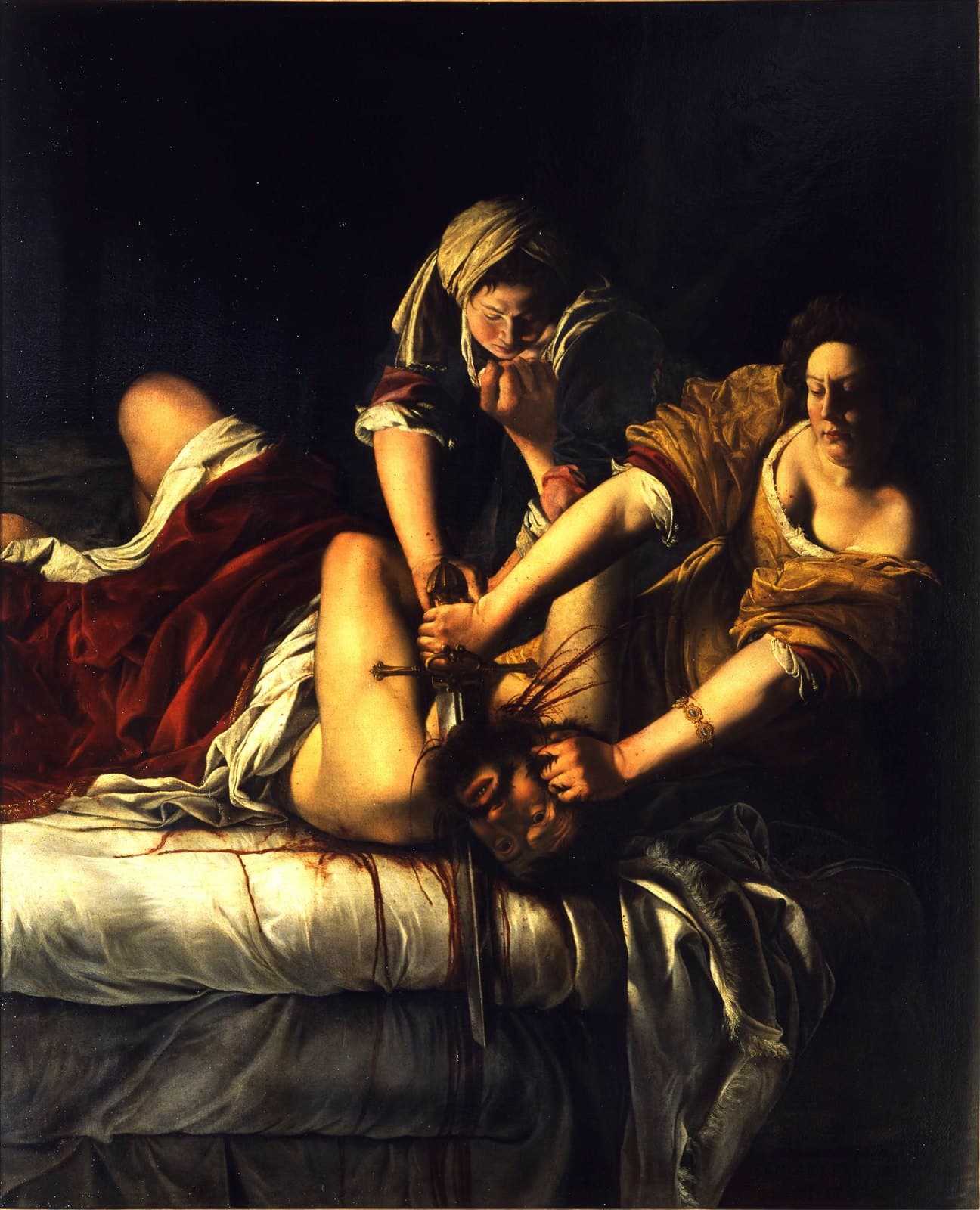
Artemisia Gentileschi painted Judith Beheading Holofernes around 1620. It hangs in the Uffizi Gallery in Florence. Judith, a widow, kills the enemy general Holofernes while her maidservant holds him down on the bed.
Judith Beheading Holofernes, also called Judith Slaying Holofernes, is an oil painting by Artemisia Gentileschi, dated to approximately 1620 and housed in the Uffizi Gallery, Florence. It represents the biblical heroine Judith killing an enemy commander with the assistance of her maidservant. This is the later, Florentine version of the composition, distinct from Gentileschi's earlier painting of the same subject in Naples.
Its significance extends beyond the severity of its subject. Gentileschi makes the women's strength, coordination, and determination essential to the action, presenting the killing as a difficult physical undertaking rather than an effortless symbolic victory.
The Biblical Story
In the Book of Judith, the Jewish widow Judith saves her community from the army commanded by Holofernes. She enters the enemy camp beautifully dressed and gains access to the general, who is attracted to her. After a banquet leaves him drunk, she takes advantage of his vulnerability and cuts off his head. The narrative presents an apparently powerless woman overcoming military domination through courage, strategy, and divine assistance. Gentileschi selects the killing itself rather than the heroine's departure with the severed head.
Artemisia's Career and the Two Versions
Gentileschi trained with her father, Orazio Gentileschi, and developed her career in artistic environments shaped by Caravaggio's naturalism. After moving to Florence, she gained important patrons and entered the city's Accademia delle Arti del Disegno in 1616. Her professional achievements required navigating a system in which women faced significant restrictions on training, mobility, and access to commissions.
Her earlier treatment of Judith Beheading Holofernes, usually dated around 1612–1613, belongs to the Museo e Real Bosco di Capodimonte in Naples. Both paintings show Judith and her attendant physically overpowering Holofernes, but the Uffizi version revises and intensifies the arrangement. Judith's golden-yellow dress is among its most recognizable features, distinguishing it from the blue costume in the earlier painting. The second version should therefore be understood as a developed reconsideration of the composition, not simply another name for the same canvas.
Published sizes for this canvas disagree. The Uffizi's own catalogue entry gives 146.5 by 108 centimetres; 199 by 162.5 centimetres is the figure printed in most other accounts.
Composition, Color, and Physical Effort
The figures are crowded into a shallow space, with the bed pushed close to the picture's edge. Their arms form an interlocking structure around Holofernes's struggling body. Judith braces herself while controlling his head and working the sword; the attendant presses downward to restrain him. The arrangement makes their cooperation necessary to the outcome. Dramatic illumination separates their bodies and richly colored clothing from the dark background, while the pale sheets make the violence especially conspicuous.
Gentileschi's attention is not limited to the instant of the blade's movement. She considers how weight, resistance, and leverage operate between the three figures. This interest in the practical realities of a dramatic event is central to the picture's naturalism. Its impact comes from a convincing interaction among bodies, not simply from the presence of blood.
The Importance of the Maidservant
One of Gentileschi's most consequential changes concerns Judith's attendant, traditionally called Abra. In the biblical narrative, the maid waits outside while Judith carries out the killing. Gentileschi brings her into the scene and makes her an active participant. She is neither a decorative companion nor a passive witness: her intervention helps make the victory possible.
This emphasis belongs to a broader feature of Gentileschi's work, in which women frequently support one another during moments of danger or vulnerability. The painting can consequently be read as an image of shared female action as well as individual heroism. That interpretation rests on what the artist actually depicts, without requiring speculation about the identities of her models.
Is It a Revenge Painting?
Gentileschi was raped by the painter Agostino Tassi in 1611, and the subsequent trial in 1612 is extensively documented. These events have understandably shaped modern interpretations of her forceful heroines. However, they do not establish that Judith is a self-portrait, that Holofernes represents Tassi, or that revenge was the painting's sole purpose.
As the National Gallery emphasizes, intensely violent biblical paintings were popular among seventeenth-century patrons and artists more generally.
Gentileschi was also responding to an established subject, competing with other painters, and demonstrating her command of demanding history painting. Her biography matters, but reducing the work to a direct illustration of personal trauma obscures its professional, religious, and artistic contexts.
Reception and the Struggle to Be Paid
The Uffizi records that the painting's uncompromising naturalism provoked a difficult reception in Florence and that it was not initially accorded prominent gallery display. Gentileschi also struggled to obtain the payment associated with the commission. According to the museum's account, Galileo Galilei helped her secure the overdue money. The episode reveals another dimension of the work's history: behind a now-celebrated image stood an artist negotiating recognition and compensation from powerful patrons.
Close reading
Reading the work, detail by detail
Artemisia Gentileschi builds the killing out of hands, weight, and cloth. These six views follow the two women's grip on Holofernes, the dress and jewelry that identify Judith, and the blood on the bed.
1.Judith's face
Judith watches what she is doing but leans her head back, away from the blood. Her mouth is closed and her brow is drawn in, so the face reads as effort and concentration rather than fury.
2.The yellow dress and the bracelet
The golden-yellow dress is the fastest way to tell this painting from Gentileschi's earlier Naples version, where Judith wears blue. The sleeve is shoved back to the elbow and a gold bracelet sits on the working arm.
3.The maidservant's grip
Abra, Judith's attendant, holds Holofernes down with her whole upper body. In the Book of Judith the maid waits outside the tent, so putting her hands on the general is Gentileschi's own change to the story.
4.The sword and the two arms
The sword is vertical and both women's arms cross around it. Reading the arms in order shows why the picture needs two people: neither woman is holding the man down and cutting at the same time.
5.Holofernes's face
Holofernes is awake. His eyes are open and turned up toward the women, which is what makes the scene a struggle between three people rather than the killing of a sleeping man.
6.Blood on the sheets
The blood runs down the white linen in thin separate lines rather than one pool. The pale sheet is the brightest thing in the lower half of the painting, so the red on it is impossible to miss.
The painter Agostino Tassi rapes Artemisia Gentileschi in Rome.
1612
The trial that follows the rape is held in Rome. Its proceedings are extensively documented, and Tassi is found guilty.
circa 1612–1613
Gentileschi paints her earlier version of Judith Beheading Holofernes, now in the Museo e Real Bosco di Capodimonte in Naples.
1616
Gentileschi enters Florence's Accademia delle Arti del Disegno, the city's academy of art and design.
circa 1620
Gentileschi paints the version of Judith Beheading Holofernes that hangs in the Uffizi Gallery in Florence.
Where to see it
Uffizi Gallery
Florence, Italy
A public viewing address has not yet been confirmed for this holding.
The Uffizi is in Florence, and the museum lists this painting in room D29, Caravaggio and Artemisia. Gallery locations change; check the museum's object record before making a special visit.
Frequently asked questions
Where is Artemisia Gentileschi's Judith Beheading Holofernes?
This painting is in the Uffizi Gallery in Florence. Gentileschi painted an earlier version of the same subject, and that one belongs to the Museo e Real Bosco di Capodimonte in Naples, so the two are often confused.
How many versions of Judith Beheading Holofernes did Artemisia Gentileschi paint?
Two. The earlier one is usually dated around 1612–1613 and hangs in Naples. The Uffizi painting of about 1620 revises and intensifies the arrangement rather than repeating it. The second version is a reconsideration of the composition, not another name for the same canvas.
How do you tell the Uffizi painting from the earlier Naples one?
Judith's golden-yellow dress is the quickest way to tell them apart, because she wears blue in the earlier Naples painting. Both paintings show Judith and her attendant physically overpowering Holofernes, but the Uffizi version rearranges the figures.
What story does the painting show?
It shows the moment in the Book of Judith when the Jewish widow Judith cuts off the head of Holofernes, the general commanding the army that is threatening her community. Judith enters the enemy camp beautifully dressed, gains access to the general, waits until a banquet leaves him drunk, and then kills him. Gentileschi chose the killing itself rather than Judith's departure with the severed head.
Who is the second woman in the painting?
She is Judith's attendant, traditionally called Abra. In the Book of Judith the maid waits outside while Judith carries out the killing, but Gentileschi brings her into the scene and makes her an active participant whose intervention helps make the victory possible.
Is Judith Beheading Holofernes a revenge painting about Artemisia Gentileschi's rape?
The evidence does not establish that. Gentileschi was raped by the painter Agostino Tassi in 1611, and the trial in 1612 is extensively documented. Those events do not establish that Judith is a self-portrait, that Holofernes represents Tassi, or that revenge was the painting's sole purpose. Violent biblical paintings were popular among seventeenth-century patrons and artists more generally.
How was the painting received in Florence?
The Uffizi records that the painting's uncompromising naturalism provoked a difficult reception and that it was not initially given a prominent place in the gallery. Gentileschi also struggled to obtain the payment associated with the commission, and by the museum's account Galileo Galilei helped her secure the overdue money.
In the atlas
What the graph records about this work — every claim carries its citation.
The Uffizi dates the painting to about 1620 and files it in the room it shares with Caravaggio, whose dramatic lighting and close, physical realism the picture works in. The dark ground, the single strong light on the three figures, and the interest in what the killing costs the two women are the Baroque manner Gentileschi trained in.
— Artemisia Gentileschi, Judith Beheading Holofernes — collection record, Inventory 1890 n. 1567; Why so violent? — Artemisia Gentileschi and depictions of violence in early 17th-century painting
References
References
The sources below include collection records, catalogues, scholarly research, and primary materials that informed this page. They document Judith Beheading Holofernes, its making, and its place in cultural history.
1Artemisia Gentileschi, Judith Beheading Holofernes — collection record
Website
Gallerie degli Uffizi
Used for
The museum's own record: date, technique, room, the biblical story, and the account of the painting's reception and payment in Florence.
Biography: training under her father Orazio Gentileschi, the 1611 rape by Agostino Tassi and the 1612 trial, the move to Florence, and her 1616 admission to the academy.
4Why so violent? — Artemisia Gentileschi and depictions of violence in early 17th-century painting
Website
The National Gallery, London, via Google Arts & Culture
Used for
The National Gallery on the physical effort Gentileschi depicts, and on how common violent biblical subjects were among seventeenth-century artists and patrons.
5Artemisia Gentileschi: The Image of the Female Hero in Italian Baroque Art
Nonfiction
Princeton University Press, 1989
Used for
The scholarly source behind the description of the two women forcing Holofernes down with interlocking arms.
6Artemisia
Exhibition catalogue
National Gallery Company, London, 2020
Used for
The National Gallery's exhibition catalogue, cited for the painting's use of chiaroscuro, the contrast of light and dark.
7The Artemisia Files: Artemisia Gentileschi for Feminists and Other Thinking People
Essays
The University of Chicago Press, 2005
Used for
Cited for the contrast between the spilled blood and the white sheets of the bed.
i
Why these sources are here
These references provide the documented foundation for this work's history and interpretation. Claim-level citations remain attached to the specific claims they support.



 View source