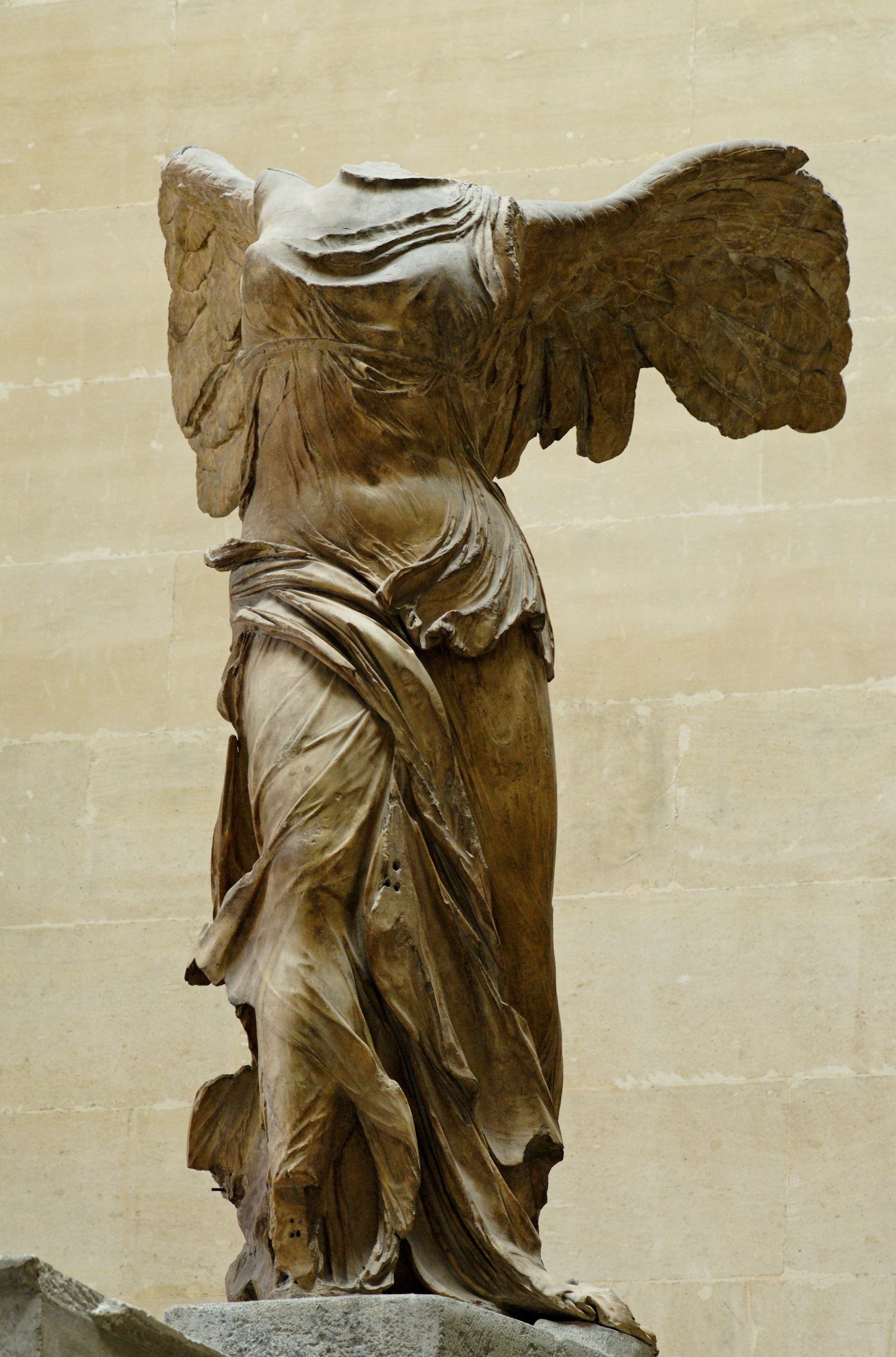
Winged Victory of Samothrace
by
A winged Greek goddess landing on the prow of a stone warship, carved in the early second century BC and found in pieces on the island of Samothrace in 1863. She is headless and armless, stands more than three metres tall, and has been the first thing visitors see at the top of the Louvre's Daru staircase for over a century.
- First quarter of the 2nd century BC
- Parian marble figure on a ship-shaped base of Lartos marble
What you are actually looking at
A woman with enormous open wings, carved from white marble, standing on the front end of a ship — also carved from marble, in a different and greyer stone. She is 328 centimetres tall on her own. With the ship and its base underneath her, the monument stands 564 centimetres, about eighteen and a half feet.
She has no head and no arms. The left side and back of her chest are lost, along with her right foot, her left calf and foot, and the drapery at the back of her legs. What survives is the torso, the legs, the wings and the thin wet-looking dress pressed against her by the wind.
The figure is a Nike — the Greek word for victory, and the name of the goddess who personified it. She is shown at the instant of landing on the deck of a warship, one leg forward, wings still braced against the air. The whole thing is a piece of theatre about arriving.
What she was for
This was not a decorative statue. In the Greek world a Nike set on a ship's prow was a victory monument: the record of a naval battle won, set up in a sanctuary so that the gods and everyone else could see who had won it. The ship is the point as much as the goddess is.
She stood in the Sanctuary of the Great Gods on Samothrace, a small mountainous island in the northern Aegean. The sanctuary was a major religious site with an initiation cult, visited from across the Greek world, and it collected offerings of exactly this kind.
The Louvre dates her to the first quarter of the second century BC — roughly 200 to 175 BC. Which battle she commemorates, and which state paid for her, are not settled.
Found in pieces, and shipped to Paris in three deliveries
Charles François Champoiseau, a French vice-consul, found her on Samothrace in 1863. She was not standing: she was in fragments, and so was the ship.
The pieces reached the Louvre across nearly thirty years and three separate consignments — 1864, 1879 and 1891 — as Champoiseau returned to the site and more of the monument was recovered. The figure and her ship were assembled in Paris from that accumulation, which is why the statue's history in the museum is really the history of a reconstruction.
The two stones tell you the parts came from different quarries and were made as a set: the goddess is Parian marble, the fine white stone from the island of Paros, while the ship and its plinth are cut from Lartos marble, a grey stone from Rhodes.
The hand in the case beside her
There is a glass case on the same landing holding a large marble right hand. It belongs to her, and its story explains why she is displayed without it.
The hand came out of later excavations at the site by the Institute of Fine Arts at New York University and the Austrian Institute of Art and Archaeology. It reached the Louvre in two instalments — two fingers in 1950, the palm in 1954. What survives is the palm with the thumb and ring finger; it is 28 centimetres long and 17 wide, and the pieces have been re-joined with plaster filling the minor losses.
It is not owned by the Louvre. The hand is on long-term loan from the Archaeological Museum of Samothrace and the Kunsthistorisches Museum in Vienna, which is a plain reminder that the monument is dispersed across several institutions and countries.
The open hand also settles an old argument. She was long imagined blowing a trumpet; an empty, open palm suggests instead a raised hand in a gesture of greeting or announcement.
The staircase, and the 2014 restoration
She stands in Room 703 of the Denon wing, on the Samothrace landing partway up the Daru staircase, and the placement is deliberate: the staircase turns, and she appears above you at the turn. It is one of the few pieces of stagecraft in the Louvre that is genuinely close to how the object was meant to be seen, since she was designed to be looked at from below.
The monument was taken apart and restored in a campaign completed in 2014. The museum's stated aims were to fix structural problems in the assembly and to bring back the original tones of both marbles, which had darkened and diverged over a century of display. More than 6,700 donors contributed to the work.
The cleaning restored something that had been lost: two different-coloured stones, the white goddess and the grey ship, reading as the two separate things they always were.
Close reading
Reading the work, detail by detail
The Winged Victory was designed as a naval monument seen from below, not as an isolated museum figure. The details show wind pressing cloth against the body, wings opening into space, and the ship's prow completing the forward surge.
1.Stone cloth makes the wind visible
Thin folds cling to chest and abdomen while heavier fabric twists around the legs. The body does not simply wear cloth; it becomes the surface on which an invisible headwind registers.
2.The wings turn a standing figure into an arrival
The wings open behind the torso with unequal profiles, giving the monument a directional push rather than perfect symmetry. Victory seems to have landed only this instant.
3.The ship's prow names the victory as naval
The paler figure stands on a darker stone prow whose angled forms project forward. Without this base she would be a generalized Nike; with it, the monument records victory at sea.
4.The broken neck redirects attention toward posture
Without a face, expression has to come from the lifted chest, turning torso, and wings. The loss intensifies attention to the body's arrival rather than ending the sculpture's action.
5.The forward leg gives the landing its next step
One leg pushes through clinging cloth and establishes movement toward the front of the prow. The figure seems to have landed, yet her stance still carries momentum.
6.Layered feathers make the wings structural rather than decorative
Overlapping rows describe how the great wings are built and direct movement outward. Their weight balances the wind-driven cloth across the front of the body.
Timeline
c. 200–175 BC
The monument is carved and set up in the Sanctuary of the Great Gods on Samothrace, commemorating a naval victory.
1863
Charles François Champoiseau, a French vice-consul, finds the statue in fragments on Samothrace.
1864, 1879, 1891
The pieces reach the Louvre in three separate consignments as more of the monument is recovered from the site.
1950 and 1954
Her right hand arrives on long-term loan — two fingers first, then the palm — and goes on show in a case beside her.
2014
A restoration campaign supported by more than 6,700 donors repairs the monument's structure and recovers the original tones of both marbles.
Where to see it
A viewing location has not yet been listed for this work.
Frequently asked questions
What is the Winged Victory of Samothrace?
An ancient Greek marble monument showing Nike, the goddess of victory, landing on the prow of a warship. It was carved in the first quarter of the second century BC, found on the island of Samothrace in 1863, and has been in the Louvre ever since. The figure is 328 cm tall; the whole monument including its ship-shaped base is 564 cm.
Why does she have no head or arms?
They were not recovered. She was found in fragments in 1863 and reassembled in Paris from pieces delivered in 1864, 1879 and 1891. Her right hand was found in later excavations and reached the Louvre in the 1950s; it is displayed separately in a case on the same landing. The head has never been found.
What does the statue commemorate?
A naval victory. A winged Nike standing on a ship's prow was a standard Greek victory monument, set up in a sanctuary to record a battle won at sea. She stood in the Sanctuary of the Great Gods on Samothrace. Which specific battle, and which state commissioned her, are not settled.
Where is the Winged Victory in the Louvre?
Room 703 in the Denon wing, on the Samothrace landing of the Daru staircase, on Level 1. She is placed to be seen from below as you come up the stairs, which is close to how she was originally meant to be viewed.
Whose hand is in the glass case next to her?
Hers — her right hand, found in later excavations at Samothrace and lent to the Louvre in two parts, two fingers in 1950 and the palm in 1954. It is 28 cm long. It remains the property of the Archaeological Museum of Samothrace and the Kunsthistorisches Museum in Vienna, and is on long-term loan.
Who made the Winged Victory of Samothrace?
Unknown. The Louvre's catalogue entry names no sculptor and the monument carries no signature — the same situation as the Venus de Milo, the museum's other famous Greek marble.
Why is the ship a different colour from the statue?
Because it is a different stone. The goddess is carved from Parian marble, the white marble of the island of Paros; the ship and plinth are Lartos marble from Rhodes, which is grey. The 2014 restoration cleaned both so the contrast reads as it was meant to.
References
The sources below include collection records, catalogues, scholarly research, and primary materials that informed this page. They document Winged Victory of Samothrace, its making, and its place in cultural history.


1Victoire de Samothrace — catalogue entry (Ma 2369)
WebsiteMusée du Louvre, Département des Antiquités grecques, étrusques et romaines, 2026Used forThe museum's catalogue record: date, the two marbles, the 328 cm and 564 cm measurements, Champoiseau's 1863 discovery, the three consignments, and the current room.
2Main de la Victoire de Samothrace — catalogue entry (Ma 2369 bis)
WebsiteMusée du Louvre, Département des Antiquités grecques, étrusques et romaines, 2026Used forCatalogue record for the right hand — the excavators, the 1950 and 1954 loan dates, its measurements, and the two institutions that own it.
3The Winged Victory of Samothrace — restoration campaign
WebsiteMusée du Louvre, 2026Used forThe Louvre's own account of the restoration campaign, its aims, and the 6,700 donors who funded it.

4The Nike of Samothrace: Setting the Record Straight
PeriodicalAmerican Journal of Archaeology, 2020Used forPeer-reviewed archaeological reassessment of the monument’s date, setting, reconstruction, and historical context.
These references provide the documented foundation for this work's history and interpretation. Claim-level citations remain attached to the specific claims they support.
 Explore more resources