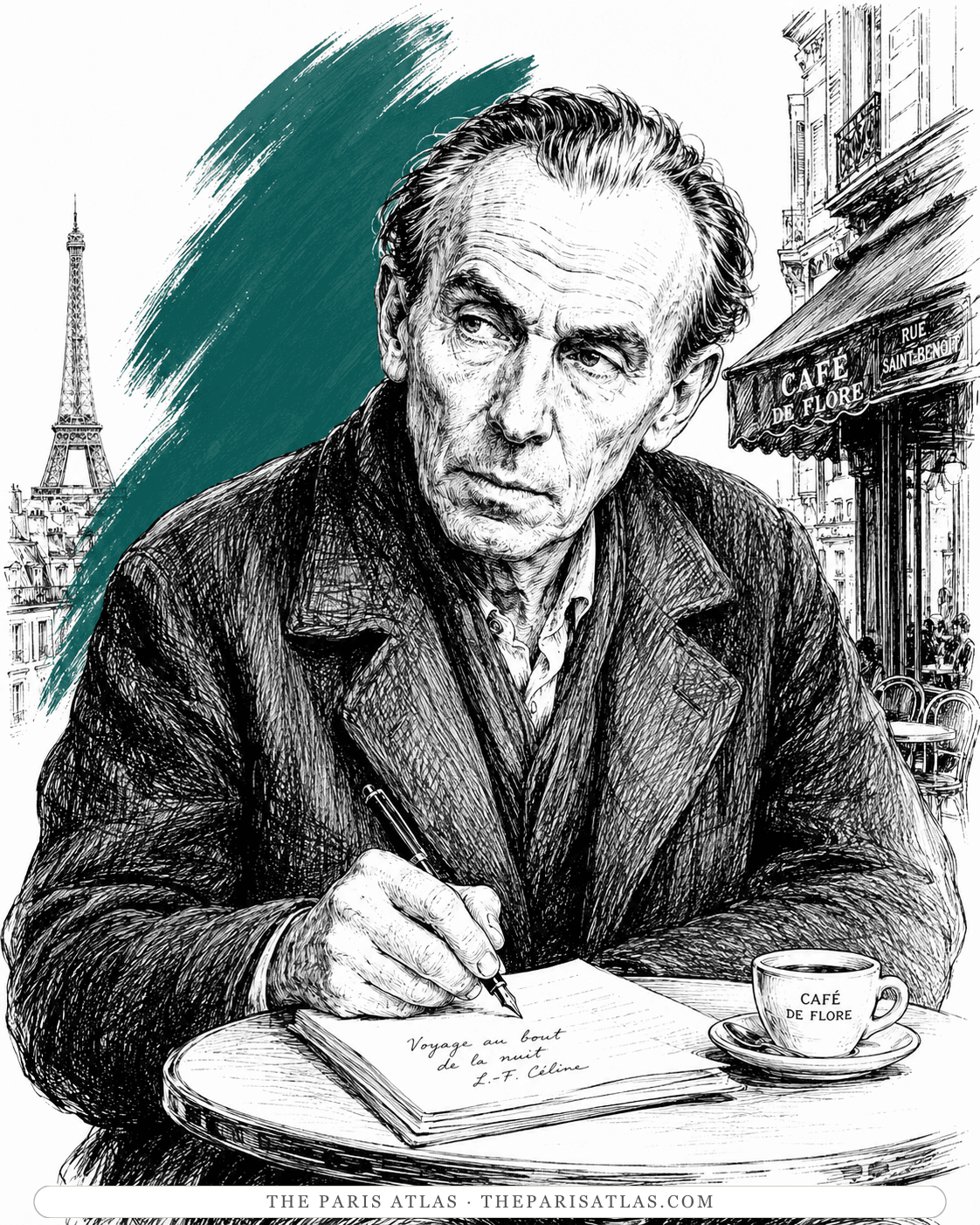
Louis-Ferdinand Céline
Le Feu brought the trenches into French prose from the ranks a generation before Journey — and Céline, famously stingy with admiration, named Barbusse among the few modern writers he rated.
The novelist of Le Feu — the Great War's first great trench book, written from the ranks at forty-one — and the standard both Céline and Hemingway measured war writing against.
Henri Barbusse was a French writer whose novel Le Feu, published in 1916 while the First World War was still being fought, is the first major book to describe trench warfare from inside it. He was born at Asnières-sur-Seine on 17 May 1873 and died in Moscow on 30 August 1935.
He was forty-one and did not have to serve. He volunteered anyway, spent months in the front line as an infantryman, and wrote the novel from the notebooks he kept there.
Le Feu — published in English as Under Fire — won the Prix Goncourt in December 1916, sold enormously, and was read by soldiers on both sides.[1] It was also read by the writers who came after: Siegfried Sassoon read it in hospital and said it strengthened his resolve to tell the truth about the war.
Barbusse spent the rest of his life as a communist. He joined the party in 1923, founded and edited papers, campaigned against fascism, and wrote a biography of Stalin. He died in Moscow while working on a second one.
Henri Barbusse was born on 17 May 1873 at Asnières-sur-Seine, outside Paris. His father, Adrien Barbusse, was a journalist and drama critic; his mother was English and died when he was three.
He published a book of poems, Pleureuses, in 1895, and three years later married Hélyonne Mendès, the daughter of the poet Catulle Mendès. He worked in journalism and then in publishing, as an editor at Hachette.
His early novels are decadent and pessimistic in the manner of the period. Les Suppliants appeared in 1903. L'Enfer, published in 1908 and translated into English as Hell, is narrated by a man in a Paris boarding house. He finds a hole in his bedroom wall and spends the book watching the room next door. Sex, birth, illness and death go past, observed and never interrupted. It sold well and was thought scandalous. Nothing in it predicts what he did next.
When war broke out in August 1914 Barbusse was forty-one, in poor health, and exempt from service. He enlisted in the infantry as a private and joined the 231st Infantry Regiment that December.[2]
He served for seventeen months in the front line, as a stretcher-bearer and a runner, and was cited twice for bravery. He was invalided out in 1916 with lung damage and exhaustion.
He kept notebooks throughout, and he was explicit that the novel came out of them: he had set out to record what he was seeing because he did not believe anyone at home understood it.
Le Feu: journal d'une escouade was serialised in the Paris daily L'Œuvre from August to November 1916, and published as a book by Flammarion late that year, while the Battle o[3]f Verdun was still going on.
It has almost no plot. It follows a squad of ordinary soldiers — a carter, a miner, a farm labourer — through mud, boredom, lice, cold, artillery and death, and it is written in their language, with the obscenity and the dialect left in. The famous chapter, The Dawn, ends with survivors lying in a flooded shell-hole arguing about what the war has been for.
Two things made it new. It described the physical conditions exactly, without heroism, at a time when official accounts did not. And it was published while the war continued, by a decorated soldier, which made it very hard to dismiss.
Le Feu won the Prix Goncourt in December 1916 and sold in the hundreds of thousands.
Not every reader accepted it. Nationalist critics said the book would damage morale and that no real squad had ever talked the way Barbusse's squad talks. Others complained about the last chapter, in which the survivors reach a political conclusion about who profits from the fighting, and said the argument had been bolted onto a documentary.
Barbusse did not dispute that the last chapter of Le Feu argues a political case. He had joined up to see the war, and he came out of it convinced that the men who fought it had nothing to gain from it. He put that conclusion inside the novel rather than saving it for afterwards.
Barbusse spent almost all of his working life in and around Paris. He was born at Asnières-sur-Seine, just outside the city, and from his twenties he worked in its newspaper offices and publishing houses. After the war he ran the Clarté group and then the paper Monde from Paris offices, and he spoke at meetings across the working-class suburbs.[4]
From 1919 he kept a house at Aumont-en-Halatte, in the forest of Halatte about fifty kilometres north of Paris, and wrote there whenever the political work let him. It was where he did most of his writing for the last sixteen years of his life, and the house is preserved.
Le Feu was translated into English in 1917 by Fitzwater Wray, as Under Fire: The Story of a Squad. Siegfried Sassoon read it that year while recovering in hospital and recorded that it hardened his determination to write about the war truthfully; his own public protest against the war's continuation followed.
Erich Maria Remarque's All Quiet on the Western Front, published in 1929, comes out of the same territory a decade later, and the two books are usually discussed together as the point where the soldier's account displaced the official one.
Barbusse came out of the war a pacifist and moved steadily left. In 1917 he helped found the ARAC, a republican veterans' association, and in 1919 the Clarté group, an international association of writers and intellectuals against war; he published a novel with the same title that year. He joined the French Communist Party in 1923.
For the rest of his life he wrote and organised full time. He founded and edited the weekly Monde in 1928, published two books in 1927 presenting Jesus as a revolutionary — Jésus and Les Judas de Jésus — and campaigned against the rise of fascism in Germany. In 1932 he and Romain Rolland organised the World Congress Against War at Amsterdam; the movement that grew out of it, known as Amsterdam-Pleyel after its two meeting places, was his last large piece of political work.
He travelled repeatedly to the Soviet Union, and in 1935 published Staline, a biography that presents Stalin admiringly and is now read chiefly as a document of how Western intellectuals of the period wrote about him.
Barbusse died of pneumonia in Moscow on 30 August 1935, aged sixty-two, while working on a second book about Stalin.
His body was returned to France by train. The funeral procession crossed Paris on 7 September and drew a crowd counted in the hundreds of thousands. He is buried at Père Lachaise, close to the Mur des Fédérés. In the decades that followed, French municipalities named a great many streets, squares and schools after him, most of them in towns with communist councils.
Le Feu changed what a war book could be. Before it, the literature of war was largely written from outside the fighting or after it, in a register that made the deaths meaningful. Barbusse wrote from the mud, while it was happening, in the soldiers' own words, and refused the consolation.
Later accounts of infantry war used the form he built. Remarque, Sassoon and Céline's Journey to the End of the Night all give the ordinary soldier his own account, in his own speech, with no redeeming purpose supplied at the end.
Soldiers wrote to Barbusse after Le Feu to tell him he had got the trenches right, which was part of why the book could not be dismissed as a civilian's invention.
As a communist he ran the literary pages of the party's daily paper, L'Humanité. He was in Moscow for a writers' congress in 1935 when he died there.
Born on 17 May at Asnières-sur-Seine, outside Paris, to a French journalist father and an English mother.
His mother dies when he is three.
Publishes his first poems in a Paris review while still at school.
Publishes Pleureuses, a book of poems.
Works in journalism and publishing in Paris.
Marries Hélyonne Catulle-Mendès, daughter of the poet Catulle Mendès.
Publishes the novel Les Suppliants.
Publishes the novel L'Enfer, a pessimistic book about a man watching life through a hole in a hotel wall.
War breaks out in August. Barbusse, forty-one, in poor health and exempt, enlists in the infantry as a private.
Is assigned to the 231st Infantry Regiment in December after enlisting.
Serves in the front line as a stretcher-bearer and runner, and is cited twice for bravery. He keeps notebooks throughout.
Takes part in the fighting in Artois and at the Argonne.
Is invalided out with lung damage and exhaustion after seventeen months at the front.
Le Feu is serialised in a newspaper through the year and published as a book in November, while the fighting at Verdun continues.
Wins the Prix Goncourt in December. The novel sells in the hundreds of thousands.
Siegfried Sassoon reads Le Feu in hospital and records that it hardened his determination to write truthfully about the war.
Le Feu is translated into English as Under Fire and read widely by soldiers and civilians in Britain.
The war ends. Barbusse comes out of it a pacifist and moves steadily left.
Helps found the Clarté group, an international association of writers and intellectuals against war.
Publishes Clarté, a novel of political awakening.
Travels and lectures for the Clarté movement across Europe.
Joins the French Communist Party.
Publishes Les Enchaînements.
Travels to the Soviet Union for the first of many visits.
Campaigns publicly for Sacco and Vanzetti.
Founds and edits the paper Monde.
Erich Maria Remarque's All Quiet on the Western Front is published, and is discussed alongside Le Feu as the soldier's account of the war.
Publishes a biography of Jesus, read through his own politics.
Helps organise the World Congress Against War at Amsterdam.
Campaigns against the rise of fascism in Germany after Hitler comes to power.
Helps organise the anti-fascist Amsterdam-Pleyel movement in France.
Publishes Staline, a biography written admiringly and now read as a document of how Western intellectuals wrote about him.
Dies of pneumonia in Moscow on 30 August, aged sixty-two, while working on a second book about Stalin.
His body is returned to France. The funeral in Paris draws an enormous crowd, and he is buried at Père Lachaise.
Le Feu brought the trenches into French prose from the ranks a generation before Journey — and Céline, famously stingy with admiration, named Barbusse among the few modern writers he rated.
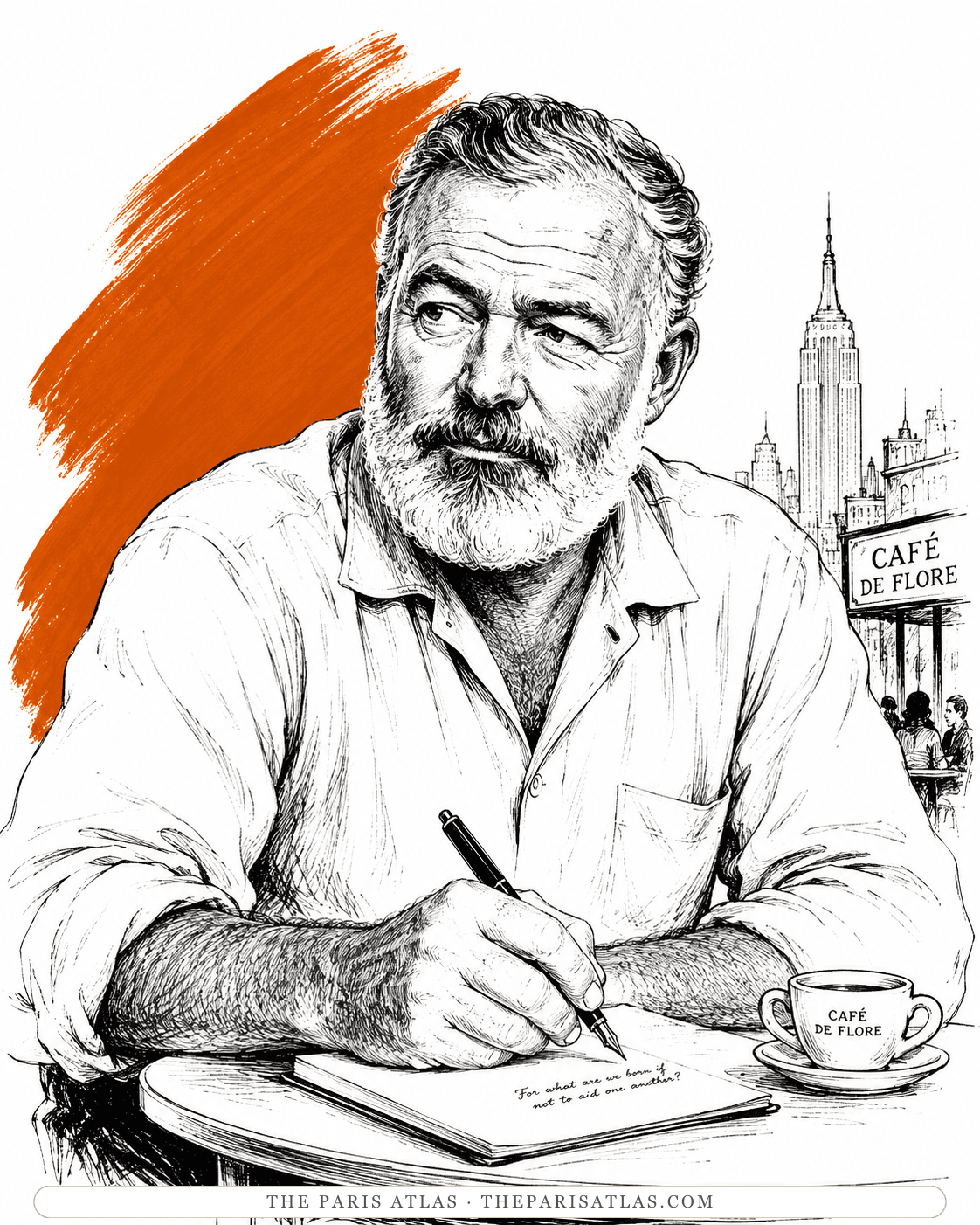
Editing the Men at War anthology in 1942, Hemingway singled out Le Feu as the rare book that told the truth about the war while it was still being fought — the trench-level standard his own war writing answered to.

The first great trench novel — written in the mud by a forty-one-year-old private, Goncourt-crowned while the war it describes still ran.
A French writer, born in 1873 and died in 1935, whose novel Le Feu described trench warfare from inside it while the First World War was still being fought. He won the Prix Goncourt for it in 1916 and spent the rest of his life as a communist writer and organiser.
A squad of ordinary French soldiers — a carter, a miner, a farm labourer — going through mud, cold, lice, boredom, artillery and death. It has almost no plot, it is written in the soldiers' own language with the obscenity left in, and it refuses to make the deaths meaningful.
Because it described the physical conditions exactly, without heroism, at a time when official accounts did not, and because it was published in 1916 while the war was still on, by a decorated soldier. That made it very hard to dismiss.
Yes. He was forty-one, in poor health and legally exempt, and he enlisted in the infantry as a private. He served seventeen months in the front line as a stretcher-bearer and runner, was cited twice for bravery, and was invalided out in 1916 with lung damage.
Siegfried Sassoon read it in hospital in 1917 and said it hardened his resolve to write truthfully about the war. It is usually discussed alongside Erich Maria Remarque's All Quiet on the Western Front, published thirteen years later, as the point where the soldier's account displaced the official one.
Of pneumonia, in Moscow, on 30 August 1935, aged sixty-two, while working on a second biography of Stalin. His body was returned to France and he is buried at Père Lachaise.
Influenced
Le Feu brought the trenches into French prose from the ranks a generation before Journey — and Céline, famously stingy with admiration, named Barbusse among the few modern writers he rated.
Influenced
Editing the Men at War anthology in 1942, Hemingway singled out Le Feu as the rare book that told the truth about the war while it was still being fought — the trench-level standard his own war writing answered to.
The sources below include biographies, scholarly essays, interviews, and primary materials that informed this page. They reflect both the historical record and ongoing critical conversations about Henri Barbusse and their work.


Official French account of the Goncourt award and of Barbusse's service with the 231st Infantry Regiment.
Account of his enlistment, front-line service and the writing of Le Feu.
Reference article used for the serialisation in L'Oeuvre from 3 August 1916 and the Flammarion book edition.
Reference entry used for the early novels, Clarté and the Moscow years.
Reference article on the novel, its English translation by Fitzwater Wray, and its reception.
Publisher's record of the novel in its current French edition.
Reference article cross-checked for the birth and death dates, the war service, the Goncourt and the communist years.
Reference entry on Le Feu and his place in the literature of the First World War.
Scholarly encyclopedia entry on his war service, the novel's reception and his politics.

Contemporary reporting or criticism used to document the historical reception and context of Henri Barbusse.
Published analysis and historical context used in preparing the Henri Barbusse page.
Archival evidence used to document the historical record connected to Henri Barbusse.
Official record used to verify names, dates, institutional details, or other factual information on this page.
These references anchor the page in the documented record and in the scholarly conversations around Henri Barbusse. Every claim on this page traces back to one or more of the works listed here.
 Explore more resources