
Two Persian travellers loose in Paris, writing home about a city they cannot make sense of — and the household one of them left behind, coming apart while he is away.
A judge from the Bordeaux wine country who in 1721 published, anonymously, a novel in letters about two Persian travellers loose in Paris — a device that let him mock the French court, the church and the city while pretending only to report what foreigners saw. Nearly thirty years later he produced The Spirit of the Laws, the book that argued a state's powers must be split so that each can check the others; the Americans writing their constitution called him the oracle on the subject.
Montesquieu was born Charles-Louis de Secondat in 1689 at the château of La Brède, in the vineyards south of Bordeaux, and inherited the family's judicial office: from 1716 he was président à mortier — a presiding judge — in the parlement of Bordeaux, one of the sovereign law courts of the French provinces. A French parlement was a court of justice, not an elected assembly, though it could obstruct the king's edicts, and its judgeships were private property, bought and inherited. He found the work dull. In 1721 he published anonymously a book that made him famous overnight: the Persian Letters (Lettres persanes), in which two Persian travellers, Usbek and Rica, write home about a Paris they find absurd.[1]
The disguise was the whole method. By putting the criticism in the mouths of visitors who genuinely do not understand what they are looking at, Montesquieu could ridicule the last years of Louis XIV — the Sun King, who had reigned for seventy-two years and died in 1715 — the regency of the duc d'Orléans that followed while the new king was a child, the Paris salons, the fashions and above all the church, while formally doing nothing but transcribing foreign correspondence. The book opened every salon door in the city. He handed on his judicial office for an annuity, was elected in 1728 to the Académie française — the state academy of forty writers and scholars, elected for life, that guards the French language — spent three years travelling Europe with eighteen months in England, and then spent two decades on The Spirit of the Laws (De l'esprit des lois, 1748), a comparative study of every legal system he could find. The Catholic Church put it on the Index of forbidden books, Rome's register of works Catholics were prohibited from reading, in 1751, and the Sorbonne — the theology faculty of the University of Paris — condemned it. James Madison, one of the authors of the American constitution and later the fourth president of the United States, called Montesquieu "the oracle who is always consulted and cited on this subject" while arguing for that constitution in 1788.
He was born on 18 January 1689 at the château of La Brède, a moated medieval house south of Bordeaux that had come to him through his mother, into a family that had spent a century marrying into the Bordeaux magistracy. He was taught first by the village schoolmaster, then sent at eleven to the collège at Juilly near Meaux, a boarding school run by the Oratorians, a teaching order of priests, and at sixteen to the law faculty at Bordeaux; he was admitted to plead before the parlement of Bordeaux, the region's sovereign court of justice, in 1708. When his uncle died in 1716 he inherited the barony of Montesquieu and, with it, the office of président à mortier — a senior judge presiding over the criminal chamber of a court that was both a tribunal and a political body.[2]
He was twenty-seven, ten years under the age the post required, and needed a royal dispensation to sit at all. He disliked the work and said so: "My heart was quite upright; I understood the questions themselves; but as for procedure, I understood nothing about it." On 31 March 1717 he installed himself in Paris for the first time, and after that he was away so often that his Bordeaux colleagues granted him leave as a matter of routine, sending him off with the court's old formula — good travels and a timely return. In 1726 he handed the office over in exchange for an annual income — parting with the work, but not yet with the family's claim on the post, which his son could still take up — and was free to write.[2]
The Persian Letters — Lettres persanes — appeared anonymously in 1721, printed in Amsterdam, beyond the reach of the royal censors who licensed everything published in France. It is a novel made entirely of letters, and its two chief correspondents are Usbek and Rica, Persian noblemen travelling in Europe who write home describing what they see. What they see is Paris — the crowds, the coffee-houses, the fashions that change twice a year, the theatre, the king, the pope, the convents — and because they have no idea what any of it means, they describe it exactly, which is what makes it ridiculous. Rica reports that the King of France is a great magician, since he can convince his subjects that one coin is worth two; the pope, a greater one, since he can make people believe that three are one.[3]
That is the device the whole book runs on, and it is why the book could be written at all. Direct satire of the court, the church and the money of France in 1721 was dangerous; satire delivered by a bewildered foreigner is merely a traveller's honest report, and the author is only the man who found the letters. Behind the comedy the book argues for what the Bibliothèque nationale de France — the French national library — calls a liberalism set against the despotism embodied by Louis XIV, the absolute monarch who had died six years before it appeared. The boldest passages are the ones about religion. Success was immediate, and it made an anonymous provincial judge the most talked-about writer in Paris.[4]
The salons opened — the salon being a private drawing room where a hostess gathered writers, nobles and officials to talk, and where in eighteenth-century France reputations and careers were actually made. He became a fixture at the house of the marquise de Lambert, whose Tuesday gatherings on the rue de Richelieu were the most literary in the city and whose encouragement pushed him towards writing full-time, and probably at the club de l'Entresol, a short-lived discussion society for politics and public affairs. After Madame de Lambert died he was taken up by the Brancas and the d'Aiguillon families, by Madame de Tencin, Madame du Deffand and Madame Geoffrin — the women whose drawing rooms were, in practice, the institutions of the French Enlightenment, the century-long argument for reason, tolerance and reform against church and absolute monarchy. In 1728 the Académie française — France's official literary academy, forty members elected for life — elected him, over objections from churchmen who had read the Persian Letters and from academicians who had noticed that the book mocked the Académie too.[2]
Immediately after his election he left, and spent three years crossing Italy, Germany, Austria and England, taking notes on how each country was actually governed; the eighteen months in England mattered most. He came home to Bordeaux in 1731 with failing eyesight and a project. It took him roughly twenty years. The Spirit of the Laws — De l'esprit des lois — published in Geneva in 1748 and, like the Persian Letters, without his name on it, surveys the laws of every society he could get information about and tries to explain them by their causes — climate, terrain, population, commerce, religion, the character a nation acquires from all of these together, which he called its general spirit. He sorts governments into three kinds: republics, monarchies, and despotisms, and argues that only moderate governments protect individual liberty.[2]
The idea that made him permanent is in Book XI. A state has three powers — the legislative, which makes laws; the executive, which enforces them; and the judicial, which tries cases — and liberty survives only when these are held by different hands, so that no one can do all three. His formulation of why is the sentence everyone quotes: it is necessary that by the very disposition of things power should be a check to power. He believed he had found the arrangement working in the English constitution, which is where he had spent his eighteen months.[5]
The reception in France was hostile in the quarters that mattered. The attacks began as soon as the book appeared, which is why he had already published a Défense de L'Esprit des lois — 'A Defence of The Spirit of the Laws' — in 1750; the condemnations came anyway. The church placed the book on the Index of prohibited works, the Vatican's list of what Catholics were forbidden to read, on 29 November 1751, and the Sorbonne, the theology faculty of the University of Paris, condemned it too. Abroad it did the opposite. When the American states argued about ratifying their new constitution in 1787–88, the separation of powers was the crux, and in Federalist 47 — one of the newspaper essays written to argue the constitution through — James Madison called Montesquieu "the oracle who is always consulted and cited on this subject" before spending the rest of the essay explaining what Montesquieu had actually meant. That argument is why an eighteenth-century Bordeaux magistrate is still looked up daily by American readers.[3]
The proportions of his life reversed at the end. The bench had once kept him in the south; between 1741 and 1755 he spent roughly ten years in Paris against four in Bordeaux. In 1748 he sold the ancestral judicial office outright, twenty-two years after giving up the work of it, because his son would not take it on. He went on writing with the help of secretaries as his sight failed, went on appearing in the salons, was elected director of the Académie française in 1753 — the member who chairs its sessions, a post that rotates — and left an unfinished essay on taste for the Encyclopédie, the great alphabetical survey of human knowledge that the philosophers Denis Diderot and Jean le Rond d'Alembert were then assembling in Paris.[2]
In December 1754 he gave up the lease on his Paris house and dismissed his servants, meaning to go home to La Brède and die there. He never saw it again. He caught one of the fevers that carried off so many people in an eighteenth-century winter, and after several weeks — with the duc de Nivernais attending on behalf of the reigning king, Louis XV, and the Swedish ambassador calling, and his son at the bedside, and two Jesuit priests and the chevalier de Jaucourt, one of the Encyclopédie's chief contributors, all in the room at once — he died in Paris on 10 February 1755, aged sixty-six. He was buried in the church of Saint-Sulpice, the enormous seventeenth-century church on the Place Saint-Sulpice in what is now the 6th arrondissement.[1]
Born Charles-Louis de Secondat on 18 January at the château of La Brède, south of Bordeaux.
Sent at eleven to the collège at Juilly, near Meaux, a boarding school of the Oratorian teaching order; returns to Bordeaux at sixteen to read law, and is admitted to plead before the parlement — the region's sovereign law court — in 1708.
His uncle dies; he inherits the barony of Montesquieu and the office of président à mortier — presiding judge — in the parlement of Bordeaux, a decade under the required age.
Installs himself in Paris for the first time on 31 March, and begins spending as little time on the bench as he can.
The Persian Letters (Lettres persanes) is published anonymously in Amsterdam, out of reach of the French censors — two Persian travellers, Usbek and Rica, reporting home on an absurd Paris — and is an instant sensation.
Gives up the work of the judicial office in exchange for an annual income, encouraged by the marquise de Lambert's Paris salon, and writes full-time.
Elected to the Académie française — the state academy of forty writers and scholars that guards the French language — despite objections from churchmen, then leaves on three years of travel through Europe.
Returns to the Bordelais — the country around Bordeaux — after eighteen months in England, with failing eyesight and notebooks full of observations on how each country he saw was governed.
Publishes the Considerations on the Causes of the Greatness of the Romans and of their Decline — his account of why Rome rose and why it fell, and of what that tells any state about itself.
The Spirit of the Laws (De l'esprit des lois) appears in Geneva after some twenty years' work; he sells the family judicial office outright on 4 August.
After publishing his Défense de L'Esprit des lois — 'A Defence of The Spirit of the Laws' — the year before, he sees the book placed on the Index of prohibited works, Rome's register of banned reading, on 29 November, and condemned by the Sorbonne, the theology faculty of the University of Paris.
Elected director of the Académie française, the member who chairs its sessions; candidates for election come to his Paris rooms to seek his support.
Dies of a fever in Paris on 10 February, aged sixty-six, and is buried in the church of Saint-Sulpice on the Left Bank. He leaves an unfinished essay on taste for the Encyclopédie, the vast survey of human knowledge Denis Diderot and Jean le Rond d'Alembert were assembling.
Arguing for the American constitution in Federalist 47 — one of the newspaper essays written to win its ratification — James Madison, a principal author of that constitution and a future US president, calls him "the oracle who is always consulted and cited" on the separation of powers.
Two Persian travellers loose in Paris, writing home about a city they cannot make sense of — and the household one of them left behind, coming apart while he is away.

Twenty-three short chapters on why Rome grew and why it fell, written in 1734 by a judge who thought a country's dissensions were a sign of life.

Twenty years of comparing the laws of every country Montesquieu could find out about, and the Book XI argument that split power three ways in the United States Constitution.
It is a novel made entirely of letters, published anonymously in 1721. Two Persian noblemen, Usbek and Rica, travel to France and write home about what they find. Most of the book is their bewildered running commentary on Paris — the crowds, the coffee-houses, the changing fashions, the theatre, the king, the pope, the convents — described exactly as it looks to someone who has no idea what it means, which is what makes it funny and what makes it devastating. A second thread follows the harem Usbek has left behind in Isfahan, then the Persian capital — the enclosed household of wives and eunuchs he still rules by letter — which falls apart in his absence, and gives the book its argument about what absolute power does to everyone under it.
Because it let him say things that were dangerous to say in his own voice. In 1721 France, mocking the king, the church, the coinage and the court could bring real trouble; the book was published anonymously in Amsterdam for the same reason. But when the mockery comes from a Persian visitor honestly reporting his confusion, the author has technically only transcribed some foreign letters. The device also does something a direct satire cannot: it makes the reader see Paris from outside, as strange, rather than as normal.
Montesquieu's argument, set out in Book XI of The Spirit of the Laws (1748), that a state holds three distinct powers — the legislative, which makes the laws; the executive, which carries them out; and the judicial, which applies them to particular cases — and that political liberty survives only when different hands hold each, so that no one can make a law, enforce it, and judge it. His reason is the sentence he is quoted for: it is necessary that by the very disposition of things power should be a check to power. He thought he had observed the arrangement working in England.
Yes, and the framers said so at the time. During the debates of 1787–88 over whether the states should ratify the new constitution, the objection that it failed to keep the three powers properly separate was serious enough that James Madison — one of the constitution's authors, later the fourth US president — devoted Federalist 47, one of the newspaper essays written in its defence, to answering it, and opened by calling Montesquieu "the oracle who is always consulted and cited on this subject." Madison then argued that Montesquieu had never meant an absolute separation — since the English constitution he admired does not have one — but a system in which no single power holds all the attributes of another.
The Spirit of the Laws was, on 29 November 1751, when it was placed on the Index of prohibited books — the Vatican's register of works Catholics were forbidden to read; the Sorbonne, the theology faculty of the University of Paris, condemned it as well. Montesquieu had seen it coming and published a defence of the book, the Défense de L'Esprit des lois, in 1750. The condemnations did nothing to its standing outside France.
In Saint-Sulpice, the enormous seventeenth-century church on the square of the same name in the 6th arrondissement of Paris. He died in the city on 10 February 1755, having given up his Paris house that December meaning to return to La Brède, the château near Bordeaux where he was born — a journey he was too ill to make.
Charles-Louis de Secondat, baron de La Brède et de Montesquieu. La Brède was his mother's estate south of Bordeaux, where he was born and which he ran as a working vineyard all his life; the barony of Montesquieu came from an uncle in 1716, along with the judgeship, and it is the name the books are published under. The château at La Brède still stands and is open to visitors.
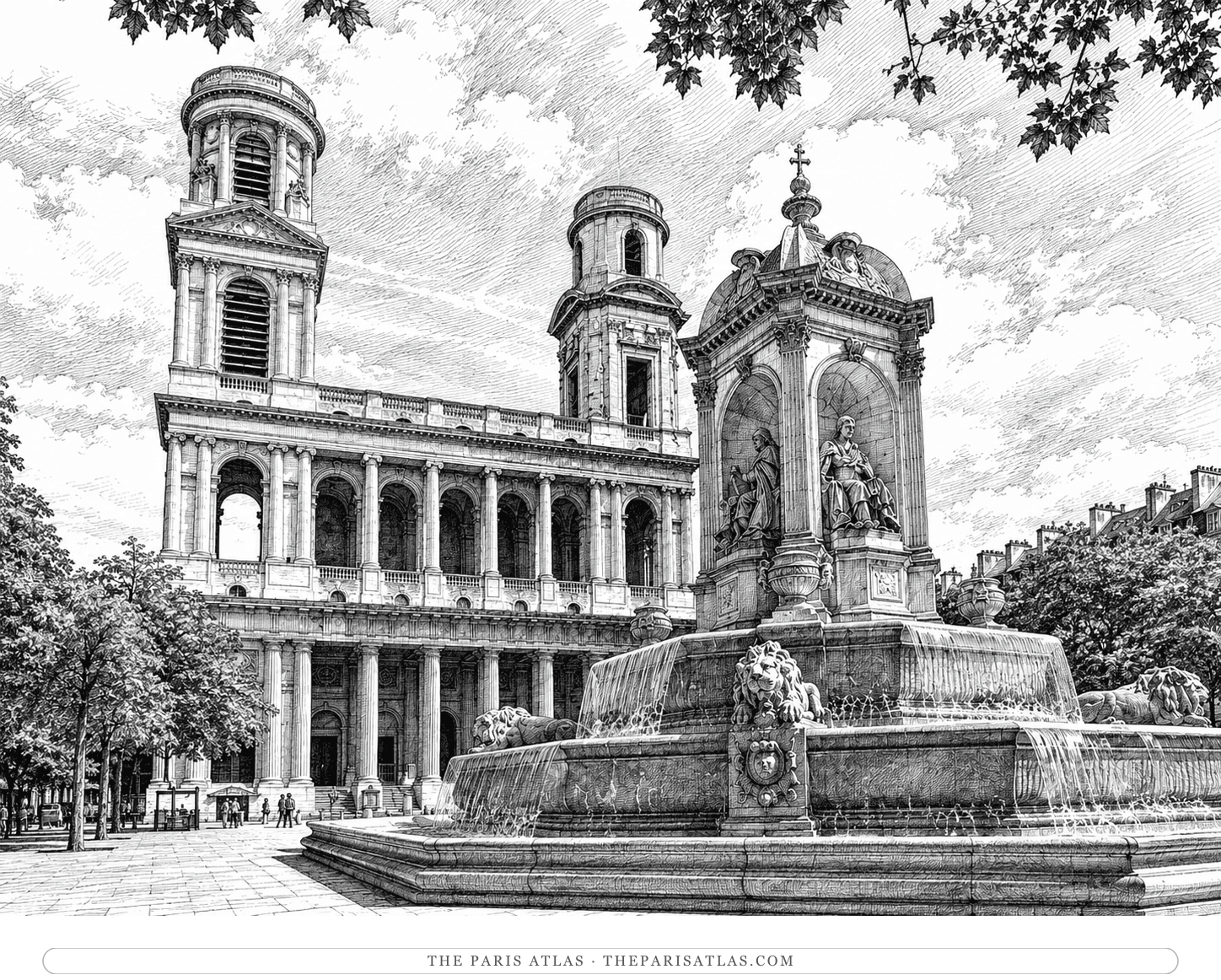
Buried at · 1755
Montesquieu died in Paris on 10 February 1755 and was buried inside the church of Saint-Sulpice, which stands on the Place Saint-Sulpice.
The sources below include biographies, scholarly essays, interviews, and primary materials that informed this page. They reflect both the historical record and ongoing critical conversations about Montesquieu and their work.

The primary text, in the earliest full English translation — Rica's Paris letters and the collapse of the seraglio.

The philosophical summary, including the separation of powers.
Norbert Campagna on how the American federalists read and used him.
These references anchor the page in the documented record and in the scholarly conversations around Montesquieu. Every claim on this page traces back to one or more of the works listed here.
 Explore more resources