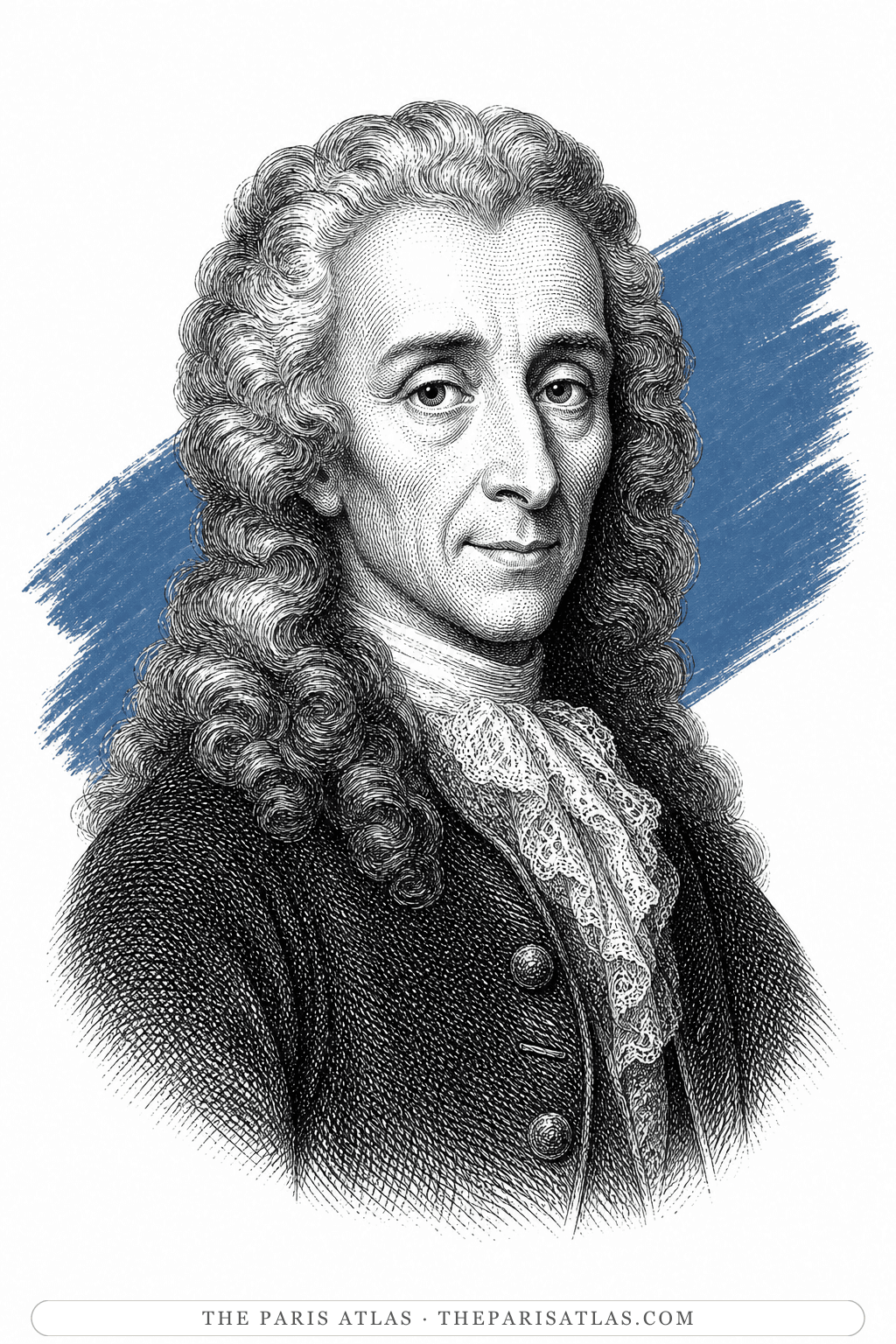
Persian Letters
Montesquieu
Persian Letters
Montesquieu's first book, and the one that made him famous. Two Persian travellers mock the France that The Spirit of the Laws later analyses.
Read our takeThe Spirit of the Laws
Montesquieu
by Montesquieu
Twenty years of comparing the laws of every country Montesquieu could find out about, and the Book XI argument that split power three ways in the United States Constitution.
Charles-Louis de Secondat, baron de Montesquieu, published this book in Geneva in 1748, without his name on it, after roughly twenty years of work. The book sets the laws of dozens of societies beside each other and asks what caused each one. His list of causes is long: the climate, the terrain, the size of the population, the trade, the religion, and the character a nation takes on from all of them together. That last one he called a nation's general spirit. He sorts governments into republics, monarchies and despotisms, and argues that only a moderate government leaves a person free.[1] The part everyone still reads is Book XI. A state holds three powers — the power to make laws, the power to carry them out, and the power to judge — and liberty survives only when different hands hold each of them.[2] The Roman Catholic Church put the book on its Index of prohibited reading in 1751.[3] Forty years after that, the Americans arguing over their constitution treated Montesquieu as the authority on the question.[4]
The book runs to thirty-one books, as Montesquieu called his parts, and no reader gets through all of them the same way. The first three define his three kinds of government and the principle each runs on: virtue in a republic, honour in a monarchy, fear in a despotism. Books IV to X apply that to education, to law-making, to luxury, to the standing of women and to war. Book XI is the famous one, on political liberty and the constitution of England. Books XII to XIII deal with criminal law and taxation. Books XIV to XVIII are the causes: climate, terrain, soil. Book XV is on slavery. Books XX to XXII turn to commerce and money, XXIII to population, XXIV to XXVI to religion, and the last five to the history of French and feudal law.
Montesquieu's method is comparison, not deduction, which is why the book reads more like history than like philosophy. He had spent three years after 1728 travelling Italy, Germany, Austria and England, taking notes on how each country was actually run, and the eighteen months in England mattered most.[5] He came home to the country outside Bordeaux in 1731 with failing eyesight and a project that took him the rest of his working life. Secretaries read to him and wrote for him as his sight went.
Thomas Nugent put the book into English in 1750, two years after the French appeared, and his translation is the one that carried Montesquieu to British and American readers for the next two centuries. Nugent revised it for a 1758 edition, and that edition is the text quoted here. His preface to it does something unusual: rather than introduce the book, Nugent spends most of it summarising Montesquieu's own Defence of The Spirit of the Laws, answering the charges of irreligion that French critics had already made.[2]
Two parts of the book have worn badly and are dealt with below rather than skipped. The chapters on climate in Book XIV explain national character by what cold and warm air do to the fibres of the body, and they include a claim that the English kill themselves because of their weather. Book XV, on slavery, opens by calling slavery bad in its own nature, delivers a famous chapter of sustained sarcasm against the people who defended it, and then allows that in some hot countries slavery is more reconcilable to reason. Readers have argued about that combination ever since.[2]
The chapter opens by counting powers, and the count is stranger than the summaries suggest. In Thomas Nugent's translation Montesquieu writes that in every government there are three sorts of power. The first is the legislative. The second is the executive in respect to things dependent on the law of nations, and the third the executive in regard to things that depend on the civil law. He then renames the third: the latter we shall call the judiciary power, and the other simply the executive power of the state. So the power to judge arrives as a second kind of executive power, not as a third branch standing alongside the other two.
What follows is a warning rather than a design. When the legislative and executive powers are united in the same person, Montesquieu writes, or in the same body of magistrates, there can be no liberty. His reason is that the same monarch or senate may enact tyrannical laws in order to execute them tyrannically. There would be an end of every thing, he adds, were the same man or the same body to exercise all three. The chapter also gives his definition of what is being protected: the political liberty of the subject is a tranquillity of mind, arising from the opinion each person has of his safety.
Montesquieu never used the phrase separation of powers. Michel Troper, writing in the scholarly Dictionnaire Montesquieu, argues that the doctrine attributed to him is a nineteenth-century construction. Jurists of that century turned his argument into a rule that each branch must be specialised and independent. That rule is close to the opposite of what his English model describes. In the England of the chapter the king, the House of Commons and the House of Lords all take part in making law, the king holds an absolute veto, and the Lords judge. Troper's reading, following Charles Eisenmann, is that Montesquieu wanted powers distributed among several bodies so that each could block the others, and that the principle is purely negative — do not let one hand hold everything.
How much of the England in the chapter is real England is a separate question. Philippe Raynaud, in the same dictionary, argues that the chapter is neither a plain description nor a fantasy. Montesquieu had watched the country for eighteen months and filled notebooks with unflattering detail — the English are occupied, he wrote, and do not have the time to be polite. The chapter sets that aside and builds a model meant to solve a puzzle: how England came to be free without either the virtue of a republic or the honour of a monarchy. Raynaud notes that Montesquieu leaves out the English constitutional debates of his own day, and that his handling of the power to judge is curiously thin for a country whose law was made by judges.
One line from the chapter has done more damage than any other. Montesquieu writes that the national judges are no more than the mouth that pronounces the words of the law, mere passive beings incapable of moderating either its force or rigor. Read as a description of English common law it is simply wrong, and Raynaud's point about the thinness of the judicial power lands hardest here. Read as part of the model it does a job: a judge who can bend the law has taken a piece of the legislative power, and the whole arrangement depends on nobody doing that.
Book XIV sets out to explain national character by air temperature, and it does so physically. Cold air, Montesquieu writes, constringes the extremities of the external fibres of the body, which increases their elasticity and helps the blood return to the heart; warm air relaxes and lengthens those fibre-ends and so reduces their force. From there he draws the conclusion the book is remembered for: people are more vigorous in cold climates, and the inhabitants of warm countries are, like old men, timorous, while the people in cold countries are, like young men, brave.
The chapters that follow apply the idea to religion, to farming, to drink, to law-making and to how far a government may trust its own people. Chapter XIII takes England as a case. Montesquieu writes that the English destroy themselves most unaccountably, and that they destroy themselves often in the very bosom of happiness; the cause he gives is the weather. In a nation so distempered by the climate as to have a disrelish of every thing, he continues, the fitting government is one in which the people cannot blame their unease on any single person.
Set those chapters beside Book XI and the awkwardness is plain. Book XI praises the English arrangement of powers as the thing that keeps a country free. Book XIV explains the same country's politics by a suicidal national temperament produced by damp air. The two accounts do not sit together, and the second is not an argument a reader can repair. The physiology it rests on is not how bodies work. The national characters it produces are the stock prejudices of eighteenth-century travel writing.
The climate chapters matter anyway, for two reasons. They are the clearest statement of what Montesquieu was trying to do: explain laws by causes outside anyone's intention, so that a legal code becomes evidence about a place rather than a list of decisions. And Chapter V of the same book states the limit he set himself — bad legislators favour the vices of the climate, good ones oppose them. Climate, on his own account, is a pressure and not a sentence.
Book XV opens with a definition and a verdict. Slavery, properly so called, Montesquieu writes, is the establishment of a right which gives one man such a power over another as renders him absolute master of his life and fortune. The state of slavery, he adds in the next sentence, is in its own nature bad. The four chapters after that take the justifications one at a time — the Roman lawyers' account, conquest, sale of the self, birth — and dismantle each.
Chapter 5, Of the Slavery of Negroes, is the chapter people quote. Montesquieu writes it entirely in the voice of a slaveholder making his case, and every argument he puts in that mouth is meant to be absurd. Sugar would cost too much otherwise. A colour of skin settles whether a creature is a man. The Egyptians killed red-haired men, so appearance has always mattered. The chapter turns at its end, where the borrowed voice says it is impossible for us to suppose these creatures to be men, because allowing them to be men, a suspicion would follow, that we ourselves are not Christians. Sarcasm that sharp against the slave trade was rare in 1748.
Two later chapters of the same book complicate it, and they are where the dispute lives. Chapter 7 says that there are countries where the excess of heat enervates the body, and renders men so slothful and dispirited that nothing but the fear of chastisement will make them work. In those countries, it goes on, slavery is more reconcileable to reason. Chapter 8 draws the conclusion: natural slavery, then, is to be limited to some particular parts of the world, and in all other countries even the most laborious works of society may be performed by freemen. The Stanford Encyclopedia of Philosophy, summarising the same passages, adds that Montesquieu goes on to hope there is not that climate upon earth where the work could not be done by free men.
So the text says three things in one book: that slavery is bad in its own nature, that the people defending it are contemptible, and that in some hot places it is more reconcilable to reason than elsewhere. Readers have drawn opposite conclusions from that set, and the disagreement is a real one about how far the sarcasm of Chapter 5 reaches. Nothing here settles it. What can be said is where each claim sits — Chapter 1 for the verdict, Chapter 5 for the sarcasm, Chapters 7 and 8 for the qualification — so that a reader can go and see the combination for themselves.
The attack came from the Jansenists first. Pierre Retat, in the Dictionnaire Montesquieu, records that the Nouvelles ecclesiastiques ran a long hostile review across its issues of 9 and 16 October 1749. The paper was a Jansenist one, and Retat notes it had never before taken a non-religious book so seriously. Montesquieu answered in February 1750 with the Defence of The Spirit of the Laws, printed by Huart et Moreau in Paris under a Geneva imprint. The Defence has three parts: a general statement that he writes as a Christian, a point-by-point reply, and a set of reflections meant to lift the quarrel above theology.
The condemnations came anyway. The Stanford Encyclopedia of Philosophy states that the Roman Catholic Church placed The Spirit of the Laws on the Index of Forbidden Books in 1751. The Bibliotheque nationale de France gives the date as 29 November of that year. The Catholic Encyclopedia of 1913, writing from the Church's own side, confirms the book had reached the Roman Index before March 1752. The same 1913 article records that the Sorbonne, the theology faculty of the University of Paris, drew up a list of passages from Montesquieu's writings that seemed to call for censure in August 1752.
Abroad the book did the opposite. When the American states argued in 1787 and 1788 about whether to ratify their new constitution, one serious objection was that it failed to keep the three powers properly apart. James Madison, a principal author of that constitution and later the fourth president of the United States, gave a whole essay to the objection. The oracle who is always consulted and cited on this subject, Federalist 47 begins, is the celebrated Montesquieu.
Madison then argued against the reading his opponents had taken. Montesquieu did not mean that these departments ought to have no partial agency in, or no control over the acts of each other, he wrote. His evidence was Montesquieu's own model. The British Constitution was to Montesquieu what Homer has been to the didactic writers on epic poetry, Madison said, and Montesquieu had treated England as the mirror of political liberty. English powers are emphatically not kept separate. Michel Troper's reading of Book XI, two centuries later, reaches the same place Madison did in 1788.
To prevent the abuse of power, it is necessary that by the very disposition of things power should be a check to power.
In every government there are three sorts of power: the legislative, the executive in respect to things dependent on the law of nations; and the executive, in regard to things that depend on the civil law.
When the legislative and executive powers are united in the same person, or in the same body of magistrates, there can be no liberty; because apprehensions may arise, lest the same monarch or senate should enact tyrannical laws, to execute them in a tyrannical manner.
Book XI is where the case for splitting a state's powers three ways is made, and James Madison opened Federalist 47 by calling Montesquieu the oracle always consulted on the subject.
Montesquieu reasons from examples rather than from first principles, and most of his chapters are a paragraph long. A reader can open it at Book XI and follow the argument without the thirty books around it.
Thomas Nugent's translation is public domain and free online, so the famous sentences can be checked in the place they actually sit. Several of them turn out to say something narrower than the summaries claim.
The same writer, twenty-seven years later, making the argument straight that the novel had made by sarcasm. The comparison shows what the disguise in the earlier book was for.
1728
Newly elected to the Academie francaise, Montesquieu leaves Paris for three years of travel through Italy, Germany, Austria and England, taking notes on how each country is governed.
1729
He reaches England, and stays eighteen months. The notebooks he fills there become the raw material of Book XI.
1748
The Spirit of the Laws is published in Geneva in two volumes, without his name on it, after roughly twenty years of work.
1749
The Nouvelles ecclesiastiques, a Jansenist newspaper, runs a long hostile review on 9 and 16 October — the first time it had attacked a non-religious book at that length.
1750
Montesquieu answers in February with the Defence of The Spirit of the Laws, printed by Huart et Moreau in Paris under a Geneva imprint. Thomas Nugent's English translation appears the same year.
1751
The Roman Catholic Church places the book on the Index of Forbidden Books; the Bibliotheque nationale de France gives the date as 29 November. Laurent Angliviel de La Beaumelle publishes a continuation of the Defence.
1752
The Sorbonne, the theology faculty of the University of Paris, draws up a list of passages from Montesquieu's writings that seem to call for censure, in August.
1755
Montesquieu dies in Paris on 10 February, aged sixty-six, with the book still on the Index.
1758
Nugent publishes a revised English translation, prefaced by his own summary of Montesquieu's Defence. That edition is the text quoted here.
1788
Arguing for the United States Constitution in Federalist 47, James Madison calls Montesquieu the oracle who is always consulted and cited on the subject, then argues that his opponents have misread what Montesquieu meant.
1989
Cambridge University Press publishes the translation by Anne Cohler, Basia Miller and Harold Stone, which becomes the modern scholarly standard in English.

Persian Letters
Montesquieu
Montesquieu's first book, and the one that made him famous. Two Persian travellers mock the France that The Spirit of the Laws later analyses.
Read our takeConsiderations on the Causes of the Greatness of the Romans and their Decline
Montesquieu
The 1734 book that opened the way to this one: one country over two thousand years, asking what made it strong and what killed it.
Read our takeMontesquieu sets the laws of dozens of societies beside one another and asks what caused each set — the climate, the land, the population, the trade, the religion, and the character a nation takes on from all of them. He sorts governments into republics, monarchies and despotisms, and argues that only a moderate government leaves people free. Book XI, on splitting a state's powers three ways, is the part still read everywhere.
It counts three powers in every government: the power to make law, the power to carry it out, and a third that Montesquieu first calls a kind of executive power and then renames the judiciary power. It warns that liberty ends if one person or body holds more than one of them, and it offers England as the place where the arrangement works. It never uses the phrase separation of powers.
He gave the argument the form that later constitutions used, but he did not coin the phrase and did not argue for the version usually taught. Michel Troper, in the Dictionnaire Montesquieu, shows that nineteenth-century jurists turned Montesquieu's case into a rule that each branch must be specialised and independent. Montesquieu's own English model has the king, Commons and Lords all sharing in law-making.
Yes, and the framers said so while the argument was live. In Federalist 47, written to win ratification in 1788, James Madison called Montesquieu the oracle who is always consulted and cited on this subject. Madison then argued that Montesquieu had never demanded total separation, since the English constitution he admired does not have it.
The Roman Catholic Church placed it on the Index of Forbidden Books in 1751; the Bibliotheque nationale de France dates that to 29 November, and the Catholic Encyclopedia of 1913 confirms the listing happened before March 1752. In August 1752 the Sorbonne drew up a list of passages calling for censure. Montesquieu had already published a defence of the book in February 1750.
Book XV opens by calling slavery bad in its own nature and takes apart the usual justifications. Chapter 5 is a famous piece of sarcasm written in a slaveholder's voice, ending on the line that these creatures cannot be men, because if they were, a suspicion would follow that we ourselves are not Christians. Chapters 7 and 8 then say that in some very hot countries slavery is more reconcilable to reason. Readers disagree about how to take the three together.
Book XIV explains national character physically: cold air tightens the body's fibres and warm air slackens them, so cold countries produce brave people and hot ones timorous people. The physiology is wrong and the national characters are the prejudices of eighteenth-century travel writing. Chapter 13 blames the English suicide rate on the weather. Chapter 5 of the same book does set a limit — good legislators oppose the vices of the climate.
The Cambridge edition translated by Anne Cohler, Basia Miller and Harold Stone is the modern standard and the one scholars cite. Thomas Nugent's translation, first published in 1750 and revised in 1758, is public domain and free on Wikisource; it is the version Madison's generation read, and it is the one quoted on this book's page.
No, and almost nobody does. Book XI is short, self-contained and the reason most readers come. Books I to III give the three kinds of government the rest depends on. Books XIV and XV are worth reading for what they show about Montesquieu's method, including where it fails.
Explore authors with a similar voice, perspective, and influence.
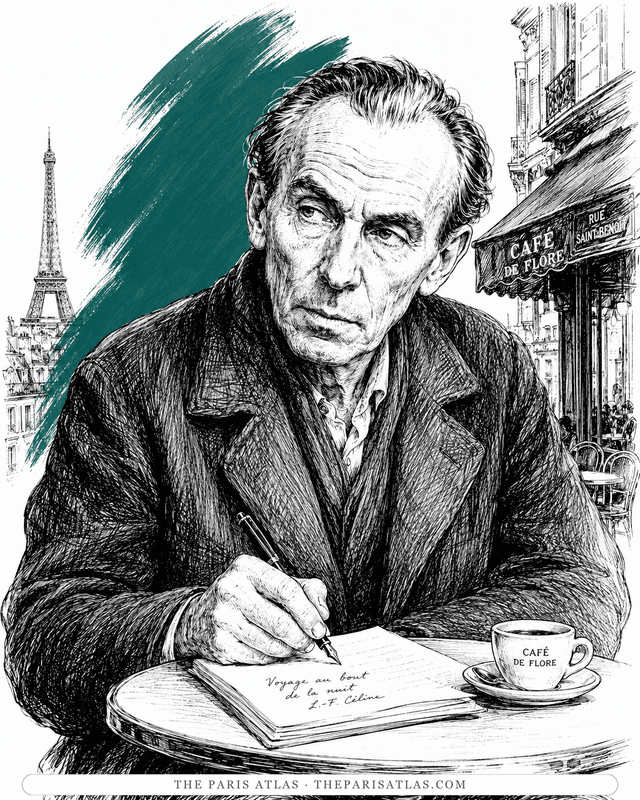
The doctor of the Paris slums who wrote the century's blackest, funniest novel — and changed the sound of French prose.
View author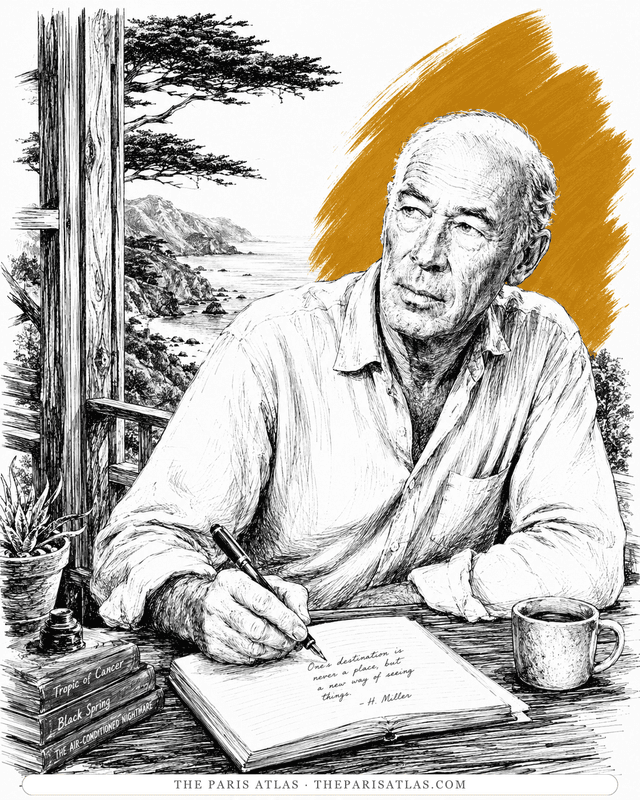
The Brooklyn dropout who arrived in Paris broke at thirty-eight and wrote the exuberant, banned books that ended American censorship.
View author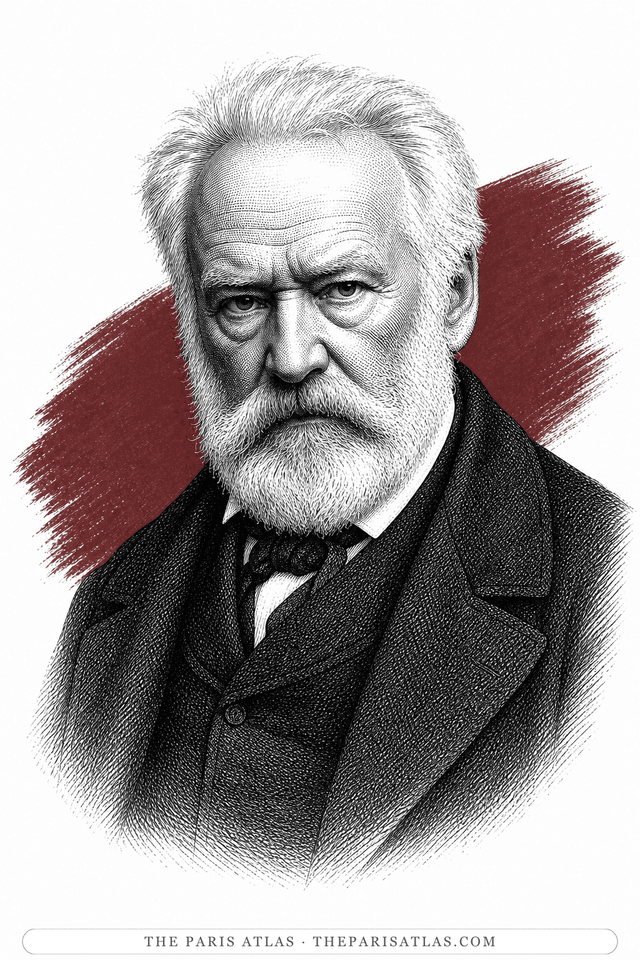
Poet, novelist and playwright who spent sixteen years in an apartment on the Place des Vosges that is now his museum, wrote a novel about Notre-Dame that shamed France into repairing the cathedral, spent nineteen years in exile for opposing the emperor Napoleon III, and was buried in the Panthéon — the Paris monument where France buries its most honoured dead — in 1885 after a funeral that brought roughly two million people into the streets of Paris.
View authorThe sources below include the primary text, editions, scholarship, archival materials, and other records that informed this page. They document The Spirit of the Laws, its publication, and its place in literary history.

The philosophical summary: the three kinds of government, the Book XIV physiology, the Book XV chapters on slavery, and the 1751 Index listing.
A Catholic reference work of 1913, used as independent confirmation that the book reached the Roman Index, and for the Sorbonne's list of August 1752.
The primary source for Madison's oracle sentence and for his argument about what Montesquieu did not mean.

Francois Cadilhon's scholarly life, for the years of composition, the travels and the eighteen months in England.

The French text on Project Gutenberg, used to check the book and chapter numbering against the original.
Michel Troper on what Montesquieu argued, the phrase he never used, and the doctrine nineteenth-century jurists built from him.
Philippe Raynaud on the eighteen months in England, the notebooks, and whether Book XI describes England or models it.
Pierre Retat on the Jansenist attack of October 1749 and the Defence of February 1750, with its publisher and structure.
The French national library on the two major books and the precise date of the 1751 condemnation.
Norbert Campagna on how the American federalists read and used Montesquieu.
Open Library edition records, used to resolve and confirm the Cambridge ISBN listed above.
The primary text represented by this page, used for descriptions of the work’s contents and for any quoted passages shown here.
The primary text is the baseline reference for every book page. Additional references document publication history, interpretation, and historical context where that evidence is available.
 Explore more resources