The Paris AtlasCharting the artists, works, and places worth returning to.
  • Painter
· American; British by her 1903 marriage · 1874–1970

Romaine Brooks

American painter who spent her career on portraits of the women around her, worked almost entirely in greys, and gave most of what she made to the Smithsonian American Art Museum.

In images

Details

Lived
1874–1970
Born
1 May 1874
Birthplace
Rome, Italy
Died
7 December 1970 · aged 96
Place of death
Nice, France
Nationality
American; British by her 1903 marriage
Married
John Ellingham Brooks · married 1903, separated 1904; he died in 1929
Partner
Ida Rubinstein · c. 1911–1914Natalie Clifford Barney · c. 1915–1968
Roles
Painter
Also known as
Beatrice Romaine Goddard
In fiction
Cynic Sal in Ladies Almanack

About Romaine Brooks

Romaine Brooks was an American painter who lived most of her life in France and Italy and made her name with portraits of the people in her own circle. She worked in a narrow range of blacks, whites and greys, with an occasional stroke of red or ochre, and she painted almost nobody she did not know: Natalie Clifford Barney, the dancer Ida Rubinstein, the translator Una, Lady Troubridge, the young Jean Cocteau, and, in 1923, herself in a top hat.

She was rich from the age of twenty-eight, after a childhood her biographers describe as brutal, and she never had to sell a picture. That independence shows in the work. Her portraits are unflattering by intention, and several of her sitters are dressed in men's clothes at a date when that was legible only to people who knew what they were looking at.

Her fifty-year relationship with Natalie Clifford Barney is the fact most often attached to her name, and it ran alongside Barney's other attachments, an arrangement both women discussed openly. Brooks stopped exhibiting in the 1930s, spent the war years in Italy, painted very little after it, and died at ninety-six in Nice. Most of what survives is in Washington, because she gave it there herself.

The childhood, and what it does not explain

Romaine Brooks was born Beatrice Romaine Goddard in Rome on 1 May 1874, the youngest of three children of Ella Waterman Goddard, an American heiress, and Major Henry Goddard, who left the family. Her mother moved the household around Europe and America without settling anywhere, and reserved what care she had for Romaine's older brother St. Mar, who was ill and unstable. When Romaine was seven her mother left her in New York with an Irish washerwoman, without money and without an address to send her on to.

She wrote all of this down in the 1930s in an autobiographical manuscript called No Pleasant Memories, which was never published and which her biographers use with care. Meryle Secrest, who wrote the first life of her in 1974, and Cassandra Langer, who wrote the second in 2015, both note how hard it is to separate what happened from what Brooks made of it afterwards. Secrest raised the possibility that Brooks bore a daughter in 1897 and placed the child in a convent, where she died. The reference accounts treat that as unconfirmed rather than established.

The paintings are not a diagram of any of this. She was a slow, deliberate portraitist with a settled technique and a fixed set of colours, and the temptation to read her greys as a symptom should be resisted. The childhood is worth stating because it is true, and because the money that came out of it is what let her paint whatever she liked for sixty years.

St. Mar died in 1901 and her mother a few months after him. What came to Romaine in 1902 was an apartment in Paris, eight more around France, the Château Grimaldi, and a fortune in gold coin. She was twenty-eight.

The marriage that gave her the name

On 13 June 1903, on Capri, she married John Ellingham Brooks, an English translator and unsuccessful pianist. Both of them were homosexual and neither pretended otherwise, and she later called the marriage a bourgeois convention. It broke down inside a year, chiefly over her clothes. She cut her hair short and ordered a man's walking suit, he objected, and she moved to London in 1904.

They never divorced. She paid him £300 a year to stay away, which he did, living comfortably on Capri until his death in 1929. She kept his surname for the rest of her life and signed her canvases with her first name alone.

How she found the grey

She had trained in Rome at the Scuola Nazionale, where she was the only woman in the life class, and then lived on Capri on almost nothing. In 1904 she went to St Ives in Cornwall dissatisfied with her own colour, and came back with the palette she used from then on: black, white and a long ladder of greys, touched here and there with ochre, umber, alizarin or a single red. The Smithsonian American Art Museum, which holds most of her work, names James McNeill Whistler as the influence she took it from.

Romaine Brooks photographed in Paris by Eugène Pirou before 1910. The dark coat, high collar and short waved hair are what she painted herself in nineteen years later, minus the top hat, which she kept. (Eugène Pirou; Smithsonian Institution, Archives of American Art · Public domain)

Her first solo exhibition opened in 1910 at the Galeries Durand-Ruel in Paris and held thirteen paintings, most of them of women. Two nudes did the work: Azalées Blanches, a reclining figure that reviewers set beside Goya and Manet, and The Red Jacket. Robert de Montesquiou, the aristocratic critic and poet, wrote about her and called her the thief of souls, a phrase that stuck for the rest of the century and became the title of her first retrospective. Accounts differ over whether he coined it for the 1910 show or in an article two years later.

In 1914 she painted La France Croisée, a Red Cross nurse standing against a burning Ypres. It was reproduced in fundraising booklets with a poem by Gabriele D'Annunzio printed beside it, and the French state gave her the cross of the Legion of Honour for the money it raised. The red ribbon on the lapel of her 1923 self-portrait is that decoration.

The sitters

From about 1920 nearly everyone she painted came out of Natalie Clifford Barney's circle. The run of portraits from those years amounts to a group photograph of a world nobody had painted before. The major ones, and where they now hang:

  • Self-Portrait (1923), Smithsonian American Art Museum. Riding coat, gloves and top hat against grey ruins, the eyes shadowed by the hat brim and the Legion of Honour ribbon the only strong colour.
  • Una, Lady Troubridge (1924), Smithsonian American Art Museum. Morning suit, cravat, monocle and two dachshunds. Troubridge was the translator who first gave Colette to English readers, and Radclyffe Hall's partner.
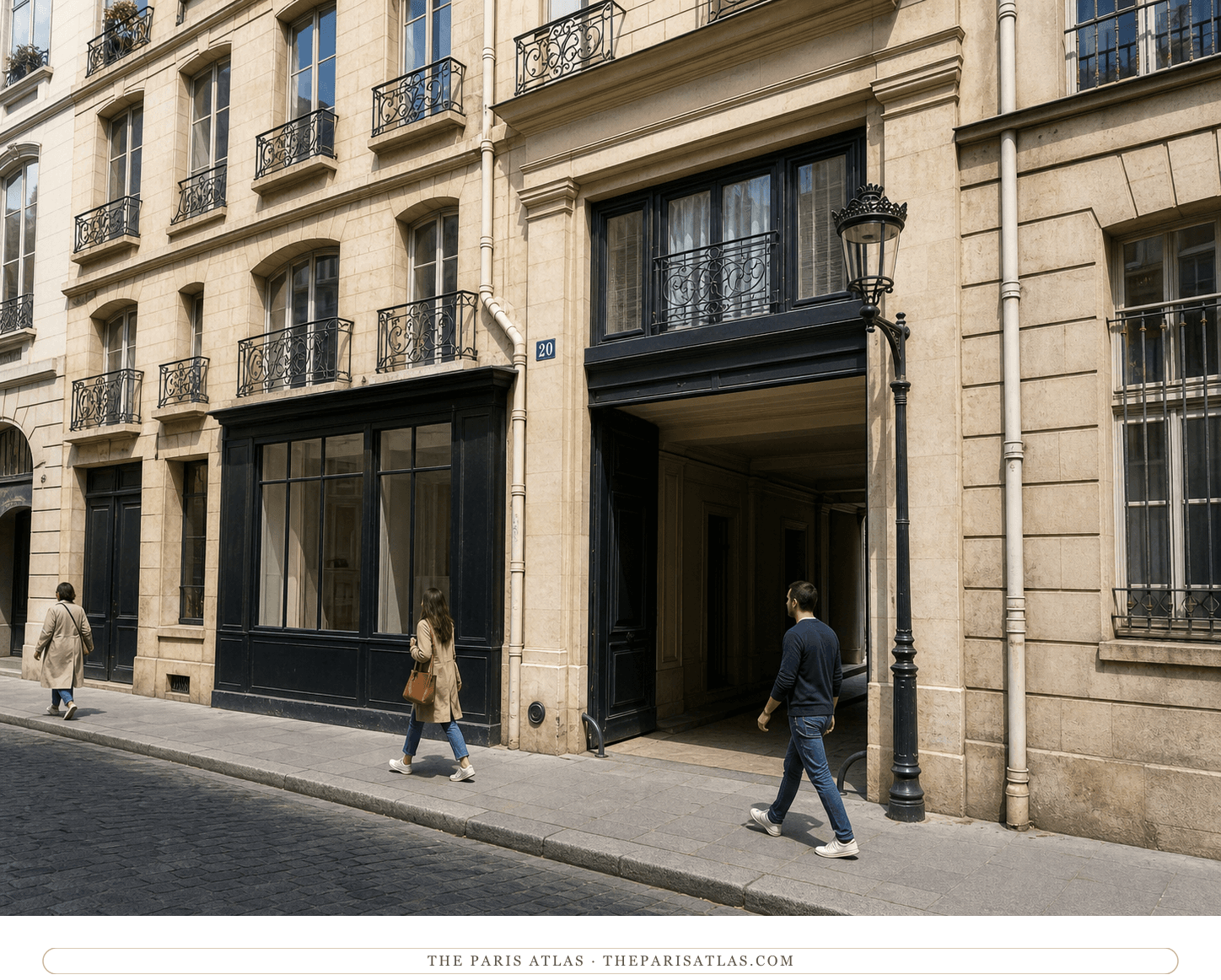
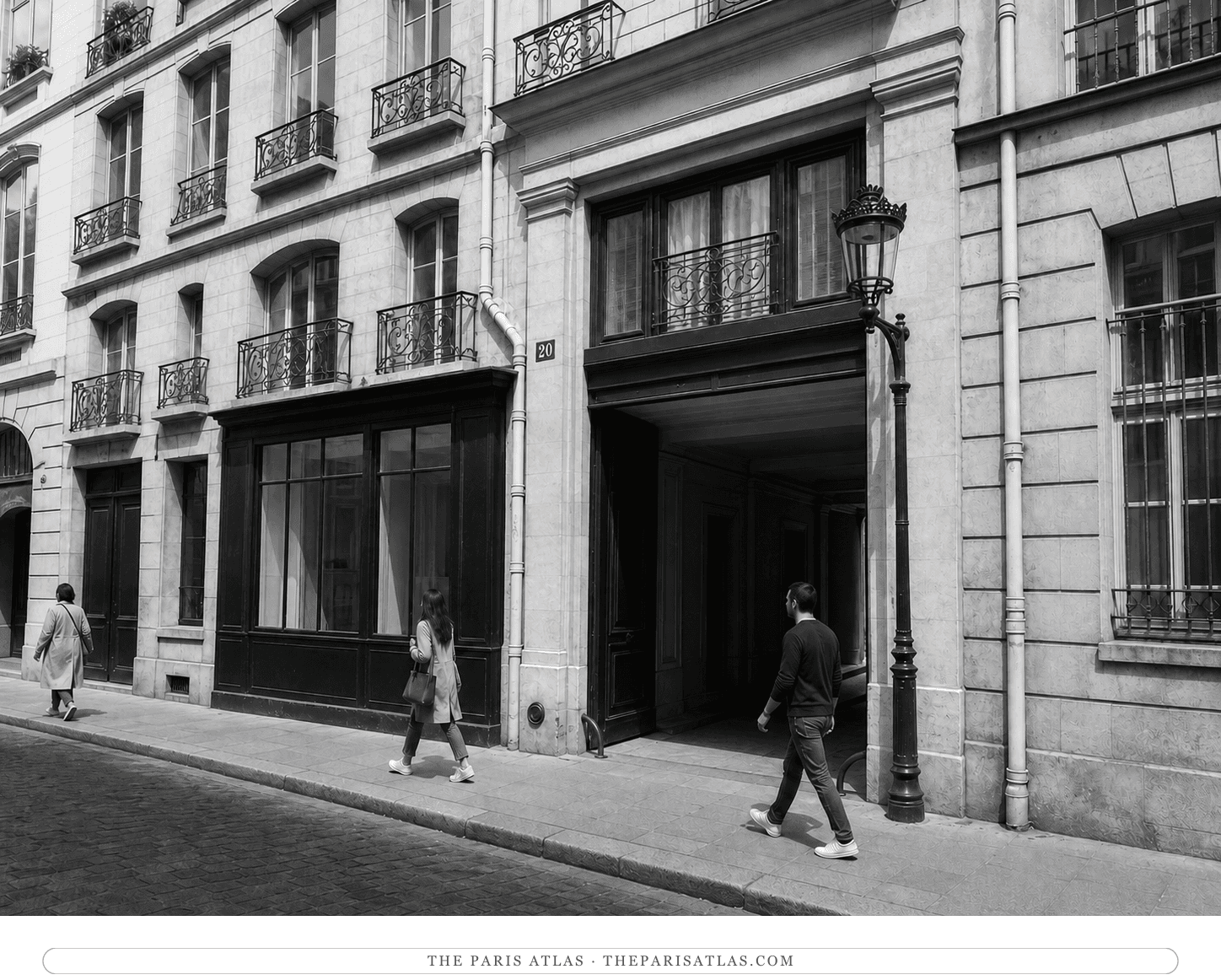
  • Portrait de Natalie Clifford Barney, dit « L'Amazone » (1920), Musée Carnavalet. Barney in a fur coat at her desk with a small black ceramic horse in front of her; the museum reads the background as the courtyard of 20 rue Jacob.
  • Jean Cocteau à l'époque de la grande roue (1912), Musée national d'art moderne, Centre Pompidou. Cocteau at twenty-three, with the Ferris wheel of the 1900 exposition behind him.
  • Le Trajet (c. 1911), Smithsonian American Art Museum. A nude of Ida Rubinstein, the dancer Brooks was involved with, floating on a wing-shaped white form in a black void.
  • Ida Rubinstein (1917) and La Baronne Emile D'Erlanger (c. 1924), both Smithsonian American Art Museum.

She did not flatter. The Troubridge portrait has been read as everything from a feminist statement to an outright cartoon, and Brooks settled the question herself in a letter: she meant it as a caricature of a headstrong, demanding woman, and thought it might amuse future feminists. When a sitter complained that she had not been made beautiful, Brooks is said to have answered that she had been ennobled instead.

Several of the portraits put women in men's tailoring, and by the mid-1920s that was fashion as much as signal. Magazines were recommending severe jackets and high collars to women who had no interest in anything the clothes might mean. What Brooks added was the face above the collar. Her sitters look back at the viewer with the flat confidence usually reserved in portraiture for men.

Fifty years with Natalie Clifford Barney

Brooks met Natalie Clifford Barney in 1915. Barney was an American writer who lived in Paris, wrote in French, and had been running a Friday salon at 20 rue Jacob since 1909. She had been with the writer Élisabeth de Gramont for several years and had no intention of giving her up. The three settled into an arrangement that lasted, and Brooks and Barney stayed together for more than fifty years.

It suited Barney better than it suited Brooks. Barney argued against monogamy in print and kept several attachments running at once. Brooks wanted one person and tolerated the rest, with one recorded ultimatum, over Dolly Wilde. She disliked Paris, disliked the salon, and kept her own flat in the rue Raynouard rather than live in Barney's house. On the Riviera the two of them built the Villa Trait d'Union, the hyphen villa: two separate wings joined by a shared dining room, so that Brooks could shut a door and Barney could still expect her at dinner.

The 1920 portrait is the record of it. Barney sits in fur at a writing table, wearing a sapphire necklace Brooks had given her, with a bolting ceramic horse in front of her. The horse is a joke on l'Amazone, the name Remy de Gourmont had fixed on her. Brooks gave the painting to the Musée Carnavalet in 1966.

The circle put her into fiction too. In Ladies Almanack, the comic roman à clef the American writer Djuna Barnes printed privately in Paris in 1928 about Barney's salon, Brooks appears as Cynic Sal, who dresses like a coachman and drives an empty cab. Barney and the journalist Janet Flanner annotated their own copies with the real names, which is how the identifications are known.

Italy, and what the record says about her politics

She met the Italian poet Gabriele D'Annunzio in 1909, when he came to France to escape his creditors, and the friendship lasted until his death in 1938. He wrote about her painting in terms she valued, and she painted him. D'Annunzio seized the Adriatic city of Fiume with a private army in 1919 and governed it for over a year, and the style of that adventure, the balcony speeches and the black shirts and the salutes, was taken up wholesale by Italian Fascism afterwards.

Brooks kept a villa outside Florence and an apartment in Nice, and by the end of the 1930s Italy was where she mostly was. Barney joined her there in 1939 and the two women spent the Second World War in Italy, returning to Paris in 1946.

Her politics are part of the record and are usually stated badly, in both directions. Here is what the sources actually hold.

  • Her long-standing reputation, as her publisher's own summary of Cassandra Langer's 2015 biography puts it, is of an aloof heiress who associated with fascists in the 1930s.
  • Lambda Literary's review of that biography describes the personality Langer had to account for as pro-Fascist, admiring of Mussolini's government and of D'Annunzio's philosophy, and prejudiced against Jewish people.
  • A specific documented incident: at a salon she referred to the playwright Henry Bernstein as "that dirty Jew" in front of a Jewish hostess, and was publicly rebuked for it.
  • Langer's own reading, given in an interview in 2016, is that Brooks was an elitist whose prejudices were her class's, and she draws a line between holding them and acting on them. She records that Brooks and Barney saved at least three Jewish lives at risk to themselves during the war, and helped conceal the whereabouts of the art historian Bernard Berenson.

The two halves of that do not cancel. Nobody has produced evidence that Brooks joined anything or acted politically, and nobody disputes what she said. Her biographers disagree over how much weight the opinions should carry against the life, and a reader is entitled to the disagreement rather than to whichever half is more convenient.

The drawings, and the memoir

In 1930, laid up with a sprained leg, she began drawing in a single unbroken line without lifting the pencil, and did not stop for years. More than a hundred survive: figures, angels, animals, things that are none of the three. She said she did not know where a line was going when she started it and did not plan them, which is automatic drawing by another name, arrived at independently and years before the Surrealists made a programme of it. She signed them with a small winged spring.

No Pleasant Memories was written in the same years, with drawings of its own. It has still not been published. At eighty-five she gave an interviewer the sentence her first biographer took a title from: her dead mother, she said, got between her and life.

The long withdrawal

She held solo exhibitions in Paris, London and New York in 1925, showed drawings in New York in 1935 to a cool reception, and after that effectively stopped. The often-repeated claim that she gave up painting in 1925 is wrong. She painted Carl Van Vechten in 1936 and Muriel Draper in 1938, bought paints in Florence during the war, and finished a portrait of the Duke Uberto Strozzi in 1961, when she was eighty-seven. But the flow had stopped, and she never explained why.

By the mid-1950s she was barely seeing anyone. Barney, visiting, had to stay in a hotel and was given lunch. Brooks spent weeks in darkened rooms convinced she was losing her sight, and her suspicions widened until they took in her own household. Secrest describes this as paranoia. Langer's later research found that some of the fears had a basis.

The end of the friendship came over Janine Lahovary, whom Barney had met in Nice in 1958 and stayed with for the rest of her life. Brooks stopped answering. In her last year she left Barney's letters unopened and would not come to the door when Barney called. Barney's last letter to her was returned.

Romaine Brooks died in Nice on 7 December 1970, aged ninety-six.

Where the paintings are

The Smithsonian American Art Museum in Washington holds close to half of everything she is known to have made, because she gave it to them in a series of donations in the last years of her life. Its 2016 exhibition, The Art of Romaine Brooks, was drawn entirely from that collection and put out eighteen paintings and thirty-two drawings, many of which had not been on a wall in decades.

Her first retrospective opened three months after her death. Romaine Brooks: Thief of Souls ran at the National Collection of Fine Arts in Washington from 24 February to 4 April 1971 and then at the Whitney Museum of American Art in New York, with a catalogue by Adelyn Breeskin. Outside Washington, the Musée Carnavalet has the Barney portrait and the Centre Pompidou the Cocteau.

She was written off for most of the twentieth century as a realist who had missed everything that mattered in modern painting. That reading has come apart since the 1980s, and the portraits are now looked at for what they were doing rather than for what they were not: a group of women, painted by one of them, at the exact moment such a group first became visible enough to paint.

Life events

  1. 1874

    Born Beatrice Romaine Goddard in Rome on 1 May, to the American heiress Ella Waterman Goddard and Major Henry Goddard, who leaves the family.

    Romaine Brooks — artist record; Brooks, Romaine (1874–1970) — Women in World History: A Biographical Encyclopedia

  2. 1898

    Studies at the Scuola Nazionale in Rome, the only woman in the life class, then lives on almost nothing on Capri.

    Romaine Brooks — artist record; Romaine Brooks — artist notice

  3. 1901–1902

    Her brother St. Mar and her mother die within months of each other. The inheritance that reaches her in 1902 makes her independent for life.

    Romaine Brooks — artist record; Brooks, Romaine (1874–1970) — Women in World History: A Biographical Encyclopedia

  4. 1903

    Marries John Ellingham Brooks on Capri on 13 June. They separate within a year. She keeps the name and pays him £300 a year until his death in 1929.

    Brooks, Romaine (1874–1970) — Women in World History: A Biographical Encyclopedia

  5. 1904

    Goes to St Ives in Cornwall dissatisfied with her colour and settles on the black, white and grey palette she uses for the rest of her career.

    The Art of Romaine Brooks — exhibition record (2016)

  6. 1910

    First solo exhibition, thirteen paintings at the Galeries Durand-Ruel in Paris. Robert de Montesquiou writes about her and calls her the thief of souls.

    The Art of Romaine Brooks — exhibition record (2016); Romaine Brooks — artist notice

  7. c. 1911

    Paints Le Trajet, a nude of Ida Rubinstein floating on a white wing-shape in a black void. She painted Rubinstein more often than anyone else.

    Romaine Brooks photographed in Paris by Eugène Pirou before 1910, in the dark coat and high collar she wore all her adult life and painted herself in thirteen years later. Public domain; the print is in the Smithsonian Institution's Archives of American Art. (Eugène Pirou; Smithsonian Institution, Archives of American Art)

    Romaine Brooks, Le Trajet (c. 1911) — collection record, accession 1968.18.3

  8. 1912

    Paints Jean Cocteau à l'époque de la grande roue, now in the Musée national d'art moderne at the Centre Pompidou.

    Romaine Brooks, Jean Cocteau à l'époque de la grande roue (1912) — collection record

  9. 1914

    La France Croisée, a Red Cross nurse against a burning Ypres, is reproduced for war fundraising with a D'Annunzio poem. She receives the cross of the Legion of Honour.

    The Art of Romaine Brooks — exhibition record (2016)

  10. 1915

    Meets Natalie Clifford Barney. The relationship runs more than fifty years, alongside Barney's others.

    Brooks, Romaine (1874–1970) — Women in World History: A Biographical Encyclopedia; Diana Souhami, Wild Girls: Paris, Sappho, and Art — The Lives and Loves of Natalie Barney and Romaine Brooks (2005)

  11. 1920

    Paints Barney in fur at her writing desk, with a bolting ceramic horse in front of her. She gives the picture to the Musée Carnavalet in 1966.

    Romaine Brooks, Portrait de Natalie Clifford Barney, dit « L'Amazone » (1920) — inventaire P2302

  12. 1923–1924

    The best-known portraits: the top-hatted Self-Portrait, Peter (A Young English Girl), and Una, Lady Troubridge with her monocle and her dachshunds.

    Romaine Brooks, Self-Portrait (1923) — collection record, accession 1966.49.1; Romaine Brooks, Una, Lady Troubridge (1924) — collection record, accession 1966.49.6

  13. 1930

    Begins the continuous-line drawings, more than a hundred of them, and writes the autobiographical manuscript No Pleasant Memories, still unpublished.

    The Art of Romaine Brooks — exhibition record (2016)

  14. 1939–1946

    Spends the Second World War in Italy, joined by Barney. They return to Paris in 1946.

    Inside the Secret Life of Lesbian Feminist Artist Romaine Brooks — an interview with Cassandra Langer (2016); Anna Livia, Barney, Natalie Clifford (1876–1972), in Women in World History: A Biographical Encyclopedia (2002)

  15. 1961

    Paints her last portrait, Le Duc Uberto Strozzi, at eighty-seven. By then she has been out of sight for years.

    The Art of Romaine Brooks — exhibition record (2016); Brooks, Romaine (1874–1970) — Women in World History: A Biographical Encyclopedia

  16. 1968

    The friendship with Barney ends over Janine Lahovary. Brooks leaves the letters unopened and will not come to the door.

    Anna Livia, Barney, Natalie Clifford (1876–1972), in Women in World History: A Biographical Encyclopedia (2002); Diana Souhami, Wild Girls: Paris, Sappho, and Art — The Lives and Loves of Natalie Barney and Romaine Brooks (2005)

  17. 1970

    Dies in Nice on 7 December, aged ninety-six.

    The Art of Romaine Brooks — exhibition record (2016)

  18. 1971

    Romaine Brooks: Thief of Souls, her first retrospective, opens at the National Collection of Fine Arts in Washington on 24 February and travels to the Whitney.

    Adelyn D. Breeskin, Romaine Brooks: Thief of Souls (1971)

People they knew

Documented connections — every one carries its source.

Illustrated portrait of Natalie Clifford Barney

Natalie Clifford Barney

  • Author
  • Poet
  • Salon host
  • +2

Partner of · 1915–1968

Brooks and Barney met in 1915 and were together for more than fifty years. Barney refused monogamy as a matter of principle and was already attached to Élisabeth de Gramont, so the relationship ran alongside her others; Brooks tolerated the arrangement and gave one recorded ultimatum, over Dolly Wilde. They built the Villa Trait d'Union on the Riviera with two separate wings joined by a shared dining room. It ended in Brooks's last years, over Barney's relationship with Janine Lahovary: Brooks stopped answering and Barney's last letter came back unopened.

Brooks, Romaine (1874–1970) — Women in World History: A Biographical Encyclopedia; Diana Souhami, Wild Girls: Paris, Sappho, and Art — The Lives and Loves of Natalie Barney and Romaine Brooks (2005); Anna Livia, Barney, Natalie Clifford (1876–1972), in Women in World History: A Biographical Encyclopedia (2002)

Painted a portrait of · 1920

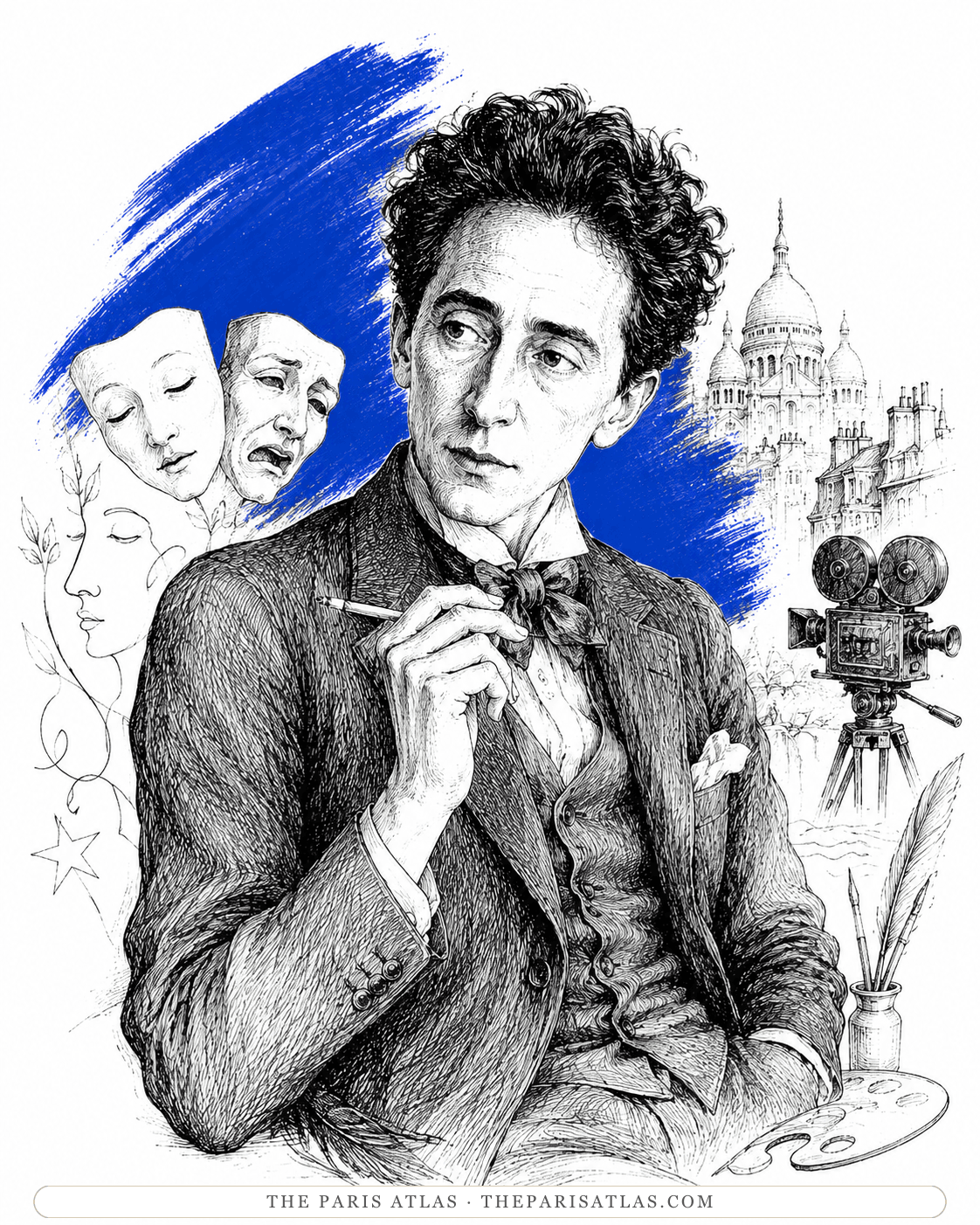
Portrait de Natalie Clifford Barney, dit « L'Amazone », oil on canvas, signed and dated Romaine 1920. Barney sits in a fur coat at a writing table wearing a sapphire necklace Brooks had given her, with a black ceramic horse bolting across the desk in front of her — a joke on the nickname Remy de Gourmont had given her. The museum reads the background as the courtyard of 20 rue Jacob. Shown at the Salon de la Société nationale des beaux-arts in 1922 as number 135. Brooks gave it to the Musée Carnavalet in 1966; inventory P2302.
Romaine Brooks, Portrait de Natalie Clifford Barney, dit « L'Amazone » (1920) — inventaire P2302

Illustrated portrait of Jean Cocteau

Jean Cocteau

  • Poet
  • Playwright
  • Illustrator
  • +1

Painted a portrait of · 1912

Jean Cocteau à l'époque de la grande roue, oil on canvas, painted when Cocteau was twenty-three, with the Ferris wheel of the 1900 exposition behind him. It is in the collection of the Musée national d'art moderne at the Centre Pompidou.

Romaine Brooks, Jean Cocteau à l'époque de la grande roue (1912) — collection record

Romaine Brooks’s Places

The cataloged places connected to Romaine Brooks — through the books, and through the documented record.

Places you can enter today appear first, followed by addresses to see from outside and sites that have vanished.

Questions about Romaine Brooks

Who was Romaine Brooks?

An American painter (1874–1970) who worked mainly in Paris and Italy and made her name with portraits of the women in her own circle, painted in a narrow range of blacks, whites and greys. Her best-known pictures are the 1923 self-portrait in a top hat and the 1924 portrait of Una, Lady Troubridge, both at the Smithsonian American Art Museum. She was independently wealthy from 1902 and never needed to sell a painting.

Why did Romaine Brooks paint everything in grey?

She chose it. In 1904 she went to St Ives in Cornwall dissatisfied with her own use of colour and came back working in black, white and a long range of greys, with occasional ochre, umber, alizarin or a single red. The Smithsonian American Art Museum, which holds most of her work, names James McNeill Whistler as the source of the approach.

Were Romaine Brooks and Natalie Barney a couple?

Yes, for more than fifty years, from 1915 until 1968. Natalie Clifford Barney was an American writer who ran a literary salon at 20 rue Jacob in Paris and refused monogamy as a matter of principle, so the relationship ran alongside her others, notably with Élisabeth de Gramont. Brooks and Barney built a villa on the Riviera with two separate wings joined by a shared dining room, which is roughly how the whole arrangement worked.

Was Romaine Brooks a fascist?

No source shows her joining anything or acting politically, and her biographers disagree about what to make of her opinions. The University of Wisconsin Press, publishing Cassandra Langer's 2015 biography, describes her long-standing reputation as an heiress who associated with fascists in the 1930s, and Lambda Literary's review of that book describes her as pro-Fascist, admiring of Mussolini's government and of Gabriele D'Annunzio's philosophy, and prejudiced against Jewish people. She was publicly rebuked at a salon for calling the playwright Henry Bernstein "that dirty Jew". Langer's own reading is that the prejudice was her class's rather than a politics, and she records that Brooks and Barney saved at least three Jewish lives at risk to themselves during the war and helped hide the art historian Bernard Berenson.

Where can you see Romaine Brooks's paintings?

The Smithsonian American Art Museum in Washington holds close to half of her known output, given by the artist herself, including the 1923 Self-Portrait, Una, Lady Troubridge and Le Trajet. The Musée Carnavalet in Paris has her 1920 portrait of Natalie Clifford Barney, and the Musée national d'art moderne at the Centre Pompidou has her 1912 portrait of Jean Cocteau. Individual works are not always on view.

Did Romaine Brooks stop painting?

Almost, but later than the usual story says. She exhibited in Paris, London and New York in 1925 and showed drawings in New York in 1935, and after that produced very little. She did paint Carl Van Vechten in 1936, Muriel Draper in 1938, and a last portrait of the Duke Uberto Strozzi in 1961, at eighty-seven. She never gave a reason for stopping.

How did Romaine Brooks die?

She died in Nice on 7 December 1970, aged ninety-six, after two decades of near-total withdrawal. By the mid-1950s she was spending weeks in darkened rooms convinced she was losing her sight and refusing almost all visitors, including Natalie Barney, who had to stay in a hotel and was given lunch.

Is Romaine Brooks a character in Djuna Barnes's Ladies Almanack?

Yes. Ladies Almanack, the comic roman à clef the American writer Djuna Barnes printed privately in Paris in 1928 about Natalie Barney's circle, has Brooks in it as Cynic Sal, who dresses like a coachman and drives an empty cab. The identifications are known because Barney and the journalist Janet Flanner annotated their own copies with the real names.

Sourced claims

Every connection the graph holds for Romaine, with the evidence behind it.

Frequented

20 rue Jacob

Brooks was at the house across five decades as Barney's partner, and painted her there in 1920 with what the Musée Carnavalet reads as the rue Jacob courtyard behind her. She was not a salon guest in the ordinary sense: she disliked Paris and disliked the Fridays, kept her own flat in the rue Raynouard rather than move in, and spent parts of every year elsewhere. No first or last visit is fixed by the sources.

Romaine Brooks, Portrait de Natalie Clifford Barney, dit « L'Amazone » (1920) — inventaire P2302; Diana Souhami, Wild Girls: Paris, Sappho, and Art — The Lives and Loves of Natalie Barney and Romaine Brooks (2005); Brooks, Romaine (1874–1970) — Women in World History: A Biographical Encyclopedia

Partner of · 1915–1968

Natalie Clifford Barney

Brooks and Barney met in 1915 and were together for more than fifty years. Barney refused monogamy as a matter of principle and was already attached to Élisabeth de Gramont, so the relationship ran alongside her others; Brooks tolerated the arrangement and gave one recorded ultimatum, over Dolly Wilde. They built the Villa Trait d'Union on the Riviera with two separate wings joined by a shared dining room. It ended in Brooks's last years, over Barney's relationship with Janine Lahovary: Brooks stopped answering and Barney's last letter came back unopened.

Brooks, Romaine (1874–1970) — Women in World History: A Biographical Encyclopedia; Diana Souhami, Wild Girls: Paris, Sappho, and Art — The Lives and Loves of Natalie Barney and Romaine Brooks (2005); Anna Livia, Barney, Natalie Clifford (1876–1972), in Women in World History: A Biographical Encyclopedia (2002)

Painted a portrait of · 1912

Jean Cocteau

Jean Cocteau à l'époque de la grande roue, oil on canvas, painted when Cocteau was twenty-three, with the Ferris wheel of the 1900 exposition behind him. It is in the collection of the Musée national d'art moderne at the Centre Pompidou.

Romaine Brooks, Jean Cocteau à l'époque de la grande roue (1912) — collection record

Painted a portrait of · 1920

Natalie Clifford Barney

Portrait de Natalie Clifford Barney, dit « L'Amazone », oil on canvas, signed and dated Romaine 1920. Barney sits in a fur coat at a writing table wearing a sapphire necklace Brooks had given her, with a black ceramic horse bolting across the desk in front of her — a joke on the nickname Remy de Gourmont had given her. The museum reads the background as the courtyard of 20 rue Jacob. Shown at the Salon de la Société nationale des beaux-arts in 1922 as number 135. Brooks gave it to the Musée Carnavalet in 1966; inventory P2302.
Romaine Brooks, Portrait de Natalie Clifford Barney, dit « L'Amazone » (1920) — inventaire P2302

Sources and further reading

  • Romaine Brooks — artist record
  • The Art of Romaine Brooks — exhibition record (2016)
  • Romaine Brooks, Self-Portrait (1923) — collection record, accession 1966.49.1
  • Romaine Brooks, Una, Lady Troubridge (1924) — collection record, accession 1966.49.6
  • Romaine Brooks, Le Trajet (c. 1911) — collection record, accession 1968.18.3
  • Romaine Brooks, Portrait de Natalie Clifford Barney, dit « L'Amazone » (1920) — inventaire P2302
  • Romaine Brooks, Jean Cocteau à l'époque de la grande roue (1912) — collection record
  • Brooks, Romaine (1874–1970) — Women in World History: A Biographical Encyclopedia
  • Romaine Brooks — artist notice
  • Cassandra Langer, Romaine Brooks: A Life (2015)
  • Meryle Secrest, Between Me and Life: A Biography of Romaine Brooks (1974)
  • Whitney Chadwick, with Joe Lucchesi, Amazons in the Drawing Room: The Art of Romaine Brooks (2000)
  • Adelyn D. Breeskin, Romaine Brooks: Thief of Souls (1971)
  • Inside the Secret Life of Lesbian Feminist Artist Romaine Brooks — an interview with Cassandra Langer (2016)
  • Review of Cassandra Langer's Romaine Brooks: A Life (2015)
  • Diana Souhami, Wild Girls: Paris, Sappho, and Art — The Lives and Loves of Natalie Barney and Romaine Brooks (2005)
  • Suzanne Rodriguez, Wild Heart: A Life — Natalie Clifford Barney's Journey from Victorian America to Belle Époque Paris (2002)
  • Shari Benstock, Women of the Left Bank: Paris, 1900–1940 (1986)