

In Cold Blood
Truman Capote's book also rebuilds a real murder case from court records and interviews, and readers still argue about how much of it was shaped.
Read our takeAlias Grace
Margaret Atwood
Margaret Atwood's novel about Grace Marks, a real Irish servant girl convicted of murder in Canada in 1843, who says she cannot remember the day it happened.
Alias Grace is Margaret Atwood's ninth novel, published in 1996.[1] Grace Marks was a real servant, convicted at sixteen in 1843 of the murder of her employer, Thomas Kinnear.[1] In the novel it is 1859, and Grace is serving a life sentence in the Kingston Penitentiary. She says she has no memory of the killings.[2] A young doctor interested in the new science of the mind is hired by reformers who want her pardoned, and he listens to her tell her life.[3] The novel won the Giller Prize in 1996.[4]
Grace tells much of the story herself. In the chapter that opens in 1859, she sits on a purple velvet settee in the prison Governor's parlour, a seat meant for guests. By day she works in the Governor's house as a servant and a skilled seamstress. In the evening the keepers take her back to the prison and lock her up.[3]
Visitors come to look at her. On Tuesdays the Governor's wife hosts talk about the Woman Question, and on Thursdays a Spiritualist Circle meets for tea and conversation with the dead. Grace knows why the ladies stare. She has been written down as a celebrated murderess.[3]
Grace has read what the newspapers said about her, because the Governor's wife pastes famous crimes into a scrapbook. The papers called her an inhuman demon and an innocent victim, tall and short, blue-eyed and green-eyed. Grace wonders how she can be all of these things at once.[3] Her own lawyer told the court she was next door to an idiot, because he thought it was her best chance.[3]
The other main voice belongs to Dr. Simon Jordan, a young expert in mental illness. A group of reformers and spiritualists hires him to help their campaign for Grace's pardon. He hopes that by listening to her story he can bring her closer to the day she cannot remember.[3][5]
Grace was born in Ireland and came to Canada with her family at twelve. Her mother died on the voyage and was buried at sea. Her father was a violent drunk. Grace went into service young, at the house of Mrs. Alderman Parkinson, where she became close friends with another servant, Mary Whitney. Mary died after an abortion.[6]
Grace then took a place at Thomas Kinnear's house in Richmond Hill. She did not get on with the housekeeper, Nancy Montgomery, or with the hired man, James McDermott. She was friendly with Jamie Walsh, a boy from a neighbouring farm, and with Jeremiah, a travelling peddler.[6]
In 1859, Dr. Simon Jordan starts meeting Grace regularly. She tells him her life in detail, up to the days around the murders, which she says she cannot remember. Meanwhile Simon begins an affair with his landlady, Rachel Humphrey, whose husband has left her.[6]
Simon talks to Grace's old lawyer, Kenneth MacKenzie, and visits Kinnear's house. He still cannot decide whether she is guilty. He agrees to let a hypnotist, Dr. Jerome DuPont, put Grace into a trance. Grace recognizes DuPont as Jeremiah the peddler in disguise.[6]
Under hypnosis, a voice speaks through Grace and claims to be Mary Whitney. The voice says Mary took over Grace's body and killed Nancy. Simon cannot put this in a report without being called a quack, so he tricks Rachel into leaving the house and escapes on a train to the United States.
Simon becomes a surgeon in the American Civil War, is wounded in the head and, according to his mother, loses his memory of Canada. She admits that he sometimes calls his fiancée Grace.
In 1872, after nearly three decades in prison, Grace is pardoned. She goes to Ithaca, New York, and marries Jamie Walsh, now a widower. At the close she is nearly forty-six and thinks she may be pregnant, though it could be something else. The novel never says whether she took part in the murders.
In July 1843, Thomas Kinnear, a gentleman farmer, and his housekeeper Nancy Montgomery were murdered. Kinnear had been having an affair with Nancy. Grace Marks, one of his servants, was barely sixteen. She ran off with the hired man, James McDermott. Atwood noted that when the two reached a tavern in Lewiston, they took separate rooms.
Grace and McDermott were tried for the murder of Kinnear. McDermott was hanged. Grace's sentence was commuted to life in prison. She spent time in the Lunatic Asylum in Toronto before the novel begins.
Atwood said people at the time were split over her. One side thought women were too feeble to act, so Grace must have been forced. The other thought women, once they got going, were worse than men, so Grace must have led McDermott on. Atwood summed it up as woman as demon against woman as pathetic.
Atwood first met the story in the 1960s, as a student at Radcliffe College. She read it in Susanna Moodie's 1853 book Life in the Clearings. She was writing a series of poems about Moodie at the time. In 1974 she wrote a television play about the case, The Servant Girl, for CBC.
Moodie wrote from memory, and Atwood later found that she got a lot wrong. When Atwood went back to the newspapers of the time and the prison records, the real story turned out to be less theatrical than Moodie's version.
Her rule for the novel was simple. Where a fact was known, she used it. Where the record had gaps, or hinted at things nobody explained, she felt free to invent. One gap gave her a character. The name Mary Whitney appeared as Grace's alias in the picture printed with her confession, and none of the commentators said anything about it.
The hardest fact to find was Thomas Kinnear himself. Atwood discovered two men of that name. Neither his grave nor Nancy's was marked. His family's entry in Burke's Peerage showed him dying in the same year he turned up in Canada.
Atwood tells the novel in two main voices. Grace speaks in the first person. Simon Jordan's side of the story comes partly through his letters. The publisher's guide asks readers which of the two they trust more.
Simon is an American, trained at Harvard, who dreams of opening his own asylum. He wants a clear answer about Grace's guilt, and she never gives him one. In a letter to his friend Dr. Edward Murchie he writes that not knowing is as bad as being haunted.
Grace describes the physical world of a servant closely: laundry, emptying the slops, sewing, the patterns in a carpet. She compares the ladies in their stiff crinolines to jellyfish, lovely under water and nothing once they dry out on the beach. The guide points to her image of laundry on the line looking like angels rejoicing without any heads.
The reason they want to see me is that I am a celebrated murderess.
I would rather be a murderess than a murderer, if those are the only choices.
And I wonder, how can I be all of these different things at once?
Grace Marks, James McDermott, Thomas Kinnear and Nancy Montgomery were real people. Margaret Atwood went back to the newspapers and prison records of the time.
Grace is funny, observant and hard to read. She has learned to keep her face still while the ladies stare, and to tell the Governor's wife what she wants to hear.
Alias Grace won the Giller Prize in 1996 and was shortlisted for the Booker Prize and the Governor General's Award.
The novel leaves the question of Grace's guilt open. Book clubs have plenty to argue about.
An Irish-born servant and seamstress, convicted in 1843 of the murder of Thomas Kinnear and serving a life sentence. She says she cannot remember the killings.
A young American doctor with an interest in mental illness, hired to help the campaign for Grace's pardon.
Grace's closest friend when both were young servants. She dies after an abortion, and her name was the alias Grace used.
The stable hand at Thomas Kinnear's house, hanged for the murder in 1843.
Thomas Kinnear's housekeeper and mistress, killed with him in 1843.
A gentleman farmer at Richmond Hill, Grace's employer, murdered in 1843.
A travelling peddler Grace knew before the murders, who comes back in disguise as a hypnotist, Dr. Jerome DuPont.
A boy from a farm near Kinnear's house who was friendly with Grace.
1843
Thomas Kinnear and Nancy Montgomery are murdered. Grace Marks, aged sixteen, is convicted of Kinnear's murder.
1853
Susanna Moodie tells the story of the case in her book Life in the Clearings.
1974
Margaret Atwood's television play about the case, The Servant Girl, is made for CBC.
1996
Alias Grace is published, by Bloomsbury in London on 19 September and by Nan A. Talese in New York.
1996
The novel wins the Giller Prize and is shortlisted for the Booker Prize and the Governor General's Award.
1997
The novel is a finalist for the Orange Prize and wins the Premio Mondello in Italy. Anchor Books publishes the paperback on 13 October.
1998
Robert Laffont publishes the French translation, Captive, by Michèle Albaret-Maatsch, in Paris.
2017
A six-episode television series, directed by Mary Harron and starring Sarah Gadon as Grace, airs on CBC in Canada and on Netflix elsewhere. The series wins six Canadian Screen Awards.


Truman Capote's book also rebuilds a real murder case from court records and interviews, and readers still argue about how much of it was shaped.
Read our take
Toni Morrison's novel also starts from a real 19th-century case of a woman who killed, and imagines the life the records left out.
Read our takeThe Blind Assassin
Margaret Atwood
Margaret Atwood's next novel is also told by a woman looking back on a death, who does not tell everything at once.
Read our take
Both novels are told by a woman held by the authorities, telling her story in pieces to a listener she cannot fully trust.
Read our takeThe novel is based on one. Grace Marks was a real servant convicted in 1843 of murdering her employer, Thomas Kinnear. Margaret Atwood used every fact she could find and invented where the record was silent.
Nobody knows, and the novel does not decide. James McDermott was hanged for the murder of Thomas Kinnear. Grace was convicted too, but her sentence was commuted to life in prison.
She read about Grace Marks as a student at Radcliffe College in the 1960s, in Susanna Moodie's 1853 book Life in the Clearings. She later found that Moodie had got a lot wrong, and went back to the newspapers and prison records.
Grace's closest friend in the novel, a fellow servant who dies after an abortion. Atwood took the name from Grace's real alias, which appeared in the picture printed with her confession.
Yes. A six-episode series directed by Mary Harron, with Sarah Gadon as Grace, Paul Gross as Thomas Kinnear and Anna Paquin as Nancy Montgomery, came out in 2017. The series aired on CBC in Canada and on Netflix elsewhere.
The Giller Prize in 1996 and the Premio Mondello in Italy in 1997. The novel was also shortlisted for the Booker Prize and the Governor General's Award, and was a finalist for the Orange Prize.
Explore authors with a similar voice, perspective, and influence.

American novelist and composer whose expatriate fiction explores dislocation, unstable intimacy, fatalism, and North Africa.
View author
The doctor of the Paris slums who wrote the century's blackest, funniest novel — and changed the sound of French prose.
View author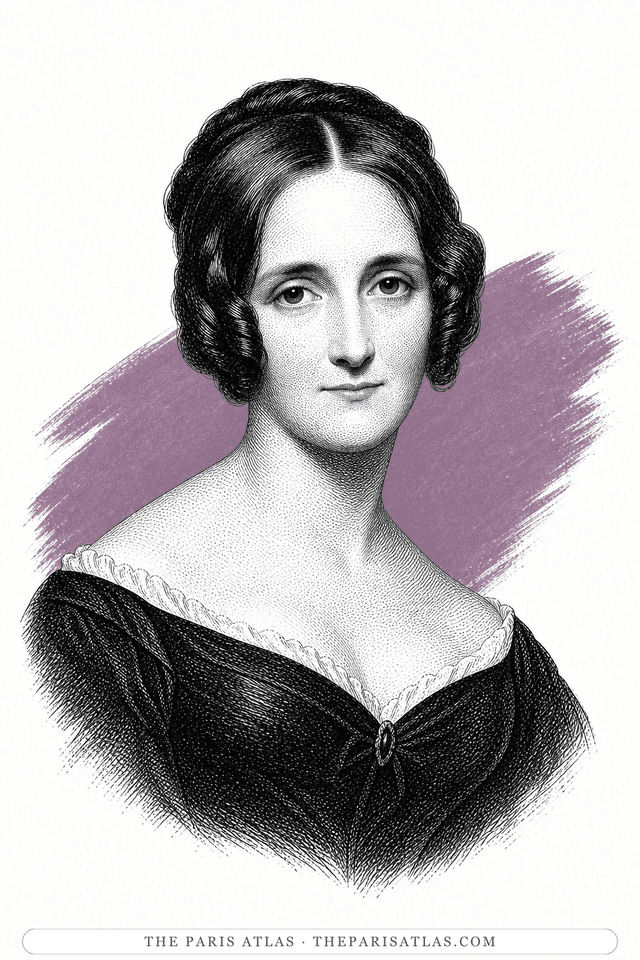
The author of Frankenstein, who first saw Paris at sixteen as a runaway. In the summer of 1814 she crossed from England to Calais with the poet Percy Bysshe Shelley and her stepsister Claire Clairmont, spent a week trapped in an expensive Paris hotel with no money, then bought a donkey and walked south-east across a France still wrecked by the Napoleonic wars. That journey became her first published book. Two years later, on a lake in Switzerland, she began her second.
View authorThe sources below include the primary text, editions, scholarship, archival materials, and other records that informed this page. They document Alias Grace, its publication, and its place in literary history.


The Booker Library entry: shortlisted for the 1996 prize, published by Bloomsbury on 19 September 1996. Read through the Wayback Machine capture of 11 August 2026.
Publisher's page. Primary text for the Governor's parlour chapter, and Margaret Atwood's interview on Susanna Moodie, the records, Thomas Kinnear and the name Mary Whitney.
The Giller Prize's list of winners, confirming Alias Grace in 1996.
Publisher's introduction and discussion questions, used for the two narrators and for passages the guide quotes from the novel.

Library of Congress record for the first United States edition: New York, Nan A. Talese, 1996, 468 pages.
Bibliothèque nationale de France record for Captive, Paris, Robert Laffont, 1998, translated by Michèle Albaret-Maatsch.
Bibliothèque nationale de France record for the 2017 Robert Laffont reissue of Captive, with its ISBN.
Margaret Atwood's own award list: the Giller Prize and Booker shortlist in 1996, and the Premio Mondello in 1997.
Open Library edition records, used to confirm that each ISBN listed here resolves to Alias Grace, including the 2017 French edition.
The primary text represented by this page, used for descriptions of the work’s contents and for any quoted passages shown here.
The primary text is the baseline reference for every book page. Additional references document publication history, interpretation, and historical context where that evidence is available.
 Explore more resources